


Synonym name:
Catalogue No.: BP1160
Cas No.: 102036-29-3
Formula: C16H16O6
Mol Weight: 304.298
Botanical Source: Caesalpinia sappan
Purity: 95%~99%
Analysis Method: HPLC-DAD or/and HPLC-ELSD
Identification Method: Mass, NMR
Packing: Brown vial or HDPE plastic bottle
Can be supplied from milligrams to grams.
For Reference Standard and R&D, Not for Human Use Directly.
Inquire for bulk scale.
HPLC of Protosappanin B
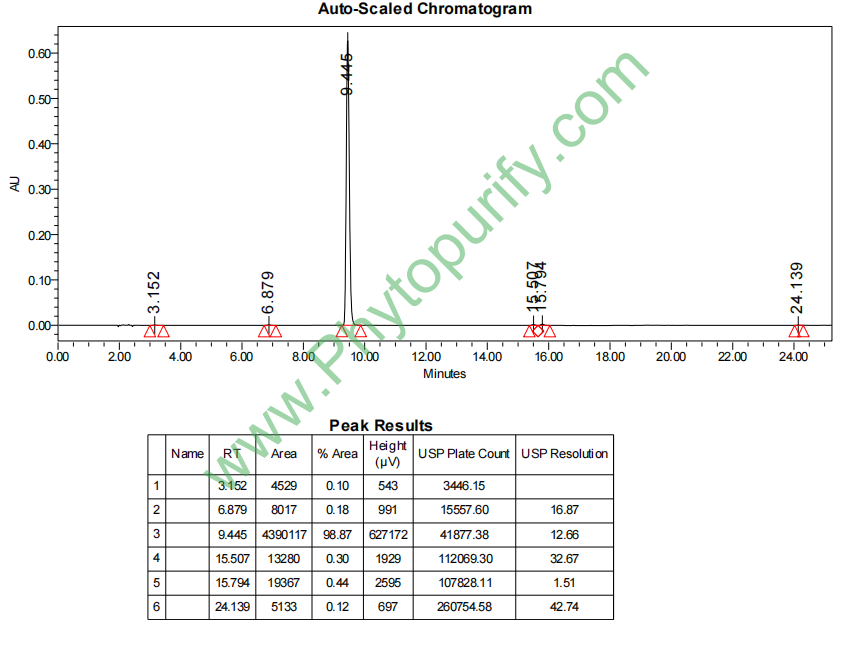
Storage conditions:Short-term storage at 2~8℃, long-term storage at -20 ~ -80℃
110.3800
.8418
.8330
.6167
1.8897
2.1989
Low
74.0268
3.2927
No
No
No
No
Yes
Yes
0.6
Yes
No
Yes
Yes
Natural products have always been an important source of innovative drug discovery, among which polyphenolic compounds have attracted much attention due to their wide range of biological activities. Protosapanin B (PSB), CAS number 102036-29-3, is derived from the traditional Chinese medicine Su Mu(Caesalpinia sappan L. A characteristic polyphenolic component isolated from the heartwood of). As a commonly used medicinal herb for promoting blood circulation, removing blood stasis, reducing swelling, and relieving pain, the basic research on its pharmacological active substances has always been a hot topic. Protohematoxylin B, as one of its core active components, has been proved to have significant anti-tumor activity in recent years, especially in solid tumor models such as bladder cancer, which shows the potential to play a role by interfering with cell cycle, inducing apoptosis and other ways. With the development of molecular biology technology, its target network is becoming increasingly clear, involving multiple key cancer-related proteins such as MCL1, BCL2, STAT3, MMP2, etc. This article aims to systematically review the chemical properties, plant sources, pharmacological activities, molecular mechanisms of action, pharmacological evaluation, and clinical application prospects of protoporphyrin B, in order to provide comprehensive scientific references for the deep development of this natural product and the research and development of anti-tumor new drugs.
The chemical name of the original lignin B is (6aS, 11aS) -3,6a, 9,10-tetrahydroxy-7H-benzofuran [3,2-c] chromene-7-one, which belongs to the highly oxidized biphenyl type new lignin compounds. Its molecular formula is C16H16O6 and its molecular weight is 304.2980. Structurally, its core is composed of a benzodihydrofuran ring fused with a benzopyranone ring, containing multiple phenolic hydroxyl groups. This structural feature determines its significant antioxidant activity and potential for interaction with various biomolecules.
Based on its chemical structure calculation, the drug properties related parameters show that its lipid water partition coefficient (LogP) is 0.8418, indicating that it has moderate lipophilicity. The topological polar surface area (TPSA) is 110.38 Å ², which is relatively high and mainly attributed to multiple hydroxyl and carbonyl oxygen atoms in the molecule. The theoretical water solubility is about 0.6167 mg/mL, which belongs to the category of slight solubility. These physicochemical parameters suggest that protoporphyrin B has the basic characteristics of a drug like molecule, but its high TPSA may pose certain limitations on its transmembrane permeability. Preliminary ADMET predictions suggest that its ability to cross the blood-brain barrier is low, which to some extent limits its direct effects on central nervous system tumors, but may also reduce potential neurotoxic risks. In addition, its hERG inhibition risk prediction is negative, and the Ames test prediction value is 0.6 (usually considered high risk if>0.9), indicating relatively low risks of cardiac toxicity and genetic toxicity, providing preliminary safety evidence for its further development.
Original Su lignin B mainly comes from the Yunzhen plant of the legume family, Su Mu(Caesalpinia sappan L. Dry heartwood. Sumu is mainly produced in Southeast Asia and Guangxi, Yunnan, Guangdong and other places in China. Its heartwood is reddish brown and rich in various pigments and active ingredients such as Brazilian hematoxylin, lignin and chalcones. The characteristic component group of Su Mu is composed of the original Su Mu lignin B and its homologues, such as the original Su Mu lignin A and C.
The extraction and separation of original hematoxylin B from Su Mu is usually achieved by combining organic solvent extraction with modern chromatographic techniques. The classic extraction process is as follows: first, the heartwood of Sumu is crushed, and then heated with methanol, ethanol, or aqueous ethanol (such as 70% -95%) for reflux or ultrasound assisted extraction. After vacuum concentration, the crude extract was subjected to gradient extraction with solvents such as petroleum ether and ethyl acetate, and the original lignin B was mainly enriched in the ethyl acetate fraction. Further purification depends on column chromatography technology. Silica gel, macroporous adsorption resin (such as D101), dextran gel (Sephadex LH-20), etc. are often used as stationary phases, and chloroform methanol, dichloromethane methanol or pure methanol and other solvent systems are used for gradient elution. High performance liquid chromatography (HPLC), especially preparative HPLC, is the final key step in obtaining high-purity precursor of hematoxylin B. It is commonly used as a C18 reverse phase chromatography column, with methanol water or acetonitrile water (containing a small amount of formic acid or acetic acid to adjust pH) as the mobile phase for separation. In recent years, green technologies such as supercritical CO2 extraction have also been explored for the extraction of active ingredients from hematoxylin, but their selective enrichment effect on the original hematoxylin B needs to be optimized.
Numerous in vitro and in vivo pharmacological studies have confirmed that the core biological activity of lignin B is anti-tumor, and it has shown potential in anti-inflammatory, antioxidant, and other aspects.
1. Antitumor activity
Protohematoxylin B has shown growth inhibition and cytotoxicity effects on a variety of human cancer cell lines, of which bladder cancer is the most intensively studied. Studies have shown that protohematoxylin B can significantly inhibit the proliferation of human bladder cancer cells (such as T24, 5637) in a dose-dependent and time-dependent manner. Its effect is not limited to bladder cancer, but also has certain inhibitory activity on breast cancer (MCF-7), liver cancer (HepG2), colon cancer (HT-29), lung cancer (A549) and other cell lines. In animal models, the administration of lignin B can effectively inhibit the growth of transplanted tumors in nude mice, and the toxicity is relatively mild, indicating its anti-tumor effect in vivo.
2. Anti inflammatory and antioxidant activity
As a polyphenolic substance, lignin B has certain free radical scavenging ability and antioxidant activity. Research has shown that it can alleviate the inflammatory response of macrophages induced by lipopolysaccharide (LPS), inhibit the excessive production of pro-inflammatory factors such as nitric oxide (NO), prostaglandin E2 (PGE2), tumor necrosis factor - α (TNF - α), interleukin-6 (IL-6), etc. Its anti-inflammatory mechanism may be related to the inhibition of nuclear factor kappa B (NF - κ B) and mitogen activated protein kinase (MAPK) signaling pathways. These activities suggest that they may have auxiliary value in the treatment of tumor associated inflammation or chronic inflammatory diseases.
The anti-tumor effect of lignin B involves multiple targets and pathways, and its mechanism is complex and interrelated. It can be mainly summarized as follows:
1. Inducing cell cycle arrest
In human bladder cancer cells, protohematoxylin B can significantly induce cell cycle arrest at G1 phase. Mechanism studies have found that this is closely related to upregulating the expression of cyclin dependent kinase inhibitors p21 and p27, while downregulating the expression of cyclin D1 and cyclin dependent kinase 4/6 (CDK4/6). G1 phase blockade prevents cells from entering the DNA synthesis phase (S phase), thereby inhibiting the unlimited proliferation of cancer cells.
2. Cell apoptosis triggered by mitochondrial pathway
Inducing apoptosis is the core mechanism of the anti-tumor effect of protoporphyrin B. It works by regulating the balance of Bcl-2 family proteins:Downregulation of anti apoptotic proteins MCL1 and BCL2 At the same time, it may upregulate the expression of pro apoptotic proteins such as Bax. The disruption of this balance leads to an increase in mitochondrial outer membrane permeability, the release of cytochrome c from mitochondria into the cytoplasm, which in turn activates caspase-9 and effector caspase-3, ultimately triggering programmed cell death.
3. Inhibit tumor cell metastasis and invasion
Protohematoxylin B can inhibit the migration and invasion of bladder cancer and other tumor cells. This effect is related to Downregulation of Matrix Metalloproteinase 2 (MMP2) The expression and activity are related. MMP2 is a key enzyme that degrades the extracellular matrix (ECM) and basement membrane. Inhibiting its activity means that the ability of tumor cells to break through tissue barriers and undergo distant metastasis is weakened.
4. Interference with key oncogenic signaling pathways
* STAT3 signaling pathway Signal transduction and transcription activator 3 (STAT3) is an important oncogenic transcription factor. Yuansu lignin B can inhibit the phosphorylation (activation) of STAT3, prevent its nuclear translocation and the transcription of downstream target genes (such as Survivor, Bcl-2, Cyclin D1), thereby synergistically exerting inhibitory effects on proliferation and inducing apoptosis.
* MAPK/ERK pathway Original lignin B has a regulatory effect on the activity of MAPK1 (i.e. ERK2). In different cellular backgrounds, it may block the transmission of pro proliferative signals by inhibiting the excessive activation of ERK.
* HIF-1 α pathway In the hypoxic microenvironment of tumors, protoporphyrin B can Inhibition of hypoxia inducible factor-1 α (HIF1A) The stability and activity may interfere with tumor angiogenesis and metabolic adaptation.
5. Impact on other potential targets
* Topoisomerase (TOP1/TOP2A)As a key enzyme in DNA replication and transcription, topoisomerases are targets of many chemotherapy drugs. Research has shown that protoporphyrin B may have the potential to inhibit TOP1 and TOP2A activity, leading to DNA damage and cell death, but its direct effect strength and specificity need further verification.
* Estrogen receptor and aromatase (ESR1/CYP19A1): In hormone dependent tumors (such as some breast cancer), protohematoxylin B may reduce the synthesis of endogenous estrogen by interfering with estrogen receptor (ESR1) signal or inhibiting the activity of aromatase (CYP19A1), thus playing an inhibitory role.
In summary, the original lignin B forms a multi-layered anti-tumor network by acting on key targets such as MCL1, BCL2, STAT3, MMP2, and HIF1A, synergistically achieving the effects of inhibiting proliferation, inducing apoptosis, and preventing metastasis.
Although primitive hematoxylin B exhibits good activity in vitro, its drug like and pharmacokinetic (PK) properties are the key factors determining whether it can be developed into a drug.
1. Absorption, distribution, metabolism, and excretion (ADME)
At present, research on the pharmacokinetics of the original hematoxylin B system is relatively limited. Based on its physicochemical properties (moderate LogP, high TPSA), predicting its oral bioavailability may face challenges, and intestinal absorption may be moderate to weak. its Low blood-brain barrier permeability The characteristics have been confirmed through predictive models. In the body, polyphenolic compounds are often prone to extensive II phase metabolic binding reactions, such as glucuronidation and sulfation. The multiple phenolic hydroxyl groups in the structure of lignin B are the main sites for metabolic binding, which may lead to the rapid clearance of its prototype drug in the bloodstream with a short half-life. The main pathways of excretion may be through bile and urine.
2. Formulation and administration strategy
In order to improve its bioavailability and efficacy, it is necessary to develop suitable drug delivery systems. Possible strategies include: preparing phospholipid complexes, cyclodextrin inclusion complexes to increase solubility and membrane permeability; Develop nanocarrier systems such as nanoparticles, liposomes, or micelles to achieve targeted delivery, prolong circulation time, and enhance tumor tissue enrichment (EPR effect); Or explore prodrug strategies to modify its phenolic hydroxyl groups to improve metabolic stability.
3. Preliminary evaluation of safety
The existing in vitro toxicity prediction data (hERG negative, low Ames test risk) provide positive early signals. However, comprehensive safety evaluation requires systematic in vivo toxicology studies, including acute toxicity, long-term repeated administration toxicity, and assessment of specific organ functions (such as liver and kidney) that may be affected. Its multi-target action characteristics not only bring therapeutic advantages, but also require vigilance against potential off target effects and side effects.
As a natural small molecule with clear anti-tumor activity, lignin B has broad prospects for clinical application and development, but also faces many challenges.
1. Development of anti-tumor drugs
* Single drug development As a novel anti-tumor candidate drug, the advantage of protoporphyrin B lies in its multi-target action and high efficiency in inducing apoptosis, which may be effective against tumors resistant to traditional chemotherapy (such as BCL2 overexpression). Future research should focus on optimizing its pharmacokinetic characteristics, defining its effective dose and toxicity window in vivo, and verifying its efficacy in specific cancers (such as bladder cancer) through clinical trials.
* combination therapy The combination of original lignin B with existing chemotherapy drugs (such as cisplatin, gemcitabine) or targeted drugs may produce synergistic effects, reduce their respective dosages and toxic side effects, and reverse drug resistance. For example, its STAT3 inhibitory properties may enhance the efficacy of immune checkpoint inhibitors.
* adjuvant therapy Utilizing its anti-inflammatory and antioxidant properties, it may be used to alleviate normal tissue damage and inflammatory reactions caused by radiotherapy and chemotherapy.
2. Modernization of Traditional Chinese Medicine and Quality Markers
In terms of quality control of the original medicinal material Su Mu, Su Mu lignin B can serve as an important factor Quality marker (Q-Marker) one of. Establishing a rapid and accurate method for determining its content is of great significance for ensuring batch consistency and clinical efficacy stability of Su Mu medicinal materials and related preparations (such as compound preparations).
3. Challenges and Future Directions Faced
* Synthesis and structural modification To ensure stable supply and optimize properties, it is necessary to develop a complete or semi synthetic route for the original hematoxylin B and systematically study it Structural modification By modifying phenolic hydroxyl groups or modifying the core skeleton, it is expected to obtain derivatives with more stable metabolism, stronger activity, and higher selectivity.
* Precision mechanism clarification Further verification of its direct interaction and precise binding sites with targets such as STAT3 and TOP1 requires the use of chemical biology methods, such as affinity fishing and molecular probes.
* Clinical translational research Promoting standardized preclinical research and IND applications is a necessary step in transforming laboratory results into clinical drugs.
Yuansu lignin B is a natural polyphenolic compound with significant research value discovered from the traditional Chinese medicine Su Mu. It exhibits multi pathway anti-tumor pharmacological activity by intervening in the cell cycle, activating the mitochondrial apoptosis pathway, inhibiting key targets such as STAT3 and MMP2. Despite challenges such as solubility and metabolic stability in drug development, its clear mechanism of action and relatively good preliminary safety predictions have laid a solid foundation for its drug development. In the future, through chemical modification of drugs, application of new delivery systems, and in-depth translational medicine research, original Su lignin B is expected to be developed into a new anti-tumor drug or adjuvant therapy drug with Chinese original characteristics, while also effectively promoting the modernization and internationalization process of traditional Chinese medicine Su Mu.
