


Product name: Brazilin
Synonym name:
Catalogue No.: BP0281
Cas No.: 474-07-7
Formula: C16H14O5
Mol Weight: 286.283
Botanical Source:
Physical Description: Red powder
Type of Compound: Flavonoids
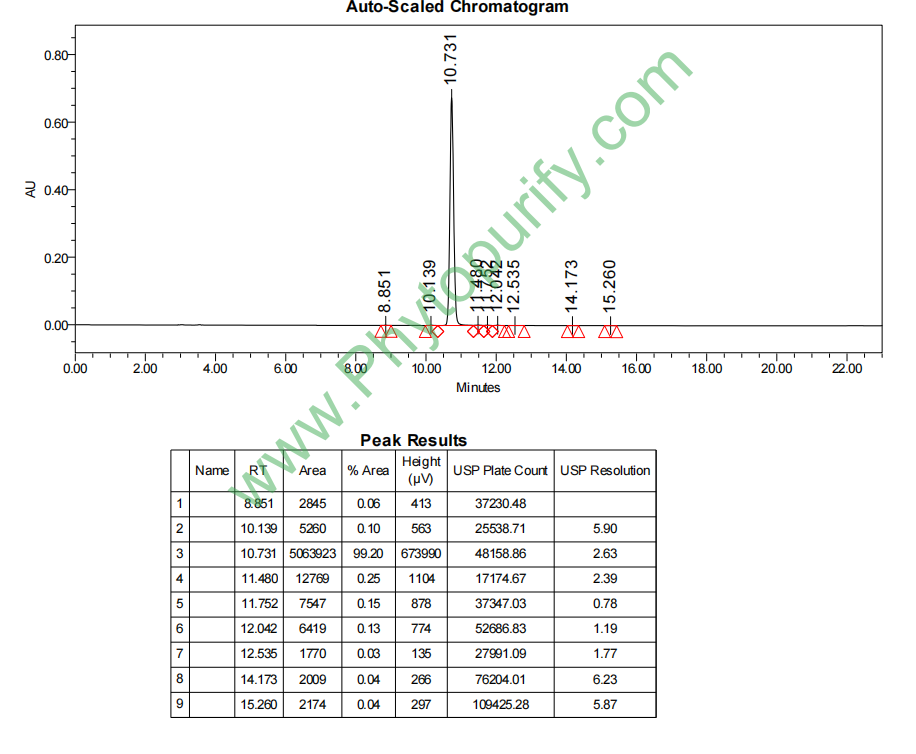
Purity: 95%~99%
Analysis Method: HPLC-DAD or/and HPLC-ELSD
Identification Method: Mass, NMR
Packing: Brown vial or HDPE plastic bottle
Storage: Store in a well closed container, protected from air and light. Put into refrigerate or freeze for long term storage.
Whenever possible, you should prepare and use solutions on the same day. However, if you need to make up stock solutions in advance, we recommend that you store the solution as aliquots in tightly sealed vials at -20℃. Generally, these will be useable for up to two weeks.
The product could be supplied from milligrams to grams, up to kilograms
Inquire for bulk scale.
Descriptions:
Brazilin, isolated from Caesalpinia sappan has been known as a natural red pigment, exhibits the inhibitory effect on lipopolysaccharide (LPS)-stimulated NO production in a dose-dependent manner (IC50=24.3 microM), might be associated with the regulation of transcription factors NF-kappaB and AP-1; inducible isoform of nitric oxide synthase (NOS) plays an important role in inflammation and carcinogenesis, suggests that the suppressive effect of iNOS gene expression by brazilin might provide one possible mechanism for its anti-inflammatory and cancer chemopreventive activity. [1]
Brazilin exhibits anti-hepatotoxicity, antiplatelet activity, and anti-inflammatory activities, it also inhibits UVB-induced MMP-1/3 expressions and secretions by suppressing of NF-κB activation in human dermal fibroblasts, thus, it might be used as a potential agent for treatment of UV-induced skin photoaging.[2]
Brazilin protects the cells against t -butyl hydroperoxide ( t -BHP)-induced cell death, and the protective effect was abrogated by anti-sense oligodeoxynucleotides (ODN) against the HO-1 gene, suggests that the expression of HO-1 by brazilin is mediated via the PI3K/Akt and ERK pathways, and this expression inhibits t -BHP-induced cell death in House Ear Institute-Organ of Corti 1 (HEI-OC1) cells.[3]
Brazilin induces vasorelaxation by the increasing intracellular Ca(2+) concentration in endothelial cells of blood vessels and hence activating Ca(2+)/calmodulin-dependent NO synthesis, the NO is released and then transferred into smooth muscle cells to activate guanylyl cyclase and increase cGMP content, resulting in vasorelaxation.[4]
Brazilin, the main principle of Caesalpinia sappan, was able to improve the altered immune functions caused by halothane administration in mice.[5]
Brazilin induces apoptosis and G2/M arrest via inactivation of histone deacetylase in multiple myeloma U266 cells, suggests that it has potential as a chemotherapeutic agent alone or in combination with an anticancer agent for multiple myeloma treatment.[6]
Brazilin shows dose-dependent inhibition of cell proliferation and induction of apoptosis in glioma cells, it also increases the ratio of cleaved poly-(ADP)-ribose polymerase and decreases the expression of caspase-3 and caspase-7.[7]
Brazilin has anti-IKK activity , can selectively disrupt proximal IL-1 receptor signaling complex formation by targeting an IKK-upstream signaling components.[8]
References:
[1] Bae I K, Min H Y, Han A R, et al. Eur J Pharmacol, 2005, 513(3):237-42.
[2] Lee Y R, Noh E M, Han J H, et al. Eur J Pharmacol, 2012, 674(2–3):80-6.
[3] Choi B M, Kim B R. Eur J Pharmacol, 2008, 580(1–2):12-8.
[4] Hu C M, Kang J J, Chen C L, et al. Eur J Pharmacol, 2003, 468(1):37-45.
[5] Choi S Y, Yang K M, Jeon S D, et al. Planta Medica, 1997, 63(5):405-8.
[6] Kim B, Kim S H, Jeong S J, et al. J Agr Food Chem, 2012, 60(39):9882-9.
[7] Lee D Y, Lee M K, Kim G S, et al. Molecules, 2013, 18(2):2449-57.
[8] Jeon J, Ji H L, Park K A, et al. Biochem Pharmacol, 2014, 89(4):515-25.
[9] Zhao H X, Bai H, Wang Y S, et al. West China J Pharm Sci, 2010, 25(3):363-4.
HPLC of Brazilin
Storage conditions:Short-term storage at 2~8℃, long-term storage at -20 ~ -80℃
Brazilin (CAS number: 474-07-7) is a natural precursor of red dye, mainly found in the heartwood of several tropical hardwoods, particularly represented by plants such as Caesarpinia sappan L. As a natural pigment with a long history of application, Brazilian hematoxylin not only occupies an important position in the traditional dye industry, but has also become a hot topic in natural product pharmacology research in recent years due to its diverse biological activities. Numerous studies have shown that Brazilian hematoxylin has significant anti-inflammatory, anti-tumor, antioxidant, and cartilage protective effects, particularly exhibiting unique molecular mechanisms in regulating cell proliferation, inducing cell apoptosis, and autophagy. It shows therapeutic potential for various disease models by regulating the AMPK/mTOR signaling pathway, affecting cell metabolism and survival status.
In addition, the application prospects of Brazilian hematoxylin in inflammatory bowel disease (IBD) have attracted widespread attention. Related studies have revealed that it can regulate the expression and activity of inflammatory factors such as TNF, IL-1 β, IL-18, and NLRP3 inflammasome, thereby alleviating intestinal inflammation and improving pathological conditions. This article aims to systematically review the chemical structure and physicochemical properties, plant sources and extraction methods, pharmacological activity and mechanism of action, pharmacological evaluation and pharmacokinetic characteristics of Brazilian hematoxylin, and finally prospect its clinical application potential, providing theoretical basis and reference for future related research.
Brazilian hematoxylin is a typical natural compound of diphenylmethane, with a molecular formula of C16H14O5 and a molecular weight of 286.28. Its chemical structure consists of two aromatic rings connected by a methane bridge, and the molecule contains multiple hydroxyl and phenolic carboxyl groups, endowing it with good polarity and biological activity. The presence of hydroxyl groups in the molecular structure not only enhances its water solubility, but also provides possibilities for its binding to various biological targets.
In terms of physical and chemical properties, the LogP value of Brazilian hematoxylin is about 0.7, indicating that it has moderate lipid solubility, which is beneficial for cell membrane penetration but not excessively lipid soluble and affects bioavailability. The topological polar surface area (TPSA) is 92.89 Å ², indicating its polarity and facilitating interaction with polar targets. The molecule contains 5 hydrogen bond receptors that can form stable binding with protein targets through hydrogen bonding. The low penetration ability of the blood-brain barrier suggests its limited role in the central nervous system. Toxicity evaluation shows that Brazilian hematoxylin has no hepatotoxicity, cardiotoxicity, hERG channel inhibition, and no mutagenicity (Ames test negative), indicating high safety.
Brazilian hematoxylin is mainly found in the heartwood of Caesarpinia sappan L. and its related species. This plant is distributed in parts of tropical Asia and South America, with a bright red heartwood color. It has always been used as a natural dye and traditional Chinese medicine. In traditional Chinese medicine, Brazilian hematoxylin is used to promote blood circulation, relieve pain, reduce inflammation and detoxify. Modern research has confirmed that its main active ingredients are Brazilian hematoxylin and its derivatives.
There are various methods for extracting Brazilian hematoxylin, including solvent extraction, ultrasound assisted extraction, and microwave-assisted extraction. Generally, ethanol or methanol is used as the extraction solvent, and the extraction efficiency is improved by reflux or ultrasonic treatment. The extract was concentrated, separated, and purified by column chromatography to obtain high-purity Brazilian hematoxylin. In recent years, green extraction technologies such as supercritical CO2 extraction and hydrothermal extraction have also been attempted to improve extraction efficiency and environmental friendliness.
Brazilian hematoxylin has shown significant anti-inflammatory effects in various inflammatory models. It reduces inflammatory response by inhibiting the activation of inflammatory mediators such as tumor necrosis factor alpha (TNF - α), interleukin-1 β (IL-1 β), interleukin-18 (IL-18), and inflammasome NLRP3. Especially in anti-inflammatory intestinal disease models, Brazilian hematoxylin can regulate the intestinal immune microenvironment, reduce inflammatory cell infiltration, promote intestinal mucosal repair, and exhibit good cartilage protection and anti-inflammatory effects.
Brazilian hematoxylin exhibits potential anti-tumor activity by inhibiting tumor cell proliferation, inducing cell apoptosis, and promoting autophagy. Its mechanism of action involves activating the AMPK signaling pathway, inhibiting mTOR signaling, regulating cellular energy metabolism and growth cycle. Many in vitro and in vivo studies have shown that brazilian hematoxylin has inhibitory effects on breast cancer, liver cancer, lung cancer and other tumor cells, and has low cytotoxicity to normal cells.
Brazilian hematoxylin exhibits cartilage protective function in degenerative diseases such as osteoarthritis. It slows down the degradation of cartilage matrix and promotes the survival and functional maintenance of chondrocytes by inhibiting the expression of inflammatory factors and matrix metalloproteinases (MMPs). In addition, Brazilian hematoxylin can regulate autophagy levels, maintain cellular homeostasis, and delay the process of cartilage degeneration.
The pharmacological effects of Brazilian hematoxylin are mainly achieved through multiple signaling pathways, with the core mechanism involving the regulation of the AMPK/mTOR pathway. AMPK, as an energy sensing enzyme, regulates cellular metabolic balance. Brazilian hematoxylin activates AMPK, thereby inhibiting mTOR signaling, promoting autophagy and apoptosis, and inhibiting abnormal cell proliferation.
In terms of anti-inflammatory effects, Brazilian hematoxylin downregulates the activation of NLRP3 inflammasomes, reduces CASP1 (caspase-1) activity, lowers the maturation and secretion of IL-1 β and IL-18, and alleviates inflammatory responses. Its inhibitory effect on TNF - α further blocks the inflammatory cascade and alleviates tissue damage. In addition, Brazilian hematoxylin may also inhibit the transcriptional expression of inflammatory genes by regulating the NF - κ B signaling pathway.
The pharmacological parameters of Brazilian hematoxylin indicate that it has good potential for drug development. Moderate molecular weight and LogP value are beneficial for in vivo absorption and distribution. A higher number of TPSA and hydrogen bond receptors contribute to stable binding with target proteins. The low penetration rate of the blood-brain barrier suggests that it mainly acts on peripheral tissues, reducing the risk of central nervous system side effects.
The safety assessment shows that Brazilian hematoxylin has no significant hepatotoxicity, cardiotoxicity, or hERG channel inhibition, and the Ames test is negative, indicating a low risk of toxicity. Preliminary pharmacokinetic studies have shown that Brazilian hematoxylin is well absorbed and widely distributed in the body after oral administration, but its bioavailability is limited by first pass effects and metabolic conversion. In the future, drug formulation optimization is needed to improve its in vivo stability and duration of action.
Given the multiple activities of Brazilian hematoxylin in anti-inflammatory, anti-tumor, and cartilage protection, it has broad application prospects in the field of clinical treatment. Especially in the treatment of anti-inflammatory bowel disease, Brazilian hematoxylin has shown potential as a natural anti-inflammatory drug by regulating key inflammatory factors and signaling pathways, and is expected to become a new choice for IBD adjuvant or alternative treatment.
In addition, the anti-tumor activity of Brazilian hematoxylin provides the possibility for its use in adjuvant therapy for tumors, especially suitable for combination chemotherapy or targeted therapy to enhance efficacy and reduce side effects. The protective effect of cartilage provides a new approach for the treatment of degenerative diseases such as osteoarthritis.
Future research should focus on pharmacokinetic optimization, formulation development, and clinical safety and efficacy evaluation of Brazilian hematoxylin. At the same time, in-depth analysis of its molecular mechanism and target of action, combined with modern drug design technology, will promote the clinical translation of Brazilian hematoxylin.
As a widely sourced and structurally unique natural product, Brazilian hematoxylin has shown significant potential for drug development due to its diverse pharmacological activities and good safety. Its research in the fields of anti-inflammatory, anti-tumor, and cartilage protection continues to deepen, providing valuable examples for natural product pharmacology. In the future, through systematic pharmacological mechanism research, pharmacological optimization, and clinical validation, Brazilian hematoxylin is expected to become a new natural medicine for treating inflammatory diseases and tumors, contributing significantly to human health.
