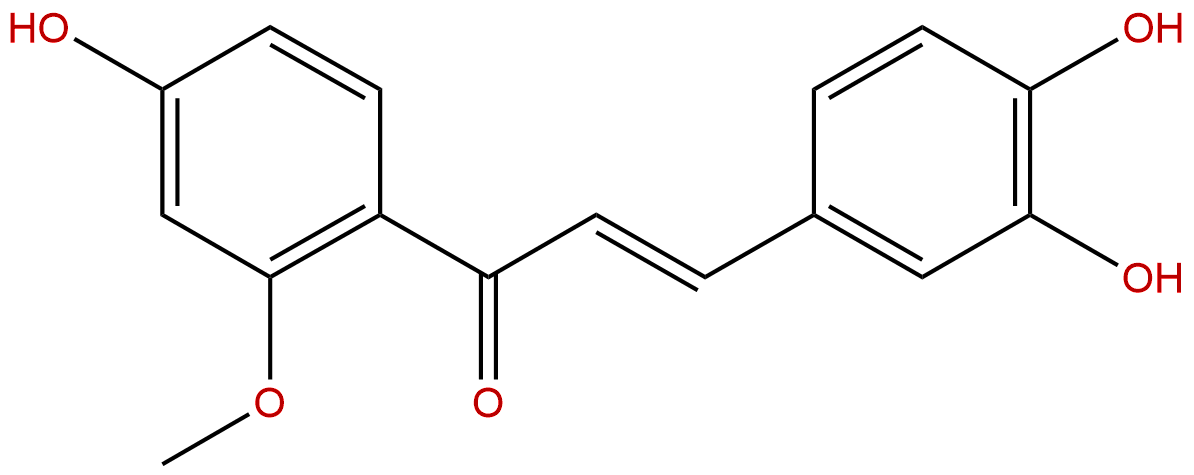
Sumu chalcone: a multi-target anti-tumor natural compound derived from traditional Sumu
1. Overview
Sappanchalcone (CAS number: 94344-54-4) is a traditional medicinal plant derived from Sappanchalcone (scientific name:)Biancaea sappan, formerly known as Caesalpinia sappan L. The flavonoids isolated from the compound belong to the chalcone family. Its molecular formula is C ₁₆ H ₁₄ O ₅, and its molecular weight is 286.2830 g/mol. As a natural active molecule, Su Mucha'er ketone has received high attention from researchers in natural product pharmacology and tumor pharmacology in recent years due to its wide range of biological activities. Research shows that it not only has significant antioxidant and anti-inflammatory It has demonstrated the ability to induce cell apoptosis and inhibit cell proliferation in various tumor cell models, especially in models such as human colon cancer and oral cancer. Its mechanism of action involves the regulation of multiple key cellular signaling pathways and target proteins (such as p53, CASP3, MYC, etc.), making it a highly valuable lead compound for research. This article will systematically elaborate on the scientific value of this natural product from its chemical structure, plant origin, pharmacological mechanism, medicinal evaluation, and research prospects.
2. Chemical structure and physicochemical properties
The chemical structure of Sumu Chalone belongs to Trans chalcone Its skeleton is composed of two benzene rings (A ring and B ring) connected by a three carbon α, β - unsaturated ketone bridge. The SMILES string (COc1cc (O) ccc1C (=O)/C=c1ccc (O) c (O) c1) accurately describes its substitution pattern: there is a methoxy group (- OCH h3) at the 2 'position of the A ring, a hydroxyl group (- OH) at the 3 and 4 positions of the B ring, and a hydroxyl group at the 4' position of the B ring. This Polyhydroxyl and methoxy groups The substitution mode is the structural basis for its strong antioxidant activity, as hydroxyl groups are effective hydrogen donors that can neutralize free radicals.
According to the analysis of drug parameters, its molecular weight (MW) is 286.28, which meets the requirement of "less than 500" in Lipinski's five rules. The calculated lipid water partition coefficient (LogP) is 2.71, indicating that the compound has moderate lipophilicity, which is beneficial for its penetration into cell membranes. The topological polar surface area (TPSA) is 86.99 Å ², which is a moderate value and is usually associated with good membrane permeability. Its water solubility parameter is 0.0908, which is slightly soluble, indicating that solubilization strategies may need to be considered during formulation development. The permeability data of Caco-2 cells is 9.5290, indicating that it has Good intestinal absorption potential However, its blood-brain barrier (BBB) penetration has been evaluated as' low ', meaning it may not easily enter the central nervous system, which may not be a barrier for treating peripheral system diseases such as arthritis and colon cancer, but limits its application for central nervous system related diseases. The plasma protein binding rate (PPB) is as high as 87.64%, indicating that most drugs in the blood bind to proteins, which may affect their free drug concentration and efficacy.
3. Plant sources and traditional applications
The Plant Source of Sumu Chalone——Sumu(Sappanwood), It is a Fabaceae plant, mainly distributed in Southeast Asia, South Asia, and southern China. The heartwood of Sumu has a bright orange red to reddish brown color and has been an important species since ancient times Natural dyes and Traditional medicinal herbs。
In the traditional medical system, the application of Sumu has a long history. In traditional Chinese medicine theory, Su Mu has a flat nature, a sweet and salty taste, and is associated with the heart, liver, and spleen meridians Promote blood circulation, remove blood stasis, reduce swelling and relieve pain Its efficacy is commonly used to treat injuries caused by falls, stasis, swelling and pain, menstrual cramps, and postpartum blood stasis. There are records of its decoction or soaking in wine for external and internal use. In Ayurvedic medicine in India and traditional medicine in Southeast Asia, Sumu is also used to treat inflammation, diarrhea, skin diseases, and as a blood supplement. The red color presented by the water or alcohol extract of Sumu heartwood is not only used for fabric dyeing, but also commonly used as a food coloring agent.
Modern plant chemistry research has confirmed that Su Mu is rich in various bioactive components, including Brazilian Su Mu Su Su, Su Mu Cha Er ketone, Original Su Mu Yin Such as various chalcones, flavonoids, and phenolic compounds. It is these compounds that together form the material basis of the traditional medicinal properties of Sumu. The targeted isolation of Sumu Chalone from Sumu and in-depth study of its specific pharmacological effects is a model for the modernization of traditional medicine research, reflecting the scientific development path from "crude herbal extracts" to "clear active monomers".
4. Pharmacological activity and mechanism of action
The pharmacological activities of Sumu Chalone are extensive, among which the most notable is its Antitumor activity The existing description clearly states that it can induce apoptosis in human colon cancer cells and inhibit the growth of oral cancer cells, induce apoptosis, and arrest the cell cycle in the G2/M phase by activating the p53 dependent mitochondrial pathway, p38, ERK, JNK, and NF - κ B signaling pathways. Behind these complex biological effects is the precise regulation of multiple key cellular targets by sulbactam.
Based on the provided target information, we can delve into its potential functional network:
- TP53 (p53)This is one of the most important tumor suppressor genes, known as the 'guardian of the genome'. Sumu chalcone can activate p53, which can act as a transcription factor to upregulate the expression of a series of downstream target genes, triggering cell cycle arrest (to buy time for DNA repair) or initiating apoptosis programs (when the damage is irreparable). This is one of the core mechanisms by which it induces apoptosis in tumor cells.
- CASP3 (Caspase-3)Known as the 'death executing protease', it is a key effector molecule downstream of the cell apoptosis pathway. Whether through the mitochondrial (endogenous) pathway or the death receptor (exogenous) pathway, Caspase-3 is ultimately activated, which cleaves various cytoskeletal and nuclear proteins, leading to irreversible cell apoptosis. The apoptosis induced by Sumu Chalone is inevitably accompanied by the activation of Caspase-3.
- BAX It is a pro apoptotic protein in the Bcl-2 family. After p53 activation, the expression of BAX is often upregulated. BAX protein will transfer to the outer membrane of mitochondria, forming pores, leading to the loss of mitochondrial membrane potential and the release of cytochrome C into the cytoplasm, thereby activating the Caspase cascade reaction and triggering apoptosis. Sumu chalcone promotes apoptosis through the p53 BAX mitochondrial pathway.
- CDKN1A (p21/WAF1)It is an important downstream target gene of p53. P21 is a potent inhibitor of cyclin dependent kinase (CDK). When p21 is induced to express, it can inhibit the activity of various Cyclin CDK complexes, leading to cell cycle arrest (usually in G1 or G2 phase) and preventing cell proliferation. This is consistent with the phenomenon of G2/M phase blockade caused by sulbactam.
- MYC It is a proto oncogene that can promote cell proliferation, growth, and metabolism. MYC is overexpressed in many tumors. Research has shown that some treatment strategies can suppress tumors by inhibiting the expression or function of MYC. Although the current description does not directly explain the direction of action of Sumucharol on MYC, as one of its targets, it may regulate the transcription or stability of MYC through indirect means (such as p53 activation) or direct interactions, thereby inhibiting its pro cancer function.
In summary, Su Mucha'er ketone may be administered through a Multi target collaborative network Function: Activate tumor suppressor p53, thereby upregulating pro apoptotic protein BAX and cycle inhibitor protein p21, and possibly regulating oncogene MYC; Ultimately leading to tumor cell cycle arrest and execution of mitochondrial pathway apoptosis (activated by CASP3). In addition, it exerts its effects by inhibiting pathways such as NF - κ B anti-inflammatory effect It is also related to the improvement of tumor microenvironment and adjuvant anti-tumor effects.
In addition to anti-tumor effects, it anti-inflammatory Activity shows bone protective potential in rheumatoid arthritis models; its Anti-allergy The activity was confirmed in the RBL-2H3 cell model (IC ₅₀ was 7.6 µ M); its antioxidant and neuroprotection The activity also provides possibilities for its application in the field of neurodegenerative diseases. It inhibits the activity of xanthine oxidase and suggests its potential use in the treatment of gout.
5. Evaluation of drug properties
Based on the provided pharmacological parameters, we can conduct a preliminary evaluation of the potential development prospects of Sumucharol as a drug. Main references for evaluation Lipinski's Five Rules Empirical rules such as the Rule of Five are used to predict the absorption and permeation potential of compounds for oral administration.
-
Lipinski Five Rule Compliance:
- Molecular weight (MW):286.28 < 500, Comply with。
- Lipid water partition coefficient (LogP):2.71 < 5, Comply with。
- Number of hydrogen bond donors (HBDs)According to the structure (3- OH), 3<5, Comply with。
- Number of hydrogen bond acceptors (HBA)According to the structure (5 O atoms), there are 5<10, Comply with。
- Number of rotatable keys The chalcone skeleton has high rigidity and a small number of rotatable keys. It is expected that Comply with。
- Conclusion Sumu chalcone fully conforms to Lipinski's five rules, indicating its good performance Oral bioavailability potential。
-
Absorption and distribution:
- Permeability The permeability data (9.5290) and effective permeability coefficient (Peff: 4.2948) of Caco-2 both indicate good intestinal absorption characteristics.
- Blood-brain barrier (BBB)The penetrability is "low", which limits its therapeutic application for central nervous system diseases, but reduces the potential risk of central nervous system side effects.
- Plasma protein binding rate (PPB)Up to 87.64%, indicating a high binding rate. This means that only a small amount of free drugs can exert their therapeutic effects in the bloodstream, which may require higher dosages to achieve effective blood drug concentrations, but may also prolong the half-life of the drug in the body.
-
Metabolism and toxicity:
- Synthetic accessibility The SyneAccess value is 2.1736, indicating moderate feasibility for chemical synthesis or semi synthesis, which is conducive to large-scale production and structural modification.
- Toxicity Warning:
- AMES test A value of 0.6 (usually<1 is considered negative,>1.5 is considered positive) indicates that Low risk of mutagenicity。
- chromosome aberration Marked as' present ', this is a signal that requires high vigilance, indicating that the compound may cause genetic damage under specific testing conditions and is a toxicity that needs to be carefully investigated and evaluated in drug development.
- HERG inhibition Marked as' no ', this is a positive signal, indicating a low likelihood of causing QT interval prolongation in the heart (a serious risk of arrhythmia).
- Organ toxicity warning Ser_LK, Ser_CGT, Ser_ST, and Ser_LT are all labeled as "yes" and are biomarkers of liver function. This strongly suggests that under experimental conditions, Su Mu Cha Er ketone may Potential hepatotoxicity This is a core issue that must be thoroughly investigated in subsequent toxicology research.
- Other Skin sensitization (Skid_Sens) is "no", but respiratory sensitization (Resp_Sens) is "yes", and phototoxicity (Photo_tox) is "none".
Comprehensive Assessment: Sumu Chalone in Excellent oral absorption potential Comply with the basic rules of drug properties. However, it High plasma protein binding rate, potential risk of chromosomal abnormalities, and liver toxicity warning It is a major challenge that it must face and solve on the road to drug conversion. Future structural optimization work may need to focus on reducing protein binding rates, eliminating genetic and liver toxicity while maintaining activity.
6. Research Status and Application Prospects
At present, research on Su Mu Cha Er ketone has progressed from early plant chemical isolation and activity screening to In depth exploration of the mechanism of action and Preliminary preclinical evaluation Stage. A large number of in vitro studies have confirmed its biological activities in anti-tumor, anti-inflammatory, antioxidant, anti allergic and other aspects, and preliminarily outlined its multi-target characteristics in key signaling pathways such as p53 and NF - κ B. In specific tumor models such as oral cancer and colon cancer, research on their efficacy and mechanisms is relatively concentrated.
However, current research also has obvious limitations: firstly, the vast majority of studies remain at the level of Cell experiment level However, there is still a lack and dispersion of pharmacokinetic, pharmacodynamic, and toxicological data in animals, especially insufficient systematic evaluation of their warning toxicity (such as hepatotoxicity and genotoxicity). Secondly, it The mechanism of action network has not been fully elucidated yet The primary secondary relationships and synergistic/antagonistic effects between various targets require more detailed research (such as using gene knockout, proteomics, and other techniques). Finally, as a natural product, it Poor water solubility The problem also restricts the development of dosage forms and in vivo administration.
Looking ahead to the future, there may be several directions for the research and application of Su Mucha'er ketone:
1. In depth preclinical development The primary task is to conduct systematic animal in vivo experiments to comprehensively evaluate its efficacy, pharmacokinetic characteristics (ADME), and safety toxicity profile in different disease models (such as arthritis and colon cancer), especially conducting specialized research on warned hepatotoxicity and genotoxicity.
2. Structural optimization and modification: Take it as lead compound Structural modification is carried out through medicinal chemical methods. For example, by introducing water-soluble groups to improve solubility, by changing specific substituents to reduce protein binding rates and eliminate toxicity, while retaining or enhancing its core pharmacological activity, derivatives with better drug properties can be obtained.
3. Formulation innovation Develop new drug delivery systems, such as nanoparticles, liposomes, cyclodextrin inclusion complexes, etc., to address their low water solubility issues and improve their bioavailability and targeting.
4. Exploration of combination therapy Given its multi-target mechanism of action and anti-inflammatory properties, exploring its combination with existing chemotherapy drugs or targeted drugs may produce synergistic effects, reduce drug resistance, or alleviate toxic side effects.
5. Expand application areas In addition to anti-tumor effects, its activities in anti-inflammatory, anti allergic, neuroprotective and other aspects are also worth further exploration, especially in the fields of osteoarthritis, allergic asthma, neuroinflammatory related diseases and so on.
In summary, as a natural active molecule derived from traditional Chinese medicine, Su Mucha'er ketone exhibits rich biological activity and a clear multi-target mechanism of action, making it a highly promising lead compound for development. Although it still faces challenges such as toxicity and solubility on the road to drug development, with the deepening application of modern pharmaceutical technology, it is expected to provide new candidate drugs or important structural templates for the treatment of major diseases such as tumors and inflammation in the future.