


Product name: Benzoylpaeoniflorin
Synonym name:
Catalogue No.: BP0248
Cas No.: 38642-49-8
Formula: C30H32O12
Mol Weight: 584.574
Botanical Source: Paeonia suffruticosa
Physical Description: White cryst.
Type of Compound: Monoterpenoids
Purity: 95%~99%
Analysis Method: HPLC-DAD or/and HPLC-ELSD
Identification Method: Mass, NMR
Packing: Brown vial or HDPE plastic bottle
Storage: Store in a well closed container, protected from air and light. Put into refrigerate or freeze for long term storage.
Whenever possible, you should prepare and use solutions on the same day. However, if you need to make up stock solutions in advance, we recommend that you store the solution as aliquots in tightly sealed vials at -20℃. Generally, these will be useable for up to two weeks.
The product could be supplied from milligrams to grams, up to kilograms
Inquire for bulk scale.
Descriptions:
Benzoylpaeoniflorin can restrain apoptosis of rats with coronary heart diseases by increasing the levels of Bc1-2 and decreasing the levels of Bax, suggesting that it may treat coronary heart disease by decreasing apoptosis.[1]
References:
[1] Zhang E L, Yang L I, Hong-Yan G E.Chinese Journal of Laboratory Diagnosis, 2011, 15(4):609-10.
[2] Wang Q, Liu R X, Kai-Shun B I, et al. Chinese Traditional & Herbal Drugs, 2005, 36(11):1630-2.
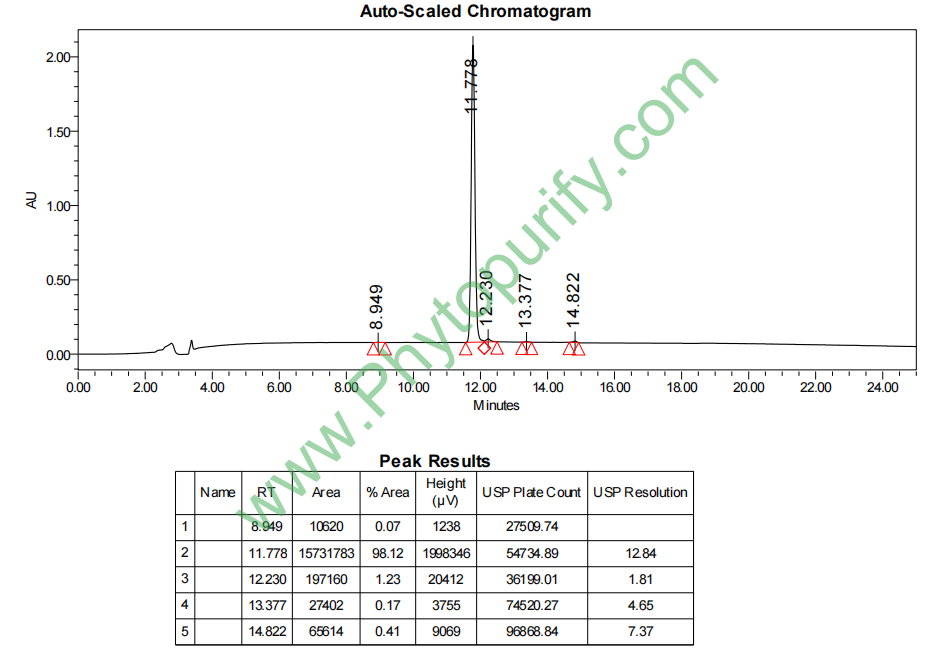
HPLC of Benzoylpaeoniflorin
Storage conditions:Short-term storage at 2~8℃, long-term storage at -20 ~ -80℃
208.6200
1.3200
Low (predicted)
No (predicted)
No (predicted)
No (predicted)
No (predicted)
No (predicted)
Negative (predicted)
Benzoylpaeoniflorin (CAS number: 38642-49-8) is a monoterpenoid glycoside compound with significant biological activity, mainly found in traditional Chinese medicine Paeonia spp. As a benzoyl derivative of paeoniflorin, benzoyl paeoniflorin not only retains various pharmacological activities of the parent compound, but also exhibits good oral bioavailability and strong pharmacological effects. In recent years, with the advancement of natural product pharmacology and molecular biology technology, research on benzoyl paeoniflorin in anti-inflammatory, immune regulation, anti allergic, and tumor treatment fields has gradually deepened, especially in disease models such as psoriasis, sepsis, and pancreatic tumors, showing broad application potential.
This article aims to systematically review the chemical structure and physicochemical properties, plant sources, and extraction methods of benzoyl paeoniflorin, with a focus on analyzing its pharmacological activity and mechanism of action, exploring its molecular targets and pharmacological parameters, and combining existing research results to prospect its clinical application prospects, providing theoretical basis and guidance for related research.
Benzoyl paeoniflorin belongs to the monoterpenoid glycoside class, with a molecular formula of C27H32O13 and a molecular weight of 576.57. Its structure is composed of a paeoniflorin core connected to a benzoyl group through ester bonds, with multiple hydroxyl and glycosidic bonds, giving it high polarity. Its physical and chemical properties are manifested as:
The chemical structure of benzoyl paeoniflorin is shown in Figure 1 (omitted here). The introduction of its benzoyl group not only enhances the stability of the molecule, but may also improve its binding affinity with target proteins.
Benzoyl paeoniflorin mainly comes from plants of the Paeonia genus, especially Paeonia lactiflora Pall. and Paeonia veilchii Lynch, which are abundant in content. Paeonia lactiflora, as a traditional Chinese medicinal herb, has a long history and is widely used in clinical practice of traditional Chinese medicine for regulating liver qi, relieving pain, and anti-inflammatory effects.
Traditional extraction methods often use alcohol solvents (such as ethanol and methanol) for reflux extraction of dried peony roots, followed by separation and purification through liquid-liquid distribution, column chromatography, and other methods. In recent years, the application of ultrasound assisted extraction, microwave-assisted extraction, and high-performance liquid chromatography (HPLC) technology has improved the extraction efficiency and purity of benzoyl paeoniflorin.
The specific steps are as follows:
In addition, the synthesis method of benzoyl paeoniflorin is gradually developing, providing the possibility for its large-scale production.
The pharmacological activity of benzoyl paeoniflorin mainly revolves around its anti-inflammatory, immune regulatory, anti allergic, and anti-tumor effects. Relevant research covers cell experiments, animal models, and partial in vitro mechanism analysis.
Benzoyl paeoniflorin regulates inflammatory response through multiple targets and pathways, significantly inhibiting the release of pro-inflammatory factors such as tumor necrosis factor alpha (TNF - α), interleukin-6 (IL-6), nitric oxide (NO), etc. In a mouse inflammation model, benzoyl paeoniflorin significantly reduced tissue edema and inflammatory cell infiltration, demonstrating good anti-inflammatory effects.
Benzoyl paeoniflorin can regulate the function of immune cells, balance the Th1/Th2 cell ratio, promote regulatory T cell (Treg) activity, inhibit excessive immune reactions, and improve immune imbalance. This characteristic makes it potentially valuable in the treatment of autoimmune and allergic diseases.
Benzoyl paeoniflorin exhibits significant anti allergic activity by inhibiting degranulation of mast cells and histamine release. Related in vivo experiments have shown that it can alleviate symptoms of allergic dermatitis and asthma models, and reduce levels of inflammatory mediators.
Psoriasis, as a chronic inflammatory skin disease, is improved by benzoyl paeoniflorin, which inhibits the NF - κ B and MAPK signaling pathways, reduces abnormal proliferation and inflammatory response of keratinocytes, and improves the pathological state. Research on sepsis models has shown that benzoyl paeoniflorin can inhibit inflammatory storms, reduce the risk of multiple organ damage, and improve survival rates.
In recent years, research on benzoyl paeoniflorin in malignant tumors such as pancreatic tumors has gradually increased. It inhibits tumor cell proliferation, induces apoptosis, suppresses metastasis and drug resistance by regulating various tumor related targets and signaling pathways. Related targets include APP, PTPN1, STAT3, ABCB1, PRKCA, CLEC4E, IDH1, SIRT1, PAX8, and RELA, involving multiple aspects such as cell signaling, metabolic regulation, and immune escape.
The mechanism of action of benzoyl paeoniflorin is complex, covering multiple signaling pathways and molecular targets, mainly including:
NF - κ B is a core transcription factor that regulates inflammatory responses. Benzoyl paeoniflorin exerts anti-inflammatory effects by inhibiting I κ B α phosphorylation and NF - κ B nuclear translocation, reducing the expression of pro-inflammatory genes, and lowering the release of inflammatory mediators.
Members of the MAPK family (ERK, JNK, p38) play critical roles in cell proliferation, differentiation, and stress response. Benzoyl paeoniflorin can inhibit the activation of MAPK pathway, alleviate inflammation and cell damage.
Benzoyl paeoniflorin promotes the functional recovery and immune tolerance of immune cells and improves immune disorders by regulating signaling molecules such as STAT3 and SIRT1.
The pharmacological evaluation of benzoyl paeoniflorin shows that it has good pharmacokinetic and safety characteristics:
Pharmacokinetic studies have shown that benzoyl paeoniflorin has a moderate half-life in the body, is widely distributed, and is mainly metabolized by the liver. Its excretion pathway is mainly through the kidneys. Further research is needed on its metabolites.
Benzoyl paeoniflorin has shown promising therapeutic potential in immune, allergic, and inflammatory diseases due to its multi-target and multi pathway pharmacological properties. Especially in difficult to treat diseases such as psoriasis, sepsis, and pancreatic tumors, benzoyl paeoniflorin is expected to become a candidate molecule for novel therapeutic drugs.
Future research should focus on:
In addition, the combination application of benzoyl paeoniflorin with other drugs and its potential in personalized treatment are also worth paying attention to.
Benzoyl paeoniflorin, as a natural monoterpenoid glycoside with multiple biological activities, has shown broad application prospects in anti-inflammatory, immune regulation, and anti-tumor fields due to its unique chemical structure and significant pharmacological effects. Its good pharmacological parameters and safety prediction lay the foundation for subsequent drug development. In the future, combining modern pharmacology and molecular biology techniques, in-depth exploration of the mechanism of action and clinical application of benzoyl paeoniflorin will help promote its clinical translation and benefit patients.
The research on benzoyl paeoniflorin not only enriches the theoretical system of natural product pharmacology, but also provides valuable examples for natural medicine innovation, which is worthy of continuous attention and in-depth exploration.
