Introduction/Overview
In the field of natural product chemistry and pharmacology research, medicinal fungi have attracted much attention due to their rich bioactive secondary metabolites. Among them, Ganoderma lucidum(Ganoderma lucidum)As a treasure of traditional Chinese medicine, it has a history of thousands of years of application, and its effects of "strengthening the body and promoting longevity" are widely known. Modern scientific research has revealed that many pharmacological activities of Ganoderma lucidum, such as immune regulation, anti-tumor, liver protection, blood glucose lowering, and cardiovascular protection, are closely related to the triterpenoids, polysaccharides, sterols, and other compounds it contains. Ganoderol B is a lanostane triterpenoid compound with significant biological activity isolated from Ganoderma lucidum. Since its discovery, it has become a research hotspot because of its strong inhibitory effect on α - glucosidase, which indicates its potential value in the management of diabetes and its complications. In recent years, with the deepening of research, the multi-target mechanism of action of Danzhichun B in cardiovascular protection has gradually been revealed, expanding it from a candidate molecule for lowering blood sugar to a highly promising natural product with multiple effects in the fields of metabolic syndrome and cardiovascular disease. The purpose of this article is to systematically review the chemical properties, sources, pharmacological activities of Danzhichun B, especially its multi-target cardiovascular protection mechanism, and to prospect its pharmacological properties and clinical application prospects.
Chemical structure and physicochemical properties
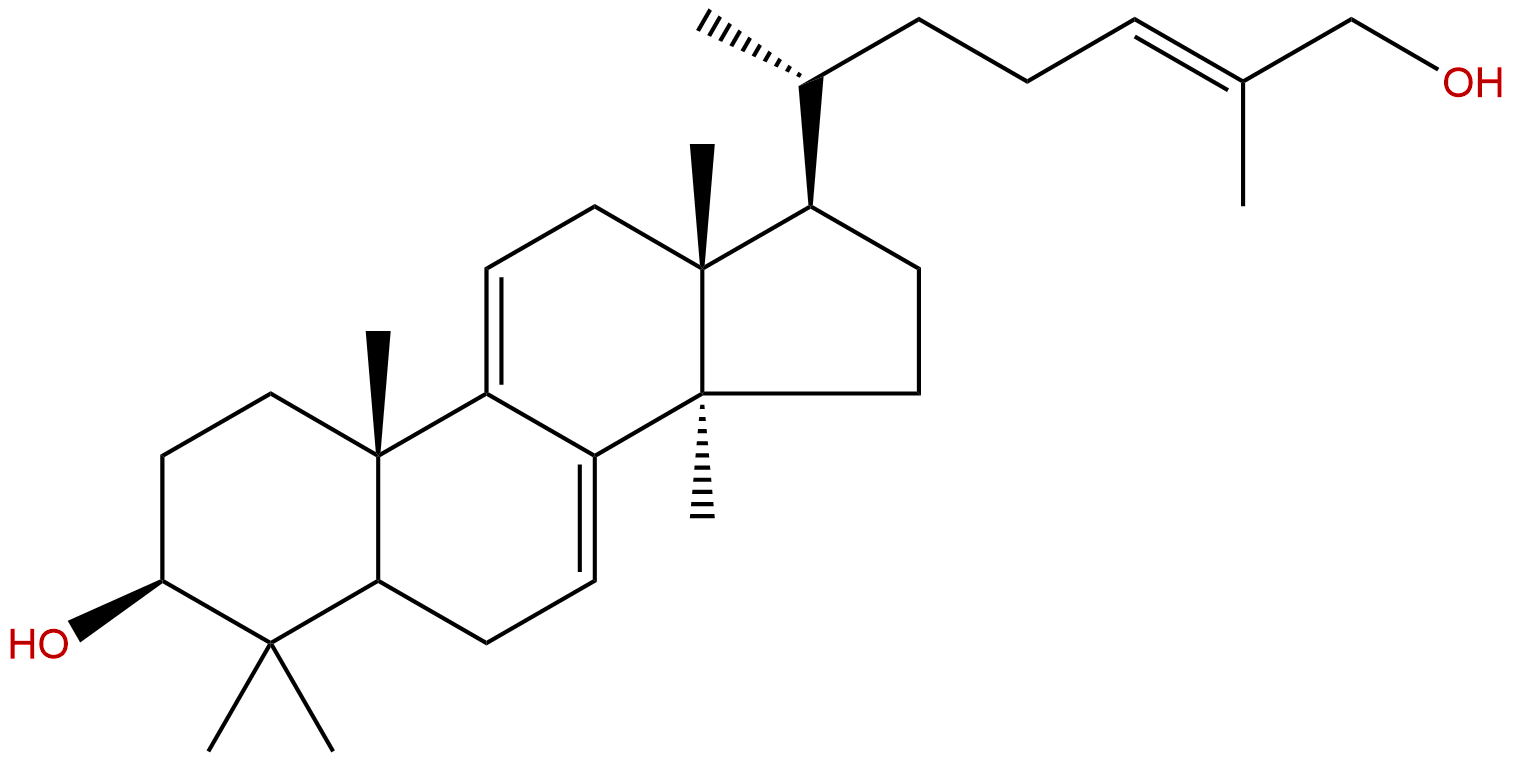
The chemical name of Danzhichun B is (24E) -3 β - hydroxylanostane-8,24-diene-26-acid, and its CAS number is 104700-96-1. Structurally, it belongs to highly oxidized tetracyclic triterpenoids with a typical lanostane skeleton (C30). Its molecular formula is C30H48O3 and its molecular weight is 440.7120. The structural features include: A/B rings, B/C rings, and C/D rings are all trans fused; There is a hydroxyl group with a β - configuration connected to the C-3 position; There is a double bond at positions C-8 and C-24, with position C-24 being in the E configuration; The end of the side chain is carboxyl (C-26). This unique structure is the material basis for its biological activity.
Its physical and chemical properties are determined by its structure and profoundly affect its bioavailability and medicinal properties. The calculated lipid water partition coefficient (LogP) is as high as 7.3252, indicating that Danzhichun B has extremely strong lipophilicity. Consistent with this, its water solubility is extremely low, about 0.0003 mg/mL, which poses the primary challenge for its formulation development. The topologically polar surface area (TPSA) is 40.46 Å ², which is relatively small, further confirming its hydrophobic properties. Based on these properties, the predictive model shows that Danzhichun B has a high blood-brain barrier permeability, which provides a possibility for its potential central nervous system related applications (such as neuroprotection), but caution should also be taken against possible neurological side effects. It is gratifying that the preliminary pharmacological risk assessment shows that the hERG channel inhibition risk is "no", and the Ames test result is 0.0, indicating that it may not have cardiotoxicity or genotoxicity, and the safety starting point is good.
Plant sources and extraction methods
Danzhichun B mainly comes from fungi of the Ganoderma genus in the Polyporus family, especially Ganoderma lucidum(Ganoderma lucidum)And Zizhi(Ganoderma sinense)The fruiting body, mycelium, and spore powder. There are significant differences in the content of Danzhichun B in different regions, varieties, growth stages, and parts (such as fruiting body caps, stems, and spores). Usually, the content of triterpenoids in spore powder is higher, but the extraction process is also more complex.
The extraction of Danzhichun B from Ganoderma lucidum materials mainly follows the general extraction and separation process of triterpenoids. Firstly, organic solvents are used to extract the dried and crushed raw materials. Common solvents include methanol, ethanol, chloroform, or mixed solvents of different proportions (such as chloroform methanol). Ethanol has become a commonly used industrial choice due to its low toxicity and high extraction efficiency. Extraction methods include traditional hot reflux extraction, Soxhlet extraction, as well as modern technologies such as ultrasound assisted extraction and microwave-assisted extraction, the latter of which can effectively shorten extraction time and improve yield.
After obtaining the crude extract, a series of separation and purification steps are required to obtain high-purity Danzhiol B. Silica gel column chromatography is often used as the preliminary separation method, and different polarity solvent systems (such as petroleum ether ethyl acetate, chloroform methanol gradient elution) are used for segmentation. The fractions rich in target components are further purified by repeated silica gel column chromatography, reverse phase silica gel column chromatography (such as ODS), preparative thin-layer chromatography, or high-performance liquid chromatography (HPLC) for fine purification. In recent years, preparation chromatography techniques such as high-speed countercurrent chromatography have shown advantages in the preparation of triterpenoid monomers such as erythritol B due to their high recovery rate and separation efficiency. Structural identification involves the comprehensive use of techniques such as nuclear magnetic resonance (NMR, including 1H-NMR, 13C-NMR, 2D-NMR), mass spectrometry (MS), infrared spectroscopy (IR), and X-ray single crystal diffraction.
Pharmacological activity research
The pharmacological activity research of Danzhichun B has expanded from the initial enzyme inhibition activity to the level of cell and animal models, demonstrating various biological effects.
-
α - glucosidase inhibitory activity This is one of the earliest reported and most prominent activities of Danzhichun B. Alpha glucosidase is a key enzyme on the brush border of the small intestine responsible for breaking down oligosaccharides and disaccharides into monosaccharides (such as glucose). Inhibiting its activity can delay the digestion and absorption of carbohydrates, thereby reducing postprandial blood glucose peak. Research has shown that Danzhichun B has significant competitive or non competitive inhibitory effects on the enzyme, with an IC50 value of 48.5 μ g/mL (approximately 119.8 μ M). This activity is stronger than or comparable to certain positive control drugs (such as acarbose), laying the foundation for its potential as an oral hypoglycemic drug.
-
Cardiovascular protective activity This is the core expanded field of pharmacological research on Danzhichun B. In various experimental models, it exhibits comprehensive cardiovascular benefits:
- Hypolipidemia and anti atherosclerosis Danzhichun B can inhibit intracellular cholesterol synthesis, possibly by affecting the activity or expression of HMGCR (3-hydroxy-3-methylglutaryl-CoA reductase). At the same time, it can regulate lipid metabolism, reduce serum total cholesterol, triglyceride and low-density lipoprotein cholesterol levels, and improve high-density lipoprotein cholesterol, thereby reducing the formation of atherosclerotic plaque.
- Improving endothelial function and anti-inflammatory effects Danzhichun B can upregulate the expression of endothelial nitric oxide synthase (NOS3), promote the production of nitric oxide (NO), thereby relaxing blood vessels and inhibiting platelet aggregation. In addition, it can significantly inhibit the expression of vascular cell adhesion molecule-1 (VCAM-1) and intercellular adhesion molecule-1 (ICAM1) induced by inflammatory factors such as tumor necrosis factor - α (TNF - α), reduce the adhesion of leukocytes to vascular endothelium, and play the role of anti atherosclerotic inflammation.
- Lowering blood pressure and protecting the heart Its potential angiotensin-converting enzyme (ACE) inhibitory activity may contribute to the hypotensive effect. By activating signaling pathways such as protein kinase B (AKT1), it can inhibit myocardial cell apoptosis, alleviate myocardial ischemia/reperfusion injury, and directly protect the heart.
-
Other potential activities Based on its antioxidant and anti-inflammatory properties, Danzhichun B has also shown preliminary activity in liver protection and anti-tumor (possibly by inducing apoptosis or inhibiting proliferation), but further research is needed.
Mechanism of action and molecular targets
The cardiovascular protective effect of Danzhichun B is not achieved through a single target, but presents a network regulatory feature of multi-target and multi pathway synergy, which is consistent with its complexity as a natural product. The core mechanism of action and key molecular targets can be summarized as follows:
-
Regulating lipid metabolism and cholesterol synthesis - targeting HMGCR and PPARG Danzhichun B may inhibit the activity of HMGCR directly or indirectly, which is the rate limiting enzyme for cholesterol synthesis in the body and is consistent with the target of statins. Meanwhile, it may act as a partial agonist or modulator of peroxisome proliferator activated receptor gamma (PPARG). PPARG is a member of the nuclear receptor superfamily, which upon activation can promote the uptake, storage, and metabolism of fatty acids, improve insulin sensitivity, and exert anti-inflammatory effects, thereby comprehensively regulating lipid metabolism and glucose metabolism disorders.
-
Protecting vascular endothelium and anti-inflammatory effects - targeting NOS3, ICAM1, VCAM1, and SELP Danzhichun B activates the PI3K/AKT1 signaling pathway, phosphorylates and activates NOS3, and increases the production of NO with vascular protective effects. In an inflammatory environment, it can inhibit the activation of key inflammatory signaling pathways such as nuclear factor kappa B (NF - κ B), thereby downregulating the expression of endothelial cell surface adhesion molecules (ICAM1, VCAM1) and P-selectin (SELP). These molecules are the key mediators of leukocyte rolling, adhesion and trans endothelial migration. Their down-regulation directly weakens the recruitment of inflammatory cells in the vascular wall and slows down the process of atherosclerosis.
-
Regulating blood pressure and cardiac electrophysiology - potential targets for ACE, ADRB2, and KCNH2 Some functional groups in the structure of Danzhichun B may allow it to bind with the active pocket of ACE, competitively inhibiting the conversion of angiotensin I to angiotensin II, producing a blood pressure lowering effect similar to that of Puli drugs. Its potential regulatory effect on β 2-adrenergic receptors (ADRB2) may affect vascular tone and heart rate. Of particular importance, preliminary data shows that it does not inhibit the hERG potassium channel (encoded by the KCNH2 gene), which reduces the risk of cardiac toxicity associated with acquired long QT syndrome and apical torsion ventricular tachycardia, and is a potential safety advantage compared to certain synthetic drugs.
-
The key role of AKT1, the core signal node AKT1 (protein kinase B) plays a pivotal role in the pleiotropy of danzhichun B as a central signaling molecule. After Danzhichun B activates AKT1, on the one hand, it phosphorylates and activates NOS3, promoting NO production; On the other hand, AKT1 can inhibit pro apoptotic proteins, promote cell survival, and have a protective effect on cardiomyocytes and endothelial cells. In addition, AKT1 signaling is closely related to the insulin signaling pathway and glucose metabolism regulation.
To sum up, tanziol B forms a network of synergistic interactions by simultaneously acting on multiple key targets such as metabolic regulation (HMGCR, PPARG), endothelial protection (NOS3), inflammation inhibition (ICAM1/VCAM1/SELP), and blood pressure regulation (ACE), and jointly exerts the comprehensive effects of anti atherosclerosis, lipid reduction, blood pressure reduction, and heart protection.
Evaluation of drug properties and pharmacokinetics
Despite the attractive pharmacological activity and multi-target mechanism of action of Danzhichun B, there are significant challenges in its drug like properties, mainly due to its outstanding hydrophobicity.
-
Absorption, distribution, metabolism, excretion (ADME) characteristics:
- absorb The extremely high LogP value and low water solubility severely limit its solubility and dissolution rate in the gastrointestinal water environment, which may be the primary reason for its extremely low oral bioavailability. Developing appropriate dosage forms (such as nanocrystals, solid dispersions, liposomes, self microemulsions) to improve their solubility and permeability is a necessary step.
- distribution High lipophilicity and predicted high blood-brain barrier permeability suggest that Danzhichun B may have a large distribution volume in the body, making it easy to enter adipose tissue and various organs including the brain. This may both expand its therapeutic window (such as for central nervous system diseases) and increase the risk of accumulation in non target tissues.
- Metabolism and excretion As a triterpenoid compound, danzhichun B is likely to undergo extensive phase I (such as cytochrome P450 enzyme catalyzed oxidation and reduction) and phase II (such as glucuronidation and sulfation) metabolism in the liver. There is currently limited research on its metabolites, major metabolic enzymes, and whether it produces toxic metabolites. The prototype drug and its metabolites may be mainly excreted through bile and feces.
-
Current status of pharmacokinetic research Currently, there are very limited reports on preclinical pharmacokinetic studies of the Danzhichun B system. Based on limited animal experimental data, it is speculated that oral administration may result in slow and incomplete absorption, low blood drug concentration, and unclear half-life and in vivo residence time. The lack of quantitative research on its absolute bioavailability, tissue distribution characteristics, main metabolic pathways, and excretion is the main knowledge gap in promoting its new drug development.
-
Preliminary evaluation of safety The existing preliminary data provides positive signals. The absence of hERG inhibition suggests a low risk of cardiac toxicity, while negative Ames test results suggest no genetic toxicity. However, this does not represent comprehensive security. Its long-term toxicity, reproductive toxicity, carcinogenicity, and whether it inhibits or induces major CYP450 enzymes (which may cause drug drug interactions) all need to be evaluated through standardized GLP toxicology studies.
Clinical application prospects and prospects
The clinical application prospects of Danzhichun B mainly revolve around its two core pharmacological effects: α - glucosidase inhibition and multi-target cardiovascular protection.
-
Potential indications:
- Type 2 diabetes and diabetes complications As an alpha glucosidase inhibitor, Danzhichun B can be directly used to control postprandial hyperglycemia, especially as an early intervention or in combination with other hypoglycemic drugs. More importantly, its powerful cardiovascular protective effects (lipid lowering, anti-inflammatory, improving endothelial function) make it have unique advantages in preventing and treating macrovascular complications (such as coronary heart disease, stroke) and microvascular complications (such as diabetes nephropathy, retinopathy) of diabetes, and achieve the synergy of "hypoglycemic" and "heart care".
- Metabolic syndrome and atherosclerotic cardiovascular disease: For non diabetes patients with metabolic syndrome, or confirmed hyperlipidemia, hypertension, atherosclerosis patients, the multi target effect of tanziol B can simultaneously interfere with multiple risk factors, which is expected to become a new type of multi potent cardiovascular prevention and treatment drug.
- Other Based on its antioxidant and anti-inflammatory properties, there is also room for exploration in the adjuvant treatment of non-alcoholic fatty liver disease and certain inflammation related diseases.
-
Challenges faced and future research directions:
- Formulation innovation Solving the problem of poor water solubility is the primary technical bottleneck for conversion. Nanotechnology (such as nanosuspensions, polymer nanoparticles), novel carrier systems (such as cyclodextrin inclusion complexes, phospholipid complexes), and cutting-edge delivery strategies are worth further research.
- Systematic pharmacokinetics and toxicology research Comprehensive and standardized preclinical ADME and toxicology studies must be conducted to clarify their in vivo fate and safety boundaries, providing a basis for clinical trial design.
- Deep exploration of the mechanism of action Using chemical biology methods such as affinity fishing and molecular probes to confirm their direct target of action; Using systems pharmacology and omics techniques (transcriptomics, proteomics, metabolomics) to comprehensively reveal its functional network.
- Structural optimization and derivative development By using it as the parent nucleus and modifying its structure (such as introducing hydrophilic groups and preparing prodrugs) to improve its physicochemical properties and pharmacokinetic characteristics, it is possible to obtain derivatives with better activity and drug properties.
- clinical research Ultimately, rigorous Phase I-III clinical trials need to be designed to validate its effectiveness, safety, and optimal medication regimen in humans.
Conclusion
Danzhichun B, as a natural triterpenoid compound derived from the traditional medicinal fungus Ganoderma lucidum, has become a star molecule in natural product pharmacology research due to its significant α - glucosidase inhibitory activity and emerging multi-target network-based cardiovascular protective effects. It weaves a fine regulatory network from HMGCR and PPARG to NOS3, ICAM1/VCAM1, and then to ACE and AKT1, vividly interpreting the therapeutic concept of multi-component, multi-target, and holistic regulation of natural products. However, behind its outstanding biological activity is the enormous challenge of drug formation caused by extremely poor solubility. Future research requires close collaboration among multiple disciplines such as formulation, pharmacokinetics, pharmacology, and toxicology. While delving into the molecular mechanisms, efforts should be made to overcome delivery bottlenecks and complete systematic preclinical evaluations. Only in this way can Danzhiol B, a modern active molecule in the ancient Ganoderma lucidum, be able to bridge the gap from laboratory to clinic and provide a new, natural solution for the prevention and treatment of major chronic diseases such as diabetes and cardiovascular diseases. The research process once again proves that delving into the scientific connotation of traditional Chinese medicine is one of the effective ways to achieve modernization and internationalization of traditional Chinese medicine.