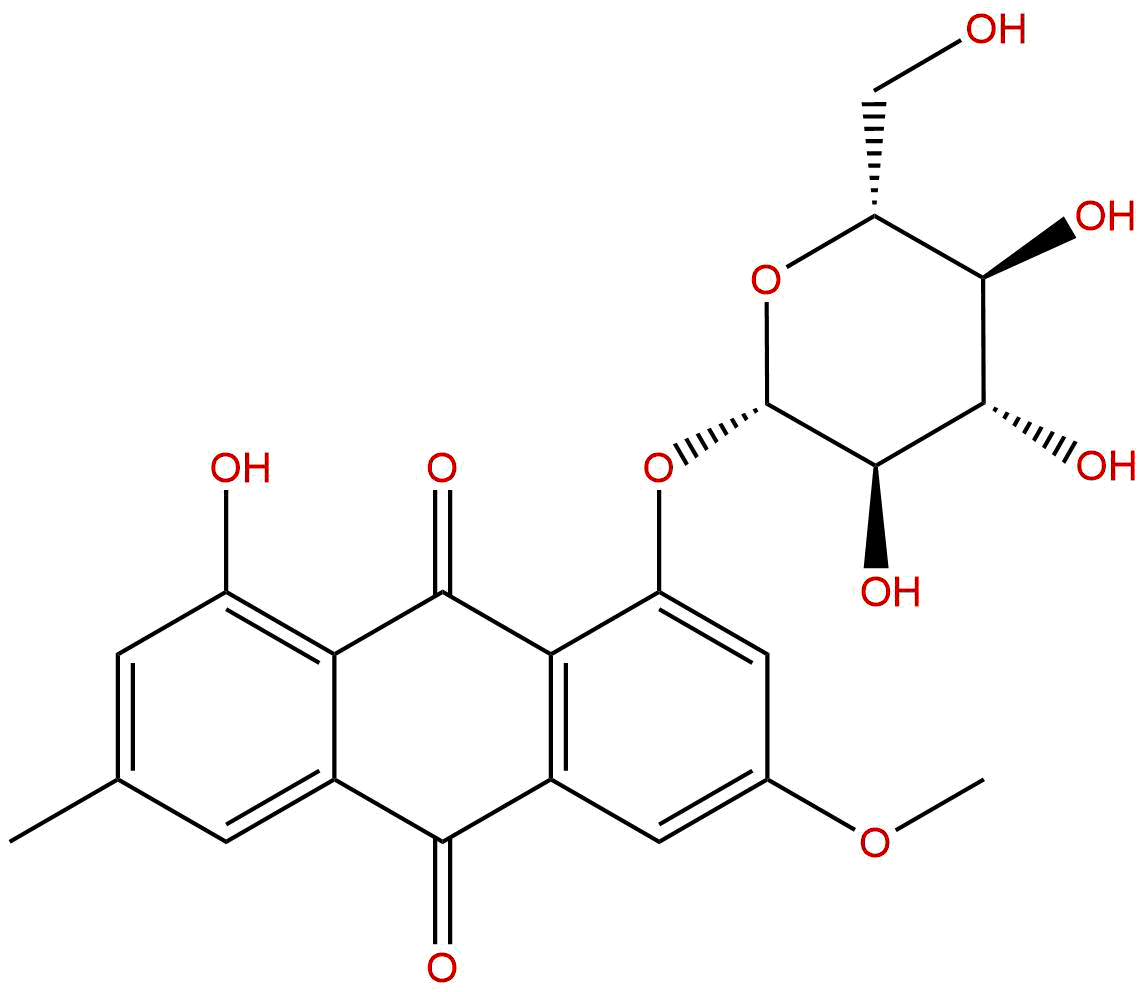


Product name: Physcion 8-glucoside
Synonym name: Anthraglycoside A;Physcion 8-O-β-D-glucoside;Physcion 8-O-β-D-glucopyranoside
Catalogue No.: BP4506
Cas No.: 23451-01-6
Formula: C22H22O10
Mol Weight: 446.408
Botanical Source:
Type of Compound:
Purity: 95%~99%
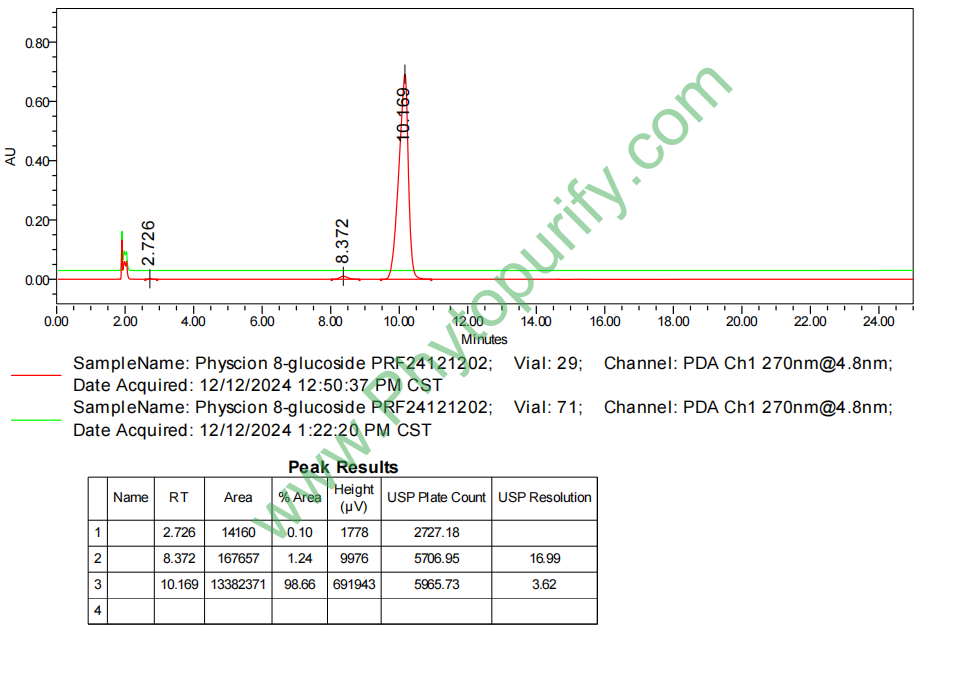
Analysis Method: HPLC-DAD or/and HPLC-ELSD
Identification Method: Mass, NMR
Packing: Brown vial or HDPE plastic bottle
Storage: Store in a well closed container, protected from air and light. Put into refrigerate or freeze for long term storage.
Whenever possible, you should prepare and use solutions on the same day. However, if you need to make up stock solutions in advance, we recommend that you store the solution as aliquots in tightly sealed vials at -20℃. Generally, these will be useable for up to two weeks.
The product could be supplied from milligrams to grams
Inquire for bulk scale.
For Reference Standard and R&D, Not for Human Use Directly.
HPLC of Physcion 8-glucoside
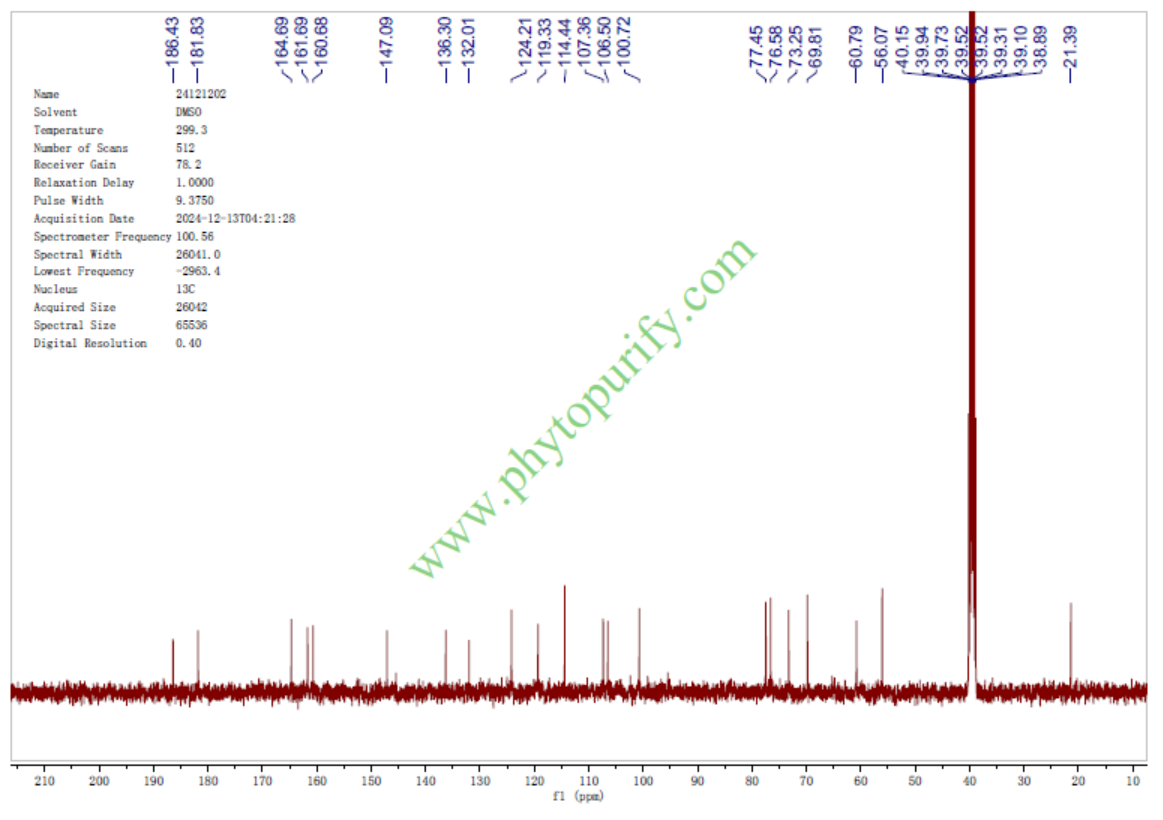
NMR of Physcion 8-glucoside
Storage conditions:Short-term storage at 2~8℃, long-term storage at -20 ~ -80℃
162.9800
.8892
.8300
.8037
.4799
.3460
Low
76.2328
3.8541
Yes
No
No
No
Yes
No
1.2
Yes
No
Yes
Yes
Natural products, as an important treasure trove for drug discovery and development, play an irreplaceable role in the long history of human fight against diseases. Among them, anthraquinone compounds have attracted much attention due to their wide range of biological activities, especially occupying a significant position in traditional Chinese medicine systems. Physcion 8-glucoside (also known as Parietin, CAS number: 23451-01-6) is one of the representative molecules with important research value. This compound is mainly isolated from traditional Chinese medicine Rheum palmatum L. and is a typical member of anthraquinone glycosides. Traditionally, rhubarb and its components have been known for their significant laxative effects, but modern pharmacological research continues to reveal deeper biological activities and molecular mechanisms. Research has shown that emodin monomethylene-8-glucoside not only retains the role of anthraquinone substances in regulating intestinal function, but also exhibits multi-target and multi pathway pharmacological properties. As an orally effective inhibitor of 6-phosphogluconate dehydrogenase (6PGD) that can cross the blood-brain barrier, as well as a TLR4/NF - κ B signaling pathway inhibitor, it has shown great potential in anti-inflammatory, antibacterial, anticancer and other fields, especially in its dual mechanism of inducing cancer cell apoptosis and autophagy, providing new ideas for tumor treatment. This article aims to systematically review the chemical properties, plant sources, pharmacological activities, molecular mechanisms of action, medicinal properties, and clinical application prospects of emodin monomethylene-8-glucoside, in order to provide comprehensive scientific references for the in-depth research and development of this natural product.
The chemical name of emodin methyl ether 8-glucoside is 1,8-dihydroxy-3-methoxy-6-methylanthraquinone-8-O - β - D-glucoside. Its molecular formula is C22H22O10 and its molecular weight is 446.4080. Structurally, the compound is composed of emodin methyl ether (Physcion) as the aglycone, and a β - D-glucosyl group is connected to the 8th hydroxyl group of its parent nucleus through a glycosidic bond. This glycosylation modification significantly alters the physicochemical properties and biological activity of its parent aglycone.
In terms of physicochemical properties, the introduction of glycosidic bonds greatly enhances the hydrophilicity of the molecule. The calculated lipid water partition coefficient (LogP) is 0.8892, indicating that the compound has good hydrophilic and lipophilic balance. The topologically polar surface area (TPSA) is as high as 162.9800 Å ², mainly attributed to the numerous oxygen atoms in the molecule (from hydroxyl, methoxy, carbonyl, and sugar units), further confirming its strong polarity. The predicted value of its water solubility is 0.8037 mg/mL, which belongs to the range of slightly soluble to soluble, which is beneficial for its dissolution and absorption in organisms. However, despite its structural polarity, its ability to penetrate the blood-brain barrier is predicted to be "low" based on a comprehensive evaluation of its molecular weight and polarity descriptors, which may limit its direct efficacy in central nervous system diseases, but may also reduce the risk of central nervous system side effects. In addition, preliminary pharmacological risk assessment showed no significant inhibition of hERG potassium channels (hERG inhibition: no), indicating a low risk of cardiac toxicity; The Ames test value is 1.2, indicating a low risk of mutagenicity and providing preliminary positive signals for its safety.
Emodin methyl ether 8-glucoside mainly comes from the dried roots and rhizomes of plants in the Polygonaceae family, such as Rheum palmatum L., Rheum tanguticum Maxim. ex Balf., or medicinal Rheum officinale Baill. These are the authentic sources of traditional Chinese medicine "Rheum". In these plants, the compound often coexists with other anthraquinone substances such as rhein, aloe emodin, emodin, emodin, and their respective glucosides.
The extraction and separation methods follow the conventional process of natural product chemistry and are constantly optimized. Traditional methods often use solvent extraction:
1. Extract Usually, dried rhubarb medicinal materials are crushed and subjected to reflux extraction or ultrasound assisted extraction using methanol, ethanol, or alcohol water mixed solvents of different concentrations. To increase the extraction rate of anthraquinone glycosides, sometimes acid hydrolysis and extraction are carried out synchronously or step by step, but attention should be paid to controlling the conditions to avoid excessive breakage of glycosidic bonds.
2. Separation and purification After vacuum concentration, the crude extract was subjected to gradient extraction using organic solvents such as petroleum ether, chloroform, ethyl acetate, and n-butanol. Emodin methyl ether 8-glucoside was mainly enriched in the n-butanol extraction site or water layer due to its high polarity. Further purification depends on column chromatography technology. Silica gel, macroporous adsorption resin (such as D101, AB-8), polyamide or dextran gel (such as Sephadex LH-20) are often used as stationary phases, and chloroform methanol, petroleum ether ethyl acetate or methanol water systems are used for gradient elution.
3. appraisal The isolated monomer compounds were structurally confirmed using modern spectroscopic techniques, including UV Vis spectroscopy (anthraquinone characteristic absorption), infrared spectroscopy (IR), mass spectrometry (MS, providing molecular weight and fragment information), and nuclear magnetic resonance spectroscopy (NMR, especially 1H-NMR and 13C-NMR, which can accurately analyze the chemical environment and connection mode of hydrogen and carbon in the molecule, and are key to determining the position and configuration of glycosidic bonds).
In recent years, green and efficient extraction techniques such as supercritical fluid extraction (SFE), microwave-assisted extraction (MAE), and high-speed countercurrent chromatography (HSCCC) have also been applied to the separation of anthraquinone components in rhubarb, which is expected to improve the yield and purity of target compounds.
A large number of in vitro and in vivo studies have revealed that emodin monomethylene-8-glucoside has diverse pharmacological activities, far exceeding its traditional range of laxative effects.
The multiple pharmacological activities of emodin monomethylene-8-glucoside stem from its regulation of multiple molecular targets and signaling pathways.
Based on its physicochemical parameters and preliminary biological data, emodin monomethylene-8-glucoside has shown certain potential as a drug, but also faces challenges.
Advantage:
* Oral efficacy As a natural product glycoside, its oral absorption is usually better than its aglycone. Moderate LogP values and certain water solubility are beneficial for its dissolution and transmembrane absorption in the gastrointestinal tract.
* Preliminary safety warning is good The absence of hERG inhibition and low risk of Ames mutagenicity provide a positive starting point for its preclinical safety assessment.
* Multi-target effect Targeting multiple key pathways in inflammation and tumors may result in synergistic therapeutic effects and reduce the risk of drug resistance.
Challenges and unknowns:
* Blood-brain barrier permeability Predicted as' low ', this is a limitation for treating central nervous system related diseases such as neuroinflammation and brain tumors, but may be beneficial in reducing central side effects.
* Lack of pharmacokinetic (PK) data Currently, there is relatively limited detailed data available on the PK studies of this compound system, including absorption, distribution, metabolism, and excretion. As a glucoside, it may be partially hydrolyzed by the gut microbiota or glycosidase on the intestinal mucosa into aglycones (emodin methyl ether), which may undergo different metabolic pathways after absorption (such as hydroxylation, methylation, glucuronidation of liver microsomal enzymes, etc.). The activity, distribution, and toxicity of aglycones and their metabolites may differ from the prototype glycoside and require further research.
* bioavailability Although oral administration is effective, its absolute bioavailability is still unclear. Glycoside structure may affect its cross cellular transport efficiency.
* Dose and toxicity The potential toxicity of long-term or high-dose use (such as known hepatotoxicity, nephrotoxicity, or carcinogenicity concerns based on other anthraquinone substances) requires strict preclinical toxicological evaluation.
Future research needs to focus on conducting systematic ADMET (absorption, distribution, metabolism, excretion, and toxicity) studies to clarify their in vivo fate and provide a basis for dosage form design (such as nanomaterials, prodrug strategies to improve bioavailability or targeting) and clinical dosing regimens.
The multiple pharmacological activities of emodin monomethylene-8-glucoside depict broad prospects for its application in multiple therapeutic fields.
Future research directions should focus on:
* In depth mechanism exploration Elucidate its precise binding mode with targets such as TLR4 and 6PGD, and discover its potential new targets.
* structural optimization Structural modification is carried out through medicinal chemical methods to enhance activity, selectivity, metabolic stability, and bioavailability.
* Delivery system development Develop new nano formulations, liposomes, or prodrugs using modern pharmaceutical technology to improve their pharmacokinetic properties and targeting.
* Preclinical and clinical research Conduct standardized pharmacological, pharmacokinetic, and toxicological studies and gradually advance them to clinical trials to verify their safety and efficacy.
Emodin methyl ether 8-glucoside, as an active natural product discovered from traditional Chinese medicine rhubarb, is a model that connects traditional medical wisdom with modern scientific research. The glycosylation modification on its chemical structure endows it with unique physicochemical properties and biological activity spectrum. Beyond traditional laxative uses, this compound demonstrates a multi-target mechanism of action in anti-inflammatory, antibacterial, and especially anti-tumor fields, including specific inhibition of 6PGD metabolic enzymes, blocking of TLR4/NF - κ B inflammatory pathways, and effective induction of cancer cell apoptosis and autophagy, making it an attractive lead compound. Despite facing challenges such as blood-brain barrier permeability and unclear systemic pharmacokinetics in drug development, its good preliminary safety and clear target of action have laid a solid foundation for subsequent development. With a deeper understanding of its molecular mechanism, rational optimization of medicinal chemistry, and the application of advanced delivery technologies, emodin monomethylene-8-glucoside is expected to move from the laboratory to clinical practice, providing a new natural source drug choice for the treatment of inflammatory diseases and tumors, fully demonstrating the sustained vitality and value of natural products in innovative drug development.
