


Synonym name: Forsythin; Phillyroside; Chionanthin
Catalogue No.: BP1087
Cas No.: 487-41-2
Formula: C27H34O11
Mol Weight: 534.558
Botanical Source: From Forsythia suspensa, Chionanthus virginica, Phillyrea latifolia, Phillyrea angustifolia and others
Purity: 95%~99%
Analysis Method: HPLC-DAD or/and HPLC-ELSD
Identification Method: Mass, NMR
Packing: Brown vial or HDPE plastic bottle
Can be supplied from milligrams to grams.
For Reference Standard and R&D, Not for Human Use Directly.
Inquire for bulk scale.
HPLC of Phillyrin
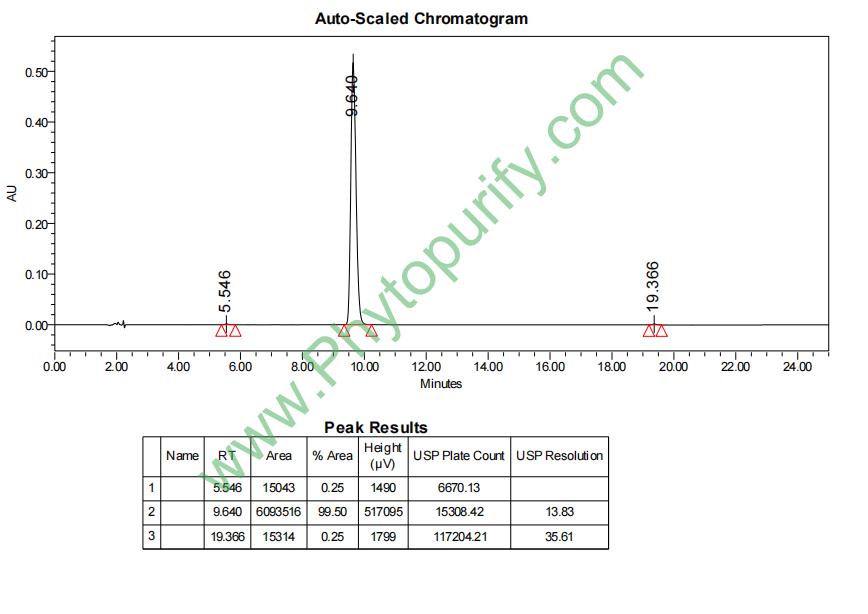
Storage conditions:Short-term storage at 2~8℃, long-term storage at -20 ~ -80℃
145.5300
.9886
.9889
1.0724
.7474
.2806
Low
76.1261
4.4017
Yes
No
No
No
No
No
0.0
Yes
No
No
Yes
Natural products, as an important source of drug discovery, play an irreplaceable role in the long history of human fight against diseases. Forsythia suspensa(Forsythia suspensa)As a representative herb in traditional Chinese medicine for clearing heat and detoxifying, its pharmacological activity has attracted much attention. Phillyrin, also known as forsythoside or forsythoside A, is a phenylethanoid glycoside compound isolated from the fruit of Forsythia suspensa, with a CAS number of 487-41-2. Modern pharmacological research has shown that Forsythia suspensa glycosides not only inherit the traditional function of clearing heat and detoxifying Forsythia suspensa, exhibiting broad-spectrum antibacterial and anti-inflammatory activities, but also show unique potential in the field of antiviral, especially in the fight against influenza virus. In addition, its selective regulatory effect on liver drug metabolizing enzymes also suggests its potential value in drug interactions. This article aims to systematically review the chemical structure, plant origin, pharmacological activity, mechanism of action, medicinal properties, and clinical application prospects of Forsythia suspensa glycoside, in order to provide comprehensive scientific references for the in-depth research and development of this natural product.
The chemical name of Forsythia suspensa glycoside is 2- (3,4-dihydroxyphenyl) ethyl-O - β - D-glucopyranosyl - (1 → 6) - O - β - D-glucopyranoside, with a molecular formula of C27H34O11 and a molecular weight of 534.5580. The core of its structure is a phenylethanolic glycoside (a derivative of pine bark alcohol), which is connected to a disaccharide chain consisting of two molecules of glucose in a (1 → 6) manner through glycosidic bonds. This structure gives it typical properties of phenylethanoid glycosides.
From the analysis of parameters related to drug properties, the lipid water partition coefficient (LogP) of Forsythian suspensa is about 0.99, indicating that it has moderate lipophilicity but overall leans towards hydrophilicity. Its topological polar surface area (TPSA) is as high as 145.53 Å ², mainly attributed to the abundant hydroxyl and ether bonds in the molecule, indicating its good water solubility (calculated value of about 1.07 mg/mL). The higher polarity also leads to its ability to penetrate the blood-brain barrier being predicted as' low ', which to some extent limits its direct effect on central nervous system diseases, but may also reduce the associated risk of neurotoxicity. In the preliminary safety screening, Forsythia suspensa glycoside did not show hERG potassium channel inhibitory activity (low risk of arrhythmia), and the Ames test result was negative (no mutagenicity), providing preliminary positive signals for its safety evaluation.
Forsythia suspensa glycoside is mainly derived from the plant Forsythia suspensa in the family Rhinoceros(Forsythia suspensa The dried fruit of Thunb. Vahl, the authentic Chinese medicine "Forsythia suspensa". In addition, within the same genus of plants, the Golden Bell Flower(Forsythia viridissima)There is also distribution in waiting. Its content in the plant body is significantly affected by factors such as place of origin, harvest season, and processing methods, and is usually higher when the fruit is still green (green and erect) at the beginning of autumn ripening.
The extraction of Forsythia suspensa glycoside is often carried out by solvent extraction method, using methanol, ethanol or ethanol water solutions of different concentrations as solvents, and assisted by reflux or ultrasound extraction. Subsequently, it is necessary to combine various modern separation and purification techniques for refining. The macroporous adsorption resin method (such as AB-8 and D101 resins) is a commonly used method for enriching Forsythia suspensa glycosides. By utilizing its adsorption and gradient elution properties with different concentrations of ethanol, impurities such as polysaccharides and proteins can be effectively removed. Further purification relies on chromatographic techniques, including silica gel column chromatography, reverse phase silica gel (such as ODS) column chromatography, and high-performance liquid chromatography (HPLC) preparative chromatography. At present, HPLC method is mainly used for analysis and detection, often using acetonitrile water or methanol water (containing a small amount of formic acid or phosphoric acid to improve peak shape) as the mobile phase, and quantitative analysis is carried out near 280 nm of UV detector.
Forsythia suspensa glycoside has various pharmacological activities, which constitute its pharmacological basis.
Antiviral activity This is one of the most anticipated activities of Forsythia suspensa glycoside in recent years. Research has shown that Forsythia suspensa glycoside has a significant inhibitory effect on influenza A viruses (such as H1N1 and H3N2 subtypes) in vitro. Its function is not only reflected in inhibiting virus replication and reducing virus titers, but also in regulating the excessive inflammatory response of host cells caused by viral infection. In addition to influenza virus, research suggests that it may also have interfering effects on herpes simplex virus (HSV), human immunodeficiency virus (HIV), etc., but the specific efficacy and mechanism need to be further elucidated.
Antibacterial and anti-inflammatory activity Forsythia suspensa glycoside has a certain inhibitory effect on various Gram positive bacteria (such as Staphylococcus aureus) and Gram negative bacteria, which is consistent with the "clearing heat and detoxifying" effect of traditional Chinese medicine Forsythia suspensa. Its anti-inflammatory effect is particularly prominent. In various animal models of acute and chronic inflammation (such as xylene induced ear swelling in mice, carrageenan induced foot swelling in rats, and lipopolysaccharide induced macrophage inflammation model), Forsythia suspensa can significantly inhibit inflammation site swelling, reduce the levels of inflammatory mediators such as prostaglandin E2 (PGE2), nitric oxide (NO), tumor necrosis factor - α (TNF - α), interleukin-6 (IL-6), etc.
The impact on cytochrome P450 enzymes Forsythia suspensa glycoside exhibits interesting selective regulation of liver drug metabolizing enzymes. Research has shown that it can potentially induce the activity of rat CYP1A2 and CYP2D1 subtypes, but has no significant effect on the activity of CYP2C11 and CYP3A1/2. This selective induction effect suggests that if Forsythia suspensa glycoside is used in combination with drugs metabolized by CYP1A2 or CYP2D, it may accelerate the metabolism of the latter, leading to a decrease in efficacy. Therefore, attention should be paid to clinical combination therapy.
Other activities In addition, the study also reported that Forsythia suspensa glycoside has potential activities such as antioxidant, neuroprotective, and alleviation of pulmonary fibrosis, demonstrating its multi-target properties.
The pharmacological effects of Forsythia suspensa glycoside are achieved by intervening in multiple signaling pathways and molecular targets, and its multi-target nature is a typical manifestation of the comprehensive therapeutic effect of natural products.
In antiviral On the one hand, its mechanism of action is complex and may involve multiple links. According to the provided target information, its antiviral spectrum may be broad. For example, in the case of herpes viruses such as HSV, their effects may involve interfering with the functions of viral DNA polymerase helper protein (UL42), DNA polymerase catalytic subunit (UL54), immediate early protein (ICP27), thymidine kinase (TK), or viral envelope glycoprotein D (gD). In terms of anti HIV, it may be achieved by antagonizing the key co receptors CCR5 or CXCR4 that allow the virus to enter host cells, or by inhibiting the activity of viral protease (HIV1-PR) and integrase (INT). For influenza virus, its mechanism of action may be related to inhibiting viral neuraminidase activity, blocking virus adsorption or entry, and regulating host innate immune response (such as inhibiting excessive inflammation related to myeloperoxidase MPO). The specific dominant mechanism varies depending on the type of virus and still requires extensive research and confirmation.
In anti-inflammatory In its function, its core mechanism is closely related to the inhibition of the activation of nuclear factor kappa B (NF - κ B) and mitogen activated protein kinases (MAPKs) signaling pathways. Forsythia suspensa glycoside can inhibit the degradation of I κ B α and nuclear translocation of NF - κ B p65 subunit under inflammatory stimulation, thereby downregulating the gene expression of downstream inflammatory mediators such as TNF - α, IL-6, IL-1 β, inducible nitric oxide synthase (iNOS), and cyclooxygenase-2 (COX-2). Meanwhile, it can also inhibit the phosphorylation of MAPKs such as p38 and JNK.
its Selective induction of CYP450 enzyme It is speculated that it may be related to the activation of specific nuclear receptors, such as the aromatic hydrocarbon receptor (AhR), which may mediate the induction of CYP1A2. The specific mechanism still needs to be further validated in human liver cell models or in vivo.
Although Forsythian suspensa has shown good biological activity in vitro, its pharmacological properties, especially pharmacokinetic properties, are the key to determining whether it can be successfully developed as a drug.
The existing calculations and preliminary experimental data reveal the challenges it faces. Firstly, higher polarity and molecular weight may limit its transmembrane passive diffusion, resulting in lower oral bioavailability. Its blood-brain barrier permeability is predicted to be 'low', as previously mentioned. In the body, phenylethanoid glycosides often undergo extensive phase II metabolism, such as glucuronidation and sulfation, which may lead to a rapid decrease in the concentration of their prototype drugs in the bloodstream. The hydrolysis of glycosidic bonds by gut microbiota is also an important link affecting their absorption and metabolism, which may generate glycoside products whose activity and distribution may differ from the prototype drug.
At present, there are insufficient reports on the pharmacokinetic studies of the Forsythian glycoside system. Limited animal studies have shown that its oral absorption rate is slow, it is widely distributed, but the prototype drug has low plasma concentration and is eliminated quickly. How to improve its bioavailability is a key focus of future formulation research, and possible strategies include preparing novel drug delivery systems such as phospholipid complexes, cyclodextrin inclusion complexes, nanoemulsions, or solid dispersions.
In terms of safety, in addition to predicting no hERG inhibition and mutagenic risk, traditional medication experience and some toxicology experiments have shown that Forsythian suspensa has low toxicity at reasonable doses. However, its long-term toxicity, reproductive toxicity, etc. still need to be systematically evaluated according to new drug development standards.
The clinical application prospects of Forsythian suspensa are mainly based on its clear antiviral and anti-inflammatory pharmacological activities.
Treatment for influenza and other viral diseases Developing anti influenza drugs with Forsythia suspensa glycoside as the main active ingredient (or in combination with existing antiviral drugs such as oseltamivir) is a highly promising direction. Its multi link antiviral and anti-inflammatory properties can inhibit virus replication and alleviate cytokine storms, which may be particularly beneficial for severe influenza patients. In addition, the exploration of its anti HSV and anti HIV potential may also provide new candidate molecules or lead compounds for related fields.
Anti inflammatory and immune regulation Can be used to treat various inflammatory diseases, such as upper respiratory tract infections, pharyngitis, pneumonia and other inflammatory states, as an anti-inflammatory adjuvant drug. Its potential for chronic inflammation related diseases is also worth exploring.
As a drug sensitizer or detoxifier Based on its induction effect on specific CYP450 enzymes, in the context of precision medicine, it may be possible to study its use in regulating the in vivo disposal process of certain drugs metabolized by CYP1A2. However, the current more important application is to warn of its interaction with related drugs and avoid a decrease in efficacy when used in combination.
However, its development also faces severe challenges:① Optimization of pharmacokinetic properties Improving oral bioavailability is the primary challenge.② Deep analysis of the mechanism of action In particular, the exact molecular targets and pathways of antiviral action in the human body need to be clarified.③ Preclinical and clinical research It is necessary to complete systematic pharmacological, pharmacokinetic, and toxicological evaluations in accordance with international standards, and conduct rigorous clinical trials to verify their effectiveness and safety.④ Structural modification and derivative development Using it as the parent nucleus for structural optimization, improving its physicochemical properties and metabolic stability, is an effective way to obtain better candidate drugs.
Forsythia suspensa glycoside, as an active natural product derived from traditional Chinese medicine Forsythia suspensa, has become a highlight in modern natural product drug research due to its significant antiviral, anti-inflammatory and other multiple pharmacological activities, as well as relatively clear partial mechanisms of action. Its unique selective regulation of liver drug metabolizing enzymes also adds scientific interest to its research and complexity to its clinical applications. Although there are challenges in drug formulation, especially in pharmacokinetics, with the rapid development of modern pharmaceutical, medicinal chemistry, and molecular pharmacology technologies, these bottlenecks are expected to be gradually overcome. Future research should focus on further elucidating its multi-target action network, especially the exact mechanism of antiviral effects, and strive to improve its in vivo processes through new formulation technologies or rational structural modifications. The research on Forsythia suspensa glycosides is not only expected to stimulate innovative drugs derived from traditional Chinese medicine, but also provides a classic example for interpreting the modern scientific connotation of the "clearing heat and detoxifying" effect of traditional Chinese medicine.
