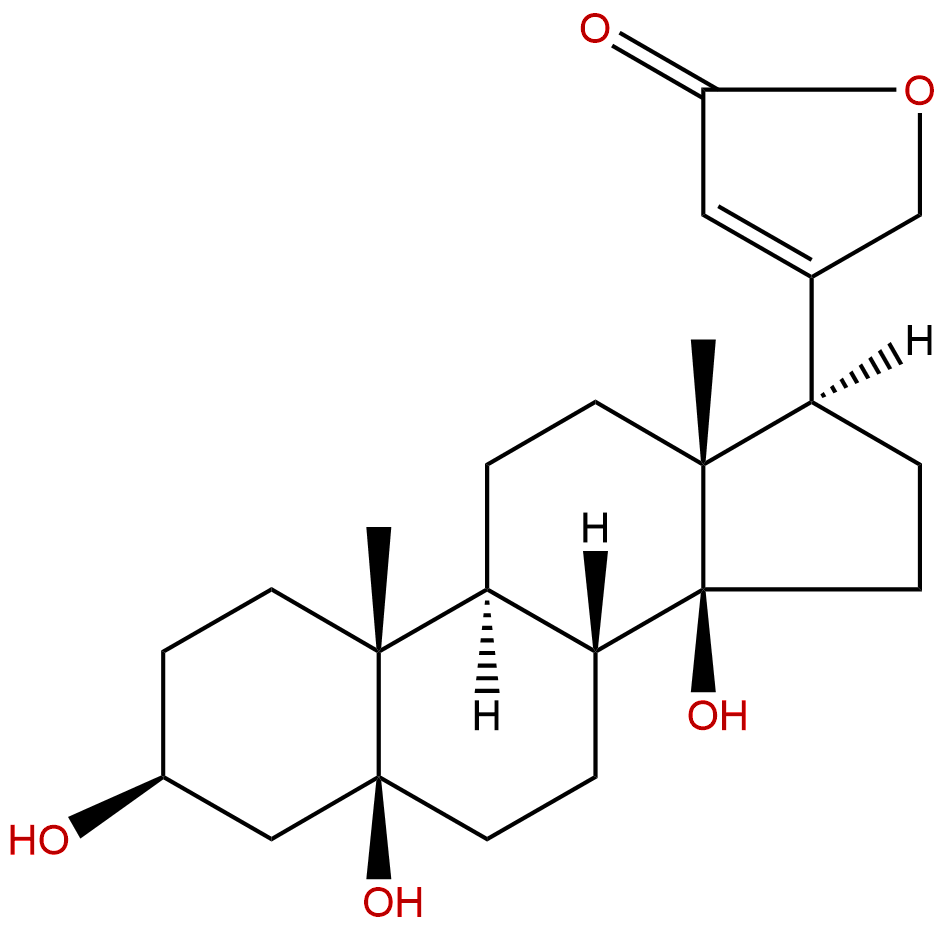


Product name: Periplogenin
Synonym name:
Catalogue No.: BP1613
Cas No.: 514-39-6
Formula: C23H34O5
Mol Weight: 390.52
Botanical Source: " Isol. from seeds of Strophanthus preussii, from Castilla elastica, Pentopetia androsaernifolia, Antiaris africana, Antiaris toxicaria and others. Isol. from defence secretion of Chrysolina coerulans"
Physical Description: Powder
Type of Compound: Steroids
Purity: 95%~99%
Analysis Method: HPLC-DAD or/and HPLC-ELSD
Identification Method: Mass, NMR
Packing: Brown vial or HDPE plastic bottle
The product could be supplied from milligrams to grams. Inquire for bulk scale.
We provide solution to improve the water-solubility of compounds, thereby facilitating the variety of activity tests and clinic uses.
For Reference Standard and R&D, Not for Human Use Directly.
Description:
Periplogenin plays protective roles against thyrotoxicosis and associated cardiovascular problems, are mediated through its direct antithyroidal and/or LPO inhibiting properties. Periplogenin induces necroptotic cell death through oxidative stress in HaCaT cells and ameliorates skin lesions in the TPA- and IMQ-induced psoriasis-like mouse models.
References:
Biochem Pharmacol. 2016 Apr 1;105:66-79.
Periplogenin induces necroptotic cell death through oxidative stress in HaCaT cells and ameliorates skin lesions in the TPA- and IMQ-induced psoriasis-like mouse models.
Psoriasis is a multifactorial skin disease that inconveniences many patients. Considering the side effects and drug resistance of the current therapy, it is urgent to discover more effective and safer anti-psoriatic drugs.
METHODS AND RESULTS:
In the present study, we screened over 250 traditional Chinese medicine compounds for their ability to inhibit the cell viability of cultured human HaCaT keratinocytes, a psoriasis-relevant in vitro model, and found that Periplogenin was highly effective. Mechanistic studies revealed that apoptosis and autophagy were not induced by Periplogenin in HaCaT cells. However, Periplogenincaused PI to permeate into cells, increased lactate LDH release and rapidly increased the number of necrotic cells. Additionally, the typical characteristics of necrosis were observed in the Periplogenin-treated HaCaT cells. Notably, the necroptosis inhibitor Nec-1 and NSA were able to rescue the cells from necrotic cell death, supporting that necroptosis was involved in Periplogenin-induced cell death. Furthermore, the ROS levels were elevated in the Periplogenin-treated cells, NAC (an antioxidant) and Nec-1 could inhibit the ROS levels, and NAC could attenuate necroptotic cell death, indicating that the Periplogenin-induced necroptotic cell death was mediated by oxidative stress. More importantly, in the murine models of TPA-induced epidermal hyperplasia and IMQ-induced skin inflammation, topical administration of Periplogenin ameliorated skin lesions and inflammation.
CONCLUSIONS:
In sum, our results indicate, for the first time, that Periplogenin is a naturally occurring compound with potent anti-psoriatic effects in vitro and in vivo, making it a promising candidate for future drug research.
Horm Metab Res. 2011 Mar;43(3):188-93.
Periplogenin, isolated from Lagenaria siceraria, ameliorates L-T₄-induced hyperthyroidism and associated cardiovascular problems.
The importance of glycoside in the regulation of thyroid dysfunction is not well understood.
METHODS AND RESULTS:
In the present investigation, effects of Periplogenin-3- O-D-glucopyranosyl (1→6)(1→4)-D-cymaropyranoside, isolated from the vegetable, LAGENARIA SICERARIA, in L-thyroxine (L-T₄)-induced hyperthyroidism and in related cardiovascular abnormalities have been revealed in Wistar albino rats. L-T₄ (500 μg/kg, s. c./d) administration for 12 days significantly increased serum concentrations of thyroxine (T₄), triidothyronine (T₃), and hepatic 5'-deiodinase I (5'-DI) activity with a parallel increase in lipid peroxidation (LPO) in different organs such as heart, liver and kidney; serum glucose and insulin concentrations and a decrease in cardiac Na (+)-K (+)-ATPase activity as well as serum total cholesterol, high-density lipoprotein cholesterol, low-density lipoprotein cholesterol, very low-density lipoprotein cholesterol and triglycerides. Most of these adverse effects were reversed following the administration of isolated Periplogenin. However, out of its 3 different concentrations (5.0, 10, and 25 mg/kg), 5 mg/kg appeared to be the most effective one as it could nearly normalize the level of T₃, glucose, insulin, Na (+)-K (+)-ATPase activity, tissue LPO and different serum lipids suggesting the protective role of Periplogenin against thyrotoxicosis and associated cardiovascular problems.
CONCLUSIONS:
It appears that the Periplogenin actions are mediated through its direct antithyroidal and/or LPO inhibiting properties.
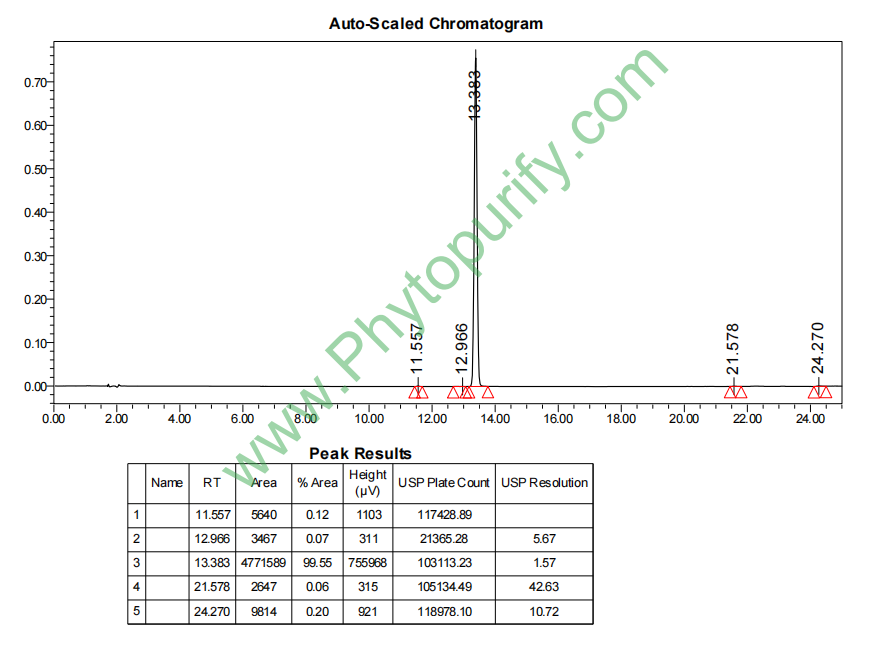
HPLC of Periplogenin
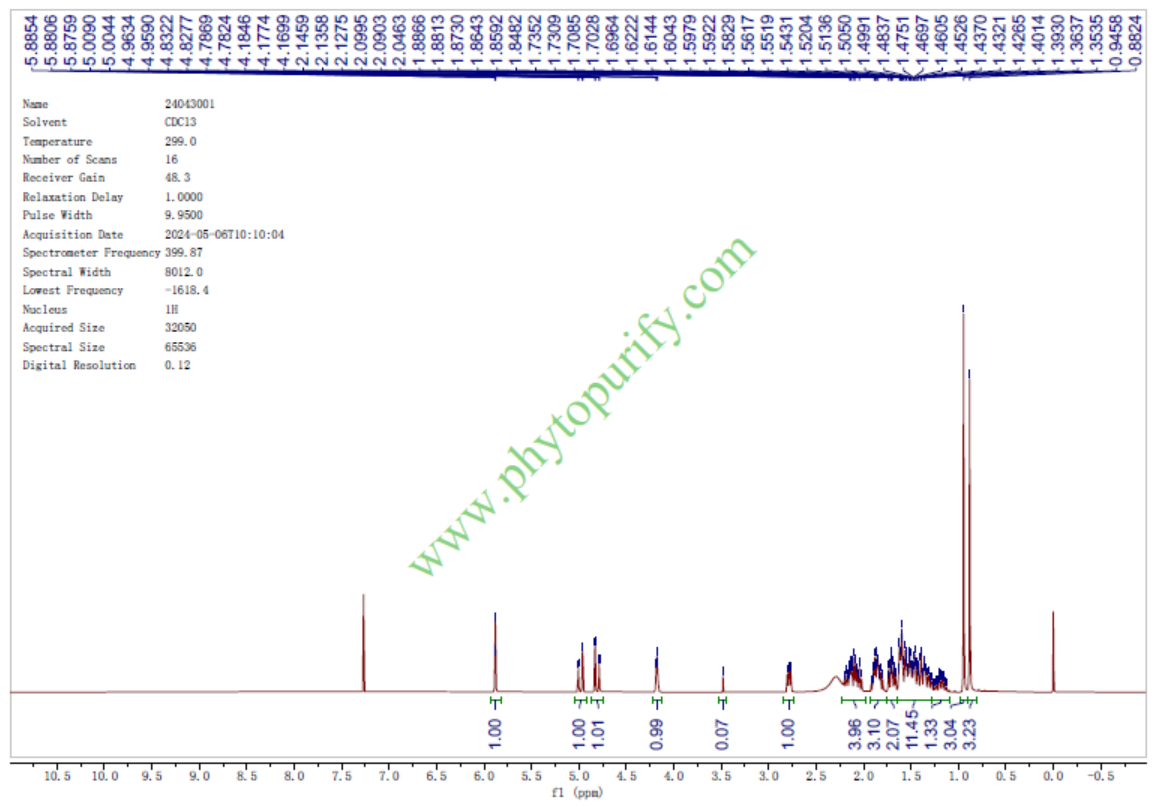
HNMR of Periplogenin
Storage conditions:Short-term storage at 2~8℃, long-term storage at -20 ~ -80℃
86.9900
2.1496
2.1496
.0482
2.4698
10.6603
High
70.1781
4.6528
No
No
No
No
Yes
No
0.0
Yes
No
No
Yes
Qiangxin is a class of steroid glycosides with a long history of medicinal use, traditionally mainly used for the treatment of congestive heart failure and arrhythmia. With the deepening of modern pharmacological research, the potential of cardiac glycosides in the fields of anti-tumor, anti-inflammatory, and immune regulation is increasingly being recognized. Gangliu nucleoside, as an orally active cardiac glycoside isolated from traditional Chinese medicine Xiangjiapi, has surpassed the traditional cardiovascular category in its research and demonstrated various biological activities. In recent years, studies have found that salidroside can exert anti-tumor effects in various tumor models such as prostate cancer by inducing reactive oxygen species generation, regulating programmed cell death (such as necroptosis and pyroptosis), and cell cycle arrest. At the same time, its regulatory role in the target network related to inflammation and autoimmune diseases such as rheumatoid arthritis and psoriasis is also beginning to emerge. This article aims to provide a systematic review of the chemical properties, plant sources, pharmacological activities, molecular mechanisms of action, medicinal characteristics, and potential clinical application prospects of salidroside, in order to provide comprehensive academic references for the in-depth research and development of this natural product.
Periplogenin, also known as 3 β, 14-dihydroxy-5 β - pregnest-20 (22) - enolide, has a CAS number of 514-39-6. Its molecular formula is C23H34O5 and its molecular weight is 390.5200. Structurally speaking, the phenylene glycoside belongs to the class of cardiac lactones, with its parent nucleus being a cyclopentane dihydrophenanthrene steroid structure. It has a fused configuration of A/B cyclic cis, B/C cyclic trans, and C/D cyclic cis, which is essential for cardiac glycoside activity. Its structural features include a β - hydroxyl group at each of the C-3 and C-14 positions, and an α -, β - unsaturated pentagonal lactone ring (butenolide) connected to the C-17 position. Unlike many cardiac glycosides (such as digoxin), the aglycone of Periphyllum is in the form of a glycoside and does not connect to a sugar group, which directly affects its physicochemical properties.
According to the provided pharmacological parameters, the lipid water partition coefficient (LogP) of Periphyllum glycoside is 2.1496, indicating that it has moderate lipophilicity and is conducive to transmembrane transport. The topologically polar surface area (TPSA) is 86.99 Å ², which is relatively low and further supports its good membrane permeability. Its water solubility is 0.0482 mg/mL, which is slightly soluble, indicating that solubilization strategies may need to be considered in formulation development. It is worth noting that its blood-brain barrier permeability is predicted to be "high", indicating that it may have the potential to act on central nervous system diseases. In terms of preliminary safety indicators, its lack of inhibition on hERG potassium channels suggests a low potential risk of arrhythmia, while the Ames test result of 0.0 indicates no mutagenicity, providing a favorable chemical basis for its subsequent development.
The main source of the aglycone in Periplocaceae is the dried root bark of the plant Periplocaceae, also known as the traditional Chinese medicine "Cortex Periplocae". Xiangjiapi is commonly used in China to treat rheumatism, rheumatism, and edema, but it contains various cardiac glycosides that are toxic and should be used with caution. Salix glycosides often combine with sugars to form glycoside forms such as salidroside, which exist in plants. Therefore, the extracted glycosides are often obtained, which are then subjected to acid hydrolysis or enzymatic hydrolysis to obtain glycosides.
Its extraction and separation usually use organic solvent extraction combined with chromatographic separation technology. The classic process is as follows: the dried powder of Xiangjiapi is heated and refluxed with ethanol or methanol for extraction, and the extracted liquids are combined and concentrated under reduced pressure to obtain a paste. After suspending the extract in water, it is extracted sequentially with organic solvents such as petroleum ether and ethyl acetate. The aglycones and their glycosides are mostly enriched in the ethyl acetate fraction. This part was further separated by silica gel column chromatography, and gradient elution was performed using a solvent system such as chloroform methanol, combined with thin-layer chromatography detection. The initially purified components can be further refined by preparative high-performance liquid chromatography to obtain high-purity cyclodextrin. Modern technologies such as high-speed countercurrent chromatography are also applied for efficient separation of such compounds. During the extraction process, attention should be paid to controlling the acid hydrolysis conditions to avoid changes in the glycoside structure.
The pharmacological activity research of Lycium barbarum has expanded from traditional cardiotonic effects to multiple fields such as anti-tumor, anti-inflammatory, and immune regulation.
1. Antitumor activity:
Research has shown that salidroside has inhibitory effects on proliferation and induces death in various cancer cells. In prostate cancer cells, resveratrol can significantly inhibit cell growth, and its mechanism is related to inducing cell cycle arrest in the G0/G1 phase. More importantly, salidroside can trigger a programmed form of necrosis called necroptosis, which is accompanied by a sharp increase in intracellular reactive oxygen species levels. The outbreak of reactive oxygen species is not only one of the executors of cell death, but may also further amplify death signals by disrupting intracellular homeostasis. In addition, the latest research reveals that the aglycone of Salix has a regulatory effect on another inflammatory programmed cell death - pyroptosis, demonstrating its diversity in regulating cell death.
2. Anti inflammatory and immune regulatory activity:
In the model of inflammation related diseases, salidroside has shown potential application value. For example, in the complex pathological network of rheumatoid arthritis, targets associated with ganglioside such as IL-6, STAT3, TLR4, NFE2L2, etc. are key inflammatory and immune regulatory nodes. By regulating these targets, salidroside may inhibit synovial inflammation, reduce the production of joint destruction mediators (such as MMP1), and regulate oxidative stress response. Its potential to inhibit IDO1 is also worth noting, as IDO1 is a key enzyme in tryptophan metabolism and plays an important role in immune tolerance and tumor immune escape.
3. Regulation of programmed cell death:
The regulation of cell fate by salidroside has a double-edged sword characteristic. On the one hand, it promotes necrotic apoptosis by inducing ROS and activating specific signaling pathways; On the other hand, it has been reported to inhibit pyroptosis by regulating the NLRP3/Caspase-1/GSDMD signaling pathway. This seemingly contradictory effect may have cell type and disease background dependence. In diseases where excessive inflammation leads to tissue damage (such as certain infections or autoimmune diseases), inhibiting pyroptosis may have a protective effect; In the tumor environment, inducing necrotic apoptosis can directly kill cancer cells.
The multiple pharmacological activities of salidroside stem from its interactions with multiple molecular targets, forming a complex regulatory network.
1. Direct target - Na+/K+- ATPase (ATP1A1):
As a cardiac glycoside compound, the most classic target of salidroside is the Na+/K+- ATPase (sodium pump) on the cell membrane, especially its α 1 subunit (ATP1A1). Research has shown that salidroside can bind to specific pockets of ATP1A1 and form hydrogen bonds with key amino acid residue T804, thereby inhibiting the ion transport function of the enzyme. The inhibition of sodium pump leads to an increase in intracellular Na+concentration, which in turn causes an increase in intracellular Ca2+concentration through Na+/Ca2+exchangers, which is the molecular basis of its traditional cardiotonic effect. In tumor cells, the disruption of ion homeostasis and subsequent signal transduction events (such as Src kinase activation) are considered important starting points for inducing ROS production, cell cycle arrest, and death.
2. Regulating necrotic apoptosis and pyroptosis:
* Inducing necrotic apoptosis: The ROS burst induced by salidroside is the key to triggering necrotic apoptosis. ROS can damage organelles such as mitochondria and may activate the core apoptotic signaling pathway RIPK1/RIPK3/MLKL.
* Inhibition of pyroptosis: Pyroptosis relies on the assembly of inflammasomes (such as NLRP3), which activate Caspase-1, cleave GSDMD protein to form membrane pores, leading to cell lysis. Gangliu nucleoside can regulate this pathway, and the specific mechanism may be related to its anti-inflammatory effects, ion balance regulation, or impact on related protein expression. The specific upstream signals are yet to be elucidated.
3. Multi target effects in the inflammatory network:
In the context of diseases such as rheumatoid arthritis, the role of ganglioside involves a wide range of target groups:
* Inhibition of pro-inflammatory signals: It may reduce the production of pro-inflammatory cytokines such as IL-6 by affecting TLR4 signaling, downregulating the activation of NF - κ B and STAT3.
* Oxidative stress regulation: By activating the AMPK (PRKAA1) and Nrf2 (NFE2L2) pathways, the antioxidant defense ability of cells is enhanced, which forms a dynamic balance with its induction of ROS and may play different roles in different pathological states.
* Medium metabolism intervention: Potential inhibition of ALOX5 (5-lipoxygenase) affects leukotriene synthesis, inhibition of MMP1 reduces extracellular matrix degradation, and inhibition of PIK3CG affects PI3K Akt inflammatory signaling.
* Immune metabolism regulation: The potential inhibitory effect on IDO1 may regulate tryptophan metabolism and affect T cell function.
The pharmacological evaluation based on calculations and preliminary experimental data shows that Periphyllum glycosides have some favorable characteristics, but also face challenges.
1. Physical, chemical, absorption, and distribution properties:
Moderate LogP values and lower TPSA indicate good oral absorption potential and membrane permeability. The prediction of high blood-brain barrier permeability provides the possibility for its treatment of central nervous system related diseases such as neuroinflammation and brain tumors. Its micro solubility is one of the main limiting factors affecting oral bioavailability, and it may be necessary to improve solubility and dissolution rate through strategies such as making solid dispersions, cyclodextrin inclusion complexes, or nano formulations.
2. Metabolism, excretion, and toxicity:
As a steroid compound, palindrome is likely to undergo extensive phase I (such as CYP450 enzyme catalyzed hydroxylation) and phase II (such as glucuronidation and sulfation) metabolism in the liver. The metabolites, main excretion pathways (bile or kidneys), and the presence of enterohepatic circulation still require experimental confirmation. In terms of safety, the absence of hERG inhibition and Ames mutagenicity negativity are important early positive signals. However, the therapeutic window of cardiac glycosides is usually narrow, and the most noteworthy toxicity of their prototype drugs is still cardiotoxicity, which arises from excessive inhibition of Na+/K+- ATPase in myocardial cells. Therefore, future toxicology research needs to systematically evaluate its effects on cardiac function, electrolyte balance, and determine safe dose ranges.
3. Pharmacokinetic research requirements:
At present, there are relatively few research reports on the pharmacokinetics of the Lycium barbarum system. In the future, it is necessary to establish sensitive and accurate analytical methods (such as LC-MS/MS), conduct complete pharmacokinetic studies in animal models, clarify key parameters such as absolute bioavailability, plasma protein binding rate, tissue distribution characteristics, main metabolic pathways, and elimination half-life, and provide a basis for dosage form design and administration regimen optimization.
The multi-target and multi pathway action characteristics of Lycium barbarum provide broad prospects for its application in various disease fields, but there are also many challenges.
1. Potential application areas:
* Tumor treatment: Especially in the treatment of prostate cancer, its mechanism of directly targeting ATP1A1 and inducing non apoptotic cell death provides a new approach to overcome the apoptotic resistance caused by traditional chemotherapy drugs. It can be explored as a single drug or in combination with existing chemotherapy and targeted drugs.
* Autoimmune and inflammatory diseases: In diseases such as rheumatoid arthritis and psoriasis, its ability to regulate multiple inflammatory targets such as AMPK, STAT3, and NLRP3 may make it a unique immunomodulatory agent with a distinct mechanism of action. Especially for patients with refractory or poor response to biologics, alternative options may be provided.
* Other fields: Its high BBB permeability suggests its potential value in neurodegenerative diseases (often accompanied by neuroinflammation) or brain tumors.
2. Challenges faced:
* Treatment window and safety: The biggest challenge in clinical translation is how to effectively separate the required dose of anti-tumor or anti-inflammatory drugs from the possible myocardial toxicity dose. Developing targeted formulations (such as tumor targeted nanoparticles) or searching for structural modification sites that are essential for their activity but not necessary for cardiotoxicity, and optimizing their structures, is an important direction.
* Complexity of mechanism of action: Its bidirectional regulation of cell death (pro apoptotic vs. anti apoptotic) needs to be accurately analyzed in specific disease models to ensure the correctness of treatment strategies.
* Optimization of drug properties: We need to address the issue of water solubility and gain a deeper understanding of its in vivo ADME process.
3. Future research directions:
* In depth mechanism research: Using chemical biology methods (such as photoaffinity labeled probes) to search for other directly acting proteins besides ATP1A1; Using multi omics techniques to comprehensively reveal the signal network changes in different cell and disease models.
* Structural modification and development of analogues: Through synthetic biology or chemical synthesis methods, the structural modification of salidroside residues is aimed at increasing potency, reducing toxicity, improving pharmacokinetic properties, and obtaining lead compounds with greater potential for development.
* Research on New Delivery Systems: Explore nano delivery systems such as liposomes and polymer micelles to achieve targeted delivery to tumor or inflammatory sites, improve efficacy, and reduce the risk of systemic exposure.
* Preclinical and clinical studies: On the basis of comprehensive pharmacological and toxicological research, promote standardized preclinical studies and ultimately explore the feasibility of their clinical applications.
As a natural cardiac glycoside derived from traditional Chinese medicine, the modern pharmacological research of Gangliu nucleoside has successfully expanded it from the cardiovascular field to a new stage of anti-tumor and immune inflammation regulation. It exhibits multifaceted biological activity by directly inhibiting Na+/K+- ATPase, triggering a series of complex intracellular events including ROS bursts, programmed cell death mode transitions, and regulation of multidimensional inflammatory signaling networks. Although it has shown certain potential in drug development, issues such as treatment window, solubility, and exact metabolic fate in vivo remain obstacles that must be overcome for its clinical application. Future research should focus on further elucidating the cell type specific mechanisms of action, optimizing its efficacy and safety profile through rational drug chemistry design and advanced delivery technologies. The research on the aglycone of Lycium barbarum not only provides valuable lead compounds for the development of new anti-tumor and anti-inflammatory drugs, but also reflects the sustained vitality of exploring modern therapeutic drugs from traditional medicinal plants. With the continuous deepening of interdisciplinary research, it is expected that in the framework of precision medicine, salidroside can find its unique therapeutic positioning, bringing new hope to patients with related diseases.
