

Product name: Otophylloside B
Synonym name: Qingyangshengenin B
Catalogue No.: BP3300
Cas No.: 106758-54-7
Formula: C49H78O16
Mol Weight: 923.147
Botanical Source:
Physical Description:
Type of Compound:
Purity: 95%~99%
Analysis Method: HPLC-DAD or/and HPLC-ELSD
Identification Method: Mass, NMR
Packing: Brown vial or HDPE plastic bottle
The product could be supplied from milligrams to grams. Inquire for bulk scale.
We provide solution to improve the water-solubility of compounds, thereby facilitating the variety of activity tests and clinic uses.
For Reference Standard and R&D, Not for Human Use Directly.
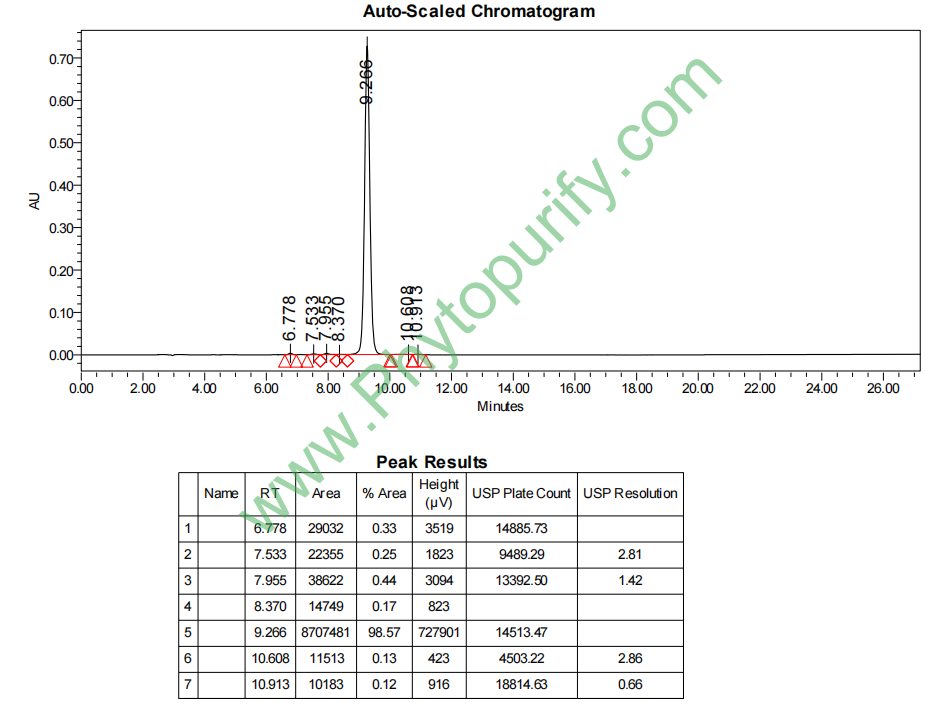
HPLC of Otophylloside B
Storage conditions:Short-term storage at 2~8℃, long-term storage at -20 ~ -80℃
207.3600
3.5496
3.5496
.0141
1.4950
2.7912
Low
70.9812
6.5112
No
No
Yes
No
No
No
0.3
Yes
No
Yes
Yes
Depression is a complex mental disorder characterized by sustained low mood, decreased interest, and cognitive impairment. Its global prevalence remains high, imposing a heavy disease burden on society. At present, first-line antidepressants, such as selective serotonin reuptake inhibitors, are widely used, but they generally suffer from delayed onset, limited efficacy, significant side effects, and relapse after discontinuation. Therefore, exploring lead compounds with novel structures and diverse mechanisms of action from natural products has become an important direction for the development of antidepressant drugs. Otophylloid B, a steroid saponin isolated from traditional antiepileptic and sedative medicinal plants, has attracted widespread attention in the pharmacological community in recent years for its potential antidepressant activity. Its unique chemical structure suggests that it may exert its effects through a multi-target mechanism different from traditional monoamine drugs, providing a valuable molecular template for developing novel and rapidly effective antidepressant strategies. This article aims to systematically review the chemical properties, plant sources, pharmacological activities, mechanisms of action, and medicinal properties of Qingyang ginseng glycoside B, in order to provide comprehensive scientific references for the in-depth research and development of this compound.
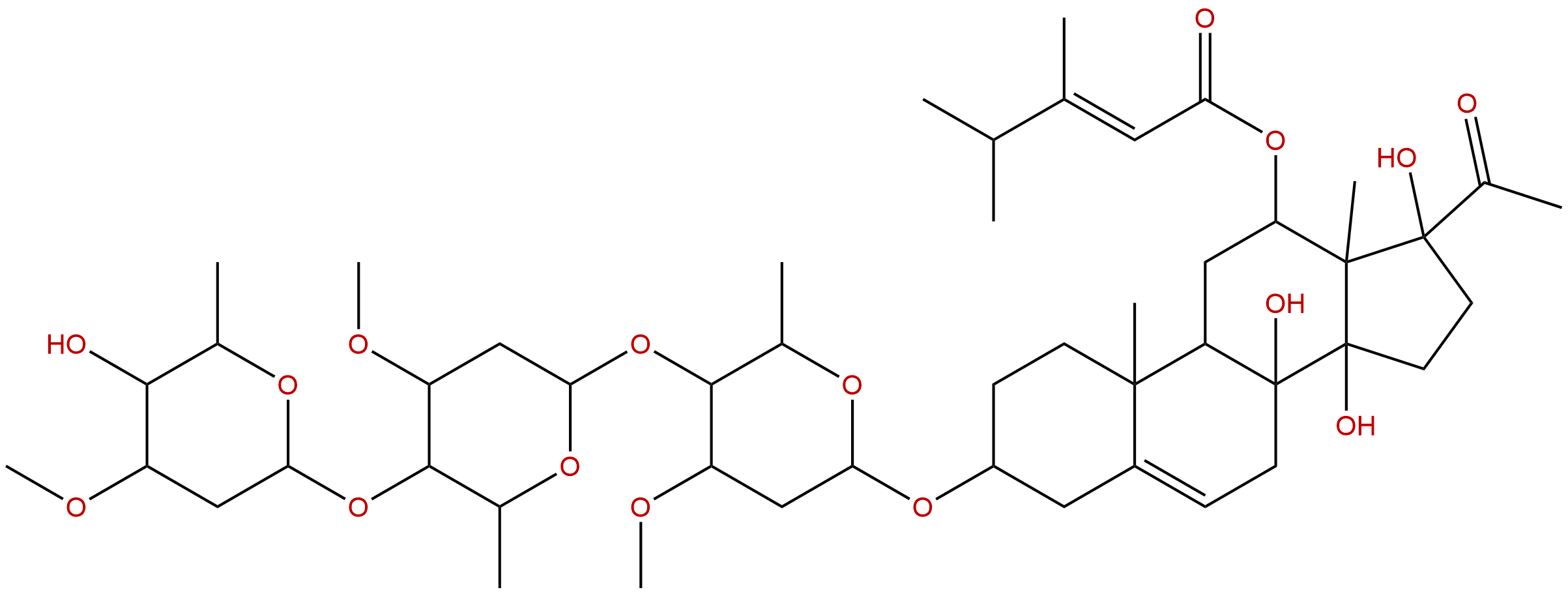
Qingyang ginseng glycoside B (CAS number: 106758-54-7) is a structurally complex C21 steroid saponin. Its aglycone is 17 α - pregnenolone, and the substituent modification on the skeleton is highly distinctive: hydroxyl groups are substituted at positions 8 α, 12 β, 14 β, and 17 β. Of particular importance is that its 14 β - hydroxyl group is linked to an uncommon acyl group, (2E) -3,4-dimethylpent-2-enoic acid, through an ester bond. This acylation modification is relatively rare in natural steroids and may have a significant impact on their biological activity and membrane permeability. The sugar chain is another structural highlight, consisting of three 2,6-dideoxy-3-O-methylhexoses connected by a β -1,4-glycosidic bond. The specific sequence is: β - D-arabinopyranosyl - (1 → 4) -2,6-dideoxy-3-O-methyl - β - D-ribose-pyranosyl - (1 → 4) -2,6-dideoxy-3-O-methyl - β - D... (Based on the information, the sugar chain may not be fully listed here). This highly modified oligosaccharide chain may be involved in target recognition and binding.
According to the analysis of drug parameters, its molecular weight is 923.1470, which belongs to the category of macromolecular compounds. The calculated lipid water partition coefficient (LogP) is 3.55, indicating that the compound has a certain lipophilicity. The topologically polar surface area (TPSA) is as high as 207.36 Å ², which is mainly attributed to the numerous hydroxyl, sugar epoxy, and ester bond oxygen atoms in the molecule, indicating its high molecular polarity. The water solubility parameter is 0.0141, which is relatively low and consistent with its high LogP and TPSA, indicating poor solubility in water. This may be a key physical and chemical bottleneck that needs to be overcome for its oral absorption and in vivo delivery. The preliminary toxicity warning shows that its Ames test value is 0.3, indicating a low risk of mutagenicity and no significant inhibition of hERG potassium channels, suggesting a low potential risk of cardiac toxicity, which is a favorable drug characteristic.
Qingyang ginseng glycoside B is mainly derived from Qingyang ginseng, a plant in the family Loricaceae and the genus Goose Vine(Cynanchum otophyllum The rhizome of Schneid. Qingyang ginseng, also known as "Xiaobaijiao" or "Duanjie ginseng", has a long history of use in folk medicine in Yunnan and other places. It is traditionally used to treat epilepsy, wind shock, rheumatism and pain, and its sedative and anticonvulsant effects provide important clues for modern research on its neuropsychiatric pharmacological activities.
The extraction and separation of Qingyang glycoside B from plant materials are usually carried out using organic solvent extraction combined with various chromatographic techniques. The general process is as follows: first, the dried roots and stems of Panax ginseng are crushed, and heated with polar solvents such as methanol or ethanol for reflux or ultrasound assisted extraction. After concentration, the total extract is obtained. Subsequently, the total extract was subjected to gradient extraction using solvents such as petroleum ether, ethyl acetate, and n-butanol. Qingyang ginseng glycoside B was mainly enriched in the n-butanol extraction site due to its strong polarity and glycoside structure. Further purification relies on column chromatography techniques, commonly using silica gel column chromatography, reverse phase silica gel (such as ODS) column chromatography, and high performance liquid chromatography (HPLC). Among them, reverse phase HPLC is a key step in obtaining high-purity Qingyang ginseng glycoside B monomer, usually using methanol water or acetonitrile water as the mobile phase for gradient elution. Structural identification involves the comprehensive use of spectroscopic techniques such as nuclear magnetic resonance (NMR, including 1H, 13C, 2D-NMR), mass spectrometry (MS), and optical rotation. The complex sequence and configuration of sugar chain connections need to be determined through detailed NMR data analysis.
The pharmacological research of Qingyang ginseng glycoside B mainly focuses on its activity on the central nervous system, especially in terms of antidepressant and neuroprotective effects.
1. Antidepressant activity: In vivo pharmacological experiments are the core evidence to prove its antidepressant potential. In classic mouse behavioral despair models such as forced swimming and tail suspension experiments, administration of Qingyang Shenzhi B can significantly shorten the immobility time of animals, and this effect shows a dose-response relationship within a certain dose range, which is comparable to classical antidepressants such as fluoxetine. In the Chronic Unpredictable Mild Stress (CUMS) model, which is closer to the pathophysiology of human depression, Qingyang Ginseng Glycoside B not only improves the behavioral despair of model animals, but also reverses stress-induced pleasure loss (such as decreased sugar preference) and reduced autonomous activity. These results strongly demonstrate that Qingyang ginseng glycoside B has a clear antidepressant like effect.
2. Neuroprotection and anti-inflammatory activity: The pathological mechanism of depression is closely related to neuroinflammation, oxidative stress, and impaired neuronal plasticity. Research has shown that Qingyang ginseng glycoside B can counteract glutamate induced neuronal toxicity in vitro and improve cell survival rate. In CUMS model animals, it can reduce the levels of pro-inflammatory cytokines (such as IL-1 β, TNF - α) in key brain regions such as the hippocampus and prefrontal cortex, while increasing the activity of antioxidant factors (such as superoxide dismutase (SOD), glutathione (GSH)). In addition, studies suggest that it may promote the expression of brain-derived neurotrophic factor (BDNF), which is crucial for synaptic plasticity and neuronal survival.
3. Other potential activities: Given the traditional use of its parent plant Qingyang ginseng, Qingyang ginseng glycoside B may also have certain anticonvulsant and sedative activities, but there are few specialized research reports in this area, which needs further exploration.
The antidepressant effect of Qingyang ginseng glycoside B is not achieved through a single pathway. Existing research suggests that it exerts its effects through a multi-target network, involving multiple levels such as the monoaminergic system, inflammatory immune pathways, oxidative stress, cell apoptosis, and neuroplasticity. Its known or potential targets include:
In summary, Qingyang Ginseng Glycoside B may act as a "multi-directional regulator" that simultaneously acts on multiple key nodes such as neurotransmitter metabolism, energy homeostasis, redox balance, and inflammatory response, jointly correcting the pathological network imbalance related to depression.
Although Qingyang ginseng glycoside B has shown great potential in pharmacological activity, its pharmacological properties, especially pharmacokinetic properties, are obstacles that must be overcome for its clinical application.
Absorption and distribution: As mentioned earlier, the compound has a large molecular weight, high polar surface area, and poor water solubility, which severely limits its ability to cross the gastrointestinal epithelial cell membrane through passive diffusion, indicating that its oral bioavailability may be low. Its LogP value is 3.55, indicating a certain degree of lipid solubility, but excessive molecules and polarity may still make it difficult to effectively penetrate. More importantly, the prediction of "low blood-brain barrier permeability" is the core challenge facing the treatment of central nervous system diseases. The low permeability of the blood-brain barrier means that even if drugs can be absorbed into the bloodstream, it is difficult to achieve effective therapeutic concentrations at the target site of the brain. The sugar chains and polar groups in the structure may be the main reasons limiting its penetration through the blood-brain barrier.
Metabolism and excretion: As a saponin compound, Qingyang ginseng glycoside B is susceptible to the influence of gastrointestinal microbiota and liver metabolic enzymes in vivo. The sugar chain may be hydrolyzed by glycosidases of gut microbiota to produce aglycones or secondary glycosides, and their activity may be altered. Ester bonds may also be hydrolyzed by esterases. The combination reaction between phase I (such as CYP450 enzyme system) and phase II of the liver may further modify its structure. At present, there is a severe lack of research data on its detailed in vivo metabolite profile, major metabolic enzymes, and excretion pathways (kidney/gallbladder), which urgently require systematic elucidation through techniques such as radioactive labeling or high-resolution mass spectrometry.
Preliminary safety evaluation: The highlight of the pharmacological parameters lies in its lack of hERG inhibition and lower Ames test risk, providing a preliminary safety basis for subsequent development. However, there has been no systematic report on the comprehensive preclinical safety evaluation of acute toxicity, chronic toxicity, reproductive toxicity, etc.
In order to improve its drug properties, possible strategies include: 1) developing prodrugs, such as esterifying or alkylating their sugar chains or hydroxyl groups to enhance lipid solubility and membrane permeability, and then hydrolyzing them into active forms in vivo; 2) Adopting new drug delivery systems, such as nanoliposomes, polymer micelles, or brain targeted nanoparticles, to enhance their solubility, stability, and promote their crossing of the blood-brain barrier; 3) Explore non oral routes of administration, such as nasal administration, to bypass first pass effects and potentially enter the brain directly.
Qingyang ginseng glycoside B, as a novel natural antidepressant lead compound, has both clinical application prospects and challenges.
Prospect:
1. Candidate molecules for novel multi-target antidepressants: Its unique multi-target mechanism of action, especially its ability to simultaneously regulate inflammation, oxidative stress, and neuroplasticity, makes it promising for the treatment of refractory depression with poor response to traditional monoamine drugs, or depression subtypes with significant inflammatory features.
2. Rapid onset potential: Traditional antidepressants usually take several weeks to take effect. Given that Qingyang ginseng glycoside B acts on pathways related to rapid cellular adaptation such as AMPK and Nrf2, there is theoretically a possibility of faster regulation of neuronal functional states, but this requires experimental verification.
3. The components of combination therapy: In the future, it may be considered to combine Qingyang ginseng glycoside B with existing antidepressants to improve efficacy, reduce monotherapy dosage and side effects through synergistic or complementary mechanisms.
4. Excellent starting point for pharmaceutical chemistry optimization: Its complex structure provides medicinal chemists with abundant modification sites (such as sugar chains, acyl side chains, hydroxyl groups), and through structural optimization, it is expected to significantly improve its pharmacokinetic properties while maintaining activity.
Challenges and Future Research Directions:
1. In depth mechanism research: At present, the targets of its action are mostly based on bioinformatics predictions or indirect evidence, and molecular docking, surface plasmon resonance, gene knockout/knockout and other technologies need to be used to directly verify its interaction and functional regulation relationship with the above targets.
2. Systematic pharmacokinetic studies: This is currently the weakest link. A complete ADME (absorption, distribution, metabolism, excretion) study must be conducted to clarify its in vivo fate, active metabolites, and pharmacokinetic relationship.
3. Optimization of drug properties: As mentioned earlier, solving the problems of poor solubility and low brain permeability through formulation or chemical modification strategies is the inevitable path towards clinical practice.
4. Expand the activity spectrum: Based on its anti-inflammatory, antioxidant, and neuroprotective properties, its therapeutic potential in other neurodegenerative diseases (such as Alzheimer's disease, Parkinson's disease) or cerebral ischemic injury can be explored.
5. Preclinical and clinical studies: After completing sufficient pharmacological, pharmacokinetic, and toxicological evaluations, gradually advance clinical trials to verify its safety and efficacy in humans.
Qingyang Ginseng Glycoside B is a C21 steroidal saponin with significant antidepressant potential discovered from the traditional medicinal plant Qingyang Ginseng. Its chemical structure is complex and unique, especially the uncommon acylation modification at the 14 β position and the triple sugar chain structure, which are the material basis of its biological activity. Pharmacological studies have confirmed that it exhibits clear antidepressant like effects in various animal models of depression, and its mechanism of action goes beyond the traditional monoamine hypothesis, involving multiple signaling pathways closely related to energy metabolism, oxidative stress, and neuroinflammation such as AMPK, Nrf2, NF - κ B, etc., exhibiting multi-target regulation characteristics. However, its poor solubility and extremely low blood-brain barrier permeability constitute the main bottleneck for its drug conversion. Future research should focus on thoroughly elucidating its molecular target network, systematically revealing its pharmacokinetic behavior in vivo, and actively utilizing modern medicinal chemistry and formulation technologies to optimize and modify its drug properties. The research on Qingyang ginseng glycoside B not only provides valuable lead compounds for the development of a new generation of multi-target antidepressant drugs, but also reflects the enormous value of exploring modern treatment options from traditional medical knowledge. With the continuous deepening of research, this natural molecule is expected to show broader application prospects in the treatment of mental and neurological diseases.
