


Product name: Gamabufotalin
Synonym name: Gamabufagin; Gamabufogenin
Catalogue No.: BP0612
Cas No.: 465-11-2
Formula: C24H34O5
Mol Weight: 402.531
Botanical Source: poisonous secretion of toads Bufo vulgaris formosus and Bufo bufo gargarizans, and toad poison Ch'an Su. Rhabdophis tigrinus
Physical Description: Powder
Type of Compound: Steroids
Purity: 95%~99%
Analysis Method: HPLC-DAD or/and HPLC-ELSD
Identification Method: Mass, NMR
Packing: Brown vial or HDPE plastic bottle
Storage: Store in a well closed container, protected from air and light. Put into refrigerate or freeze for long term storage.
Whenever possible, you should prepare and use solutions on the same day. However, if you need to make up stock solutions in advance, we recommend that you store the solution as aliquots in tightly sealed vials at -20℃. Generally, these will be useable for up to two weeks.
The product could be supplied from milligrams to grams, up to kilograms
Inquire for bulk scale.
Descriptions:
Gamabufotalin(CS-6), a bufadienolide compound from toad venom, suppresses COX-2 expression through targeting IKKβ/NF-κB signaling pathway in lung cancer cells, suggests that CS-6 exhibits potential use in the treatment of COX-2-mediated diseases such as lung cancer.[1]
Gamabufotalin has been shown to strongly inhibit cancer cell growth and inflammatory response, CS-6 inhibits angiogenesis by inhibiting the activation of VEGFR-2 signaling pathways and CS-6 could be a potential candidate in angiogenesis-related disease therapy.[2]
Gamabufotalin triggers c-Myc degradation via induction of WWP2 in multiple myeloma(MM) cells, it may be as a promising therapeutic agent in the treatment of MM.[3]
References:
[1] Yu Z, Guo W, Ma X, et al. Mol Cancer, 2014, 13(1):1-14.
[2] Tang N, Shi L, Yu Z, et al. Oncotarget, 2015, 7(3):3533-47.
[3] Yu Z, Li T, Wang C, et al. Oncotarget, 2016, 7(13):15725-37.
[4] Ma X C, Zhang B J, Xin X L, et al. Nat Prod Commun, 2009, 4(4):179-84.
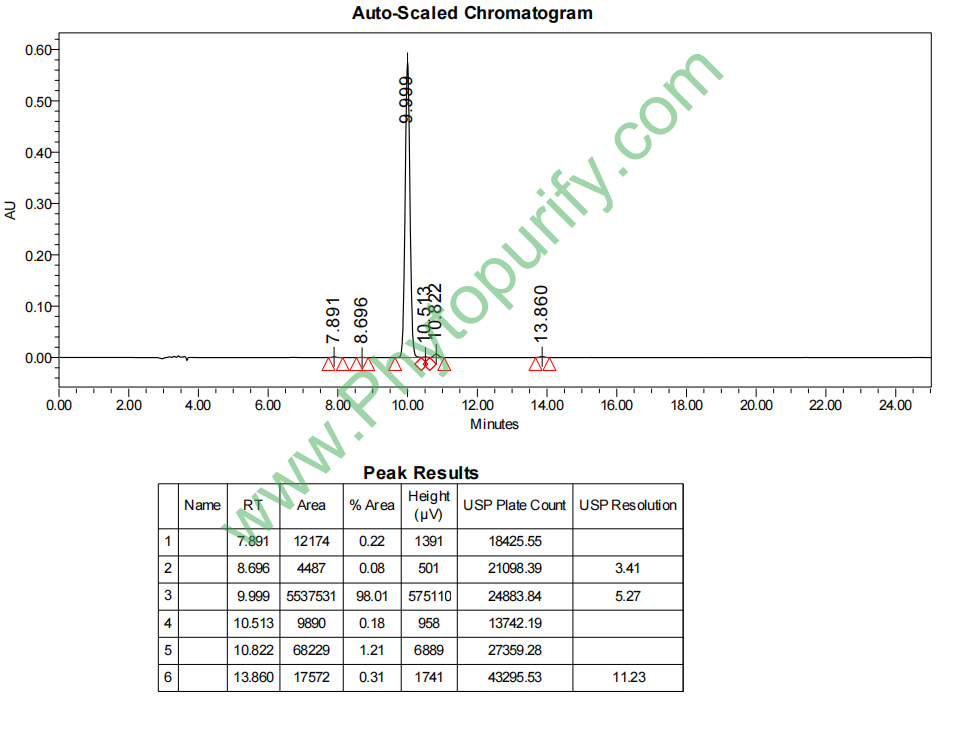
HPLC of Gamabufotalin
Storage conditions:Short-term storage at 2~8℃, long-term storage at -20 ~ -80℃
90.9000
2.5500
2.5502
.0205
3.1228
6.0925
High
85.1198
4.6250
No
No
No
No
No
No
0.0
Yes
No
No
Yes
Natural products have always been an important treasure trove for innovative drug discovery, among which toad venom, as a traditional Chinese medicine, has been recorded for hundreds of years for its cardiotonic, anti-inflammatory, anti-tumor and other activities. The active ingredients in toad venom are mainly toad sterols, and Gamabufotalin (also known as Gamabufagin, CAS number: 465-11-2) is one of the key diene type toad sterols. Compared with homologous compounds such as Bufotalin and Bufalin, bufotalin has attracted much attention for its relatively high stability and low cytotoxicity, especially in the field of tumor pharmacology research, demonstrating unique value. In recent years, studies have revealed that it exerts significant anti angiogenic effects by specifically inhibiting the vascular endothelial growth factor receptor-2 (VEGFR-2) signaling pathway, providing a highly promising lead compound for the development of novel targeted anti-tumor drugs. This article aims to provide a systematic review of the chemical characteristics, sources, pharmacological activities, molecular mechanisms of action, pharmacological properties, and clinical application prospects of Japanese toad poison talin, in order to provide comprehensive academic references for the in-depth research and development of this compound.
The chemical name of the Japanese toad poison spirit is 3 β, 14 β - dihydroxy-5 β - bufostan-20,22-dienol, with a molecular formula of C ₂₄ H ∝₄ O ₅ and a molecular weight of 402.5310. Its core structure belongs to the class of toad sterols, with a steroid mother nucleus. Its characteristic structures include cis coupling of A/B rings (5 β - H), trans coupling of C/D rings, hydroxyl group in β - configuration at C-14, and an α - pyranone ring (unsaturated hexagonal lactone ring) connected at C-17. This unique structure is the basis of its biological activity.
Its physicochemical properties are as follows: the calculated lipid water partition coefficient (LogP) is 2.55, indicating that the compound has moderate lipophilicity and is conducive to transmembrane transport. The topological polar surface area (TPSA) is 90.9 Å ², reflecting the contribution of polar groups such as hydroxyl groups in the molecule. The water solubility is relatively low, about 0.0205 mg/mL, which to some extent limits its dispersion and absorption in aqueous media. It is worth noting that the predictive model shows a high blood-brain barrier permeability, suggesting its potential role in central nervous system related diseases or metastatic tumors. In the early safety screening, the data showed no significant hERG potassium channel inhibitory activity (low risk of arrhythmia), and the Ames test result was negative (0.0), indicating no mutagenicity under the experimental conditions, providing support for its relatively good preliminary safety evaluation.
The main source of Japanese toad venom comes from animals in the family Bufonidae, such as the ear glands and skin secretions of the Chinese giant toad (Bufo gargarizans) or the black eyed toad (Bufo melanostictus), known as toad venom. In toad venom, it often exists in the form of free sterols or esters formed by binding with succinylated arginine and other substances.
Its extraction and separation usually use organic solvent extraction combined with modern chromatographic techniques. The classic process is as follows: first, the dried toad venom powder is refluxed and extracted with ethanol or methanol, and then concentrated to obtain the total toad venom base extract. Subsequently, preliminary separation was performed using silica gel column chromatography, with commonly used solvent systems being chloroform methanol or petroleum ether ethyl acetate for gradient elution. Due to the similar structure of toad steroidal compounds, separation and purification are difficult, often requiring repeated purification through multiple normal or reverse phase column chromatography (such as ODS column). High performance liquid chromatography (HPLC), especially preparative HPLC, is a key step in obtaining high-purity bufotalin. C18 chromatography columns are commonly used with methanol water or acetonitrile water as the mobile phase. In recent years, liquid-liquid distribution chromatography techniques such as high-speed countercurrent chromatography have also been applied for the separation and purification of such compounds due to their high recovery rate and avoidance of irreversible adsorption caused by solid adsorbents. Structural identification mainly relies on techniques such as nuclear magnetic resonance (NMR, including ¹ H-NMR and ¹ ³ C-NMR), mass spectrometry (MS), and X-ray single crystal diffraction.
The Japanese toad poison spirit exhibits a wide range of pharmacological activities, among which its anti-tumor effect is the most prominent.
1. Antitumor activity A large number of in vitro studies have shown that bufotalin can inhibit the proliferation and induce apoptosis of many human tumor cell lines, including liver cancer (such as HepG2, SMMC-7721), lung cancer (such as A549, NCI-H460), gastric cancer (such as SGC-7901), colon cancer (such as HCT-116) and breast cancer (such as MCF-7). Its activity is usually concentration - and time-dependent. It is worth noting that compared with bufotaxime and other drugs, Nippon bufotaxime has relatively low toxicity to certain normal cells while effectively inhibiting tumor cells, demonstrating a certain degree of selectivity.
2. Anti angiogenic activity This is one of the most highly regarded activities of the Japanese toad poison spirit. In chicken embryo chorioallantoic membrane (CAM) experiments, rat arterial ring models, and in vivo Matrigel plug experiments, Japanese toad venom can significantly inhibit the formation of new blood vessels. This activity is the key mechanism by which it inhibits tumor growth and metastasis by targeting the tumor microenvironment and cutting off tumor nutrient supply.
3. Anti inflammatory and immune regulatory activity Some studies suggest that Ritalin may exert anti-inflammatory effects by inhibiting inflammatory signaling pathways such as nuclear factor kappa B (NF - κ B), downregulating the expression of cyclooxygenase-2 (COX-2) and inducible nitric oxide synthase (iNOS). In addition, it may have a certain regulatory effect on immune cell function, but its detailed mechanism needs to be further elucidated.
4. Other activities Traditionally, toad steroidal compounds have cardiotonic effects, but there are relatively few reports on the cardiotonic activity and related cardiac toxicity of Japanese toad venom. Its potential antiviral and anti fibrotic activities are also in the preliminary exploration stage.
The anti-tumor effect of Japanese toad venom involves multiple targets and pathways, but its core mechanism focuses on inhibiting angiogenesis and inducing cell apoptosis.
Although the pharmacological activity of Japanese toad venom is significant, its pharmacological development still faces challenges, and related pharmacokinetic studies are not yet sufficient.
As a natural product with a clear anti angiogenic mechanism, the clinical application prospects of Japanese toad poison spirit are mainly reflected in the field of anti-tumor, but there are also many directions that need to be breakthrough.
As an important active bufotalin in toad venom, the Japanese toad venom has become a highlight in natural product anti-tumor research due to its relatively superior stability and safety, as well as its clear molecular mechanism in anti-tumor, especially anti angiogenesis. From inhibiting the VEGFR-2 signaling pathway to inducing multi pathway tumor cell apoptosis, its multi-target action characteristics demonstrate a complex and sophisticated pharmacological network of natural products. Despite facing challenges such as solubility and selectivity in drug development, these challenges are gradually transforming into innovative opportunities through the cross fusion of modern medicinal chemistry, pharmacy, and pharmacology technologies. In the future, in-depth research on Japanese toad poison and its spirit is expected to not only generate new anti-tumor candidate drugs with independent intellectual property rights, but also provide important theoretical and practical basis for interpreting the scientific value of traditional Chinese medicine and promoting the integration of traditional Chinese and Western medicine in the treatment of tumors. The exploration journey from traditional medicinal herbs to modern drugs is a vivid manifestation of the continuous vitality of natural products in innovative drug discovery.
