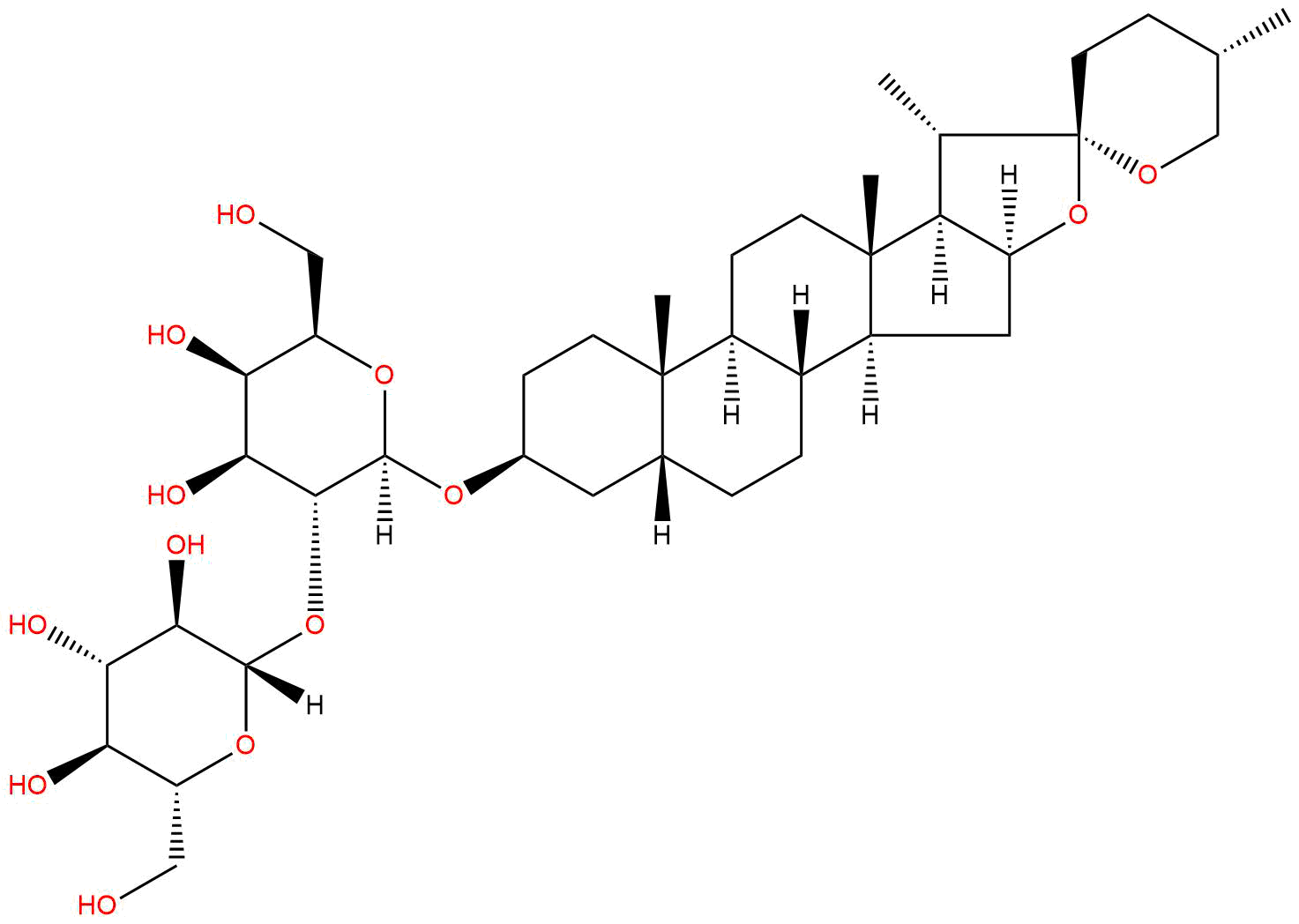


Product name: Timosaponin AIII
Synonym name: Timosaponin A3; Filiferin B; Anemarsaponin A3; Xilingsaponin A
Catalogue No.: BP1395
Cas No.: 41059-79-4
Formula: C39H64O13
Mol Weight: 740.928
Botanical Source: Anemarrhena asphodeloides Bge.
Physical Description:
Type of Compound: Steroids
Purity: 95%~99%
Analysis Method: HPLC-DAD or/and HPLC-ELSD
Identification Method: Mass, NMR
Packing: Brown vial or HDPE plastic bottle
Storage: Store in a well closed container, protected from air and light. Put into refrigerate or freeze for long term storage.
Whenever possible, you should prepare and use solutions on the same day. However, if you need to make up stock solutions in advance, we recommend that you store the solution as aliquots in tightly sealed vials at -20℃. Generally, these will be useable for up to two weeks.
The product could be supplied from milligrams to grams
Inquire for bulk scale.
Chengdu Biopurify Phytochemicals Ltd. is a leading company in the research, development, manufacture and marketing of High Quality Phytochemicals and Extracts(especially Active Ingredients from Traditional Chinese Medicine,TCM), Natural Active Pharmaceutical Ingredients worldwide.
The main services:
A. Supply active ingredients and reference standards of TCM, from mgs to kgs scale
B. Custom extraction and purification, target Herb Active Ingredients
C. Custom synthesis and semi-synthesis for Natural Active Ingredients
D. CR(contract research), CM(contract manufacture) and PD(process development) services from lab scale, pilot scale to commercial scale(GMP is also available)
E. TCM compounds library for drug screen,more than 3000 compounds available, many of them are rare and unique.
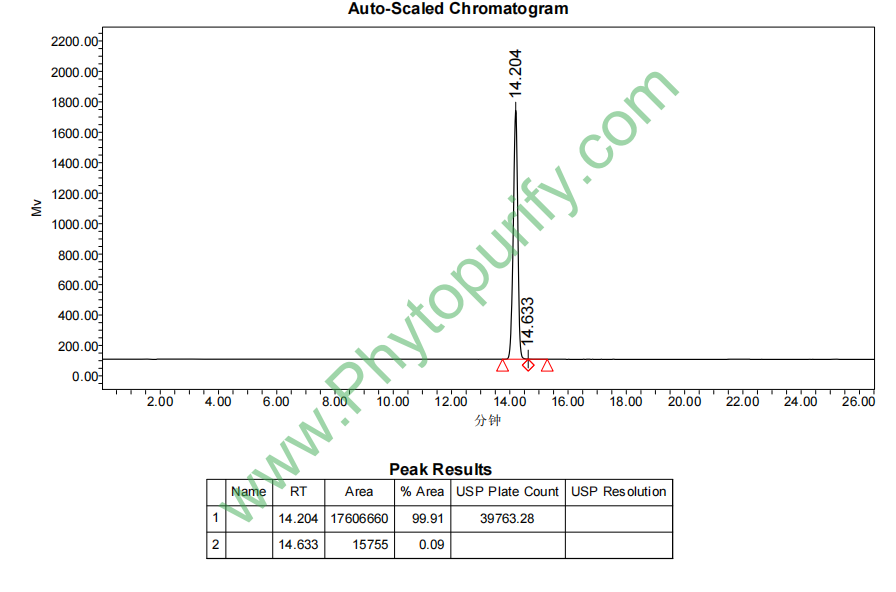
HPLC of Timosaponin AIII
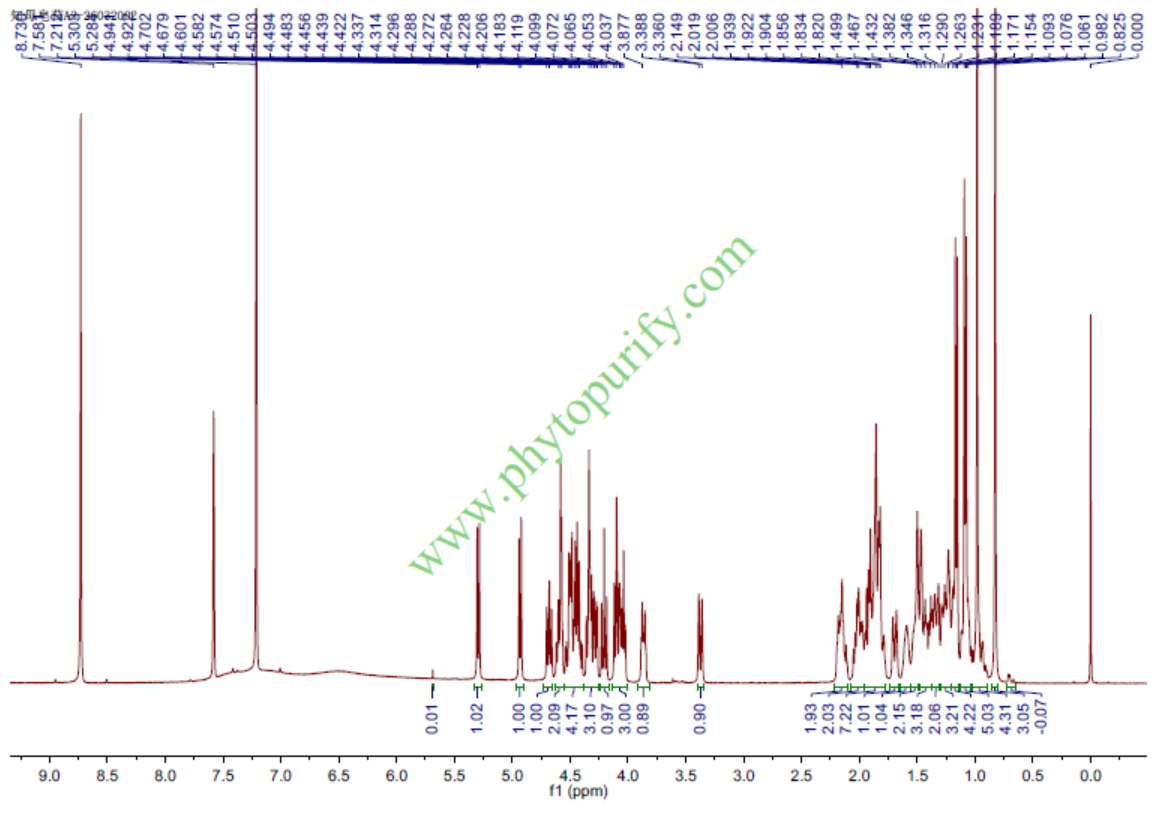
HNMR of Timosaponin AIII
Storage conditions:Short-term storage at 2~8℃, long-term storage at -20 ~ -80℃
Timosaponin AIII (CAS number: 41059-79-4) is a major active ingredient derived from the traditional Chinese medicine Anemarrhena asphodeloides Bunge, and belongs to the class of steroidal saponins. In recent years, with the deepening of pharmacological research on natural products, the saponins AIII from Anemarrhena chinensis have attracted much attention due to their multi-target and multifunctional biological activities. Especially in the fields of anti-inflammatory, neuroprotective, and anti-tumor effects, it has demonstrated significant pharmacological potential. Its inhibitory effect on acetylcholinesterase (AChE) (IC50=35.4 μ M) suggests its potential application in neurodegenerative diseases such as Alzheimer's disease (AD). In addition, the saponins AIII from Anemarrhena chinensis regulate various inflammation related signaling pathways and molecular targets, demonstrating excellent anti-inflammatory activity, providing a theoretical basis for its development as a novel anti-inflammatory drug. This article will provide a systematic review of the chemical structure, plant origin, pharmacological activity, mechanism of action, medicinal properties, and clinical application prospects of Anemarrhena saponins AIII, aiming to provide reference for subsequent basic research and drug development.
Zhimu saponin AIII is a typical steroid saponin with a molecular formula of C ₄₁ H ₆₆ O ₁₂, a molecular weight of 740.9280, and a structure containing a steroid skeleton and multiple sugar residues. The steroid core structure endows it with strong biological activity, while the sugar moiety affects its water solubility and bioavailability. In terms of physical and chemical properties, the LogP value of Anemarrhena saponins AIII is 2.2219, indicating its moderate lipid solubility, which is beneficial for membrane penetration; The TPSA (polar surface area) is 196.9900, and a higher polar surface area suggests better solubility in polar environments, but may also limit its ability to pass through the blood-brain barrier. Low water solubility (0.0231 mg/mL) suggests limited solubility in vivo and may require improvement in bioavailability through formulation techniques. In terms of pharmacological safety, Zhimu saponin AIII does not inhibit hERG channels, and the Ames mutagenicity test results are negative, indicating its good safety potential.
The saponin AIII of Anemarrhena asphodeloides Bunge is mainly present in the rhizomes of the lily family plant Anemarrhena asphodeloides Bunge. Zhimu, as a traditional Chinese medicine, has a long history and is widely used in traditional treatments such as clearing heat, purging fire, moistening dryness, and quenching thirst. Modern research has shown that saponins AIII from Anemarrhena chinensis are one of its main active ingredients.
The extraction method usually uses organic solvent extraction combined with column chromatography separation technology. The specific steps include:
In recent years, new technologies such as ultrasound assisted extraction and microwave-assisted extraction have also been applied to the extraction of saponins AIII from Anemarrhena, improving extraction efficiency and purity.
The research on the anti-inflammatory effects of Zhimu saponin AIII is relatively in-depth. It can significantly inhibit the production and release of inflammatory mediators, such as tumor necrosis factor alpha (TNF - α), interleukin-6 (IL-6), etc. Both in vitro cell models and animal inflammation models have shown that saponins AIII from Anemarrhena can reduce inflammation and alleviate tissue damage by downregulating the expression of various inflammation related genes.
Zhimu saponin AIII has an inhibitory effect on acetylcholinesterase (AChE), with an IC50 value of 35.4 μ M. AChE is a key enzyme in the nervous system that breaks down acetylcholine. Inhibiting AChE activity can increase acetylcholine levels, improve cognitive function, and suggest the potential application value of saponins AIII in neurodegenerative diseases.
In addition to anti-inflammatory and AChE inhibition, saponins AIII from Anemarrhena chinensis also exhibit various biological activities such as anti-tumor, antioxidant, and neuroprotective effects. For example, in various tumor cell lines, saponins AIII can induce cell apoptosis and inhibit cell proliferation. Its antioxidant effect is achieved by clearing free radicals, reducing oxidative stress damage, and protecting cellular function.
The pharmacological effects of Zhimu saponin AIII involve multiple signaling pathways and molecular targets, mainly including:
In addition, saponins AIII from Anemarrhena chinensis can enhance acetylcholine signaling by inhibiting AChE activity, which contributes to neuroprotection and improvement of cognitive function.
The molecular weight of Zhimu saponin AIII is relatively high (740.9280), which may to some extent limit its oral absorption and cell membrane penetration. Its LogP value of 2.2219 indicates moderate lipid solubility, which is favorable for transmembrane transport, but high TPSA (196.99) and low water solubility (0.0231 mg/mL) suggest high polarity, which may affect bioavailability and tissue distribution. The low permeability of the blood-brain barrier limits its direct role in central nervous system diseases, but it still has potential value in regulating the peripheral nervous system and inflammatory environment.
In terms of safety, saponins AIII from Anemarrhena do not inhibit hERG channels, reducing the risk of arrhythmia, and the Ames test is negative, indicating a low risk of mutagenicity and a good safety basis.
At present, there is limited systematic pharmacokinetic research on saponins AIII from Anemarrhena henryi. Previous studies have shown that after oral administration, its concentration in plasma is lower, indicating the presence of first pass effects and poor oral absorption. The metabolic pathway mainly involves the liver enzyme system, possibly through glycoside hydrolysis and metabolic transformation of the steroid skeleton. Further pharmacokinetic studies are needed in the future to optimize the administration method and dosage form design, in order to enhance its bioavailability and therapeutic efficacy.
Due to its multi-target and multifunctional pharmacological properties, Zhimu saponin AIII has shown broad clinical application potential in anti-inflammatory, neuroprotective, and anti-tumor fields. Its inhibitory effect on AChE provides the possibility for the development of novel therapeutic drugs for neurodegenerative diseases such as Alzheimer's disease. The diversity of anti-inflammatory mechanisms makes it promising for application in chronic inflammatory diseases such as rheumatoid arthritis and inflammatory bowel disease.
However, the high molecular weight, low water solubility, and limited blood-brain barrier penetration ability of saponins AIII are the main obstacles to its clinical translation. Future research should focus on:
Combining modern drug research and development technology, Anemarrhenoside AIII is expected to become an important candidate molecule in the development of natural product drugs.
As a key active ingredient in Rhizoma Anemarrhenae, saponin AIII exhibits significant pharmacological value due to its multi-target anti-inflammatory and neuroprotective effects. Its inhibitory effect on acetylcholinesterase provides a new approach for the treatment of neurodegenerative diseases. Despite the challenges in drug development, the clinical translation prospects of Zhimu saponin AIII are promising with the assistance of modern drug design and formulation technology. In the future, in-depth mechanism research, pharmacokinetic analysis, and clinical validation will lay a solid foundation for it to become a new type of natural medicine, promoting the application and development of natural products in the field of modern medicine.
