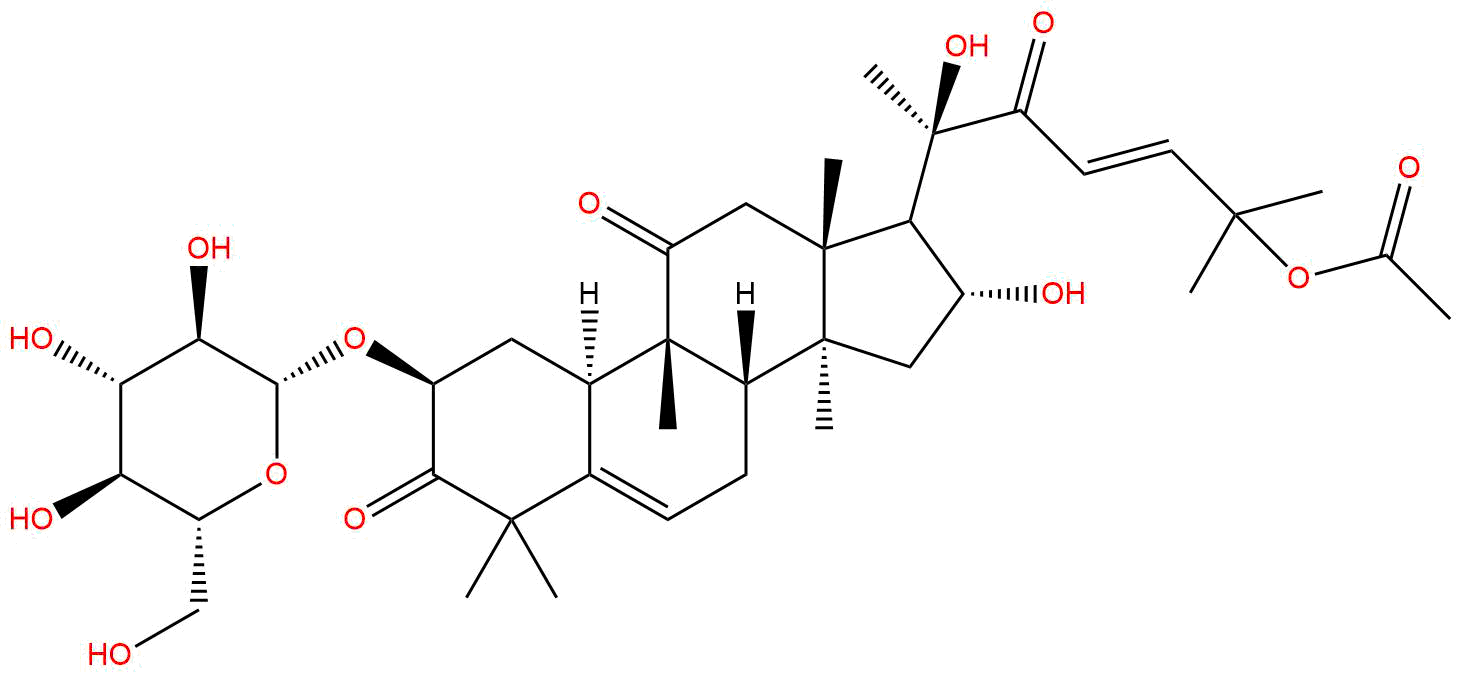


Product name: Cucurbitacin B 2-O-β-D-glucoside
Synonym name: Arvenin I
Catalogue No.: BPF2141
Cas No.: 65247-27-0
Formula: C38H56O13
Mol Weight: 720.853
Botanical Source:
Physical Description:
Type of Compound: Triterpenoids
Purity: 95%~99%
Analysis Method: HPLC-DAD or/and HPLC-ELSD
Identification Method: Mass, NMR
Packing: Brown vial or HDPE plastic bottle
The product could be supplied from milligrams to grams
Inquire for bulk scale.
For Reference Standard and R&D, Not for Human Use Directly.
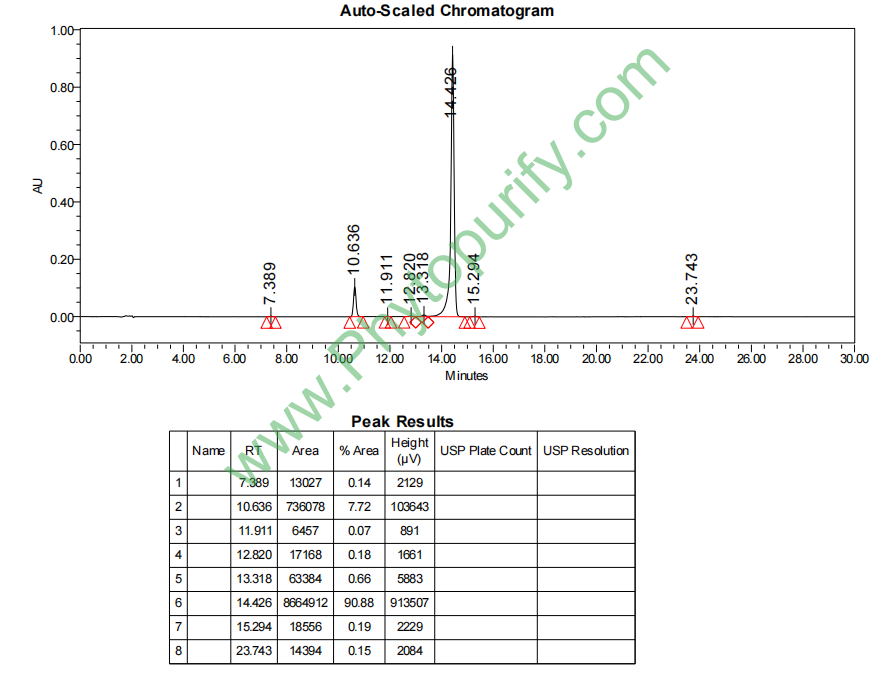
HPLC of Cucurbitacin B 2-O-beta-D-glucoside
Storage conditions:Short-term storage at 2~8℃, long-term storage at -20 ~ -80℃
217.3500
2.1021
2.1021
.0800
.5680
.9419
Low
68.0422
5.8637
No
No
No
No
No
No
0.0
Yes
No
Yes
Yes
Natural products, as an important source of drug discovery, play an irreplaceable role in the long history of human fight against diseases. Cucurbitaceae plants, including common fruits and vegetables such as cucumber, pumpkin, bitter gourd, as well as medicinal plants such as Gynostemma pentaphyllum and snow gall, have long been used in traditional medical systems to treat various diseases such as inflammation, infections, and tumors. The pharmacological activity of these plants is largely attributed to a class of highly oxidized tetracyclic triterpenoids called cucurbitacins. The cucurbitacin family is known for its significant cytotoxicity and anti-tumor activity, but its direct application as clinical drugs is greatly limited due to its strong toxicity and adverse pharmacokinetic properties.
Cucurbitacin B is one of the most abundant and extensively studied members of the cucurbitacin family. However, its poor water solubility, low bioavailability, and non-specific toxicity have prompted researchers to explore its structural modification and derivatization. Cucurbitacin B 2-O - β - D-glucoside (CB-2-G), as a natural glycosylated derivative of cucurbitacin B, introduces a glucose group at the C-2 site. This structural modification not only changes the physicochemical properties of the molecule, but also endows it with unique pharmacological activity and potential therapeutic advantages. In recent years, CB-2-G has gradually become a research hotspot in the field of natural product pharmacology due to its significant activities in anti-tumor, anti-inflammatory, and immune regulation, as well as its improved toxicity characteristics compared to the parent compound.
This article aims to systematically review the chemical structural characteristics, plant sources, extraction and separation methods, pharmacological activities, mechanisms of action, drug evaluation, and clinical application prospects of CB-2-G, in order to provide comprehensive academic references for the in-depth research and development of this natural product.
The chemical name of CB-2-G is cucurbitacin B2-O - β - D-glucoside, and its core skeleton is cucurbitane type tetracyclic triterpenoid. The parent nucleus structure of cucurbitacin B contains a cyclopentanophenanthrene skeleton with carbonyl groups at C-3, C-11, and C-22 sites, hydroxyl groups at C-2, C-16, and C-20 sites, double bonds at C-5 and C-23 sites, and an acetoxy side chain connected to C-25 site. The key difference between CB-2-G and cucurbitacin B is that its C-2 hydroxyl group is connected to β - D-glucose through glycosidic bonds, forming a 2-O - β - D-glucoside structure.
This glycosylation modification has important structural biological significance. The introduction of glucose groups increases the polarity and volume of the molecule, altering its spatial conformation and electronic distribution. The sugar moiety not only acts as a hydrophilic group that affects the solubility and membrane permeability of molecules, but may also affect the binding mode between molecules and target proteins through steric hindrance effects. In addition, the presence of glycosidic bonds suggests that CB-2-G may act as a prodrug, releasing active parent compounds through enzymatic hydrolysis (such as β - glucosidase) in vivo, thereby achieving targeted delivery or sustained release effects.
According to computational chemistry and experimental data, the key physicochemical parameters of CB-2-G are as follows: molecular weight of 720.8530 Da, much larger than cucurbitacin B (558.7 Da), reflecting the contribution of the sugar moiety. The lipid water partition coefficient (LogP) is 2.1021, indicating that the molecule has moderate lipophilicity, ranging from completely hydrophilic (LogP<0) to highly lipophilic (LogP>5). The polar surface area (TPSA) is as high as 217.3500 Å ², mainly derived from multiple hydroxyl and carbonyl oxygen atoms on the sugar group, which is much higher than the recommended threshold for oral drugs (140 Å ²), indicating that its oral absorption may be limited.
The water solubility data is 0.0800 mg/mL, which is still classified as insoluble, but has significantly improved compared to cucurbitacin B (with extremely low water solubility, usually<0.01 mg/mL). The blood-brain barrier penetration assessment is rated as' low ', which is consistent with the' 500/140 rule 'of high TPSA and molecular weight exceeding blood-brain barrier penetration, indicating that CB-2-G has a lower risk of side effects in the central nervous system. The hERG inhibition assessment is' no ', indicating a low risk of cardiac toxicity. The Ames test result is 0.0, indicating that no mutagenicity was observed in the standard bacterial recovery mutation test, and the risk of genetic toxicity is low.
These physicochemical properties collectively indicate that although CB-2-G may pose challenges in oral absorption, its safety features (low cardiac toxicity, low genetic toxicity, low central nervous system penetration) provide favorable conditions for it as a candidate drug.
CB-2-G mainly exists in the roots, stems, leaves, and fruits of Cucurbitaceae plants. The plant species currently reported to contain CB-2-G include:
Hemsleya genus Plants such as Hemsleya chinensis and Hemsleya lijiangensis, which are traditionally used in southwestern China to treat inflammation and tumors, have high levels of CB-2-G in their rhizomes.
Gynostemma genus Gynostemma pentaphyllum, as a "southern ginseng", contains various cucurbitacin glycosides in its aboveground parts, among which CB-2-G is one of the active ingredients.
Momordica genus The fruit and seeds of Momordica charantia contain various cucurbitacin derivatives, including CB-2-G.
Pumpkin genus (Cucurbita)The presence of CB-2-G has also been detected in the roots and stems of certain pumpkin varieties.
It is worth noting that the content of CB-2-G in plants is usually low and is significantly affected by factors such as growth environment, harvest season, and variety differences. Generally speaking, the rhizomes of snow gall plants are the main source of CB-2-G, with a content of up to 0.1% -0.5% of dry weight.
The extraction of CB-2-G is usually carried out using organic solvent extraction combined with modern chromatographic techniques. The classic process includes:
Extraction stage Dry plant materials are crushed and subjected to reflux extraction or ultrasound assisted extraction using ethanol water (70% -95%) or methanol water mixed solvents. Due to the water solubility of CB-2-G, increasing the water phase ratio appropriately (such as 70% ethanol) can help improve the extraction efficiency. After vacuum concentration, the extract was subjected to liquid-liquid extraction using petroleum ether, ethyl acetate, and n-butanol in sequence. CB-2-G is mainly enriched in the n-butanol extraction phase.
Separation and purification stage The n-butanol extract was preliminarily separated by silica gel column chromatography using chloroform methanol water (8:2:0.1 to 6:4:0.5) gradient elution. The fraction rich in CB-2-G is further purified by reverse phase column chromatography (such as ODS-C18) using methanol water (30:70 to 60:40) gradient elution. Finally, high-purity monomers are obtained through preparative high-performance liquid chromatography (HPLC), typically using a C18 column with acetonitrile water (25:75) isocratic elution and detection wavelength of 210-230 nm.
In recent years, high-speed countercurrent chromatography (HSCCC) and molecular imprinting techniques have also been applied to the efficient separation of CB-2-G. These methods have the advantages of easy operation and high recovery rate, especially suitable for large-scale preparation.
Structural identification mainly relies on nuclear magnetic resonance spectroscopy (NMR, including 1H, 13C, COSY, HSQC, HMBC) and high-resolution mass spectrometry (HR-ESI-MS). The connection position (C-2) and configuration (β - D) of the glycosidic bond can be determined by the correlation signal between the sugar terminal hydrogen and the glycoside C-2 in the HMBC spectrum, as well as the coupling constant of the sugar terminal hydrogen (J=7-8 Hz).
The most notable pharmacological activity of CB-2-G is its broad-spectrum anti-tumor effect. In vitro studies have shown that CB-2-G has significant proliferation inhibitory activity on a variety of human cancer cell lines, including breast cancer (MCF-7, MDA MB-231), lung cancer (A549, H1299), liver cancer (HepG2, Huh7), colorectal cancer (HCT116, SW480), prostate cancer (PC3, DU145), gastric cancer (SGC7901, BGC823) and leukemia (K562, HL60). Its half maximal inhibitory concentration (IC50) is usually in the range of 0.1-10 μ M, showing strong cytotoxicity.
It is worth noting that CB-2-G has significantly lower toxicity to normal cells (such as human normal liver cells L02 and human embryonic kidney cells HEK293) than to cancer cells, with a selectivity index (SI) of 5-20 times, which is superior to many traditional chemotherapy drugs. For example, in the breast cancer cell MCF-7, the IC50 of CB-2-G is about 0.5 μ M, while for the normal breast epithelial cell MCF-10A, the IC50 exceeds 10 μ M, which is more selective than cucurbitacin B (SI<3).
In vivo anti-tumor studies have further confirmed the efficacy of CB-2-G. In nude mice xenotransplantation model, intraperitoneal injection of CB-2-G (5-20 mg/kg, once a day) can significantly inhibit the growth of MCF-7 breast cancer, A549 lung cancer and HepG2 liver cancer xenografts, with a tumor inhibition rate of 40% -70%, and no significant weight loss or organ toxicity was observed. When used in combination with chemotherapy drugs such as cisplatin and paclitaxel, CB-2-G exhibits a synergistic effect, which can reduce the effective dose and toxic side effects of chemotherapy drugs.
In addition to its anti-tumor effect, CB-2-G also exhibits significant anti-inflammatory activity. In the macrophage RAW264.7 model stimulated by lipopolysaccharide (LPS), CB-2-G (1-10 μ M) dose dependently inhibited the production of nitric oxide (NO), prostaglandin E2 (PGE2), and tumor necrosis factor - α (TNF - α). In the carrageenan induced rat plantar swelling model, oral administration of CB-2-G (20-50 mg/kg) significantly reduced inflammatory response, with an effect comparable to indomethacin but with fewer gastrointestinal side effects.
The immunomodulatory effect of CB-2-G is reflected in its impact on the function of T cells and natural killer (NK) cells. Research has shown that CB-2-G can enhance the killing activity of NK cells, promote the proliferation and cytokine secretion of CD8+T cells, while inhibiting the function of regulatory T cells (Tregs), thereby improving the immunosuppressive state in the tumor microenvironment.
Preliminary studies also suggest that CB-2-G has antiviral (such as inhibiting hepatitis B virus replication), anti fibrotic (inhibiting hepatic stellate cell activation), and antioxidant activities. These findings, although still requiring further validation, expand the potential therapeutic areas of CB-2-G.
The pharmacological activity of CB-2-G involves the regulation of multiple molecular targets and signaling pathways, and its mechanism of action exhibits the characteristics of multiple targets and pathways.
1. Inducing cell apoptosis
CB-2-G induces tumor cell apoptosis through two pathways: endogenous (mitochondrial) and exogenous (death receptor). At the molecular level, CB-2-G significantly downregulates the expression of anti apoptotic proteins MCL1 (myeloid leukemia 1) and BCL2 (B-cell lymphoma 2), while upregulating pro apoptotic proteins BAX and BAK. MCL1 and BCL2 are key members of the BCL-2 family, and their overexpression is closely associated with drug resistance and poor prognosis in various tumors. CB-2-G disrupts mitochondrial membrane potential balance by inhibiting transcription and protein stability of MCL1 and BCL2, leading to cytochrome c release and caspase cascade activation.
2. Inhibit the STAT3 signaling pathway
Signal transducer and activator of transcription factor 3 (STAT3) is continuously activated in various tumors, promoting cell proliferation, survival, and angiogenesis. CB-2-G inhibits JAK kinase activity, reduces the phosphorylation of the Tyr705 site of STAT3, and thus blocks the nuclear translocation and transcriptional activity of STAT3. The downstream target genes of STAT3, including Cyclin D1, Survivin, VEGF, and MMP2, are significantly inhibited by CB-2-G. MMP2 (matrix metalloproteinase-2) is a key enzyme in tumor invasion and metastasis, and CB-2-G effectively reduces the migration and invasion ability of tumor cells by inhibiting the STAT3 MMP2 axis.
3. Interference with DNA topoisomerase activity
CB-2-G has a dual inhibitory effect on DNA topoisomerases I (TOP1) and II α (TOP2A). TOP1 and TOP2A are essential enzymes in DNA replication and transcription processes, as well as targets for various chemotherapy drugs such as camptothecin and etoposide. CB-2-G binds to the TOP1-TOP2A-DNA complex, stabilizing the "cleavable complex" and causing the accumulation of DNA double strand breaks, ultimately leading to cell cycle arrest and apoptosis. It is worth noting that the inhibitory activity of CB-2-G on TOP2A is stronger than that on TOP1, which may be related to its sugar structure affecting enzyme drug interactions.
4. Inhibit HIF1A and angiogenesis
Hypoxia inducible factor 1 alpha (HIF1A) is a key transcription factor for tumors to adapt to the hypoxic microenvironment, regulating the expression of genes such as VEGF and GLUT1. CB-2-G promotes the ubiquitination degradation of HIF1A and inhibits its protein accumulation, thereby reducing VEGF secretion and tumor angiogenesis. In the chicken embryo chorioallantoic membrane (CAM) model, CB-2-G significantly inhibits neovascularization, indicating its potential for anti angiogenesis.
5. Regulating MAPK and estrogen signaling
CB-2-G can inhibit the phosphorylation of MAPK1 (ERK2), block the RAS-RAF-MEK-ERK signaling cascade, and thus inhibit cell proliferation. In addition, in estrogen receptor positive (ER+) breast cancer cells, CB-2-G plays an anti estrogen role by down regulating the expression of ESR1 (estrogen receptor α) and inhibiting CYP19A1 (aromatase) activity. CYP19A1 is a key enzyme that converts androgens into estrogens, and its inhibition can reduce local estrogen levels, which has therapeutic significance for hormone dependent tumors.
The anti-inflammatory activity of CB-2-G is mainly achieved by inhibiting the NF - κ B and MAPK pathways. It inhibits the phosphorylation and degradation of I κ B α, prevents the nuclear translocation of NF - κ B p65 subunit, thereby reducing the expression of pro-inflammatory cytokines (TNF - α, IL-6, IL-1 β) and inflammatory mediators (COX-2, iNOS). Meanwhile, CB-2-G inhibits the phosphorylation of p38 MAPK and JNK, further weakening inflammatory signaling.
Based on Lipinski's "Five Rules" and Veber's Rules, the pharmacokinetic parameters of CB-2-G exhibit the following characteristics: molecular weight (720.85 Da) exceeding the threshold of 500 Da, number of hydrogen bond donors (about 10 hydroxyl groups) exceeding 5, number of hydrogen bond acceptors (about 16 oxygen atoms) exceeding 10, and TPSA (217.35 Å ²) exceeding 140 Å ². These parameters suggest that CB-2-G does not meet the standards of traditional oral drugs and may have low oral bioavailability. However, the LogP value (2.10) is within the ideal range (0-3), indicating that it has moderate membrane permeability potential.
It is worth noting that the hERG inhibition risk of CB-2-G is low (negative), and the Ames test is negative, indicating its low risk of cardiac and genetic toxicity, which is an important advantage as a candidate drug. In addition, the blood-brain barrier has low penetration and can reduce central nervous system side effects.
At present, there is insufficient systematic research on the pharmacokinetics of CB-2-G, but preliminary data is available for reference:
absorb After oral administration, the absorption of CB-2-G is poor, and the estimated absolute bioavailability is less than 10%. This is mainly attributed to its high molecular weight and polarity. However, oral absorption can be significantly improved through formulation techniques such as liposomes, nanoparticles, phospholipid complexes. Intraperitoneal injection and intravenous injection are commonly used non clinical routes of administration.
distribution CB-2-G is widely distributed in the body and mainly accumulates in the liver, spleen, and tumor tissues. Its apparent distribution volume (Vd) is relatively large (>1 L/kg), indicating a high tissue binding rate. The plasma protein binding rate is approximately 85% -90%.
Metabolism CB-2-G mainly undergoes two metabolic pathways in the body: one is glycosidic bond hydrolysis, which releases cucurbitacin B through β - glucosidase action; the other is hydroxylation and glucuronic acid binding. The liver is the main metabolic organ, and the CYP450 enzyme system (especially CYP3A4) is involved in its oxidative metabolism. It is worth noting that glycosylation modification of CB-2-G may reduce its potential as a substrate for P-glycoprotein (P-gp), thereby reducing efflux mediated drug resistance.
excretion CB-2-G and its metabolites are mainly excreted through bile and feces, with less excretion in urine. The half-life (t1/2) is approximately 4-8 hours, depending on the route of administration and animal species.
The acute toxicity of CB-2-G is significantly lower than that of cucurbitacin B. The LD50 of intraperitoneal injection in mice is about 80-120 mg/kg, while the LD50 of cucurbitacin B is only 1-2 mg/kg. In subchronic toxicity studies, no significant liver, kidney, or cardiac toxicity was observed after 28 days of continuous administration (10-30 mg/kg, intraperitoneal injection). Gastrointestinal toxicity (such as diarrhea and vomiting) is also significantly reduced compared to cucurbitacin B. These data indicate that glycosylation modification effectively reduces the toxicity of the parent compound and improves the therapeutic safety window.
Based on existing pharmacological research, CB-2-G has potential for development in the following disease areas:
malignant tumor In particular, breast cancer (including ER+and triple negative subtypes), non-small cell lung cancer, hepatocellular carcinoma and colorectal cancer. Its multi-target mechanism of action and low toxicity make it suitable as a combination therapy drug.
Chronic inflammatory diseases Such as rheumatoid arthritis, inflammatory bowel disease, and hepatitis. Its anti-inflammatory activity and low gastrointestinal toxicity make it a potential alternative to nonsteroidal anti-inflammatory drugs.
Tumor immunotherapy As a combination therapy of immune checkpoint inhibitors (such as PD-1/PD-L1 antibodies), it enhances the efficacy of immunotherapy by improving the immunosuppressive state of the tumor microenvironment.
The clinical translation of CB-2-G faces the following key challenges:
Low oral bioavailability Advanced drug delivery systems such as nanoliposomes, polymer nanoparticles, phospholipid complexes, or self microemulsifying drug delivery systems (SMEDS) need to be developed to improve their oral absorption and bioavailability.
Insufficient water solubility Although there has been some improvement compared to cucurbitacin B, the water solubility of 0.08 mg/mL is still insufficient to meet the requirements of injectable formulations. Further improvement can be achieved through salt formation, cyclodextrin inclusion, or prodrug design.
Complexity of mechanism of action Although multi-target action brings broad-spectrum activity, it also increases toxicological uncertainty and drug interaction risks. It is necessary to systematically clarify its key targets and off target effects.
Source restrictions The low content in plants makes chemical total synthesis difficult (the stereoselective synthesis of cucurbitane skeleton is challenging), which limits large-scale supply. The analysis of biosynthetic pathways and the construction of heterologous expression systems are potential approaches to solve the source problem.
structural optimization Based on the parent nucleus structure of CB-2-G, a systematic structure-activity relationship study was conducted to search for derivatives with stronger activity, higher selectivity, and better pharmacokinetic properties.
Combination therapy research Systematically evaluate the synergistic effects of CB-2-G with chemotherapy drugs, targeted drugs, and immunotherapy drugs, and optimize the combination regimen.
Target validation Using gene knockout/knock in models, proteomics, and chemical biology methods, further validate the functional importance of key targets such as MCL1, STAT3, TOP2A, etc.
Preclinical evaluation Conduct comprehensive pharmacokinetic, toxicological, and pharmacodynamic studies, including GLP toxicology, reproductive toxicity, carcinogenicity, etc., to lay the foundation for clinical trial application.
Cucurbitacin B 2-O - β - D-glucoside, as a natural glycosylated derivative of cucurbitacin B, represents a successful example of structural modification and activity optimization of natural products. By introducing the C-2 glucose group, this molecule significantly improves its toxicity characteristics and physicochemical properties while retaining the broad-spectrum anti-tumor activity of the parent compound. Its multi-target mechanism of action, including MCL1/BCL2 apoptosis regulation, STAT3 signaling inhibition, TOP1/TOP2A topoisomerase interference, HIF1A angiogenesis inhibition, and MAPK/ESR1 signaling regulation, endows it with unique therapeutic potential.
However, the road from laboratory discovery to clinical application is still long. The main bottlenecks currently faced are low oral bioavailability, insufficient water solubility, and source limitations. In the future, CB-2-G is expected to become a new candidate drug for the treatment of malignant tumors and inflammatory diseases through drug chemistry optimization, advanced formulation technology development, biosynthetic pathway engineering, and systematic preclinical evaluation. As a rising star in the field of natural product pharmacology, the research on CB-2-G not only provides new ideas for the development of cucurbitacin family drugs, but also provides important references for glycosylation modification strategies of other natural products. With the deepening of research, this natural product is expected to play its unique value in the era of precision medicine and combination therapy.
