


Synonym name: Elatericin A
Catalogue No.: BP0415
Cas No.: 3877-86-9
Formula: C30H44O7
Mol Weight: 516.675
Botanical Source: plants of the Cucurbitaceae and some others, e.g. Phormium tenax, Sorbaria sorbifolia, Trichosanthes kirilosin, Elaeocarpus glabripetalus, Elaeocarpus hainanensis, Ecballium elaterium, Bryonia spp., Datisca glomerata, Gonystylus keithii a
Purity: 95%~99%
Analysis Method: HPLC-DAD or/and HPLC-ELSD
Identification Method: Mass, NMR
Packing: Brown vial or HDPE plastic bottle
Can be supplied from milligrams to grams.
For Reference Standard and R&D, Not for Human Use Directly.
Inquire for bulk scale.
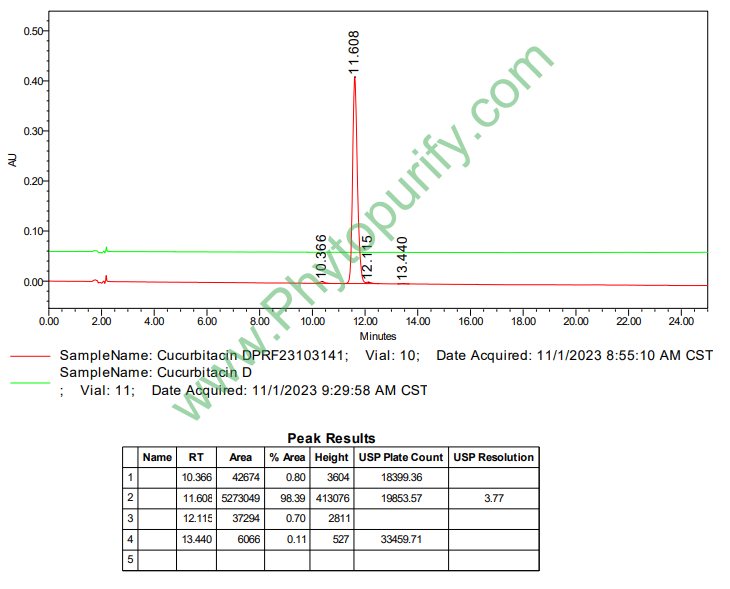
HPLC of Cucurbitacin D
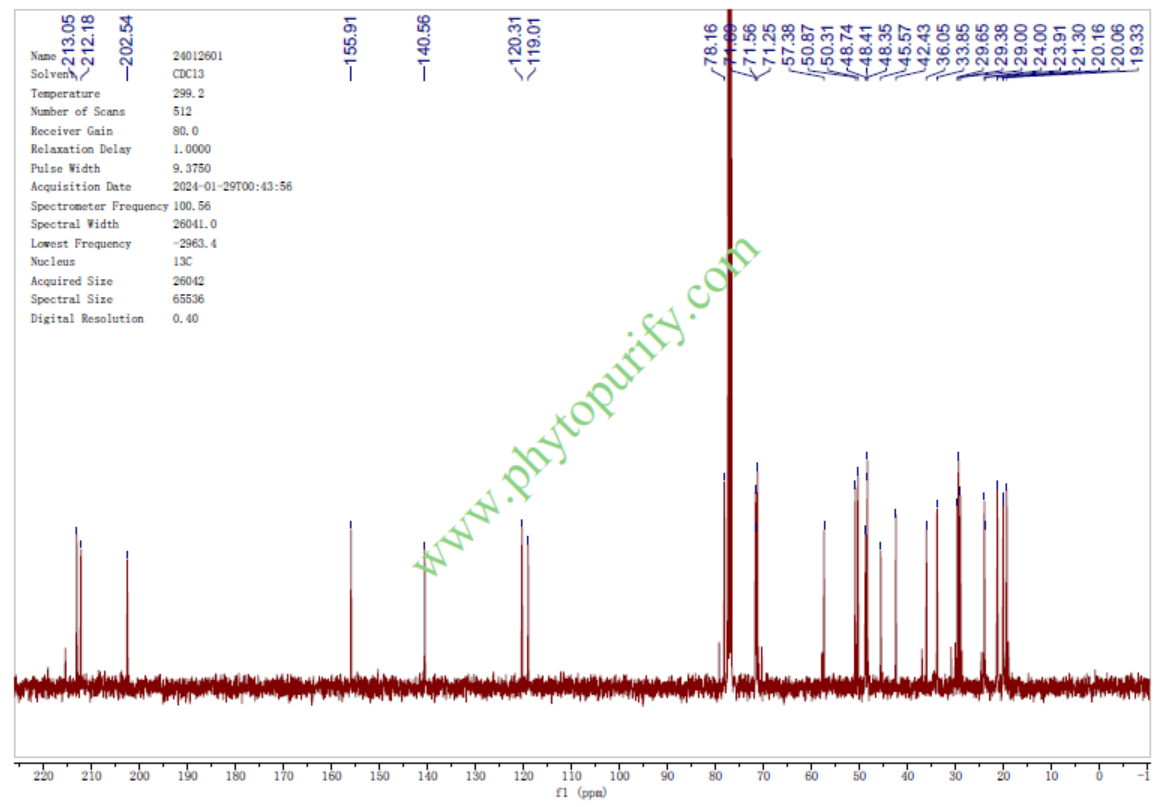
NMR of Cucurbitacin D
Storage conditions:Short-term storage at 2~8℃, long-term storage at -20 ~ -80℃
Cucurbitacin D (CAS number: 3877-86-9) is a natural product of tetracyclic triterpenoids derived from plants in the Cucurbitaceae family. Due to its unique biological activity, it has received widespread attention in the fields of pharmacology and natural product chemistry. As one of the main active ingredients in Trichosanthes kirilowii, cucurbitacin D not only has significant anti-tumor activity, but also exhibits good anti-inflammatory effects. In recent years, with the development of molecular biology and medicinal chemistry technology, research on the mechanism of action, molecular targets, and pharmacological evaluation of cucurbitacin D has been continuously deepened, providing theoretical basis and practical guidance for its clinical translation.
This review aims to systematically summarize the chemical structure and physicochemical properties, plant sources and extraction processes, pharmacological activity and mechanism of action, pharmacological evaluation and pharmacokinetic characteristics of cucurbitacin D, with a focus on exploring its potential application value in anti-tumor and anti-inflammatory fields, and looking forward to its future clinical development prospects.
Cucurbitacin D is a typical member of the cucurbitacin class compounds, with a molecular formula of C32H44O8 and a molecular weight of 516.6600. Its structural core is a tetracyclic triterpenoid skeleton, which contains multiple hydroxyl and ketone groups, endowing it with high polarity and biological activity. The LogP value of cucurbitacin D is about 3.2, indicating that it has moderate lipid solubility, which is beneficial for cell membrane penetration but not excessively hydrophobic and affects solubility. The polar surface area (TPSA) is 126.79 Å ² and the number of hydrogen bond acceptors is 7, indicating that it has strong hydrogen bonding forces when binding to biomolecules such as proteins.
Structurally, the multi hydroxyl and ketone structures of cucurbitacin D enable it to form stable binding with various protein targets, particularly disrupting the interaction between heat shock protein 90 (Hsp90) and its co chaperones Cdc37 and p23. This characteristic plays a key role in its anti-tumor mechanism. Its blood-brain barrier permeability is low, and the hERG channel inhibition activity is negative, indicating a low risk of cardiac toxicity and a certain safety advantage.
Cucurbitacin D is mainly present in the Cucurbitaceae plant Trichosanthes kirilowii, especially in its roots, stems, and fruits where its content is relatively high. As a traditional Chinese medicinal herb, Trichosanthes kirilowii has always been used for clearing heat, detoxifying, reducing swelling, and relieving pain. Modern research has revealed that its abundant cucurbitacin compounds are the basis of its pharmacological substances.
The common methods for extracting cucurbitacin D include organic solvent extraction, ultrasound assisted extraction, and high-performance liquid chromatography (HPLC) separation and purification. Generally, ethanol or methanol is used as the extraction solvent, and ultrasound assisted extraction technology can improve the extraction efficiency. The extraction solution undergoes concentration, separation, and silica gel column chromatography, and is finally purified by reverse phase HPLC to obtain high-purity cucurbitacin D.
In recent years, green extraction techniques such as supercritical CO2 extraction and microwave-assisted extraction have also been attempted to be applied to the extraction of cucurbitacin D, in order to improve yield and reduce the use of organic solvents, in line with the environmental and sustainable requirements of modern drug development.
Cucurbitacin D shows broad-spectrum anti-tumor activity, covering breast cancer, lung cancer, liver cancer, colorectal cancer and other solid tumors. Its anti-tumor effect mainly manifests as inducing tumor cell cycle arrest, promoting cell apoptosis, inhibiting tumor cell migration and invasion ability.
Multiple in vitro cell experiments have shown that cucurbitacin D can inhibit tumor cell proliferation by regulating multiple key signaling pathways. The induced cell cycle arrest is mostly concentrated in the G2/M phase, accompanied by activation of apoptosis related proteins such as cleavage of caspase family members and regulation of Bcl-2 family protein expression. In addition, cucurbitacin D can downregulate the expression of tumor related genes such as MCL1 and BCL2, promoting cell apoptosis.
In the in vivo model, cucurbitacin D significantly prolongs the survival of tumor model mice by inhibiting tumor growth and metastasis. Its anti-tumor effect is closely related to its regulation of the tumor microenvironment, including inhibiting the activity of tumor associated matrix metalloproteinase MMP2 and reducing the invasion and metastasis ability of tumor cells.
Hulusin D, as an inflammasome activator, can regulate the inflammatory response of immune cells. It participates in the regulation of inflammatory response by activating NLRP3 inflammasome, inducing the release of pro-inflammatory cytokines such as IL-1 β and IL-18. This characteristic makes it potentially therapeutic in certain immune related diseases.
In addition, cucurbitacin D can also exert anti-inflammatory effects by inhibiting the STAT3 signaling pathway, reducing the expression of inflammatory mediators. Its ability to bidirectionally regulate inflammatory responses provides new insights for its use in the treatment of inflammatory diseases.
The pharmacological mechanism of cucurbitacin D is complex and diverse, mainly achieved through the following molecular targets and signaling pathways:
Hsp90 and its auxiliary molecular partners Cdc37 and p23
Cucurbitacin D can disrupt the binding of Hsp90 with auxiliary molecular chaperones Cdc37 and p23, interfering with the molecular chaperone function of Hsp90. As a molecular chaperone, Hsp90 maintains the stability and function of various carcinogenic proteins. Its inhibition leads to the degradation of various tumor related proteins, inhibiting the growth and survival of tumor cells.
STAT3 signaling pathway
STAT3, as an important regulatory factor for tumor cell proliferation, survival, and immune escape, is inhibited by cucurbitacin D by inhibiting its phosphorylation and nuclear translocation, blocking its transcriptional activity, inducing tumor cell apoptosis, and suppressing inflammatory response.
Bcl-2 family proteins (MCL1, BCL2)
Cucurbitacin D regulates the expression of anti apoptotic protein Bcl-2 and its homolog MCL1, promoting mitochondrial mediated cell apoptosis.
Matrix metalloproteinase MMP2
Inhibiting the expression and activity of MMP2 reduces the invasion and metastasis ability of tumor cells.
TOP1 and TOP2A DNA Topoisomerases
By interfering with the activity of DNA topoisomerase, cucurbitacin D affects DNA replication and transcription processes, blocking the proliferation of tumor cells.
HIF1A and MAPK1 signaling pathways
Inhibit the adaptability of tumor cells and cell proliferation signaling in hypoxic environments, and enhance anti-tumor effects.
Estrogen receptor ESR1 and aromatase CYP19A1
In hormone dependent tumors, cucurbitacin D regulates the expression of ESR1 and CYP19A1, affects hormone signaling pathways, and inhibits tumor growth.
In summary, cucurbitacin D exerts its anti-tumor and anti-inflammatory activities through multi-target and multi pathway synergistic effects, demonstrating its potential as a multifunctional drug molecule.
The pharmacological evaluation of cucurbitacin D shows that it has good potential for drug development. Its molecular weight is 516.66, slightly higher than the Lipinski rule recommendation of 500, but still within an acceptable range. The LogP is 3.2, indicating that it has moderate lipid solubility and is beneficial for oral absorption. The TPSA is 126.79 Å ², indicating that it has a certain polarity and helps to form effective binding with target proteins.
In terms of safety, cucurbitacin D does not inhibit hERG channels, reducing the risk of cardiac toxicity. Its low blood-brain barrier permeability may limit the occurrence of central nervous system side effects, but it also limits its application in central nervous system diseases.
Pharmacokinetic studies have shown that cucurbitacin D has moderate oral bioavailability and is widely distributed in the body, but mainly concentrated in the liver and kidneys. Its metabolism is mainly carried out through enzymatic reactions in the liver, and the metabolites are mostly hydroxylation and glucuronic acid conjugates. The main excretion pathways are bile and urine. Moderate half-life, suitable for daily administration.
At present, the pharmacokinetic data of cucurbitacin D is not yet complete, and further systematic ADME (absorption, distribution, metabolism, excretion) and toxicological studies are needed in the future to improve its pharmacological evaluation system.
Hulusin D has shown promising clinical application prospects due to its significant anti-tumor and anti-inflammatory activities. Its multi-target mechanism of action gives it potential advantages in treating various types of tumors, especially in drug-resistant tumors and multi drug combination therapy, which may play an important role.
In the future, cucurbitacin D can be used as a single or combined drug component to develop innovative drugs for breast cancer, lung cancer, liver cancer and other solid tumors. At the same time, its characteristics as an activator of inflammatory bodies suggest its potential in immune regulation and treatment of inflammatory diseases, and it is worth conducting in-depth research in fields such as autoimmune diseases and inflammatory bowel diseases.
However, the clinical translation of cucurbitacin D still faces some challenges, including its low water solubility, limited oral bioavailability, and potential risk of toxic side effects. Therefore, future research should focus on:
As a natural product derived from Trichosanthes kirilowii, cucurbitacin D exhibits extensive anti-tumor and anti-inflammatory potential due to its unique chemical structure and multi-target pharmacological activity. It regulates key molecules such as STAT3, Bcl-2 family, and MMP2 by interfering with the interaction between Hsp90 and helper partner proteins, exerting cell cycle arrest and apoptosis induction effects, providing new ideas for tumor treatment.
Although its pharmacological evaluation shows certain advantages, further improvement of pharmacokinetic and safety data is still needed to overcome limitations such as bioavailability and toxicity. In the future, through interdisciplinary collaboration and technological innovation, cucurbitacin D is expected to become an important candidate molecule in the development of natural product drugs, promoting its application in the clinical treatment of tumors and inflammatory diseases.
In summary, cucurbitacin D not only enriches the pharmacological research content of natural products, but also provides valuable molecular basis and theoretical support for the development of new anti-tumor drugs, which deserves continuous attention and in-depth exploration.
