


Product name: Cucurbitacin E
Synonym name: alpha-Elaterin
Catalogue No.: BP0416
Cas No.: 18444-66-1
Formula: C32H44O8
Mol Weight: 556.696
Botanical Source: Cucumis melo L.
Physical Description:
Type of Compound: Triterpenoids
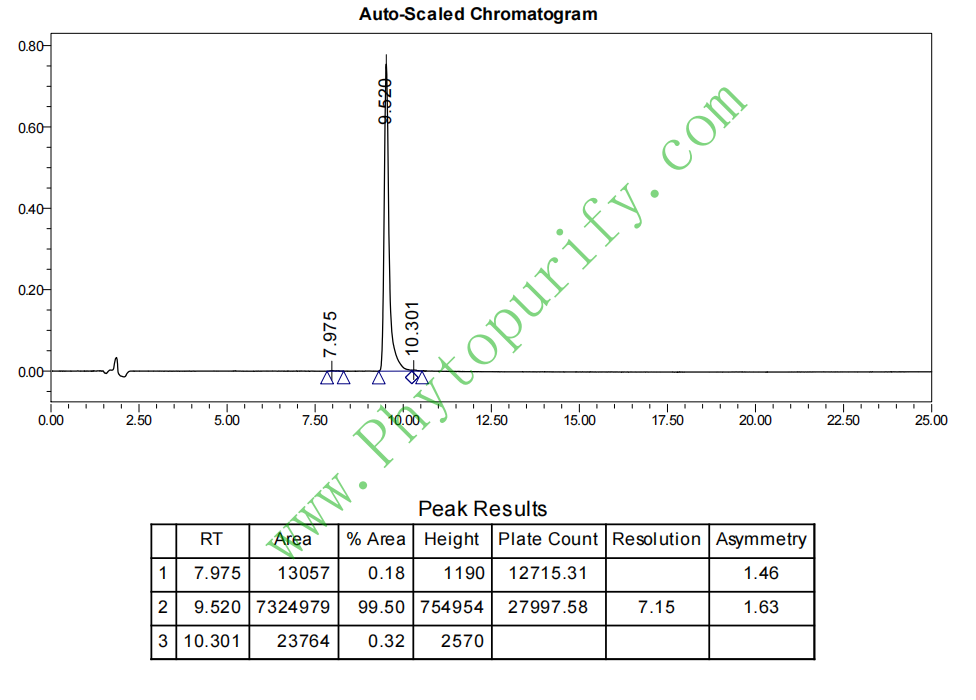
Purity: 95%~99%
Analysis Method: HPLC-DAD or/and HPLC-ELSD
Identification Method: Mass, NMR
Packing: Brown vial or HDPE plastic bottle
Storage: Store in a well closed container, protected from air and light. Put into refrigerate or freeze for long term storage.
Whenever possible, you should prepare and use solutions on the same day. However, if you need to make up stock solutions in advance, we recommend that you store the solution as aliquots in tightly sealed vials at -20℃. Generally, these will be useable for up to two weeks.
The product could be supplied from milligrams to grams
Inquire for bulk scale.
Chengdu Biopurify Phytochemicals Ltd. is a leading company in the research, development, manufacture and marketing of High Quality Phytochemicals and Extracts(especially Active Ingredients from Traditional Chinese Medicine,TCM), Natural Active Pharmaceutical Ingredients worldwide.
The main services:
A. Supply active ingredients and reference standards of TCM, from mgs to kgs scale
B. Custom extraction and purification, target Herb Active Ingredients
C. Custom synthesis and semi-synthesis for Natural Active Ingredients
D. CR(contract research), CM(contract manufacture) and PD(process development) services from lab scale, pilot scale to commercial scale(GMP is also available)
E. TCM compounds library for drug screen,more than 3000 compounds available, many of them are rare and unique.
HPLC of Cucurbitacin E
Storage conditions:Short-term storage at 2~8℃, long-term storage at -20 ~ -80℃
Cucurbitacin E (CAS number: 18444-66-1) is a type of triterpenoid natural product derived from plants in the Cucurbitaceae family. Due to its unique chemical structure and significant biological activity, it has received widespread attention in the field of natural product pharmacology in recent years. Cucurbitacin compounds are known for their strong cytotoxicity and anti-tumor activity, especially exhibiting significant inhibitory effects in various cancer models. As an important member, cucurbitacin E has become one of the hotspots in the development of anticancer drugs due to its ability to significantly inhibit the activity of the cell cycle key regulatory protein cyclin B1/CDC2 complex, demonstrating potential anti-tumor mechanisms.
Colon cancer is a malignant tumor of digestive system with high incidence rate and mortality worldwide, and its complex pathogenesis involves abnormal activation of multiple signal pathways. Hulusin E exhibits multi-target and multi pathway anti-tumor potential by regulating various key molecular targets including AMPK, BCL2, STAT3, MAPK1, etc. This article will systematically review the chemical structure and physicochemical properties, plant sources and extraction methods, pharmacological activity and mechanism of action, pharmacological evaluation and pharmacokinetic characteristics of cucurbitacin E, and explore its clinical application prospects in the treatment of colon cancer, aiming to provide theoretical basis and reference for subsequent research and drug development.
Hulusin E belongs to the triterpenoid class, with a chemical formula of C32H44O8 and a molecular weight of 556.68. Its structure is based on the tetracyclic triterpenoid parent nucleus, with typical cyclopentane and cyclohexane ring skeletons. The molecule contains multiple hydroxyl and ketone groups, endowing it with rich functional group characteristics. The LogP value of cucurbitacin E is about 3.0, indicating its moderate lipid solubility, which is beneficial for cell membrane penetration. Its topological polar surface area (TPSA) is 146.9 Å ², indicating high molecular polarity and 8 hydrogen bond acceptors. These physicochemical properties have important impacts on its bioavailability and targeting activity.
Structurally, cucurbitacin E contains multiple unsaturated bonds and oxidative functional groups, which not only determine its biological activity but also affect its stability and metabolic pathways. Its larger molecular weight and higher polarity suggest the need to optimize its pharmacokinetic performance in the drug design process to improve absorption and distribution efficiency in vivo.
Cucurbitacin E is mainly found in plants of the Cucurbitaceae family, such as Momordica charantia, Cucurbita pepo, and other wild plants of the Cucurbitaceae genus. Different plant species and their growth environments have a significant impact on the content and composition of cucurbitacin E. Usually, cucurbitacin E is concentrated in the fruits and rhizomes of plants.
There are various methods for extracting cucurbitacin E, including solvent extraction, ultrasound assisted extraction, and high-performance liquid chromatography (HPLC) separation and purification. Traditional solvent extraction often uses ethanol or methanol as solvents, combined with reflux extraction or ultrasound assisted techniques to improve extraction efficiency. Subsequently, separation and purification were carried out using silica gel column chromatography or reverse phase HPLC to ensure the acquisition of high-purity cucurbitacin E.
In recent years, green extraction techniques such as supercritical CO2 extraction and microwave-assisted extraction have gradually been applied to the extraction of cucurbitacin E, aiming to improve extraction efficiency and reduce the use of organic solvents, in line with the environmental trend of modern natural product extraction.
The pharmacological activity of cucurbitacin E focuses on its significant anti-tumor effect, especially its inhibitory effect in colon cancer cell lines. In vitro studies have shown that cucurbitacin E can effectively inhibit the proliferation of colon cancer cells, induce cell apoptosis, and block the cell cycle progression. Its anti-tumor activity is closely related to its inhibition of the cyclin B1/CDC2 complex, which blocks the G2/M phase transition and leads to cell cycle arrest.
In addition to anti-tumor effects, cucurbitacin E also exhibits multiple biological activities such as anti-inflammatory and antioxidant effects. Its anti-inflammatory effect is mainly achieved by inhibiting the inflammatory mediator TNF - α and related signaling pathways, thereby reducing the inflammatory response and having potential immune regulatory functions. Antioxidant activity helps alleviate oxidative stress and protect cells from free radical damage.
Animal model studies further support the anti-tumor potential of cucurbitacin E, showing that it can effectively inhibit tumor growth and improve the tumor microenvironment in vivo, with low toxicity and good safety basis.
The pharmacological mechanism of cucurbitacin E is complex and diverse, involving multiple signaling pathways and molecular targets. Its core mechanism includes:
cell cycle regulation
Hulusin E inhibits the activity of cyclin B1/CDC2 complex, blocking the transition of cells from G2 phase to M phase, leading to cell cycle arrest and suppressing cancer cell proliferation.
AMPK signaling pathway activation
As an energy sensing molecule, AMPK (PRKAA1) is activated by cucurbitacin E, promoting cellular energy metabolism reprogramming, inducing autophagy and apoptosis, and inhibiting tumor cell growth.
Inhibition of anti apoptotic protein BCL2
Cucurbitacin E downregulates BCL2 expression, disrupts intracellular anti apoptotic balance, and promotes mitochondrial mediated apoptosis.
STAT3 signaling pathway inhibition
STAT3, as a key transcription factor in various tumors, is inhibited by cucurbitacin E, which blocks the proliferation and metastasis ability of tumor cells.
Regulation of multidrug resistance associated protein ABCB1
Hulusin E can regulate the expression and function of ABCB1, reduce drug efflux from tumor cells, and enhance the sensitivity of chemotherapy drugs.
Inflammatory and oxidative stress-related targets
By inhibiting inflammatory mediators such as ALOX5 and TNF, cucurbitacin E alleviates chronic inflammation related to tumors and improves the tumor microenvironment.
Regulation of other signaling pathways
Including multiple molecular targets such as TOP1, MAPK1, GSK3B, and PPARG, cucurbitacin E achieves comprehensive regulation of tumor cells through multi-target synergistic effects.
In summary, cucurbitacin E exhibits strong anti-tumor activity through a multi-target and multi pathway mechanism of action, and its regulation of cell cycle and signaling pathways provides a solid molecular basis for its pharmacological effects.
The pharmacological parameters of cucurbitacin E indicate that it has certain potential for drug development. Although the molecular weight of 556.68 is relatively large, it is still within an acceptable range. LogP is 3.0, indicating moderate lipid solubility and favorable cell membrane permeability. The TPSA value of 146.9 is relatively high, indicating strong polarity that may affect oral absorption and bioavailability.
The number of hydrogen bond receptors is 8, indicating that the molecule has strong hydrogen bond binding ability, which helps to form stable complexes with target proteins, but may also limit its ability to pass through lipid membranes. The low permeability of the blood-brain barrier suggests its limited distribution in the central nervous system, reducing the risk of central neurotoxicity.
At present, there is insufficient safety data on the hepatotoxicity, cardiotoxicity, and hERG channel inhibition of cucurbitacin E, and further systematic toxicological studies are needed to clarify them. The Ames test results are unknown, and genetic toxicity assessment is required to ensure its safety.
In terms of pharmacokinetics, existing research is relatively limited. Preliminary in vivo experiments indicate that oral absorption of cucurbitacin E is limited, possibly due to its high polarity and reduced bioavailability caused by metabolic enzyme activity. Its metabolic pathway may involve the liver cytochrome P450 enzyme system, and the activity and toxicity of metabolites need further research. The half-life and distribution characteristics in the body are still unclear.
In summary, cucurbitacin E has a certain pharmacological basis, but its pharmacokinetic properties need to be improved through structural modification and pharmaceutical optimization to enhance in vivo stability and bioavailability.
Hulusin E has shown broad application prospects in the treatment of solid tumors such as colon cancer due to its multi-target anti-tumor mechanism and good cytotoxicity. It may effectively overcome the resistance of traditional chemotherapy drugs and improve treatment efficacy by regulating the cell cycle, inducing apoptosis, and inhibiting multidrug resistance related proteins.
In the future, cucurbitacin E is expected to play a synergistic anti-cancer role as an important component of single drug or combination chemotherapy regimens. In addition, its anti-inflammatory and antioxidant properties provide new ideas for regulating the tumor microenvironment, which helps to comprehensively improve the effectiveness of tumor treatment.
However, the clinical translation of cucurbitacin E still faces many challenges. Firstly, it is necessary to conduct in-depth research on its safety and toxicological characteristics, and clarify potential side effects. Secondly, optimizing its pharmacokinetic performance, improving oral bioavailability and in vivo stability are key to achieving clinical applications. Finally, conduct systematic preclinical and clinical trials to verify its efficacy and safety, and promote its transition from laboratory to clinical use.
Future research can focus on the structural modification of cucurbitacin E, the development of nanocarrier delivery systems, and its combined application with existing anticancer drugs to enhance its therapeutic efficacy and clinical applicability. Meanwhile, utilizing modern molecular biology and pharmacology techniques to elucidate the details of its mechanism of action provides theoretical support for precision therapy.
Cucurbitacin E, as an important triterpenoid natural product in the Cucurbitaceae family, has shown great potential in the treatment of colon cancer due to its unique chemical structure and multi-target anti-tumor activity. It achieves cell cycle arrest and apoptosis induction by inhibiting the activity of cyclin B1/CDC2 complex, regulating key molecular targets such as AMPK, BCL2, STAT3, etc., demonstrating the advantages of multi-dimensional intervention of natural products in tumors.
Although the safety and pharmacokinetic data of cucurbitacin E are currently incomplete, its good pharmacokinetic parameters and preliminary pharmacological research results have laid the foundation for subsequent development. In the future, through structural optimization and innovation in drug delivery technology, cucurbitacin E is expected to become a new candidate drug for the treatment of colon cancer and other tumors.
In summary, cucurbitacin E not only enriches the reservoir of natural anti-cancer drugs, but also provides important scientific basis for a deeper understanding of tumor cell cycle regulation and multi-target therapy strategies. With the continuous deepening of research, its clinical application prospects are worth looking forward to.
