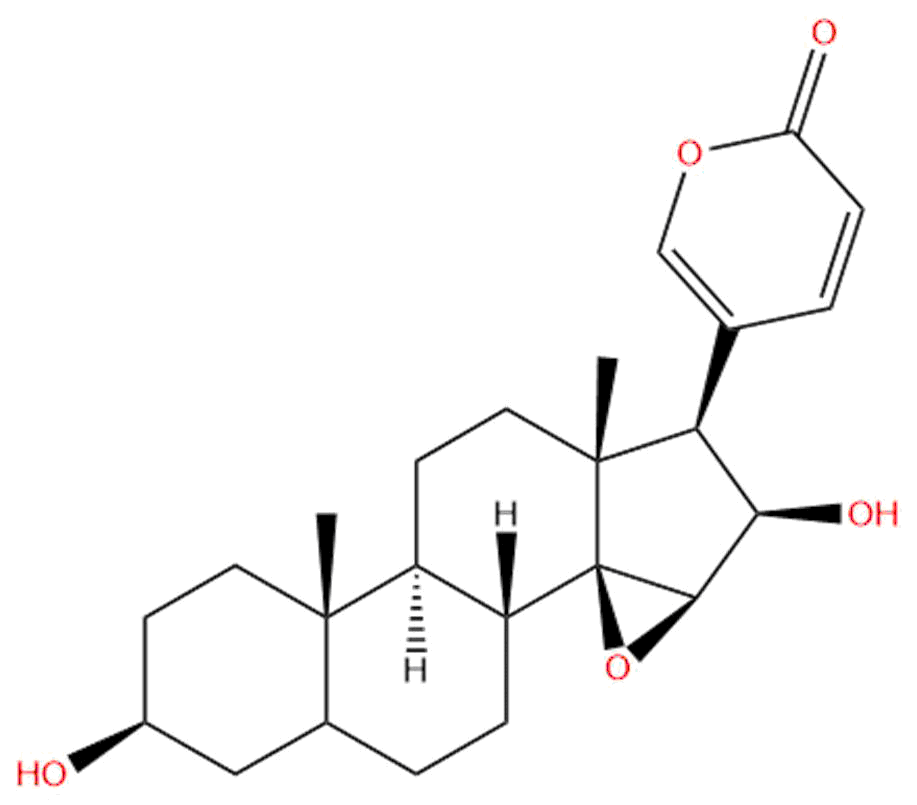


Product name: Desacetylcinobufagin
Synonym name:
Catalogue No.: BP0485
Cas No.: 4026-95-3
Formula: C24H32O5
Mol Weight: 400.52
Botanical Source:
Physical Description:
Type of Compound:
Purity: 95%~99%
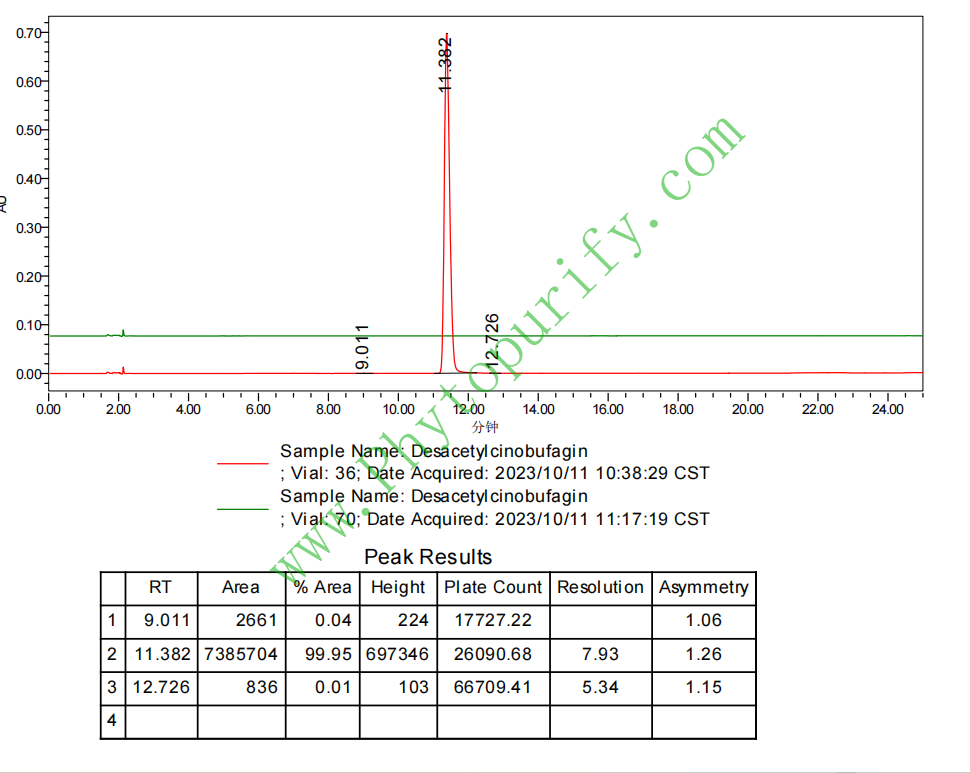
Analysis Method: HPLC-DAD or/and HPLC-ELSD
Identification Method: Mass, NMR
Packing: Brown vial or HDPE plastic bottle
Storage: Store in a well closed container, protected from air and light. Put into refrigerate or freeze for long term storage.
Whenever possible, you should prepare and use solutions on the same day. However, if you need to make up stock solutions in advance, we recommend that you store the solution as aliquots in tightly sealed vials at -20℃. Generally, these will be useable for up to two weeks.
The product could be supplied from milligrams to grams
Inquire for bulk scale.
For Reference Standard and R&D, Not for Human Use Directly.
HPLC of Desacetylcinobufagin
Storage conditions:Short-term storage at 2~8℃, long-term storage at -20 ~ -80℃
83.2000
3.0347
3.0349
.0151
1.8707
4.7008
High
85.8395
5.1950
No
No
No
No
Yes
No
0.3
Yes
No
No
Yes
Cardiotonic glycosides play an important role in the treatment history of cardiovascular diseases such as heart failure. Their core mechanism of action is to inhibit Na ⁺/K ⁺ - ATPase on the myocardial cell membrane, thereby enhancing myocardial contractility. Although traditional cardiac glycosides such as digoxin have definite therapeutic effects, their clinical application is limited due to narrow treatment windows and serious adverse reactions such as arrhythmia. Therefore, the search for new, efficient, and safer cardiac compounds has always been an important direction in drug development. Chansu, as a traditional Chinese medicine, has long been recognized for its cardiotonic activity, with its main active ingredients being bufotoxin based compounds. Desacetylcinobufagin (CAS: 4026-95-3) is a microbial transformation product of cinobufagin and belongs to the class of bufotoxin compounds. In recent years, with the deepening development of natural product chemistry and molecular pharmacology, deacetylated bufogenin has gradually emerged as an emerging hotspot in the field of cardiovascular drug research due to its significant cardiac activity and potential multi-target mechanism of action. This article aims to systematically review the chemical characteristics, pharmacological activity, molecular mechanism of action, pharmacological evaluation, and clinical application prospects of deacetylated bufotaxime, in order to provide comprehensive academic references for the in-depth research and development of this compound.
The molecular formula of deacetylated bufotalin is C ₂₄ H ∝₂ O ₆, with a molecular weight of 400.5150. Its chemical structure belongs to the steroid class of bufotoxin, which is a derivative of Cinobufagin after removing the acetoxy group (- OCOCH ∝) at the C-16 position. The core structure is a steroid skeleton with a hexagonal unsaturated lactone ring (α - pyranone ring), which is a key pharmacophore with strong cardiac activity. Compared with Huachan toxin essence, deacetylation slightly increases its polarity and decreases its lipophilicity.
The key physicochemical property parameters are as follows: the calculated lipid water partition coefficient (LogP) is 3.0347, indicating that the compound has moderate to high lipophilicity, which is beneficial for transmembrane transport, but excessively high LogP may also affect water solubility. The topological polar surface area (TPSA) is 83.2000 Å ², reflecting the area of hydrogen bond acceptors in the molecule. The predicted value of water solubility is 0.0151 mg/mL, which belongs to the category of slightly soluble to poorly soluble. This suggests that in the development of formulations, it may be necessary to improve their solubility and bioavailability through techniques such as salt formation, cyclodextrin inclusion, or nanocrystals. These basic physicochemical properties are the material basis for its subsequent pharmacokinetic behavior and biological activity.
The deacetylated bufogenin is not directly extracted from the initial components of toad venom, but is mainly obtained through biotransformation pathways. Its precursor, Huachanzhun, is widely present in the Chinese toad(Bufo gargarizans)Or black eyed toad(Bufo melanostictus)Dry secretion from the ear gland and skin - in toad venom. The components of toad venom in toad venom are complex, and Chinese toad venom essence is one of the main active ingredients.
Traditional extraction methods often use organic solvents such as methanol and ethanol to extract toad venom, and then separate and purify it through various chromatographic techniques such as silica gel column chromatography and high-performance liquid chromatography (HPLC) to obtain the monomer of Chinese toad venom essence. The main way to obtain deacetylated toad venom essence is Microbial transformation Utilizing certain specific fungi or bacteria (such as Fusarium)Fusarium Aspergillus genus Aspergillus The enzyme system selectively hydrolyzes the acetyl ester bond at the C-16 position of Bufalin to achieve deacetylation reaction. This biotransformation method has the advantages of mild conditions, high selectivity, and environmental friendliness, and is an effective means of preparing deacetylated bufotalin. In addition, chemical synthesis can also achieve structural modification, but the steps are relatively cumbersome and there are many by-products. At present, microbial transformation is the preferred method for laboratory preparation and potential large-scale production of deacetylated bufotaxime.
The pharmacological activity research of deacetylated bufogenin mainly focuses on the cardiovascular system, and its cardiotonic effect is particularly prominent.
Heart strengthening effect Multiple ex vivo and in vivo experiments have confirmed that deacetylated bufogenin has clear cardiac activity. In the Langendorff perfusion models of isolated frog hearts, guinea pig atria, and rat hearts, it can significantly enhance myocardial contractility (positive inotropic effect) and increase cardiac output. Compared with the classic cardiac glycoside digoxin, its effect is rapid and within a certain dosage range, its impact on heart rate is relatively small, suggesting that it may have different characteristics of action or a better safety window.
Anti heart failure effect In animal models of heart failure (such as coronary artery ligation induced heart failure model and doxorubicin induced cardiomyopathy model), deacetylated bufotaxime can improve cardiac function indicators, such as increasing left ventricular systolic pressure (LVSP), maximum rate of increase/decrease of left ventricular pressure (± dp/dtmax), reducing left ventricular end diastolic pressure (LVEDP), reducing pre - and post cardiac load, and alleviating heart failure symptoms.
Other potential activities In addition to its core cardiotonic effect, preliminary studies also suggest that deacetylated bufotaxime may have biological activities shared by bufotaxime based compounds such as anti-inflammatory and anti-tumor effects. However, the correlation and importance of these activities with their cardiotonic effects still need further exploration and verification.
The cardiotonic mechanism of deacetylated bufogenin is complex, involving multi-target regulation of ion channels and transporters in cardiomyocytes, which may be the key difference from traditional cardiac glycosides. Existing research has revealed its interactions with multiple key targets:
Inhibition of Na ⁺/K ⁺ - ATPase As a bufalin, deacetylated bufogenin is still an effective inhibitor of Na ⁺/K ⁺ - ATPase. It inhibits its pumping function by binding to specific sites on the alpha subunit of the enzyme, leading to an increase in intracellular Na ⁺ concentration. Subsequently, through the reverse mode of Na ⁺/Ca ² ⁺ exchange (NCX, encoded by SLC8A1 gene), Ca ² ⁺ efflux is reduced or Ca ² ⁺ influx is increased, ultimately leading to an increase in intracellular Ca ² ⁺ concentration in cardiomyocytes, activating myofilament sliding and enhancing contractility. The subtype selectivity of its action (such as different affinities for subtypes such as ATP1A1, ATP1A2, ATP1A3, ATP1B1, ATP1B3, etc.) may affect its tissue distribution and effect intensity.
Regulation of ion channels:
Multi target synergistic effect In summary, the cardiotonic effect of deacetylated bufogenin is not achieved through a single target, but through simultaneous action on Na ⁺/K ⁺ - ATPase (ATP1A1, etc.), NCX (SLC8A1), L-type calcium channel (CACNA1C), potassium channel (KCNJ2), and ryanodine receptor (RYR2) Wait for multiple key proteins to form a networked regulatory system. This multi-target characteristic may enhance myocardial contraction while regulating intracellular calcium homeostasis more finely, theoretically leading to smoother therapeutic efficacy and different safety features. However, multi-target action also increases the complexity of its pharmacological and toxicological mechanisms, requiring more in-depth systematic research.
Based on computational predictions and preliminary experimental data, the preliminary evaluation of the pharmacological properties of deacetylated bufogenin is as follows:
As a novel cardiac active compound, the clinical application prospects and challenges of deacetylated bufogenin coexist.
Potential application directions:
1. Treatment of acute and chronic heart failure As a positive inotropic drug, its core application scenario is heart failure, especially for patients with poor efficacy or intolerance to traditional cardiac glycosides, which may provide a new option. Its multi-target mechanism of action may bring more physiological cardiotonic effects.
2. Developed as a novel positive inotropic drug Based on its unique mechanism of action spectrum, it is expected to be developed into a "new generation" of cardiac glycosides or cardiac drugs different from digoxin.
3. combination therapy Possible combination with existing standard treatment drugs for heart failure, such as angiotensin-converting enzyme inhibitors (ACEIs) and beta blockers, to explore synergistic effects.
Future research focus and prospects:
1. In depth study on the mechanism of action By utilizing techniques such as molecular docking, surface plasmon resonance (SPR), and patch clamp, the binding mode, affinity, and functional regulation details of the target (CACNA1C, ATP1A1, RYR2, etc.) are accurately elucidated, and a complete pharmacological action network diagram is drawn.
2. Comprehensive preclinical efficacy and safety evaluation Systematically evaluate its cardiotonic efficacy, treatment window, long-term toxicity, especially its impact on cardiac electrophysiology (electrocardiogram) and major organ function in advanced animal models closer to human diseases, such as heart failure models in pigs and dogs.
3. Pharmacokinetic and Formulation Studies Conduct systematic ADME research to clarify its in vivo processes. To address the issue of poor water solubility, new drug delivery systems such as self microemulsions, liposomes, nanoparticles, etc. have been developed to improve their bioavailability and drug delivery stability.
4. Structural optimization and derivative development Using it as the parent nucleus, reasonable structural modifications (such as derivatization of the C-3 hydroxyl group) are carried out to further enhance activity, reduce toxicity, improve pharmacokinetic properties, and discover candidate drugs with greater development potential.
5. Explore new indications Given the extensive biological activity of bufotoxin based compounds, their potential applications in the fields of antiarrhythmic (caution needed), anti myocardial ischemia, and even anti-tumor (especially derivatives with less cardiac toxicity) can be explored.
As a microbial transformation product derived from the traditional Chinese medicine Bufonis, deacetylated bufogenin has become a promising candidate molecule in the research of natural cardiovascular drugs due to its clear cardiac activity and unique multi-target mechanism of action. It enhances myocardial contractility at multiple levels by synergistically regulating Na ⁺/K ⁺ - ATPase, multiple ion channels, and calcium processing proteins, providing a theoretical basis for its potential therapeutic and safety features that differ from traditional cardiac glycosides. However, its low solubility, safety features that require experimental verification (especially its impact on the central nervous system), and complex action networks that have not yet been fully elucidated are key scientific issues that it must face and solve on its path towards clinical translation. In the future, through interdisciplinary and in-depth research, including precise mechanism analysis, innovative formulation strategies, and systematic preclinical evaluation, deacetylated bufogenin is expected to provide a new weapon for the treatment of cardiovascular diseases such as heart failure, and also provide valuable examples for the development of multi-target drugs based on natural products.
