


Product Name: Complanatuside
Synonym name: Complanatuside A
Catalogue No.: BP0385
Cas No.: 116183-66-5
Formula: C28H32O16
Mol Weight: 624.548
Botanical Source: Astragalus complanatus and Lysimachia christinae
Purity: 95%~99%
Analysis Method: HPLC-DAD or/and HPLC-ELSD
Identification Method: Mass, NMR
Packing: Brown vial or HDPE plastic bottle
Can be supplied from milligrams to grams.
For Reference Standard and R&D, Not for Human Use Directly.
Inquire for bulk scale.
Description:
Complanatoside C is a natural product from Astragali Semen.
References:
Zhongguo Zhong Yao Za Zhi. 2018 Apr;43(7):1459-1466.
Chemical constituents from seeds of Astragali complanati.
A new flavonoid glycoside, named Complanatoside C (1), and 19 known compounds (2-20) were isolated from an 95% ethanol extract of Astragali Semen by various chromatographic methods.
METHODS AND RESULTS:
Their structures were identified on the basis of UV, IR, NMR, MS spectroscopic data analysis, and comparison with those in literature, including fifteen flavonoid glycoside (1-15), and six other constituents (16-20), among which compounds 16-19 were isolated from this plant for the first time.
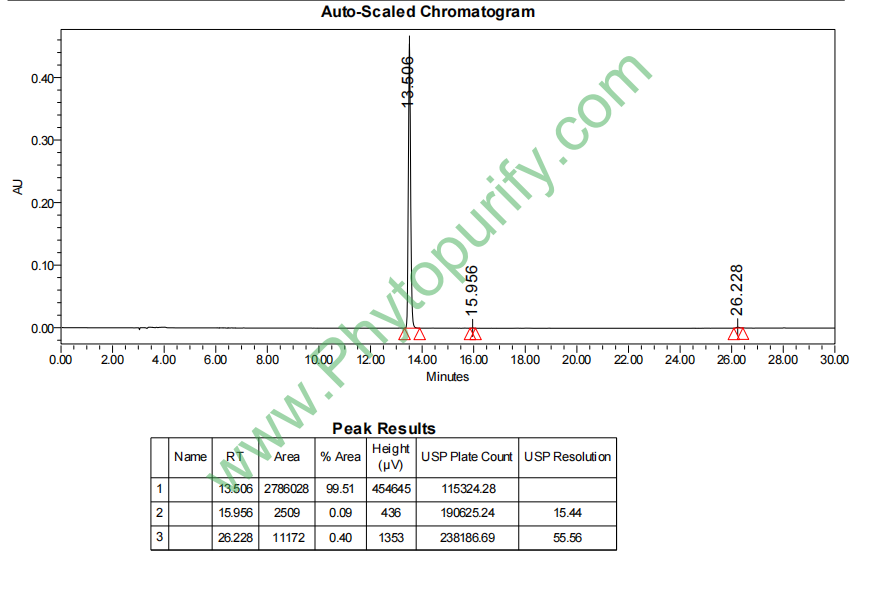
HPLC of Complanatuside A
Storage conditions:Short-term storage at 2~8℃, long-term storage at -20 ~ -80℃
Complinatuside A (CAS number: 116183-66-5) is a natural flavonoid product isolated from the traditional Chinese medicine Astrolus compliatus. As a typical representative of flavonoids, salidroside A has received widespread attention due to its significant antioxidant activity. In recent years, as the core role of oxidative stress in the pathogenesis of various diseases has been gradually revealed, research on natural products targeting antioxidant damage has become an important direction for drug development. Shayuanzi glycoside A, with its excellent antioxidant properties and good safety, has demonstrated potential application value in the prevention and treatment of oxidative stress-related diseases.
This article will provide a systematic review of the chemical structure and physicochemical properties, plant sources, and extraction methods of salidroside A, with a focus on its pharmacological activity and mechanism of action. Combined with drug evaluation and pharmacokinetic data, it will explore its clinical application prospects and future research directions, providing theoretical basis and research references for the drug development of this natural product.
Shayuanzi glycoside A belongs to the flavonoid class with a molecular weight of 624.54. Its chemical structure contains multiple hydroxyl and sugar groups, exhibiting high polarity. Its LogP value is about -2.0, indicating that the compound has strong hydrophilicity and is difficult to pass through the lipid soluble barrier. The total polar surface area (TPSA) is 278.48 Å ², and the number of hydrogen bond acceptors is as high as 16, indicating significant intermolecular hydrogen bonding interactions that may affect the permeability of its biofilm.
Structurally, salidroside A is composed of a flavonoid core and multiple glycosidic residues connected by glycosidic bonds. The presence of glycosides enhances its water solubility, but also limits its ability to penetrate the blood-brain barrier. This compound has no hepatotoxicity, cardiotoxicity, or hERG channel inhibition, demonstrating good safety characteristics. The results of its Ames mutagenicity test are not yet clear and require further evaluation.
Sha Yuan Zi Glycoside A mainly comes from the seeds of the traditional Chinese medicine Sha Yuan Zi, namely the North Sha Yuan (Astrolus complexatus Bunge). Shayuanzi, in traditional Chinese medicine, has the effects of tonifying the kidneys, strengthening yang, diuresis, and promoting lymphatic circulation, and is widely used as an adjuvant therapy for urinary system diseases. Its seeds are rich in various flavonoids, among which salidroside A is one of the main active ingredients.
The extraction method usually uses ethanol or methanol as solvents for reflux extraction, followed by multi-step purification processes such as liquid-liquid distribution, silica gel column chromatography, and reverse phase high performance liquid chromatography (RP-HPLC) to obtain high-purity salidroside A. In recent years, ultrasound assisted extraction and supercritical fluid extraction technologies have also been introduced to improve extraction efficiency and purity, while reducing solvent usage, in line with the concept of green chemistry.
The pharmacological activity research of salidroside A mainly focuses on its antioxidant damage effect. In vitro experiments have shown that salidroside A can significantly scavenge free radicals, inhibit lipid peroxidation, and protect cells from oxidative stress-induced damage. It has a regulatory effect on various oxidase systems, can enhance the activity of intracellular antioxidant enzymes, and alleviate oxidative damage.
In animal experiments, salidroside A has shown protective effects on various oxidative stress-related disease models, such as myocardial ischemia-reperfusion injury, liver injury, and neurodegenerative disease models. It shows good therapeutic potential by regulating the redox state, reducing inflammatory reactions, promoting cell survival.
In addition, salidroside A also has certain anti-inflammatory, anti-tumor, and immune regulatory activities, which may be closely related to its antioxidant mechanism, but these effects still need further systematic research.
The antioxidant mechanism of salidroside A is mainly achieved by regulating key intracellular antioxidant signaling pathways. Its targets include NFE2L2 (nuclear factor erythroid 2-related factor 2, NRF2)、 Superoxide dismutase 1 (SOD1), catalase (CAT), glutathione peroxidase 1 (GPX1), heme oxygenase 1 (HMOX1), and mitochondrial superoxide dismutase 2 (SOD2).
NRF2, as the main intracellular antioxidant transcription factor, regulates the expression of various antioxidant enzymes. Shayuanzi glycoside A can promote the nuclear translocation of NRF2, enhance its transcriptional activation of antioxidant genes, and improve the antioxidant defense ability of cells. By activating the NRF2 signaling pathway, salidroside A upregulates the expression of antioxidant enzymes such as SOD1, SOD2, CAT, GPX1, and HMOX1, promoting the clearance of reactive oxygen species (ROS) and alleviating cellular damage caused by oxidative stress.
In addition, salidroside A may exert its cell protective effect by inhibiting the expression of oxidative stress-related inflammatory factors, regulating the apoptotic signaling pathway, and further enhancing its cellular protective function. The specific molecular mechanism still needs to be further analyzed through multiple omics techniques and molecular biology experiments.
The pharmacological evaluation of Shayuanzi glycoside A shows that it has good safety and low toxicity characteristics. Its LogP value is -2, indicating strong water solubility but weak lipid solubility, which may limit its oral absorption and tissue distribution, especially difficult to pass through the blood-brain barrier, limiting its application in central nervous system diseases.
The high TPSA value and numerous hydrogen bond receptors further indicate poor membrane permeability, which may lead to limited bioavailability. The pharmacokinetic studies in vivo are not yet complete, and preliminary data suggest that salidroside A is metabolized rapidly in the body, mainly cleared through the hepatic metabolic pathway, with no significant hepatotoxicity or cardiac toxicity.
In the future, it is necessary to optimize its pharmacokinetic properties through drug formulation technology, such as nanocarrier encapsulation, liposome delivery, or structural modification, to improve its in vivo stability and bioavailability, and expand its clinical application potential.
Based on the significant antioxidant activity and good safety of salidroside A, its application prospects in antioxidant damage related diseases are broad. Oxidative stress is an important pathological mechanism in cardiovascular diseases, neurodegenerative diseases, liver diseases, and various chronic inflammatory diseases. Astragaloside A is expected to act as a natural antioxidant to assist in the prevention and treatment of these diseases.
Preclinical studies need to further improve their pharmacokinetic, toxicological, and pharmacological evaluations, and clarify the optimal route and dosage of administration. By combining modern drug delivery technology, oral or injectable formulations can be developed to improve their clinical applicability.
In addition, as a natural flavonoid product, the multi-target regulatory properties of salidroside A can help achieve multi mechanism synergistic therapy, which can be combined with other drugs in the future to exert synergistic effects. Its potential in neuroprotection, anti-inflammatory, and immune regulation is also worth exploring in depth.
As an important flavonoid active ingredient in Astragalus membranaceus, Astragaloside A has significant antioxidant damage effects, mainly by activating the NRF2 signaling pathway and regulating the expression of various antioxidant enzymes to achieve cell protection. Its good safety and multi-target mechanism of action have laid the foundation for it to become a new natural drug candidate for the treatment of antioxidant related diseases.
Although there is a preliminary understanding of its pharmacological effects and drug properties, systematic pharmacokinetic, toxicological, and preclinical evaluations are still needed to optimize drug formulations and promote their clinical translation. In the future, by combining modern molecular biology and medicinal chemistry technologies, salidroside A is expected to play a greater role in the field of natural product pharmacology and become an important drug resource in the field of antioxidant therapy.
