

Storage conditions:Short-term storage at 2~8℃, long-term storage at -20 ~ -80℃
Natural products, as an important source of drug discovery, occupy an irreplaceable position in modern pharmacological research. Flavonoids have become one of the hotspots in natural product pharmacology research due to their structural diversity and wide range of biological activities. 6 "- malonate (CAS number 2089462-18-8) is a flavonoid compound recently isolated from the traditional Chinese medicine Sophora japonica L. Shayuanzi has a long history of application in traditional Chinese medicine, mainly used for treating liver and kidney diseases, regulating immune function, and anti-inflammatory effects. With the development of modern analytical techniques, the structural identification, pharmacological activity, and mechanism of action of 6 "- malonic acid salidroside monoester have gradually been revealed, laying the foundation for its research as a potential drug candidate molecule.
This article aims to provide a systematic review of the chemical structure and physicochemical properties, plant sources and extraction methods, pharmacological activity and mechanism of action, pharmacological evaluation and pharmacokinetic characteristics of 6 '- malonic acid salidroside monoester, and to explore its clinical application prospects. By integrating existing research results, it is expected to provide theoretical support and research directions for the subsequent development and application of this compound.
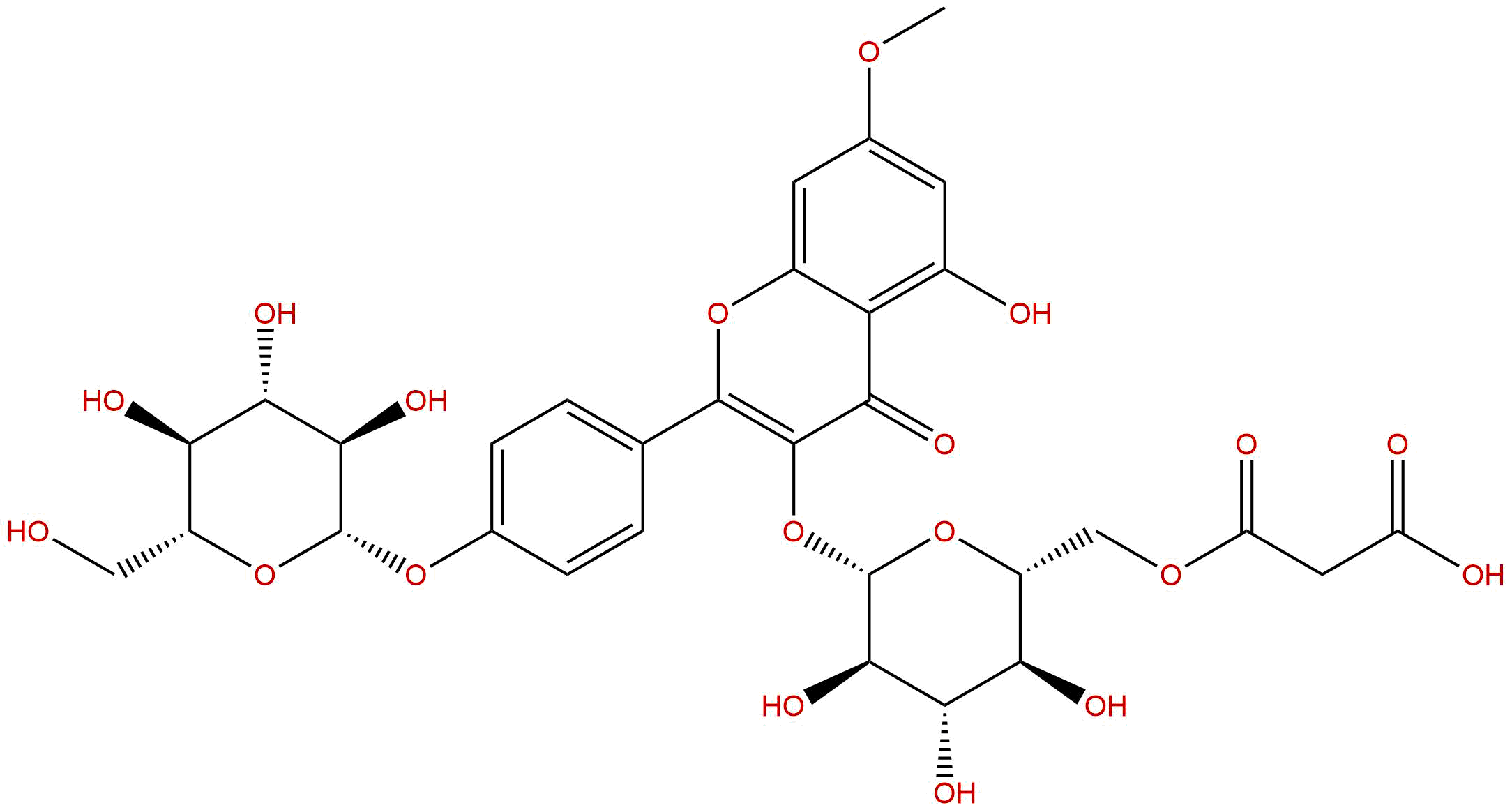
The 6 "- malonic acid salidroside monoester belongs to the class of flavonoids, specifically a monoester derivative in which the 6" hydroxyl group of salidroside is modified by malonic acid esterification. Its molecular formula is C34H-38O17 and its molecular weight is 710.5940. The structure contains a typical flavonoid skeleton, supplemented by glycosidic and malonic ester groups, endowing it with unique physicochemical properties and biological activity.
In terms of physical and chemical properties, the LogP value of 6 "- malonic acid salidroside monoester is -0.5073, indicating strong hydrophilicity and a water solubility of 3.7190, demonstrating good water solubility. The polar surface area (TPSA) is as high as 301.8 Å ², indicating that the molecule has a large number of polar groups, which may affect its cell membrane penetration ability. The low permeability of the blood-brain barrier means that the compound is difficult to enter the central nervous system. The negative result of hERG channel inhibition experiment indicates a low risk of cardiac toxicity. The Ames test result is 0.6, indicating a low risk of genotoxicity and good safety.
In summary, 6 "- malonic acid salidroside monoester has good water solubility and safety characteristics, but its high polarity and low blood-brain barrier permeability may limit its application in central system diseases.
The main source of 6 "- malonic acid salidroside monoester is Sophora japonica L., a dried and mature seed of the leguminous plant genus Sophora. It is widely used in traditional Chinese medicine for hemostasis, anti-inflammatory, and liver and kidney protection. Shayuanzi contains abundant flavonoids, especially Shayuanzi glycosides and their derivatives.
The extraction method usually uses ethanol or methanol as solvents, and obtains crude extracts through reflux extraction or ultrasound assisted extraction. Subsequently, using multi-step separation and purification techniques such as liquid-liquid distribution, silica gel column chromatography, and reverse phase high performance liquid chromatography (RP-HPLC), high-purity 6 "- malonic acid salidroside monoester was obtained. In recent years, the introduction of supercritical fluid extraction and molecular imprinting technology has further improved the extraction efficiency and purity.
The optimization of extraction process not only ensures the yield and purity of compounds, but also provides technical support for subsequent pharmacological activity research and industrial production.
As a natural flavonoid product, the 6 "- malonic acid salidroside monoester exhibits various biological activities, mainly including anti-inflammatory, antioxidant, immune regulatory, and liver and kidney protective effects.
Both in vitro cell models and animal experiments have shown that 6 "- malonic acid salidroside monoester can significantly inhibit the release of inflammatory mediators such as tumor necrosis factor - α (TNF - α), interleukin-6 (IL-6), and nitric oxide (NO). Its mechanism of action may involve inhibiting the activation of the nuclear factor kappa B (NF - κ B) signaling pathway, thereby reducing the expression of pro-inflammatory genes.
This compound has strong free radical scavenging ability and can effectively reduce the generation of reactive oxygen species (ROS), protecting cells from oxidative stress damage. Both in vivo and in vitro experiments have confirmed that it enhances the antioxidant defense ability of cells by increasing the activity of endogenous antioxidant enzymes such as superoxide dismutase (SOD) and glutathione peroxidase (GPx).
6 "- Malonic acid salidroside monoester can regulate the function of immune cells, promote lymphocyte proliferation, enhance macrophage phagocytic activity, regulate cytokine secretion balance, and demonstrate potential immune enhancement effects.
Animal models have shown that the compound can alleviate liver and kidney damage, reduce serum transaminase levels, alleviate tissue inflammation and fibrosis, suggesting its protective role in liver and kidney diseases.
Although current pharmacological research is mostly focused on in vitro and animal models, the multi-target and multi pathway action characteristics of 6 "- malonic acid salidroside monoester provide scientific basis for its clinical development.
The mechanism of action of 6 '- malonic acid salidroside monoester mainly involves the regulation of multiple signaling pathways and molecular targets.
This compound can inhibit the phosphorylation and degradation of I κ B α, prevent NF - κ B from transferring from the cytoplasm to the nucleus, reduce the transcriptional activity of pro-inflammatory factors, and exert anti-inflammatory effects.
Research has shown that 6 '- malonic acid sophoride monoester can regulate the phosphorylation status of mitogen activated protein kinase (MAPK) family members such as p38, ERK, and JNK, and regulate cellular stress and inflammatory responses.
This compound promotes nuclear factor erythroid 2-related factor 2 (Nrf2) nuclear translocation, activates antioxidant response elements (ARE), upregulates antioxidant enzyme expression, and enhances cellular antioxidant capacity.
By adjusting the proportion of T cell subsets and macrophage polarization status, 6 "- malonic acid sophoride monoester affects the balance of immune response, with specific targets including CD4+T cells, CD8+T cells, and M1/M2 macrophage related signaling molecules.
The diversity of these mechanisms of action reflects the multi-target pharmacological properties of the compound, providing possibilities for its treatment of various diseases.
The pharmacological parameters of 6 '- malonic acid salidroside monoester show that it has certain development potential.
The molecular weight is 710.5940, slightly higher than the ideal range of traditional small molecule drugs, which may affect oral absorption. The LogP value is -0.5073, indicating strong hydrophilicity, which is beneficial for solubility but may limit membrane penetration. The TPSA is as high as 301.8 Å ², indicating a high molecular polarity that may lead to a decrease in bioavailability.
The hERG channel inhibition negative and Ames test low mutagenicity results indicate that the compound has good safety and low risks of cardiac and genetic toxicity.
At present, there is limited in vivo pharmacokinetic data on 6 '- malonic acid salidroside monoester. Its high polarity and water solubility may lead to insufficient oral bioavailability, and its low blood-brain barrier permeability limits its application in the central nervous system. In the future, its pharmacokinetic performance needs to be optimized through structural modification or drug delivery systems.
Given its molecular structure and metabolic pathways, further research is needed to investigate its interaction with the cytochrome P450 enzyme system and evaluate potential drug interaction risks.
In summary, 6 "- malonic acid salidroside monoester has a good safety foundation, but it needs to overcome limitations in bioavailability and in vivo distribution in order to achieve clinical translation.
Based on the existing pharmacological activity and pharmacological evaluation, 6 "- malonic acid salidroside monoester has good clinical application potential in anti-inflammatory, antioxidant, and liver and kidney protection fields.
Its inhibitory effect on the NF - κ B and MAPK pathways makes it promising for application in chronic inflammatory diseases such as rheumatoid arthritis and inflammatory bowel disease.
By reducing oxidative stress and inflammatory response, 6 "- malonic acid sophoride monoester may become an adjuvant therapy for hepatitis, nephritis, and related fibrotic diseases.
Its immunomodulatory effect provides a new approach for the treatment of autoimmune diseases and immune dysfunction.
Future research should focus on structural optimization to improve bioavailability, combined with modern drug delivery technologies such as nanocarriers, to enhance their in vivo stability and targeting. In addition, systematic toxicological evaluation and preclinical safety studies are key to achieving clinical translation.
Overall, as a natural flavonoid compound with multi-target effects, 6 "- malonic acid salidroside monoester has the potential to become a new type of natural medicine and is worthy of further development.
As an important flavonoid derivative in Astragalus membranaceus, 6 "- malonic acid salidroside monoester exhibits rich pharmacological activity and good safety characteristics. Its anti-inflammatory, antioxidant, and immunomodulatory effects provide a theoretical basis for the treatment of various diseases. Although its high molecular weight and polarity limit its bioavailability and blood-brain barrier penetration, with the assistance of modern drug design and delivery technology, it is expected to overcome these bottlenecks and achieve clinical applications.
Future research should strengthen in-depth analysis of its mechanism of action, improve pharmacokinetic and toxicological evaluations, and conduct systematic preclinical studies. Through interdisciplinary collaborative innovation, 6 "- malonic acid salidroside monoester is expected to become another important breakthrough in the field of natural product pharmacology, contributing to the modernization of traditional Chinese medicine and the development of new drugs.
