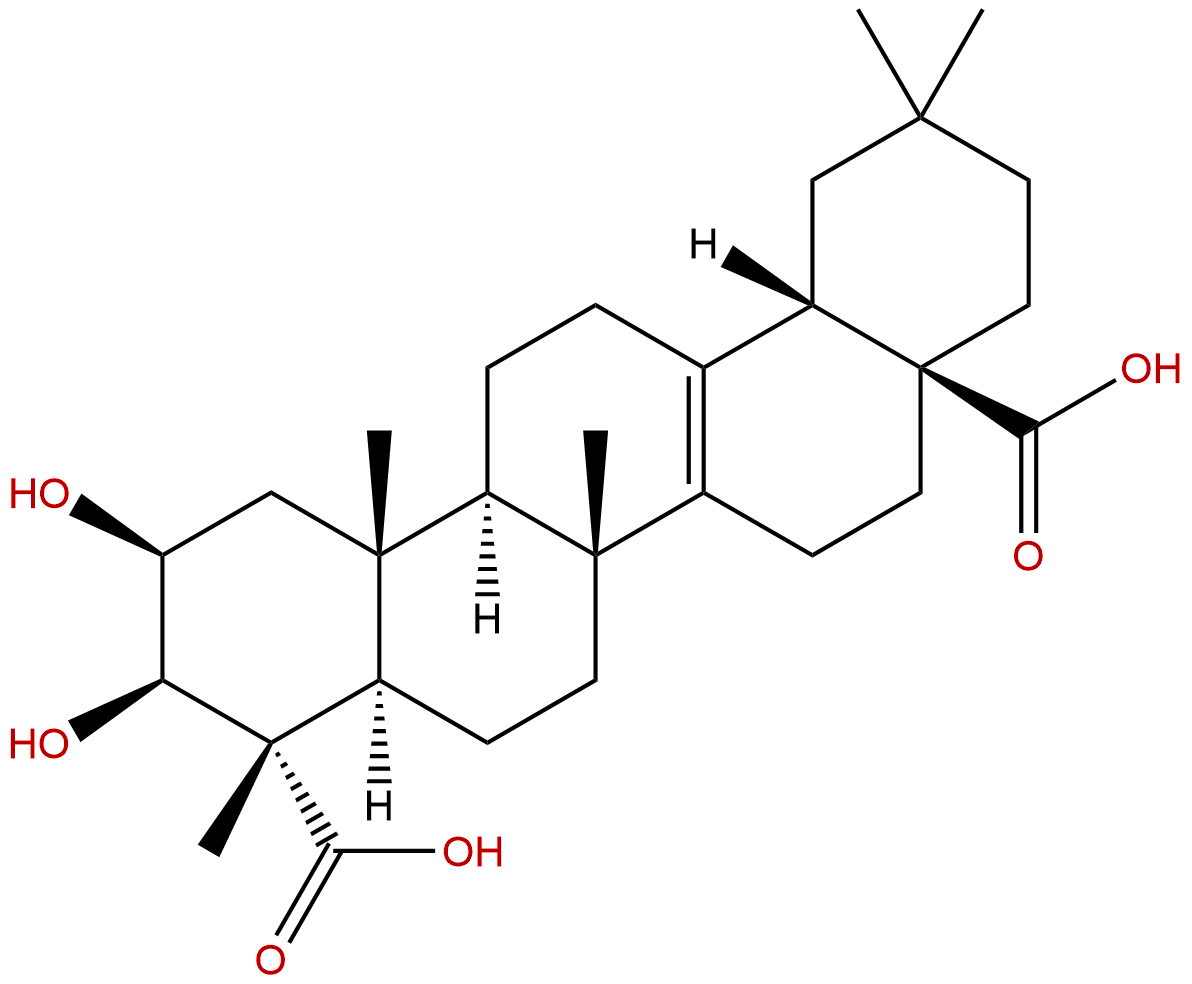


Product name: Polygalic Acid
Synonym name: Senegenic acid
Catalogue No.: BP3322
Cas No.: 1260-04-4
Formula: C29H44O6
Mol Weight: 488.665
Botanical Source:
Physical Description: Powder
Type of Compound: Triterpenoids
Purity: 95%~99%
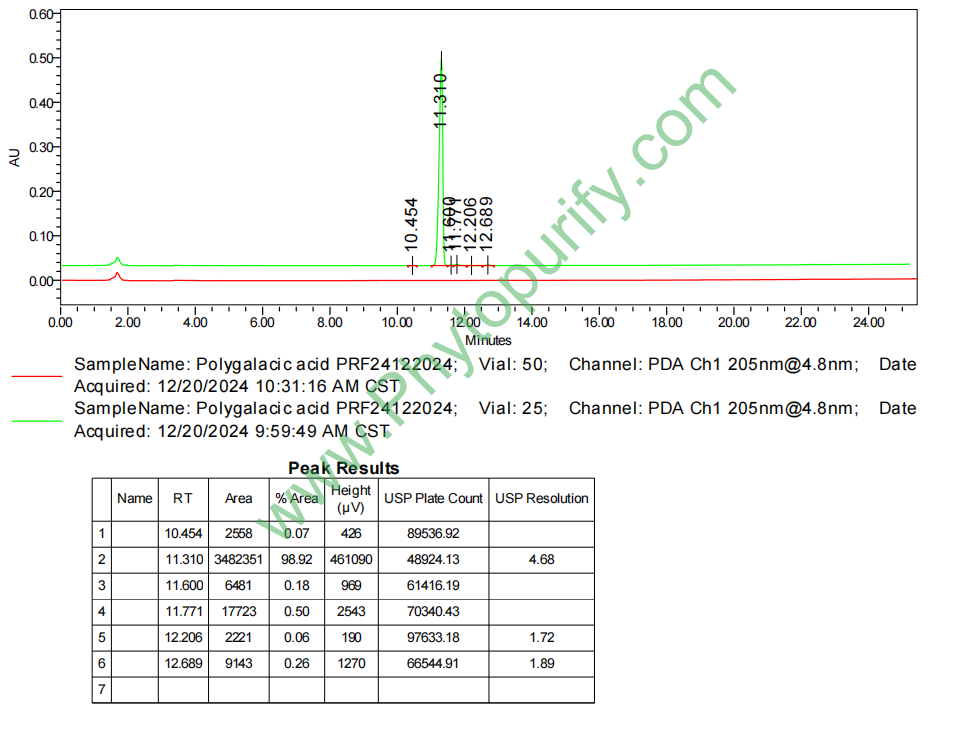
Analysis Method: HPLC-DAD or/and HPLC-ELSD
Identification Method: Mass, NMR
Packing: Brown vial or HDPE plastic bottle
The product could be supplied from milligrams to grams. Inquire for bulk scale.
We provide solution to improve the water-solubility of compounds, thereby facilitating the variety of activity tests and clinic uses.
For Reference Standard and R&D, Not for Human Use Directly.
Description:
Polygalic acid, a triterpenoid saponin, shows expectorant, emetic and stimulant effects.
References:
Biomed Chromatogr. 2012 Feb;26(2):220-4.
In vivo metabolism study of polygalic acid in rat using HPLC-ESI-MSn.
A very simple and direct method has been established for the determination of Polygalic acid and its metabolites in rat urine based on HPLC coupled with electrospray ionization multi-stage tandem mass spectrometry (HPLC-ESI-MS(n)).
METHODS AND RESULTS:
The rats were administered a single dose (100 mg/kg) of Polygalic acid by oral gavage. The urine samples were collected and purified through a C(18) solid-phase extraction cartridge, and then these pretreated samples were injected into a reversed-phase C(18) column with a gradient elution program, whereas acetonitrile-0.5% aqueous formic acid was used as mobile phase and detected by an on-line MS/MS system. As a result, the parent drug and its four metabolites were identified and characterized in rat urine for the first time by comparing their changes in molecular mass (ΔM), retention times and full-scan MS(n) spectra with those of the parent drug. A possible metabolic pathway of Polygalic acid was investigated and proposed.
CONCLUSIONS:
More importantly, the results demonstrated that the newly developed method (HPLC-ESI-MS(n)) was sensitive, simple and suitable for the determination of Polygalic acid and its metabolites in biological samples.
HPLC of Polygalic Acid
Storage conditions:Short-term storage at 2~8℃, long-term storage at -20 ~ -80℃
115.0600
4.3497
1.2987
.0284
2.4827
2.1041
Low
90.1981
5.0052
No
No
No
No
No
No
0.0
Yes
No
Yes
No
In the vast field where traditional medicine and modern pharmacology intersect, natural products have always been an important source for discovering lead compounds for new drugs. Yuanzhi(Polygala tenuifolia As a traditional Chinese medicine with a long history of calming the nerves and promoting intelligence, the material basis of its pharmacological effects has always been a research hotspot. Among the numerous chemical components of Yuanzhi, Polygalic Acid (CAS number: 1260-04-4) is becoming increasingly important as a key triterpenoid saponin component. In recent years, with the global high incidence of central nervous system diseases such as neurodegenerative diseases and cognitive dysfunction, natural products with neuroprotective activity have attracted much attention. Yuanzhi acid has become a highly promising candidate molecule in this field due to its significant neuroprotective effects demonstrated in various in vitro and in vivo models. This article aims to systematically review the chemical structure, plant origin, pharmacological activity, molecular mechanism of action, pharmacological characteristics, and clinical application prospects of yuanzhi acid, in order to provide comprehensive academic references for the in-depth research and development of this compound.
Yuanzhi acid is an Oleanane type pentacyclic triterpenoid saponin. Its molecular formula is C29H44O6 and its molecular weight is 488.6650. Its basic skeleton is oleanolic acid, which is usually connected to one or more sugar groups (such as glucose, xylose, etc.) at the C-3 position to form a saponin structure, which is also an important basis for its biological activity. The specific positions and types of glycosylation connections may vary slightly depending on plant sources and extraction and purification methods, but the core triterpenoid glycoside structure is clear.
From the analysis of parameters related to medicinal properties, Yuanzhi acid exhibits typical physicochemical properties of natural triterpenoid saponins. Its lipophilic water partition coefficient (LogP) is 4.3497, indicating that the compound has moderate to high lipophilicity. The topological polar surface area (TPSA) is 115.0600 Å ², reflecting the presence of multiple polar groups in its molecule, such as hydroxyl, carboxyl, and oxygen atoms on the sugar ring. The low water solubility value (0.0284 mg/mL) suggests poor solubility in water, which may affect its oral bioavailability. It is particularly crucial that its blood-brain barrier (BBB) permeability is predicted to be "low", which is a major challenge for drugs targeting the central nervous system, meaning that its prototype drugs may have difficulty effectively entering brain tissue to exert direct effects. However, its hERG inhibition risk is' no ', and the Ames test result is 0.0 (indicating no mutagenicity), providing favorable information for its preliminary safety assessment.
Yuanzhi acid mainly comes from the Polygalaceae family and the Polygalaceae genus(Polygala)Plants, among which are sourced from authentic traditional Chinese medicine Polygala tenuifolia Willd.'s dry roots are the main source. In addition, plants of the same genus Polygala senega(Meiyuanzhi) and others also contain such triterpenoid saponins.
The extraction of jasmonic acid from plant materials usually follows the conventional process of natural product chemistry. Firstly, crush the dried roots of Eucommia ulmoides and extract them using a solvent of suitable polarity. Due to the fact that yuanzhi acid belongs to the saponin class, methanol, ethanol, or ethanol water mixed solutions of different concentrations are commonly used extraction solvents, which can effectively extract highly polar saponin components. Extraction methods include hot reflux extraction, ultrasound assisted extraction, or microwave-assisted extraction to improve extraction efficiency.
After filtration and concentration, the crude extract needs to be further separated and purified to obtain high-purity Yuanzhi acid. The commonly used techniques include:
1. Solvent Extraction Method Preliminary enrichment can be achieved by utilizing the distribution differences of Yuanzhi acid in different polar solvents, such as extracting saponins from aqueous solutions using n-butanol.
2. Macroporous adsorption resin chromatography method It is an effective method for enriching saponin components, often using resins such as D101 and AB-8, which are washed with water to remove impurities, and then gradient eluted with different concentrations of ethanol.
3. Silica gel column chromatography This is a classic method for further separation and purification, which uses a mixed solvent system of chloroform methanol water as the mobile phase for gradient elution.
4. High performance liquid chromatography method Especially for preparative HPLC, it is the final key step to obtain high-purity monomers of jasmonic acid, often using a reverse phase C18 chromatographic column with methanol water or acetonitrile water as the mobile phase.
The optimization of extraction and purification processes aims to improve the yield and purity of Yuanzhi acid, laying the foundation for its subsequent pharmacological activity research and quality standardization.
Numerous studies have confirmed that the core pharmacological activity of yuanzhi acid is concentrated in neuroprotection The field has demonstrated multiple beneficial effects in related models.
The neuroprotective effect of Yuanzhi acid is not achieved through a single pathway, but involves a complex multi-target regulatory network. Existing research has revealed that it is closely related to multiple key neuroprotective targets and pathways:
In summary, Yuanzhi acid synergistically acts on multiple targets and pathways mentioned above, forming a comprehensive neuroprotective network that inhibits pathological damage (A β, p-tau), enhances cellular defense (antioxidant, anti-inflammatory), and promotes cell survival (anti apoptosis).
Although Yuanzhi acid exhibits excellent pharmacological activity, there are some challenges in its drug likeness, which directly relates to whether it can be developed into a clinical drug.
Absorption, distribution, metabolism, excretion (ADME):
Analysis of drug properties parameters Based on its molecular weight (488.7), LogP (4.35), and TPSA (115.1), Yuanzhi acid basically conforms to Lipinski's "five rules" boundary (molecular weight<500, LogP<5, hydrogen bond donor<5, hydrogen bond acceptor<10), but poor water solubility and low BBB permeability are the two core defects.
Formulation and structural modification strategies To overcome these obstacles, future research may focus on:
At present, there is still a relative lack of complete preclinical pharmacokinetic research data on the Yuanzhi acid system, which is a key link that must be supplemented for its development.
Yuanzhi acid, as an active ingredient derived from traditional Chinese medicine, has a clinical application prospect mainly focused on Neurological disorders Prevention and treatment, especially in the fields of neurodegenerative diseases and vascular cognitive impairment.
Potential indications:
Development Challenges and Prospects:
Yuanzhi acid is one of the key triterpenoid saponins in Yuanzhi medicinal materials that exert neuroprotective effects. Research has shown that it exhibits clear multiple pharmacological activities in cell and animal models, including anti apoptotic, antioxidant, anti-inflammatory, and cognitive improvement, by regulating multiple targets and pathways such as BCL2, CASP9, APP/ACE1, GSK3B, NFE2L2, SIRT1, and MAPK. These findings not only explain the traditional efficacy of Yuanzhi's "intelligence enhancing and calming" approach from a modern scientific perspective, but also provide a solid theoretical basis for its development as a potential drug for treating neurodegenerative diseases such as Alzheimer's disease. However, its inherent pharmaceutical bottlenecks such as poor water solubility and low blood-brain barrier permeability are important obstacles that restrict its clinical translation. Future research should focus on utilizing advanced drug delivery technologies and rational drug chemical modification strategies to overcome these shortcomings, and advance systematic preclinical and clinical studies, with the ultimate goal of transforming this ancient natural wisdom into new treatment options that benefit modern patients.
