


Product name: Lutein
Synonym name: Xanthophyll; β,ε-Carotene-3,3′-diol
Catalogue No.: BP0895
Cas No.: 127-40-2
Formula: C40H56O2
Mol Weight: 568.886
Botanical Source: Echinacea purpurea (Linn.) Moench
Physical Description:
Type of Compound: Terpenoids
Purity: 95%~99%
Analysis Method: HPLC-DAD or/and HPLC-ELSD
Identification Method: Mass, NMR
Packing: Brown vial or HDPE plastic bottle
Storage: Store in a well closed container, protected from air and light. Put into refrigerate or freeze for long term storage.
Whenever possible, you should prepare and use solutions on the same day. However, if you need to make up stock solutions in advance, we recommend that you store the solution as aliquots in tightly sealed vials at -20℃. Generally, these will be useable for up to two weeks.
The product could be supplied from milligrams to grams
Inquire for bulk scale.
Chengdu Biopurify Phytochemicals Ltd. is a leading company in the research, development, manufacture and marketing of High Quality Phytochemicals and Extracts(especially Active Ingredients from Traditional Chinese Medicine,TCM), Natural Active Pharmaceutical Ingredients worldwide.
The main services:
A. Supply active ingredients and reference standards of TCM, from mgs to kgs scale
B. Custom extraction and purification, target Herb Active Ingredients
C. Custom synthesis and semi-synthesis for Natural Active Ingredients
D. CR(contract research), CM(contract manufacture) and PD(process development) services from lab scale, pilot scale to commercial scale(GMP is also available)
E. TCM compounds library for drug screen,more than 3000 compounds available, many of them are rare and unique.
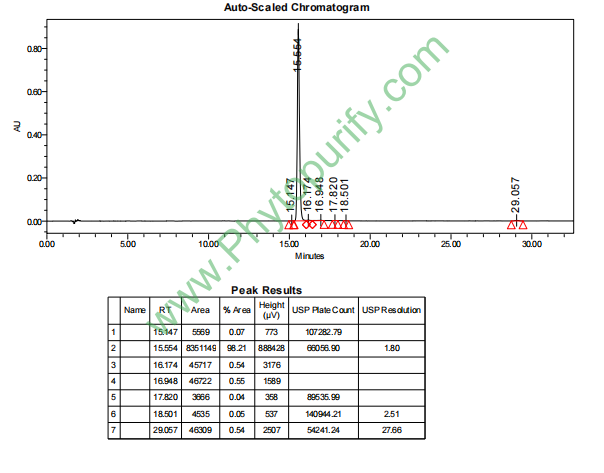
HPLC of Lutein
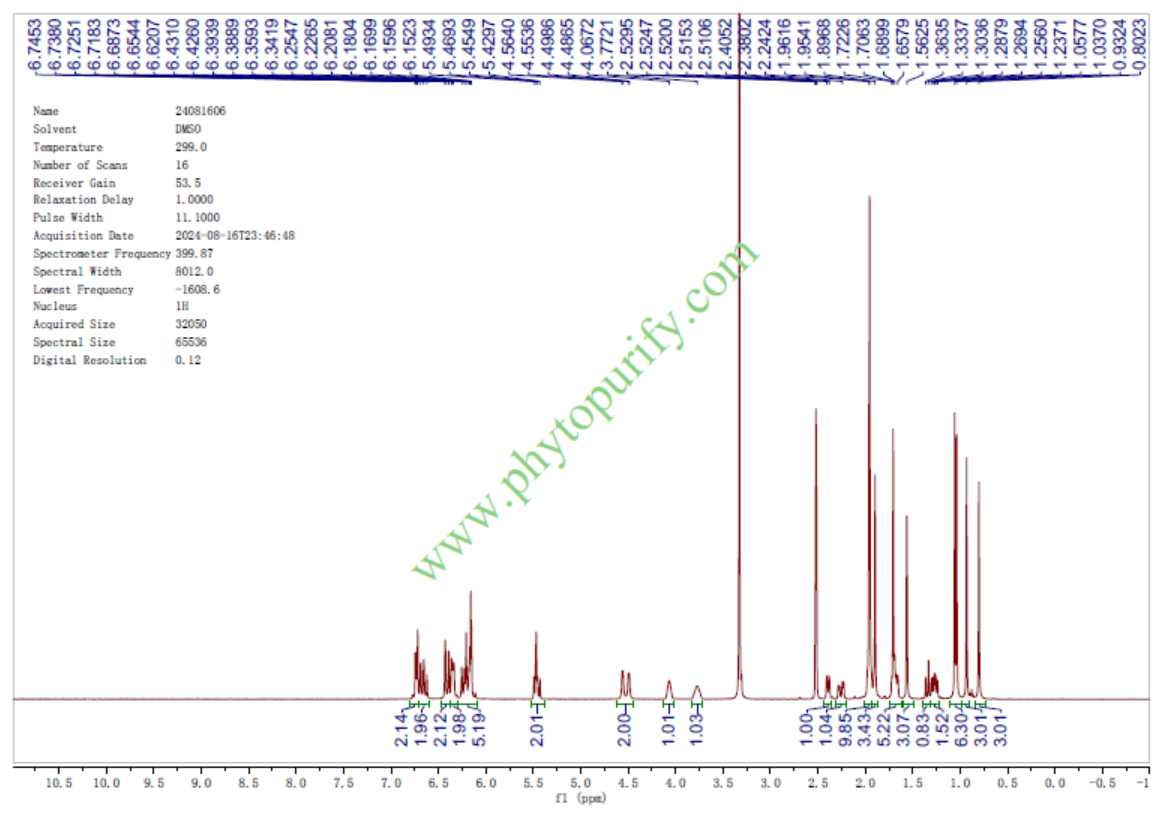
HNMR of Lutein
Storage conditions:Short-term storage at 2~8℃, long-term storage at -20 ~ -80℃
Lutein, CAS number 127-40-2, is an important member of the carotenoid family and belongs to the natural pigment class of lutein. It is widely present in various foods such as green vegetables, corn, egg yolks, etc., and has attracted much attention due to its significant biological activity and health benefits, especially in the field of ophthalmic disease prevention and treatment. Lutein not only has strong antioxidant and anti-inflammatory effects, but also exerts neuroprotective and antidepressant effects by regulating cell apoptosis and reactive oxygen species (ROS) levels. In addition, lutein has good oral bioavailability and high blood-brain barrier penetration ability, demonstrating its potential application value in central nervous system diseases. This article provides a systematic review of the chemical structure and physicochemical properties, plant sources and extraction methods, pharmacological activity, mechanism of action, pharmacological evaluation, and clinical application prospects of lutein, aiming to provide theoretical basis and reference for natural product pharmacology and related clinical research.
Lutein is a polyunsaturated carotenoid containing 40 carbon atoms, with a molecular formula of C40H56O2 and a molecular weight of 568.8860. Its structural features include two terminal hydroxyl rings (β - rings) and a long-chain conjugated double bond system in the middle, endowing it with unique optical and chemical properties. The LogP value of lutein is as high as 10.2169, indicating its strong hydrophobicity. It is difficult to dissolve in water (with a solubility of about 0.0001 mg/mL), but easily soluble in organic solvents such as ethanol, ethyl acetate, and lipid media. Its polar surface area (TPSA) is 40.4600, indicating that its molecular polarity is low and beneficial for penetrating lipid membrane structures.
The molecular structure of lutein contains two hydroxyl groups, which give it a certain polarity in carotenoids, distinguishing it from pure hydrocarbon carotenoids such as beta carotene. This hydroxyl structure not only endows lutein with strong free radical scavenging ability, but may also participate in interactions with biomolecules. In addition, the highly conjugated double bond system of lutein enables it to effectively absorb blue light and protect the retina from photooxidative damage.
Lutein is mainly found in various green leafy plants, such as spinach, kale, amaranth, and pea leaves, as well as in corn, egg yolks, and certain fruits. Lutein in plants mainly exists in two forms: free and esterified, with esterified forms dominating in some plants.
Traditional lutein extraction methods often use organic solvents for extraction, including ethanol, ethyl acetate, hexane, and their mixed solvent systems. During the extraction process, attention should be paid to avoiding light and high temperatures to prevent oxidation and isomerization of lutein. In recent years, supercritical CO2 extraction technology has gradually become one of the mainstream technologies for lutein extraction due to its advantages of green environmental protection, strong selectivity, and high extraction efficiency. This method can efficiently extract lutein at lower temperatures while maintaining its biological activity.
After extraction, purification and quantitative analysis are often performed using techniques such as silica gel column chromatography and reverse phase high performance liquid chromatography (RP-HPLC). High purity lutein products can be used in the development of pharmaceutical formulations and functional foods.
The pharmacological activities of lutein are mainly reflected in antioxidant, anti-inflammatory, anti apoptotic, and neuroprotective aspects, especially in the prevention and treatment of ophthalmic diseases.
Lutein can effectively eliminate reactive oxygen species (ROS) and free radicals, reducing cell damage caused by oxidative stress. Its conjugated double bond system can capture singlet oxygen and superoxide anions, protecting cell membrane lipids from peroxidation. Multiple in vitro and in vivo experiments have shown that lutein can significantly increase the activity of superoxide dismutase (SOD1, SOD2) and catalase (CAT), enhancing the body's antioxidant defense ability.
Lutein reduces inflammation by inhibiting the nuclear factor kappa B (NF - κ B) signaling pathway, lowering the expression of pro-inflammatory factors such as tumor necrosis factor alpha (TNF - α) and interleukin. Its anti-inflammatory effect is of great significance in alleviating chronic inflammation of the eye and nervous system.
Lutein can regulate the expression of apoptosis related proteins and inhibit the apoptosis process of retinal cells and nerve cells. Lutein protects cells from oxidative stress-induced apoptosis damage by regulating Bcl-2 family proteins and mitochondrial function.
Lutein has good blood-brain barrier penetration and can enter the central nervous system. Research has shown that lutein protects neurons and reduces neurodegenerative diseases through antioxidant and anti-inflammatory mechanisms. In addition, lutein exhibits antidepressant like effects in animal depression models, which may be related to its regulation of neurotransmitters and neuroinflammation.
The biological effects of lutein are mainly achieved by regulating multiple signaling pathways and key molecular targets, especially in ophthalmic diseases such as age-related macular degeneration (AMD).
Lutein activates the nuclear factor E2 related factor 2 (NFE2L2, also known as Nrf2) signaling pathway, promotes the expression of antioxidant enzymes such as SOD1, SOD2, and CAT, and enhances cellular antioxidant defense. Nrf2, as the main oxidative stress sensing factor in cells, its activation helps to resist oxidative damage.
Lutein inhibits the activation of the NF - κ B (NFKB1) signaling pathway, reduces the expression of pro-inflammatory cytokine TNF - α, and alleviates inflammatory responses. NF - κ B is a core transcription factor in inflammatory response, and its inhibition plays an important role in alleviating chronic inflammation.
Lutein can regulate the expression of vascular endothelial growth factors (VEGF, VEGFA) and inhibit abnormal angiogenesis, which has a positive significance for the prevention and treatment of retinal neovascularization in AMD. Abnormal angiogenesis is one of the important pathological mechanisms in advanced AMD.
The regulation of lutein on complement factor H (CFH) and age-related macular degeneration associated protein 2 (ARMS2) suggests that it may affect the pathogenesis of AMD by regulating immune response and inflammatory status. CFH and ARMS2 are key genetic susceptibility genes for AMD, involved in the local immune homeostasis of the retina.
The pharmacological parameters of lutein show that it has certain oral activity and safety.
Lutein can be effectively absorbed after oral administration, and due to its high hydrophobicity, it mainly enters the bloodstream through a lipid mediated absorption mechanism. Although its high LogP value limits its water solubility, it is beneficial for penetrating lipid membranes, including the blood-brain barrier, supporting its neuroprotective effect. The high blood-brain barrier penetration is an important advantage that distinguishes lutein from many natural products.
Lutein does not exhibit hERG channel inhibition, indicating a low risk of cardiac toxicity. The Ames test result is 0.0, indicating no significant genotoxicity. In clinical and animal experiments, lutein has good tolerance and no serious adverse reactions have been observed.
Lutein is mainly metabolized through the liver, and the metabolic pathway is not fully understood, possibly involving the cytochrome P450 enzyme system. Due to its lipid solubility, lutein is easily bound to lipoproteins in the body, affecting distribution and metabolism. Further research is needed in the future to investigate its drug interactions and metabolic kinetic characteristics.
Lutein, as a safe and effective natural carotenoid, has shown broad application prospects in the prevention and treatment of various diseases.
Lutein is widely used in the prevention and treatment of age-related macular degeneration (AMD). Numerous clinical studies have shown that lutein supplementation can improve macular pigment density, slow down the progression of AMD, and enhance visual function. Its antioxidant, anti-inflammatory, and anti angiogenic effects are the basis of its therapeutic effect.
The neuroprotective and antidepressant effects of lutein provide theoretical support for its potential applications in neurodegenerative diseases (such as Alzheimer's disease, Parkinson's disease) and psychiatric disorders. In the future, its efficacy and safety need to be validated through clinical trials.
Lutein has the potential to be developed in the fields of cardiovascular disease, diabetes and immune regulation due to its anti-inflammatory and antioxidant properties. Combining modern drug delivery technologies such as nanocarriers and liposomes may further enhance their bioavailability and therapeutic efficacy.
The high hydrophobicity and low water solubility of lutein limit its oral absorption and bioavailability, and there is an urgent need to develop new formulation technologies to overcome this bottleneck. In addition, the mechanism of action of lutein is not fully understood, especially in terms of molecular level target regulation and signal pathway crossing, which requires further research. In the future, by combining multiple omics technologies and systems pharmacology methods, it is expected to reveal more comprehensive biological functions and clinical application value of lutein.
Lutein, as an important natural carotenoid, has shown broad application prospects in the prevention and treatment of ophthalmic and neurological diseases due to its significant antioxidant, anti-inflammatory, and neuroprotective effects. Its good safety and oral activity make it a hot topic in natural product pharmacology research and functional food development. In the future, by optimizing extraction and purification techniques, deeply analyzing molecular mechanisms, and conducting high-quality clinical trials, lutein is expected to become an important natural drug resource for the prevention and treatment of various chronic diseases. The field of natural product pharmacology should continue to pay attention to multidimensional research on lutein, promote its translation into clinical applications, and benefit a large number of patients.
