


Product name: Nomilin
Synonym name:
Catalogue No.: BP1003
Cas No.: 1063-77-0
Formula: C28H34O9
Mol Weight: 514.571
Botanical Source: Euodiae fructus
Physical Description:
Type of Compound: Triterpenoids
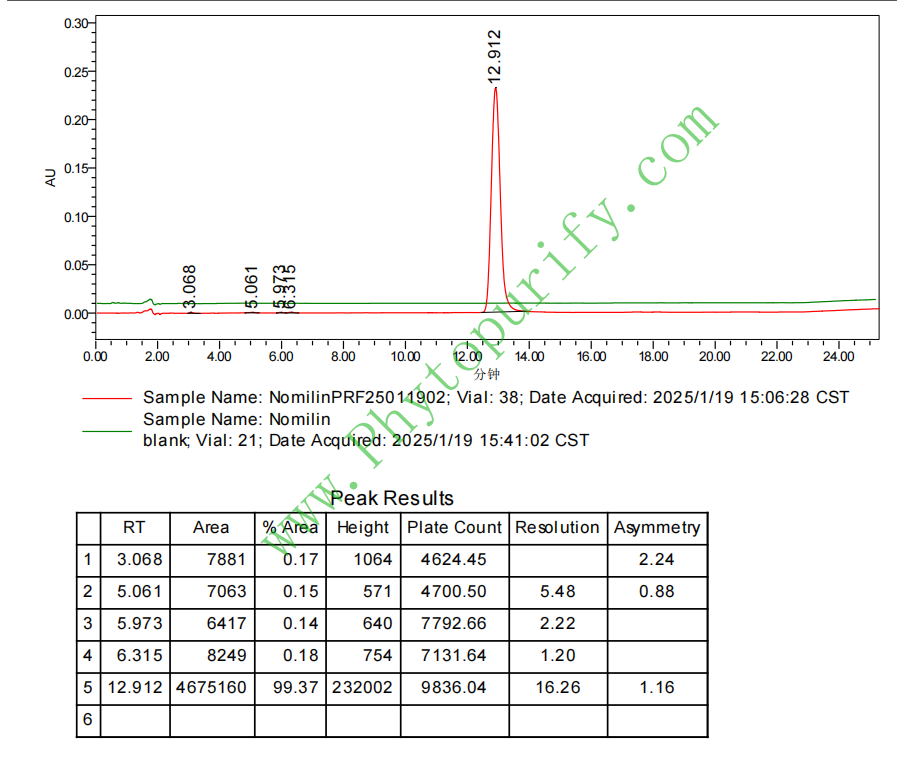
Purity: 95%~99%
Analysis Method: HPLC-DAD or/and HPLC-ELSD
Identification Method: Mass, NMR
Packing: Brown vial or HDPE plastic bottle
Storage: Store in a well closed container, protected from air and light. Put into refrigerate or freeze for long term storage.
Whenever possible, you should prepare and use solutions on the same day. However, if you need to make up stock solutions in advance, we recommend that you store the solution as aliquots in tightly sealed vials at -20℃. Generally, these will be useable for up to two weeks.
The product could be supplied from milligrams to grams
Inquire for bulk scale.
Description:
Nomilin has immunomodulatory, antioxidant, anti-human immunodeficiency virus(HIV), cancer chemopreventive, antiangiogenic, anti-obesity and anti-hyperglycemic effects. Nomilin inhibits tumor-specific angiogenesis by downregulating VEGF, NO and proinflammatory cytokine profile and also by inhibiting the activation of MMP-2 and MMP-9. It inhibits osteoclastogenesis in vitro by suppression of NFATc1 and MAPK signaling pathways, indicates that nomilin-containing herbal preparations have potential utility for the prevention of bone metabolic diseases.
References:
Food Chemistry, 2005, 93(4):599-605.
Contents and antioxidant capacity of limonin and nomilin in different tissues of citrus fruit of four cultivars during fruit growth and maturation.
METHODS AND RESULTS:
The contents of limonin and Nomilin in different fruit tissues of Foxiangyou (Citrus grandis), Citrus unshiu, Penggan (Citrus reticulata) and Huyou (Citrus changshanensis KS Chen et CX Fu) were measured during fruit growth and maturation by HPLC (high performance liquid chromatography). Results showed that limonin and Nomilin were the predominant limonoids in the extracted samples. During fruit growth and maturation, the contents of limonin and Nomilin increased from April, peaked in early September and decreased afterwards until late October when they reached a steady low level. The antioxidant capacities of limonin and Nomilin in the four tissues of mature fruit were determined by beta-carotene bleaching assay.
CONCLUSIONS:
The results showed that the antioxidant capacities of limonin and Nomilin varied in different tissues and cultivars. In the three tissues other than albedo, the antioxidant capacities of limonin and Nomilin were high (2.9-8.3 times than that of vitamine C).
Planta Med. 2003 Oct;69(10):910-3.
Effect of limonin and nomilin on HIV-1 replication on infected human mononuclear cells.
In the last years several plant-derived natural compounds have been screened for their anti-HIV activity in order to find lead compounds with novel structures or mechanisms of action. Among these, several triterpenoids have been found to exhibit an antiretroviral activity with different mechanisms of action.
METHODS AND RESULTS:
In this study the effect of two limonoids, limonin and Nomilin, on the growth of human immunodeficiency virus-1 (HIV-1) in culture of human peripheral blood mononuclear cells (PBMC) and on monocytes/macrophages (M/M) is described. Limonin and Nomilin were found to inhibit the HIV-1 replication in all cellular systems used. A dose-dependent inhibition of viral replication was observed in PBMC isolated from healthy donors and infected with HIV-1 strain after incubation with limonin and Nomilin (EC (50) values: 60.0 microM and 52.2 microM, respectively). The two terpenoids inhibited at all concentrations studied the production of HIV-p24 antigen even when the PBMC employed were chronically infected (EC (50) values of 61.0 microM for limonin and 76.2 microM for Nomilin). Moreover, these compounds inhibited the HIV-1 replication even in infected M/M. In this cellular system the inhibitory effect was significant at the concentrations of 20 microM, 40 microM and 80 microM starting from day 14 and reached the maximum effect after 18 days of incubation. As regards the mechanism of action, limonin and Nomilin inhibit in vitro HIV-1 protease activity.
CONCLUSIONS:
In general, the results obtained point out a similar anti-HIV activity of limonin and Nomilin indicating that this activity is not drastically influenced by the structural difference between the two compounds.
Biochem Biophys Res Commun. 2011 Jul 8;410(3):677-81.
Anti-obesity and anti-hyperglycemic effects of the dietary citrus limonoid nomilin in mice fed a high-fat diet.
TGR5 is a member of the G protein-coupled receptor family and is activated by bile acids (BAs). TGR5 is thought to be a promising drug target for metabolic diseases because the activation of TGR5 prevents obesity and hyperglycemia in mice fed a high-fat diet (HFD).
METHODS AND RESULTS:
In the present study, we identified a naturally occurring limonoid, Nomilin, as an activator of TGR5. Unlike BAs, Nomilin did not exhibit the farnesoid X receptor ligand activity. Although the Nomilinderivative obacunone was capable of activating TGR5, limonin (the most abundant limonoid in citrus seeds) was not a TGR5 activator. When male C57BL/6J mice fed a HFD for 9 weeks were further fed a HFD either alone or supplemented with 0.2%w/w Nomilin for 77 days, Nomilin-treated mice had lower body weight, serum glucose, serum insulin, and enhanced glucose tolerance.
CONCLUSIONS:
Our results suggest a novel biological function of Nomilin as an agent having anti-obesity and anti-hyperglycemic effects that are likely to be mediated through the activation of TGR5.
Acs Symposium, 2000, 758:185-200.
Limonin and Nomilin Inhibitory Effects on Chemical-Induced Tumorigenesis.
The increased enzyme activity was correlated with the ability of these compounds to inhibit carcinogenesis.
METHODS AND RESULTS:
Nomilin was found to reduce the incidence and number of tumors per mouse of forestomach tumors induced by benzo[a]pyrene (BP). Topical application of the limonoids was found to inhibit both the initiation and the promotion phases of carcinogenesis in the skin of SENCAR mice. Nomilin appeared to be more effective at the initiation stage while limonin was more potent as an inhibitor at the promotion phase of carcinogenesis. Administration of Nomilin and limonin to the diet or by gavage inhibited BP-induced and 4-(methylnitrosamino)-l-(3-pyridyl)-l-butanone-induced lung tumor formations, respectively, in A/J mice.
CONCLUSIONS:
These findings suggest citrus limonoids are potential cancer chemopreventive agents.
HPLC of Nomilin
Storage conditions:Short-term storage at 2~8℃, long-term storage at -20 ~ -80℃
Nomilin is a typical limonoid natural product, mainly found in citrus fruits such as lemon, lime, orange, and grapefruit. As a secondary metabolite of citrus plants, Nomilin has received widespread attention in pharmacology and natural product chemistry in recent years due to its unique chemical structure and diverse biological activities. Research has shown that nomilin not only has significant anti obesity and hypoglycemic effects, but also exhibits multiple pharmacological effects such as anti-tumor, anti-inflammatory, and antiviral effects, demonstrating high clinical development potential.
With the continuous rise of metabolic diseases and the incidence rate of cancer, the development of safe and effective natural drugs has become a hot spot in current medical research. As a naturally occurring multifunctional compound, the regulatory role of Nomilin in multiple signaling pathways provides new ideas for the treatment of related diseases. This article provides a systematic review of the chemical structure and physicochemical properties, plant sources, and extraction methods of Nomilin. It delves into its pharmacological activity and mechanism of action, and combines drug evaluation and pharmacokinetic data to explore its clinical application prospects. The aim is to provide theoretical basis and reference for further research and development of Nomilin.
The molecular formula of Nomilin is C28H34O9, with a molecular weight of 514.5710. Its structure belongs to the triterpenoid lactones of the limonoid class, with a complex cyclic skeleton and multiple oxygen functional groups. Its core structure consists of four ring systems with lactone rings and multiple hydroxyl and ether bonds, endowing it with strong polarity and diverse chemical reactivity. The LogP value of Nomilin is approximately 2.51, indicating moderate lipid solubility and facilitating membrane penetration; The polar surface area (TPSA) is 121.64, indicating that it has good hydrophilicity and may affect its bioavailability.
In terms of physical and chemical properties, the water solubility of Nomilin is relatively low (about 0.0053 mg/mL), which to some extent limits its oral absorption and bioavailability. Its molecular structure is stable and does not exhibit hERG channel inhibitory activity, indicating a low risk of cardiac toxicity. In addition, the Ames mutagenicity test result was negative, indicating that Nomilin has good safety in terms of genotoxicity. It is worth noting that nomilin has high blood-brain barrier permeability, which may make it potentially valuable for the treatment of central nervous system diseases.
Nomilin is mainly extracted from the fruits, peels, and seeds of citrus plants, especially in grapefruit and lemon where its content is higher. Citrus plants, as widely cultivated economic crops worldwide, have important sources of Nomilin as their by-products such as skin and fruit residue. Traditionally, the extraction of Nomilin relies on organic solvent extraction methods, with commonly used solvents including methanol, ethanol, ethyl acetate, and chloroform.
The specific extraction process usually includes the following steps: first, the citrus peel or seed is dried and crushed, and then the crude extract is extracted using immersion or reflux extraction methods. After concentration, the extract was separated and purified using methods such as silica gel column chromatography and reverse phase high performance liquid chromatography (RP-HPLC). In recent years, green and efficient technologies such as supercritical CO2 extraction and microwave-assisted extraction have gradually been applied to the extraction of Nomilin, improving extraction efficiency and purity, reducing the use of organic solvents, and meeting the sustainable development requirements of modern natural product extraction.
Nomilin has shown significant effects in the prevention and treatment of obesity and diabetes. In vitro and in vivo studies have shown that norepinephrine can inhibit the differentiation and lipid accumulation of adipocytes, regulate the expression of lipid metabolism related genes such as PPAR γ and C/EBP α, and reduce the inflammatory response of adipose tissue. In addition, Nomilin exhibits potential hypoglycemic effects by enhancing insulin sensitivity and promoting glucose uptake, improving glucose metabolism disorders. In animal models, Nomilin significantly reduced obesity and insulin resistance induced by high-fat diet, indicating its application value as an intervention agent for metabolic syndrome.
Nomilin exhibits the ability to inhibit proliferation, induce apoptosis, and suppress migration in various tumor cell lines. Its anti-tumor mechanism involves multiple signaling pathways and molecular targets. Research has found that nomilin can downregulate the expression of anti apoptotic proteins MCL1 and BCL2, activating the apoptotic pathway of cells; Inhibiting the STAT3 signaling pathway, blocking the proliferation and survival of tumor cells; Simultaneously, by regulating the matrix metalloproteinase MMP2, it inhibits the invasion and metastasis of tumor cells. In addition, Nomilin also has regulatory effects on key proteins related to tumors such as TOP1, TOP2A, HIF1A, MAPK1, etc., demonstrating a multi-target synergistic anti-tumor effect.
Nomilin exhibits good anti-inflammatory activity, which can inhibit the production of inflammatory mediators such as TNF - α, IL-6, and NO, and alleviate inflammatory reactions. Its anti-inflammatory mechanism is mainly achieved by inhibiting the NF - κ B and MAPK signaling pathways. In terms of antiviral activity, Nomilin has shown inhibitory effects on various viruses in vitro experiments, possibly by interfering with virus replication and regulating host immune responses, providing a new direction for the development of natural antiviral drugs.
The multiple pharmacological activities of Nomilin are attributed to its ability to regulate multiple molecular targets. In its anti-tumor effect, Nomilin downregulates MCL1 and BCL2, breaks down the anti apoptotic barrier of tumor cells, and promotes programmed cell death. Meanwhile, inhibiting the STAT3 signaling pathway blocks the proliferation and immune escape of tumor cells. The inhibition of MMP2 reduces the matrix degradation of tumor cells, limiting tumor invasion and metastasis.
In addition, the regulation of TOP1 and TOP2A by Nomilin affects the activity of DNA topoisomerases, interfering with tumor cell DNA replication and transcription processes. The inhibition of HIF1A blocks the adaptive ability of tumor cells in hypoxic environments and inhibits tumor angiogenesis. The regulation of MAPK1 and ESR1 further affects cell signaling and hormone dependent tumor development. The regulation of CYP19A1 (aromatase) may affect estrogen synthesis and has potential endocrine regulatory effects.
In terms of anti obesity and hypoglycemic effects, Nomilin improves metabolic homeostasis by regulating metabolic genes and inflammatory factors in adipose tissue. Its high blood-brain barrier permeability suggests that it may regulate energy metabolism and appetite control through the central nervous system. The anti-inflammatory and antiviral mechanisms mainly rely on the regulation of immune signaling pathways, reducing inflammatory damage and inhibiting virus replication.
The pharmacological evaluation of Nomilin shows that it has certain potential for drug development. Its molecular weight (514.57) is slightly higher than the recommended upper limit of Lipinski rule (500), but a moderate LogP (2.51) and a high polar surface area (121.64) are beneficial for balancing lipid solubility and water solubility, promoting in vivo distribution. The low water solubility is the main limiting factor for its oral bioavailability, which needs to be improved through pharmaceutical techniques such as nanocarriers, liposomes, or solid dispersions.
Pharmacokinetic studies have shown that nomilin has good blood-brain barrier penetration ability, indicating its potential application in the treatment of central nervous system diseases. The metabolic pathways in the body mainly involve the liver enzyme system, and the activity and toxicity of metabolites need further research. In terms of safety, Nomilin has no significant hERG channel inhibition, reducing the risk of cardiac toxicity; A negative Ames test indicates a low risk of genotoxicity, supporting the safety of long-term use.
Nomilin has shown broad clinical application prospects due to its multi-target and multifunctional pharmacological properties. Its potential in the fields of anti obesity and hypoglycemic effects is particularly outstanding, and it can be used as an adjuvant therapy for metabolic syndrome in the future. The multi mechanism advantage of anti-tumor effect makes it an ideal candidate compound for tumor multidrug resistance and combination therapy. The anti-inflammatory and antiviral activities provide new therapeutic approaches for chronic inflammatory diseases and viral infections.
However, the clinical translation of Nomilin still faces many challenges, mainly including poor water solubility and low oral bioavailability. Future research should focus on drug formulation optimization, in-depth analysis of in vivo metabolic kinetics, and toxicological systematic evaluation. In addition, the design and synthesis of derivatives based on the Nomilin structure are expected to obtain more efficient and safer drug candidate molecules. Combining modern molecular biology and medicinal chemistry techniques, the clinical development prospects of Nomilin and its analogues are worth looking forward to.
Nomilin, as a natural product with abundant sources and diverse biological activities, has become a hot topic in natural product pharmacology research due to its significant pharmacological effects such as anti obesity, hypoglycemic, anti-tumor, anti-inflammatory, and antiviral effects. Its complex chemical structure and multi-target mechanism of action provide new strategies for the treatment of various diseases. Despite limitations in water solubility and bioavailability, Nomilin still exhibits good drug efficacy and safety.
In the future, through pharmaceutical improvements, structural optimization, and in-depth mechanism research, Nomilin is expected to become an important candidate for natural product drug development, contributing new drug resources to the treatment of metabolic diseases, tumors, and inflammatory diseases. Continuous basic and clinical research will drive Nomilin from the laboratory to clinical applications, opening up a new chapter in the development of natural product drugs.
