


Synonym name: Evodiamine
Catalogue No.: BP0579
Cas No.: 518-17-2
Formula: C19H17N3O
Mol Weight: 303.365
Botanical Source: A major component of the Chinese drug Wou-chou-yu (the dried fruit of Evodia rutaecarpa). Also present in Araliopsis tabouensis (Rutaceae, Araliaceae)
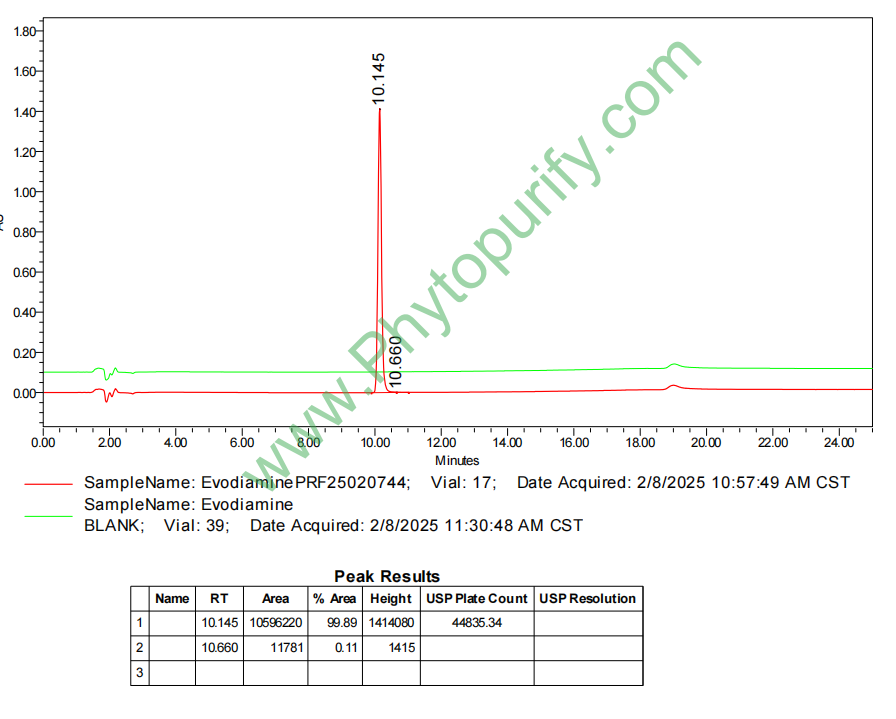
Purity: 95%~99%
Analysis Method: HPLC-DAD or/and HPLC-ELSD
Identification Method: Mass, NMR
Packing: Brown vial or HDPE plastic bottle
Can be supplied from milligrams to grams, up to kilograms.
Inquire for bulk scale.
Storage conditions:Short-term storage at 2~8℃, long-term storage at -20 ~ -80℃
39.3400
2.8332
2.8330
.0166
5.5492
20.4867
High
90.2114
2.8381
No
No
Yes
No
Yes
No
0.3
Yes
No
Yes
Yes
Natural products, as an important treasure trove for drug discovery and development, play an irreplaceable role in the history of human disease prevention and treatment. Among them, alkaloid compounds have always been a hot topic in medicinal chemistry and pharmacology research due to their structural diversity and significant biological activity. Evodiamine, an indole quinazoline alkaloid isolated from the fruit of traditional Chinese medicine Evodia, is an outstanding representative among them. Its CAS number is 518-17-2, and modern pharmacological research has revealed that it has a wide range of biological activities, including anti-inflammatory, anti obesity, and particularly remarkable anti-tumor effects. In recent years, with the development of molecular biology and structural pharmacology, the mechanism of action of evodiamine has been continuously analyzed, especially in the field of analgesia. It exhibits a complex and unique regulatory network by acting on multiple targets such as transient receptor potential vanillic acid subtype 1 (TRPV1), cannabinoid receptor 1 (CNR1), opioid receptor (OPRD1/OPRM1/OPRK1), and cyclooxygenase (PTGS1/2), providing valuable lead compounds for the development of novel multi-target analgesic drugs. This article aims to systematically review the chemical properties, plant sources, pharmacological activities, molecular mechanisms of action, pharmacological evaluation, and clinical application prospects of evodiamine, in order to provide comprehensive academic references for the in-depth research and development of this natural product.
The molecular formula of evodiamine is C19H17N3O, with a molecular weight of 303.3650. Its core structure is a unique indolo [2 ', 3': 3,4] pyridine [2,1-b] quinazoline ring system, which endows the molecule with a certain rigid planar structure and is the structural basis for its interaction with various biological targets.
From the analysis of physical and chemical properties, the lipid water partition coefficient (LogP) of evodiamine is 2.8332, indicating its moderate lipophilicity, which is beneficial for its penetration of cell membranes but may also affect its water solubility. Its topological polar surface area (TPSA) is 39.3400 Å ², which is relatively small and further confirms its good membrane permeability potential. However, its low water solubility (about 0.0166 mg/mL) to some extent limits its bioavailability, which is a key issue that needs to be overcome in formulation development. It is worth noting that based on its physicochemical parameters, evodiamine has a high blood-brain barrier permeability, which provides the possibility for its action on central nervous system targets (such as opioid receptors, 5-hydroxytryptamine transporter SLC6A4, etc.) to exert central analgesic effects. Preliminary safety screening showed that it had no significant inhibitory effect on hERG potassium channels at conventional test concentrations (indicating a low potential risk of arrhythmia), and the Ames test result was 0.3, indicating a low risk of mutagenicity, laying a preliminary safety foundation for its further development.
Evodiamine mainly comes from the Rutaceae plant Evodia rutaecarpa(Evodia rutaecarpa Dry near mature fruit of (Juss. Benth.). Wu Zhu Yu, as a traditional Chinese medicine, has the effects of dispelling cold and relieving pain, reducing nausea and vomiting, and promoting yang and stopping diarrhea. It is commonly used to treat symptoms such as Jueyin headache, cold hernia and abdominal pain, cold and damp athlete's foot, and menstrual abdominal pain. Evodiamine is one of its important pharmacological substances.
The extraction of evodiamine from plant materials is usually carried out using organic solvent extraction method. The classic process includes drying and crushing the fruit of Evodia rutaecarpa, and then heating it with ethanol, methanol, or acidic ethanol (such as an ethanol solution containing 1% hydrochloric acid) for reflux or ultrasound assisted extraction. Alkaloids can form salts under acidic conditions and are more soluble in polar solvents. After the extraction solution is concentrated under reduced pressure, it is dissolved in acidic water, and insoluble substances are filtered out. Then, the acidic water solution is alkalized (usually using ammonia or sodium hydroxide solution) to make the alkaloids free and precipitate. Subsequently, organic solvents such as chloroform, dichloromethane, or ethyl acetate are used for repeated extraction. The crude extract can be further separated and purified by methods such as silica gel column chromatography and preparative high-performance liquid chromatography (HPLC) to obtain high-purity evodiamine monomer. In recent years, some green extraction techniques such as supercritical CO2 fluid extraction and microwave-assisted extraction have also been explored and applied to the extraction of evodiamine, in order to improve efficiency and reduce the use of organic solvents.
Evodiamine exhibits broad and significant pharmacological activities, mainly covering the following aspects:
Analgesic effect This is one of the earliest studied activities of evodiamine. Multiple pain models (such as acetic acid writhing method, hot plate method, formalin induced pain method, chronic neuropathological pain model) have confirmed that evodiamine has a clear analgesic effect, and its intensity of action is dependent within a certain dose range. Its analgesic characteristics are different from classical nonsteroidal anti-inflammatory drugs or opioid drugs, and its mechanism of action involves multiple peripheral and central pathways.
anti-inflammatory effect Evodiamine has inhibitory effects on various acute and chronic inflammation models, such as carrageenan induced rat foot swelling, xylene induced mouse ear swelling, and lipopolysaccharide induced macrophage inflammation model. It can significantly reduce the levels of inflammatory mediators such as prostaglandin E2 (PGE2), nitric oxide (NO), tumor necrosis factor - α (TNF - α), interleukin-6 (IL-6), etc.
antitumor activity The anti-tumor activity of evodiamine is currently the most extensively studied field. In vivo and in vitro experiments show that it can inhibit proliferation, induce apoptosis, block cell cycle, and inhibit invasion and metastasis of breast cancer, lung cancer, liver cancer, colorectal cancer, gastric cancer, prostate cancer and other malignant tumor cells. Its anti-tumor mechanism is complex, involving multiple signaling pathways.
Anti obesity and metabolic regulation effects Evodiamine can promote adipocyte thermogenesis, increase energy expenditure, inhibit fat production, and improve insulin resistance induced by high-fat diet, showing therapeutic potential in obesity and related metabolic disease models.
Other activities In addition, the study also reported that evodiamine has pharmacological effects such as antithrombotic, cardiovascular protective, antidepressant, and cognitive improvement, reflecting its multi-target properties.
The pharmacological effects of evodiamine, especially its multi-target analgesic mechanism, stem from its direct or indirect interactions with various protein targets. According to the provided target information, its network of action in the field of analgesia can be summarized as follows:
Acting on ion channels:
Acting on G protein coupled receptors (GPCRs):
Acting on enzymes and transporters:
Integration mechanism The analgesic effect of evodiamine is not achieved through a single target, but through the simultaneous regulation of TRPV1/TRPA1 (peripheral nociceptive signaling), opioid receptors (central analgesia), 5-HT system (downregulation), and COX-2/PGE2 pathway (inflammatory pain), forming a multidimensional and synergistic analgesic network. This multi-target characteristic may make it more effective in treating complex pain such as inflammatory pain and neuropathic pain, and may reduce the side effects and tolerance caused by excessive inhibition of a single target.
In terms of anti-tumor effects, its mechanism involves inducing cell cycle arrest (often in the G2/M phase), activating mitochondrial apoptosis pathways, inhibiting survival signaling pathways such as PI3K/Akt, NF - κ B, Wnt/β - catenin, inhibiting topoisomerase I/II activity, and regulating heat shock proteins.
Despite the excellent pharmacological activity of evodiamine, its medicinal properties still face challenges, which is currently one of the research focuses.
Absorption, distribution, metabolism, excretion (ADME):
Challenges and Strategies in Drug Development:
The clinical application prospects of evodiamine are broad, but solid research is still needed to promote its transformation.
Development of analgesic drugs Regarding unmet clinical needs such as chronic pain and neuropathic pain, evodiamine is highly attractive as a multi-target analgesic lead compound. The future direction is to develop derivatives with higher selectivity, strong desensitization ability to TRPV1, and weak initial activation effect to avoid the side effects of elevated body temperature; ② Design multi-target combination drugs or "pseudo multi-target" single-molecule drugs targeting specific pain subtypes by utilizing their multi-target properties; ③ Develop new drug delivery systems to improve their brain targeting or local drug concentration.
Development of anti-tumor drugs Evodiamine and its derivatives have shown great potential in the field of anti-tumor therapy. The research focuses on: ① elucidating its specific anti-tumor targets and improving its selectivity towards tumor cells; ② Combine it with existing chemotherapy drugs to enhance efficacy and reduce drug resistance; ③ Develop tumor microenvironment responsive targeted delivery systems to reduce potential toxicity from systemic exposure.
Therapeutic agents for metabolic diseases Based on its CB1 antagonistic and thermogenic effects, evodiamine is a candidate molecule for developing anti obesity drugs. It is necessary to optimize its structure to minimize its impact on the central nervous system (avoiding psychological side effects) while retaining its regulatory effect on fat metabolism, that is, to develop peripheral restrictive CB1 antagonist derivatives.
Modernization and Quality Control of Traditional Chinese Medicine: As a key effective component of Evodia rutaecarpa, it is crucial to clarify the relationship between the content of Evodia rutaecarpa and its efficacy, and establish quality control standards based on Evodia rutaecarpa and other active alkaloids to ensure the clinical efficacy and consistency of Evodia rutaecarpa and its traditional Chinese patent medicines and simple preparations (such as Evodia rutaecarpa decoction and Zuojin pill).
Evodiamine is a treasure derived from traditional Chinese medicine, and its unique indolequinone structure contains abundant biological activity. Modern pharmacological research has not only validated its traditional associated effects such as pain relief, anti-inflammatory, and anti-tumor, but also revealed at the molecular level its complex network of action by acting on multiple targets such as TRPV1, opioid receptors, CB1, COX-2, SERT, etc. This multi-target characteristic may demonstrate advantages that single target drugs cannot match when dealing with complex diseases such as chronic pain and cancer. However, its low water solubility and bioavailability, as well as its pharmacokinetic and toxicological properties that require comprehensive evaluation, are essential obstacles to clinical application. Future research should focus on optimizing drug properties through rational drug chemical modifications and advanced formulation techniques, while conducting in-depth mechanistic studies and preclinical evaluations for specific indications. The research paradigm of evodiamine fully reflects the enormous value of deep exploration and innovative transformation based on traditional medicinal experience and modern scientific technology. It is expected to provide important candidate molecules and scientific basis for the development of new multi-target drugs with independent intellectual property rights.
