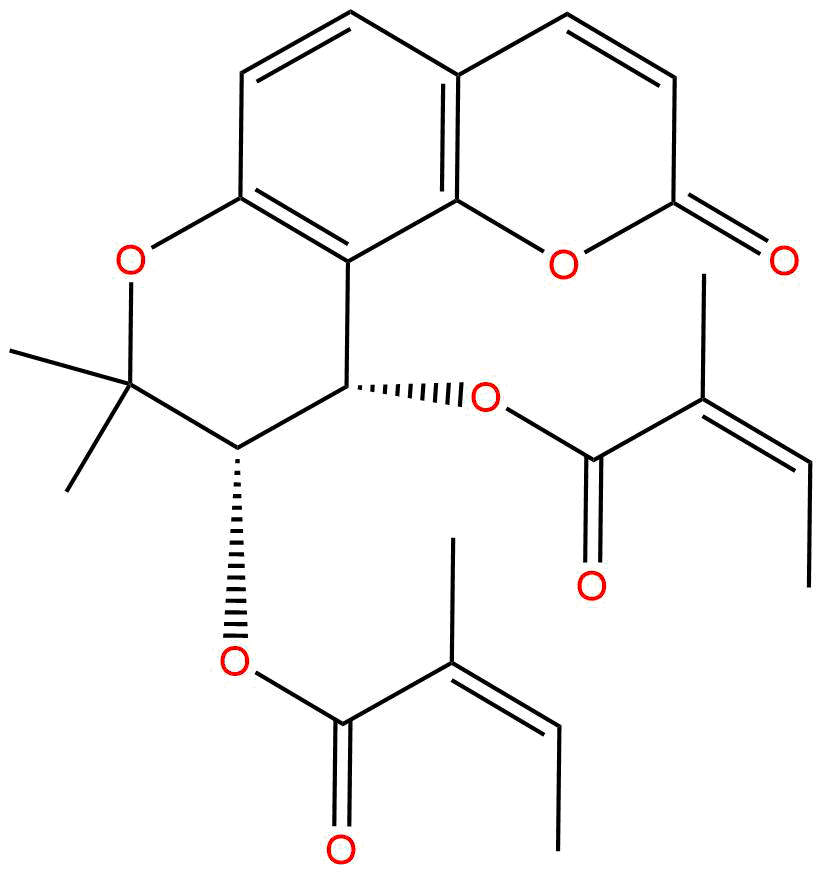


Synonym name: 81740-07-0(Deleted Cas No.); (+)-Anomalin; (+)-Praeruptorin B
Catalogue No.: BP1134
Cas No.: 73069-28-0
Formula: C24H26O7
Mol Weight: 426.465
Botanical Source: Peucedanum formosanum and Peucedanum praeruptorum
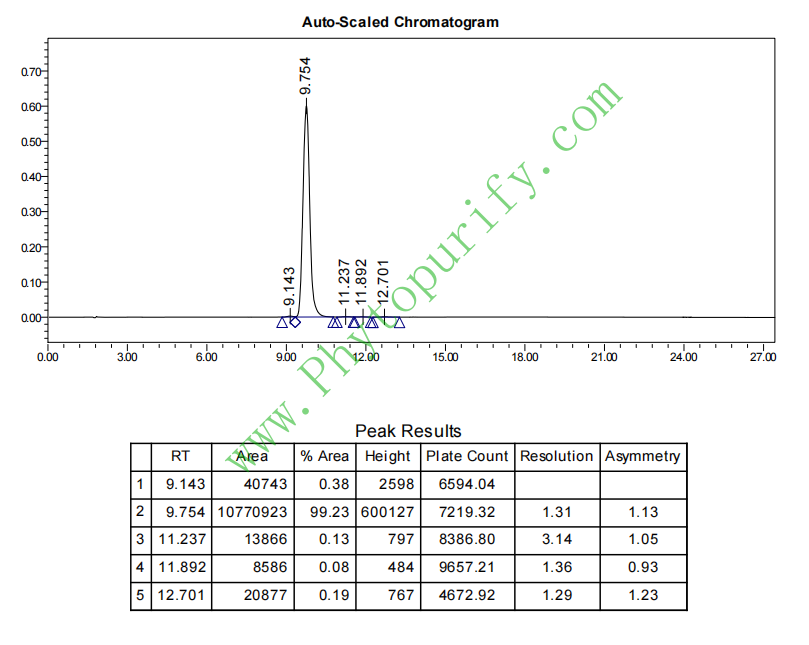
Purity: 95%~99%
Analysis Method: HPLC-DAD or/and HPLC-ELSD
Identification Method: Mass, NMR
Packing: Brown vial or HDPE plastic bottle
Can be supplied from milligrams to grams.
For Reference Standard and R&D, Not for Human Use Directly.
Inquire for bulk scale.
HPLC of Praeruptorin B
Storage conditions:Short-term storage at 2~8℃, long-term storage at -20 ~ -80℃
92.0400
4.1345
4.1342
.0072
2.9252
6.6775
High
87.2257
3.9324
Yes
Yes
No
No
No
Yes
0.0
Yes
Yes
Yes
Yes
Natural products have long been an important source of innovative drug discovery, and their structural diversity and wide range of biological activities provide unique molecular frameworks for treating various diseases. Praeruptorin B (CAS number: 73069-28-0) is derived from the Umbelliferae plant Praeruptorin B(Peucedanum praeruptorum A coumarin compound isolated from the roots of Dunn. In recent years, with the deepening of molecular pharmacology research, berberine has attracted much attention due to its significant anti-tumor activity. Research has shown that one of its core mechanisms of action is to inhibit the activity of sterol regulatory element binding proteins (SREBPs), thereby interfering with the lipid metabolism, proliferation, and survival of tumor cells. In addition, the study also revealed that it exerts multi pathway and multi-target anti-tumor effects by regulating multiple key targets such as MCL1, BCL2, STAT3, MMP2, TOP1, HIF1A, TOP2A, MAPK1, ESR1, CYP19A1, etc. This article aims to systematically review the chemical structure, plant origin, pharmacological activity, mechanism of action, pharmacological evaluation, and clinical application prospects of Peucedanum praeruptorum, in order to provide comprehensive scientific references for the deep development and transformation research of this natural product.
Baihua Qianhuyi belongs to the class of linear furan coumarins, and its chemical name is (+) - (3 'S, 4' S) -3 ', 4' - diseneciyloxy-3 ', 4' - dihydroseselin. Its molecular formula is C24H26O7 and its molecular weight is 426.4650. Its core structure is a coumarin mother nucleus, with a furan ring attached at positions 6 and 7, and senecioyloxy groups connected at positions 3 'and 4', respectively. These two chiral centers are usually in the S configuration, which determines its stereochemical properties.
In terms of physical and chemical properties, berberine exhibits typical coumarin like compound characteristics. The lipophilic water partition coefficient (LogP) of the compound is 4.1345, indicating that it has high lipophilicity. The topological polar surface area (TPSA) is 92.0400 Å ², which is relatively moderate. The water solubility is poor, about 0.0072 mg/mL, which is consistent with its high LogP value, indicating that structural modification or solubilization technology may be needed to improve its bioavailability in formulation development. It is worth noting that its blood-brain barrier permeability is predicted to be "high", indicating its potential therapeutic value for central nervous system related tumors or diseases. In early safety screening, the compound did not show significant hERG potassium channel inhibitory activity (hERG inhibition: No), and the Ames test result was 0.0, indicating a low risk of mutagenicity and providing a favorable safety starting point for its further development.
Baihua Qianhu Yi Su mainly comes from the dried roots of traditional Chinese medicine Baihua Qianhu. White flowered Peucedanum is a plant belonging to the Umbelliferae family and the Peucedanum genus. It is mainly produced in the eastern, central, and southwestern regions of China and has the effects of dispersing wind heat, reducing qi, and resolving phlegm. It is commonly used in clinical practice to treat cough, phlegm, asthma, and other diseases. Coumarin compounds are considered to be the main group of active substances.
The extraction and separation of tetrahydropalmatine from plant materials usually involves organic solvent extraction combined with modern chromatographic techniques. The classic process is as follows: first, the dried roots of Peucedanum praeruptorum are crushed, and then subjected to reflux extraction or ultrasound assisted extraction using polar solvents such as ethanol or methanol. After merging the extracts, the total extract was obtained by vacuum concentration. Subsequently, systematic solvent extraction was performed using solvents such as petroleum ether, ethyl acetate, and n-butanol, and it was found that berberine was mainly enriched in the ethyl acetate fraction. Further purification relies on column chromatography technology, often using silica gel column chromatography with gradient elution systems such as petroleum ether ethyl acetate or chloroform methanol for separation. High performance liquid chromatography (HPLC), especially preparative HPLC, is a key technology for obtaining high-purity monomers of Peucedanum praeruptorum. It usually uses a C18 reverse phase chromatography column with methanol water or acetonitrile water as the mobile phase for elution. In recent years, new separation technologies such as high-speed countercurrent chromatography have also been applied to the efficient preparation and separation of such coumarins.
The most notable pharmacological activity of Baihua Qianhuyi is its extensive anti-tumor effect. Numerous in vitro and in vivo studies have confirmed that it exhibits significant proliferation inhibition and pro apoptotic activity against various human tumor cell lines.
In addition, in addition to its core anti-tumor activity, there are also studies suggesting that berberine may have anti-inflammatory, antioxidant, and cardiovascular protective effects, but further research is needed in these areas.
The anti-tumor mechanism of Baihua Qianhu Yi Su is complex, showing the characteristics of multi-target and multi pathway synergy. Its core mechanism can be summarized as follows:
Inhibiting the SREBPs pathway and disrupting lipid metabolism in tumor cells SREBPs are key transcription factors that regulate the biosynthesis of fatty acids and cholesterol, and are often overactivated in metabolically active tumor cells. Baihua Qianhuyi has been identified as an effective inhibitor of SREBPs. It may significantly downregulate the expression of key lipid synthesis enzymes such as fatty acid synthase and acetyl CoA carboxylase by interfering with the cleavage activation process of SREBPs or preventing their binding to target gene promoters. This leads to lipid depletion within tumor cells, affecting membrane synthesis, energy storage, and signal transduction, ultimately inhibiting cell proliferation and inducing apoptosis. Targeting tumor metabolism, especially lipid metabolism, is an emerging strategy in current anti-cancer drug development, and the mechanism of berberine endows it with unique therapeutic advantages.
Inducing mitochondrial pathway apoptosis By downregulating anti apoptotic proteins such as MCL1 and BCL2, berberine disrupts the balance between pro apoptotic and anti apoptotic proteins. This leads to an increase in mitochondrial outer membrane permeability, release of cytochrome C into the cytoplasm, and activation of the caspase cascade reaction, ultimately triggering irreversible cell apoptosis.
Inhibition of STAT3 signaling pathway STAT3 is an important oncogenic transcription factor, and sustained activation of STAT3 promotes cell proliferation, survival, angiogenesis, and immune escape. Baihua Qianhuyi can inhibit the tyrosine phosphorylation of STAT3, block its dimerization and nuclear translocation, thereby inhibiting the transcription of downstream target genes (such as Cyclin D1, Bcl xL, VEGF) and exerting anti-tumor effects.
Causing DNA damage As a topoisomerase toxin, berberine stabilizes the "cleavable complex" formed between TOP1/2A and DNA, preventing the reconnection of DNA strands and leading to DNA double strand breaks. This severe DNA damage activates the DNA damage response pathway represented by p53, ultimately leading cells towards apoptosis or aging.
Inhibit tumor invasion and metastasis The inhibition of MMP2 and HIF1A jointly weakens the invasive ability of tumor cells and their ability to survive and angiogenesis in hypoxic environments, which may help to inhibit distant metastasis of tumors.
These mechanisms do not exist in isolation, but are intertwined and work together. For example, metabolic stress caused by SREBPs inhibition may exacerbate apoptotic signals triggered by DNA damage or death receptor signaling; Inhibition of the STAT3 pathway may also affect the expression of metabolism related genes. This multi-target mode of action gives Peucedanum praeruptorum potential advantages in overcoming tumor heterogeneity and drug resistance.
Although Baihua Qianhuyi has shown strong anti-tumor activity in vitro, its pharmacological properties still need to be comprehensively evaluated.
Absorption, distribution, metabolism, excretion (ADME)Due to its high lipophilicity (LogP>4) and low water solubility, the oral absorption of berberine may be limited, and its bioavailability needs to be improved. Its high blood-brain barrier permeability prediction is a positive characteristic, providing the possibility for treating brain tumors or metastases. In the body, coumarin compounds typically undergo extensive phase I and phase II metabolism. Phase I metabolism may involve the oxidation and hydrolysis of the maternal nucleus by cytochrome P450 enzyme systems (such as CYP3A4), such as ester bond hydrolysis; The combination reaction of II mainly involves glucuronidation and sulfation. Its metabolites may have activity or toxicity and require further identification. The main excretion pathways may be through bile and urine.
Pharmacokinetic Challenge Preliminary pharmacokinetic studies (mostly based on animal experiments) suggest that there may be issues with irregular oral absorption, significant first pass effects, short in vivo half-life, and insufficient systemic exposure of Peucedanum praeruptorum. Its poor solubility and permeability are the main bottlenecks of its ADME properties.
Formulation strategy and structural optimization To improve its medicinal properties, researchers are exploring various strategies:
Preliminary evaluation of safety Non hERG inhibition and negative Ames test are good starting points, but comprehensive preclinical safety evaluation, including acute toxicity, long-term toxicity, reproductive toxicity, genetic toxicity, etc., still needs to be systematically carried out.
As a multi-target anti-tumor natural lead compound, Baihua Qianhuyi has broad clinical application prospects, but also faces challenges.
Potential application directions:
Future research directions and challenges:
Baihua Qianhu Yi Su is a highly potential anti-tumor natural compound discovered from the traditional Chinese medicine Baihua Qianhu. It uniquely inhibits the SREBPs pathway, disrupts tumor cell lipid metabolism, and synergistically acts on multiple key targets such as MCL1, STAT3, TOP1/2A, demonstrating distinct characteristics of multi pathway anti-tumor effects. Despite its challenges in terms of physicochemical properties and pharmacokinetics, it is expected to be transformed into a new candidate drug with clinical application value through the optimization of modern medicinal chemistry and pharmacy methods. The in-depth study of berberine not only contributes to the development of new anti-tumor drugs, but also provides a successful example for finding lead compounds that act on metabolic targets from traditional Chinese medicine, reflecting the sustained vitality of natural products in modern innovative drug research and development. In the future, interdisciplinary collaboration and sustained investment will be key to driving this compound into clinical practice.
