


Synonym name:
Catalogue No.: BP1133
Cas No.: 73069-27-9
Formula: C21H22O7
Mol Weight: 386.4
Botanical Source: Peucedanum japonicum and Peucedanum praeruptorum
Purity: 95%~99%
Analysis Method: HPLC-DAD or/and HPLC-ELSD
Identification Method: Mass, NMR
Packing: Brown vial or HDPE plastic bottle
Can be supplied from milligrams to grams.
For Reference Standard and R&D, Not for Human Use Directly.
Inquire for bulk scale.
Description:
(+)-Praeruptorin A exerts distinct relaxant effects on isolated rat aorta rings, which may be mainly attributed to nitric oxide synthesis catalyzed by endothelial nitric oxide synthase.
References:
Chem Biol Interact. 2010 Jul 30;186(2):239-46.
(+/-)-Praeruptorin A enantiomers exert distinct relaxant effects on isolated rat aorta rings dependent on endothelium and nitric oxide synthesis.
METHODS AND RESULTS:
(+)-Praeruptorin A showed more potent relaxation than (-)-praeruptorin A against KCl- and phenylephrine-induced contraction of rat isolated aortic rings with intact endothelium. Removal of the endothelium remarkably reduced the relaxant effect of (+)-Praeruptorin A but not that of (-)-praeruptorin A. Pretreatment of aortic rings with N(omega)-nitro-L-arginine methyl ester (L-NAME, an inhibitor of nitric oxide synthase) or methylene blue (MB, a soluble guanylyl cyclase inhibitor) resulted in similar changes of the relaxant effects of the two enantiomers to endothelium removal. Molecular docking studies also demonstrated that (+)-Praeruptorin A was in more agreement to nitric oxide synthase pharmacophores than (-)-praeruptorin A. On the other hand, the two enantiomers of praeruptorin A could slightly attenuate the contraction of rat aortic rings induced by internal Ca(2+) release from sarcoplasmic reticulum (SR).
CONCLUSIONS:
These findings indicated that (+)-Praeruptorin A and (-)-praeruptorin A exerted distinct relaxant effects on isolated rat aorta rings, which might be mainly attributed to nitric oxide synthesis catalyzed by endothelial nitric oxide synthase.
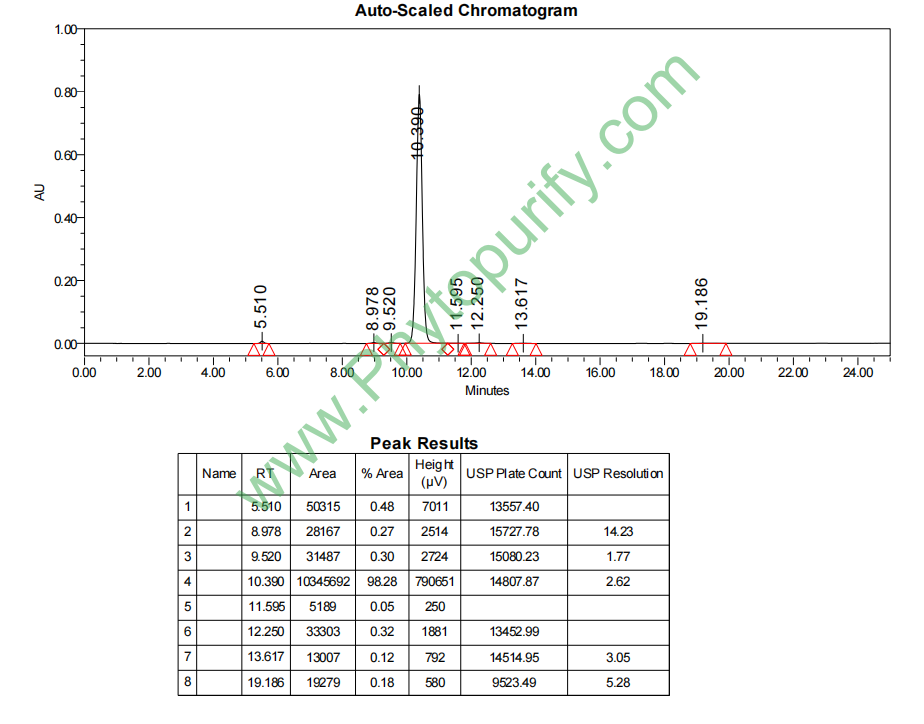
HPLC of Praeruptorin A
Storage conditions:Short-term storage at 2~8℃, long-term storage at -20 ~ -80℃
92.0400
3.1658
3.1658
.0150
2.9398
6.7126
High
85.0865
3.7180
Yes
Yes
No
No
No
Yes
0.0
No
Yes
Yes
Yes
Natural products play an irreplaceable role in the history of human disease prevention and treatment, and are an important source of modern drug discovery and development. Coumarin compounds, as a class of secondary metabolites widely distributed in the plant kingdom, have attracted much attention due to their structural diversity and significant biological activity. Among them, pyranocoumarin often exhibits richer and stronger pharmacological effects due to its unique fused ring structure. Praeruptorin A (PA), a typical horn shaped coumarin, is a traditional Chinese medicine used in the production of white flowered Peucedanum(Peucedanum praeruptorum One of the main active ingredients of Dunn. As a commonly used traditional Chinese medicine for relieving cough, asthma, dispelling wind and dispelling cold, the modern pharmacological research of Baihua Qianhu reveals that its extract and monomer components have multiple effects such as anti-inflammatory, anti-tumor, and cardiovascular protection.
In recent years, with the rapid development of molecular pharmacology and chemical biology techniques, the deep pharmacological mechanism of Peucedanum praeruptorum A has been continuously elucidated. Research has shown that one of its core functions is to exert strong anti-inflammatory effects by inhibiting the activation of the nuclear factor kappa B (NF - κ B) signaling pathway. More notably, Peucedanum praeruptorum A exhibits significant anti proliferative, pro apoptotic, and anti metastatic activities in various tumor models, involving the regulation of key apoptotic proteins such as MCL1 and BCL2, signal transduction and transcriptional activator 3 (STAT3), matrix metalloproteinase 2 (MMP2), as well as various kinase and enzyme targets. These findings make it a highly promising candidate molecule in the field of anti-tumor drug development. This article aims to systematically review the chemical properties, plant sources, pharmacological activities, molecular mechanisms of action, pharmacological evaluation, and clinical application prospects of Peucedanum praeruptorum A, in order to provide comprehensive scientific references for the in-depth research and development of this compound.
The chemical name of Baihua Qianhu Su A is (+) -3 '(S), 4' (S) - didecyloxy-3 ', 4' - dihydroartemisinin, and its CAS number is 73069-27-9. From a chemical structure perspective, it belongs to the angular pyran coumarin family, and its basic skeleton is composed of a coumarin parent nucleus (benzo [a] - pyranone) coupled with a dihydropyran ring at positions C-7 and C-8, forming an angular fused structure. Its significant structural feature is the presence of an angeloyloxy substituent at each C-3 'and C-4' position, which determines its stereochemical configuration. The (+) -3 '(S) and 4' (S) configurations are usually the main active forms.
Its molecular formula is C21H22O7 and its molecular weight is 386.40 g/mol. The calculated lipid water partition coefficient (LogP) is 3.17, indicating that the compound has moderate lipophilicity, which facilitates its penetration into cell membranes but may also affect its water solubility. Its topological polar surface area (TPSA) is 92.04 Å ², which is relatively small, further confirming its good membrane permeation potential. The water solubility data obtained from the experiment is relatively low, about 0.015 mg/mL, indicating that it may be necessary to improve its solubility and bioavailability through structural modification or the use of appropriate pharmaceutical excipients (such as cyclodextrin inclusion, nano formulations, etc.) during the formulation development process. It is worth noting that based on its physicochemical properties, it is predicted that Peucedanum praeruptorum A has a high blood-brain barrier permeability, which provides the possibility for its application in the treatment of central nervous system related diseases such as glioma and neuroinflammation. The preliminary drug risk assessment showed a negative result (0.0) in the Ames test, indicating no mutagenicity; At the same time, there was no significant inhibitory effect on hERG potassium channels, indicating a low risk of causing QT interval prolongation in the heart, which laid a relatively safe preliminary foundation for its subsequent development.
The main source of Peucedanum praeruptorum A is from Peucedanum praeruptorum, a plant in the Umbelliferae family(Peucedanum praeruptorum Dunn's dry roots. Baihua Qianhu is mainly distributed in the Yangtze River Basin and southern regions of China. It is a commonly used medicinal herb in traditional Chinese medicine and has the effects of reducing qi, resolving phlegm, dispersing wind, and clearing heat. Except for white flowered Peucedanum, in the same genus of plants such as purple flowered Peucedanum(Peucedanum decursivum)There are also coumarin components with similar structures in other Umbelliferae plants, but Peucedanum praeruptorum is considered one of the sources with high PA content.
The extraction of paeoniflorin A from plant materials usually follows the conventional process of natural product chemistry. Firstly, crush the dried roots of Peucedanum praeruptorum and extract them using organic solvents. Common extraction solvents include methanol, ethanol, ethyl acetate, etc. Among them, ethanol is often used due to its low toxicity and moderate extraction efficiency. The extraction methods can be cold soaking, hot reflux, or ultrasound assisted extraction. Ultrasound assisted extraction can effectively shorten the extraction time and improve efficiency.
After filtration and concentration, the crude extract needs to be further separated and purified to obtain high-purity Peucedanum praeruptorum A. Traditional column chromatography is the main method, often using silica gel as the stationary phase and gradient elution with solvents of different polarities such as petroleum ether ethyl acetate or chloroform methanol. According to actual needs, multiple column chromatography or other chromatography techniques (such as preparative thin-layer chromatography, medium pressure liquid chromatography, etc.) may be required to achieve separation. Modern high-performance preparative liquid chromatography (HPLC), especially reverse phase HPLC (using a C18 column with methanol water or acetonitrile water as the mobile phase), has become a key and final step in obtaining high-purity monomer compounds. The extraction and separation process typically requires online or offline monitoring using thin-layer chromatography (TLC) or high-performance liquid chromatography (HPLC) to ensure the tracking and purity identification of the target compound. Structural identification relies on spectroscopic methods such as nuclear magnetic resonance (NMR, including 1H-NMR, 13C-NMR, 2D-NMR), mass spectrometry (MS), and optical rotation determination.
A large number of in vitro and in vivo pharmacological studies have shown that resveratrol A has a wide range of biological activities, among which anti-inflammatory and anti-tumor effects are the most prominent, and extend to cardiovascular protection, asthma relief, and other aspects.
1. Anti inflammatory activity:
The anti-inflammatory effect of Baihua Qianhusin A is one of its earliest pharmacological activities that has been extensively studied. In the lipopolysaccharide (LPS) - induced macrophage (such as RAW264.7) inflammation model, PA can dose dependently inhibit the production of nitric oxide (NO), prostaglandin E2 (PGE2), and pro-inflammatory cytokines (such as tumor necrosis factor - α (TNF - α), interleukin-6 (IL-6), IL-1 β). In acute inflammation models induced by carrageenan or acetic acid in mice, PA administration significantly reduced paw swelling or increased peritoneal capillary permeability. The core mechanism of its anti-inflammatory effect is closely related to the inhibition of the NF - κ B signaling pathway.
2. Antitumor activity:
The anti-tumor effect of Peucedanum praeruptorum A has been a focus of research in recent years, and it exhibits growth inhibition and pro apoptotic effects on various human tumor cell lines.
- Cell proliferation inhibition and apoptosis induction: PA can significantly inhibit the proliferation of lung cancer (such as A549, NCI-H460), breast cancer (such as MCF-7, MDA-MB-231), liver cancer (such as HepG2, SMMC-7721), colon cancer (such as HCT116, HT-29) and other cancer cells, and its half inhibitory concentration (IC50) is mostly at the micromolar level. Its pro apoptotic effect is manifested by inducing cell cycle arrest (such as G0/G1 phase or G2/M phase), increasing the expression of apoptosis related proteins (such as cleaved caspase-3, caspase-9), reducing the levels of anti apoptotic proteins (such as Bcl-2, Mcl-1), and inducing a decrease in mitochondrial membrane potential.
- Anti invasion and anti metastasis: In addition to directly killing tumor cells, PA can also inhibit the migration and invasion ability of cancer cells. This is particularly evident in breast cancer and liver cancer models, and its mechanism is related to down-regulation of the expression and activity of matrix metalloproteinases (such as MMP2, MMP9).
- In vivo anti-tumor effect: In nude mouse transplant tumor models (such as lung cancer and liver cancer xenografts), intraperitoneal injection or gavage of PA can significantly inhibit tumor growth, and may exhibit synergistic effects when combined with certain chemotherapy drugs (such as cisplatin), while reducing some of the toxic side effects caused by chemotherapy.
3. Other pharmacological activities:
- Cardiovascular protective effect: Research has shown that PA has the potential to dilate blood vessels and lower blood pressure, and its mechanism may be related to regulating endothelial function and inhibiting calcium channels.
- Antiasthmatic effect: Consistent with its traditional efficacy, PA has been shown to alleviate airway inflammation and airway hyperresponsiveness in animal models of asthma.
- Antibacterial and antiviral activity: Some studies suggest that PA has certain inhibitory activity against certain bacteria and viruses, but further exploration is needed.
The multiple pharmacological activities of Peucedanum praeruptorum A stem from its regulation of multiple key signaling pathways and molecular targets within cells. Its mechanism of action is complex and interconnected.
1. Core anti-inflammatory mechanism: inhibition of NF - κ B pathway
NF - κ B is a core transcription factor that regulates inflammatory responses. In the resting state, NF - κ B binds to the inhibitory protein I κ B and exists in the cytoplasm. When stimulated by LPS, the I κ B kinase (IKK) complex is activated, phosphorylated, and degraded, allowing NF - κ B (mainly p65/p50 dimer) to enter the nucleus and initiate downstream inflammatory cytokine gene transcription. Research has shown that resveratrol A can effectively inhibit the activation of IKK, prevent the phosphorylation and degradation of I κ B α, thereby blocking the nuclear translocation of NF - κ B and its binding activity to DNA, ultimately downregulating the expression of inflammatory mediators such as TNF - α, IL-6, IL-1 β, COX-2, and iNOS.
2. Multi target mechanism of anti-tumor effect:
The anti-tumor effect of Baihua Qianhu Su A involves intervention in multiple aspects such as cell apoptosis, proliferation, survival, and invasion.
- Regulating apoptosis related proteins (MCL1, BCL2): PA can downregulate the expression of anti apoptotic proteins Mcl-1 and Bcl-2, while possibly upregulating pro apoptotic proteins such as Bax, disrupting mitochondrial outer membrane permeability, leading to the release of cytochrome C, activating the caspase cascade reaction, and inducing endogenous apoptosis.
- Inhibition of STAT3 signaling pathway: STAT3 is an important oncogenic transcription factor that is continuously activated in various tumors. PA can inhibit the tyrosine phosphorylation of STAT3 (such as Tyr705 site), block its dimerization and nuclear translocation, thereby suppressing the expression of downstream target genes (such as Cyclin D1, Bcl xL, Survivor), inhibiting cell proliferation and promoting apoptosis.
- Inhibition of Matrix Metalloproteinase 2 (MMP2): PA can reduce the mRNA and protein expression levels of MMP2, and may inhibit its activity through upstream signals such as NF - κ B and MAPK, thereby weakening the ability of tumor cells to degrade extracellular matrix and inhibiting invasion and metastasis.
- Impact on DNA Topoisomerase (TOP1, TOP2A): There are studies suggesting that coumarin compounds may interfere with the activity of DNA topoisomerases. PA may affect DNA replication, transcription, and repair by acting on TOP1 or TOP2A, leading to DNA damage and subsequently causing cell cycle arrest and apoptosis.
- Regulating the HIF1A and MAPK pathways: Under hypoxic microenvironment, PA may inhibit the stability or activity of hypoxia inducible factor-1 alpha (HIF1A), affecting tumor metabolic adaptation and angiogenesis. In addition, it can regulate the phosphorylation levels of members of the mitogen activated protein kinase (MAPK) family, such as ERK1/2 or MAPK1, affecting cell proliferation and survival signals.
- Intervention in estrogen related pathways (ESR1, CYP19A1): For hormone dependent tumors (such as breast cancer), PA may inhibit tumor growth by inhibiting the activity of estrogen receptor α (ESR1) or aromatase (CYP19A1), reducing the synthesis and role of endogenous estrogen.
These targets do not exist in isolation, but form a complex regulatory network. For example, there is a cross-talk between the NF - κ B and STAT3 pathways, and PA's synergistic inhibition of them may result in stronger anti-inflammatory and anti-tumor effects.
Although Baihua Qianhusin A exhibits great potential in pharmacological activity, its drug like and pharmacokinetic (PK) properties are key factors determining its successful development as a drug.
1. Analysis of pharmacological parameters:
As mentioned earlier, the molecular weight of PA (386.4) conforms to the Rule of Five, and the LogP value (3.17) indicates that it has good membrane permeability, but poor water solubility (0.015 mg/mL) is the main limiting factor for its oral absorption. The prediction of high blood-brain barrier permeability brings opportunities for its treatment of brain diseases. The absence of hERG inhibition and negative Ames mutagenicity are its early safety advantages.
2. Pharmacokinetic studies:
At present, there is relatively limited research on the pharmacokinetics of PA system, but some basic characteristics have been revealed in previous studies.
- Absorption: Due to its low water solubility, oral bioavailability may not be high. Animal experiments (in rats) have shown that PA is absorbed rapidly in the gastrointestinal tract after oral administration, but its absolute bioavailability needs to be accurately determined. Its lipophilicity facilitates transmembrane absorption.
- Distribution: PA is widely distributed in the body. Its higher lipid solubility and smaller TPSA facilitate its distribution to various tissues, including predicting its ability to cross the blood-brain barrier. In animal models, PA or its metabolites can be detected in multiple tissues such as the heart, liver, spleen, lungs, and kidneys.
- Metabolism: PA mainly undergoes liver metabolism in the body. The common metabolic pathways of coumarin compounds include hydroxylation, dealkylation, hydrolysis (especially hydrolysis of ester bonds), and subsequent glucuronic acid binding or sulfation. The acyloxy groups at C-3 'and C-4' positions may be sensitive metabolic sites. The cytochrome P450 (CYP) enzyme system, particularly the CYP3A4 and CYP2C families, may be involved in its phase I metabolism.
- Excretion: Metabolites are mainly excreted through the kidneys and urine, and some prototype drugs or metabolites may also be excreted through bile and feces.
3. Challenges and optimization strategies faced:
- Solubility and bioavailability: This is the primary challenge faced by PA development. The strategy includes: ① preparing salts or prodrugs; ② Using advanced drug delivery systems such as solid dispersions, liposomes, nanoparticles, micelles, or cyclodextrin inclusion complexes; ③ Reasonably modify the structure and introduce hydrophilic groups while maintaining activity.
- Metabolic stability: It is necessary to study its metabolic soft spots in detail, improve metabolic stability through structural modification, and prolong half-life.
- Targeted: By utilizing techniques such as nanomedicine or antibody conjugation, targeted delivery to tumor sites can be achieved, improving therapeutic efficacy and reducing systemic toxicity.
- Comprehensive security evaluation: Systematic preclinical toxicology studies are required, including acute toxicity, chronic toxicity, reproductive toxicity, etc.
As a natural small molecule compound with multiple targets and functions, Baihua Qianhusin A has broad clinical application prospects, but it is also full of challenges.
1. Potential therapeutic areas:
- Tumor treatment: This is the most promising direction. PA can be used as a single drug or in combination with existing chemotherapy drugs (such as platinum, paclitaxel) for the treatment of lung cancer, breast cancer, liver cancer, colorectal cancer, etc., especially for tumor types with abnormal activation of NF - κ B or STAT3 signaling pathway. Its anti metastatic properties also make it promising for preventing tumor recurrence and metastasis.
- Inflammatory diseases: It can be used to treat rheumatoid arthritis, inflammatory bowel disease, asthma, chronic obstructive pulmonary disease (COPD), and neuroinflammatory related diseases such as Alzheimer's disease and Parkinson's disease, especially considering its potential brain entry ability.
- Cardiovascular disease: To explore as a candidate molecule for vasodilators or antiatherosclerotic drugs.
2. Development Strategy and Prospects:
- Structural optimization and derivative development: Based on the parent nucleus structure of PA, conduct systematic structure-activity relationship (SAR) studies and synthesize a series of derivatives or analogues. Optimization directions include improving water solubility, enhancing selectivity and efficacy towards specific targets such as MCL1 and STAT3, and improving pharmacokinetic properties. Computer aided drug design (CADD) will play an important role in this process.
- Combination therapy strategy: Conduct in-depth research on the synergistic mechanism between PA and existing standard treatment drugs, develop reasonable combination therapy plans to overcome drug resistance, reduce toxic side effects, and improve efficacy.
- Application of new delivery system: Actively exploring the application of nanomedicine technology in PA delivery. For example, preparing tumor microenvironment responsive (such as pH responsive, enzyme responsive) PA nanoparticles, or loading them into biological carriers such as exosomes, to achieve intelligent and precise delivery.
- In depth mechanism exploration: By utilizing cutting-edge technologies such as proteomics, metabolomics, and CRISPR screening, a comprehensive cellular action map of PA is created, identifying its new targets and signaling pathways, and revealing its potential new indications.
- Translational Medicine Research: Strengthen high-quality preclinical research, establish disease models that are more closely related to clinical practice (such as human tumor xenograft models and organoid models), and actively promote standardized preclinical safety evaluations, laying a solid foundation for future applications for clinical trials (IND).
Baihua Qianhu Su A is a representative horn type pyranose coumarin compound isolated from the traditional Chinese medicine Baihua Qianhu. It not only has modern scientific connotations in traditional medicinal efficacy, but also has become a hot topic in natural product medicinal chemistry research due to its significant anti-inflammatory and broad-spectrum anti-tumor activities. Its pharmacological mechanism is complex and sophisticated, regulating multiple molecular targets such as MCL1, BCL2, MMP2, TOP1/2A by inhibiting key signaling pathways such as NF - κ B and STAT3, forming a multidimensional and networked biological effect system. Despite facing challenges such as poor water solubility and metabolism in drug development, its clear activity, multi-target properties, and relatively good preliminary safety characteristics make it a highly valuable lead compound for development. In the future, through in-depth structure-activity relationship research, rational structural modification, advanced drug delivery technology, and systematic preclinical development, Peucedanum praeruptorum A is expected to be optimized as a new generation of anti-inflammatory or anti-tumor candidate drugs, or provide new options for combination therapy, thereby better serving human health and demonstrating the enormous potential of modernization and internationalization of traditional Chinese medicine.
