
| Catalog No | Package | Original Price | Price | Inventory | Quantity | Operating |
|---|---|---|---|---|---|---|
| BP0351-100mg | 100mg | $40.00 | Sign in |
|


Synonym name: Ligustizine; Ligustrazine; Tetrapyrazine
Catalogue No.: BP0351
Cas No.: 1124-11-4
Formula: C8H12N2
Mol Weight: 136.198
Botanical Source: Metab. from Bacillus subtilis and an arctic marine bacterium; Galbanum oil. Ligusticum chuanxiong and Ligusticum wallichii
Purity: 95%~99%
Analysis Method: HPLC-DAD or/and HPLC-ELSD
Identification Method: Mass, NMR
Packing: Brown vial or HDPE plastic bottle
Can be supplied from milligrams to grams.
For Reference Standard and R&D, Not for Human Use Directly.
Inquire for bulk scale.
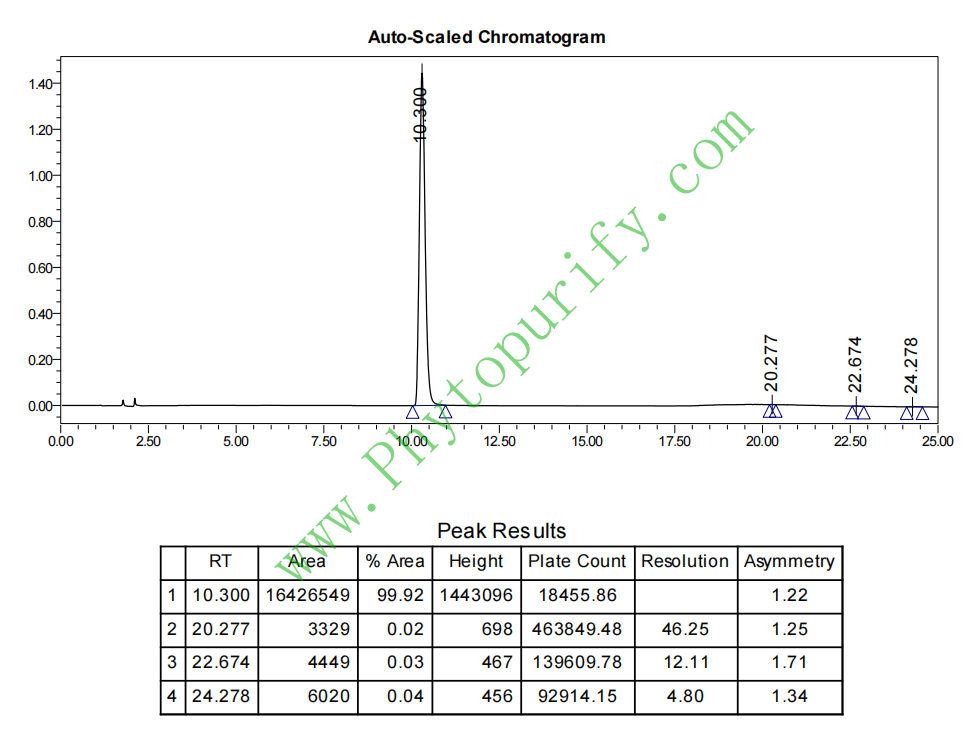
HPLC of Chuanxingzine
Storage conditions:Short-term storage at 2~8℃, long-term storage at -20 ~ -80℃
25.7800
.1900
.1900
100.0000
High
10.0000
No
No
No
No
No
No
Chuanxingzine, also known as tetramethylpyrazine, is a pyrazine alkaloid extracted from the traditional Chinese medicine Ligusticum wallichii. Chuanxiong, as a natural source of ligustrazine, has always been widely used in the field of traditional Chinese medicine, mainly for promoting blood circulation, improving blood circulation, and treating cardiovascular and cerebrovascular diseases. Ligustrazine, as one of the main active ingredients of Ligusticum chuanxiong, has attracted much attention in recent years due to its diverse pharmacological activities. Its functions cover multiple aspects such as anti-tumor, vasodilation, platelet aggregation inhibition, neuroprotection, cell apoptosis inhibition, and antibacterial, demonstrating good clinical application potential.
This article aims to systematically review the chemical structure and physicochemical properties, plant sources and extraction methods, pharmacological activity, mechanism of action, pharmacological evaluation, and clinical application prospects of ligustrazine, aiming to provide scientific references for the in-depth research and drug development of this natural product.
The chemical structure of ligustrazine is a tetramethyl substituted pyrazine ring, with a molecular formula of C8H12N2 and a molecular weight of 136.19. Its structural feature is that all four hydrogen atoms on the pyrazine ring are replaced by methyl groups, forming a stable tetramethylpyrazine skeleton. This structure endows ligustrazine with high chemical stability and good balance of lipid solubility and water solubility.
In terms of physical and chemical properties, the LogP value of ligustrazine is about 0.19, indicating that it has moderate lipophilicity and is conducive to cell membrane permeability. The polar surface area (TPSA) is 25.78 Å ², and the number of hydrogen bond acceptors is 2, indicating that its molecular polarity is moderate and conducive to binding with biomolecules. Ligustrazine has good water solubility and high blood-brain barrier permeability, indicating that it can effectively enter the central nervous system and exert neuroprotective effects. The half-life is about 1 hour, and the metabolism in the body is relatively fast, indicating the need for a reasonable dosing regimen to maintain the efficacy. Toxicological evaluation showed that its LD50 was 1500 mg/kg, and its liver toxicity, cardiac toxicity, and hERG channel inhibition were all negative. The Ames mutagenicity test was also negative, indicating that ligustilide has good safety.
Ligusticum wallichii is mainly derived from Ligusticum wallichii, a perennial herbaceous plant in the family Apiaceae, widely distributed in southwestern China. Chuanxiong is used as a medicinal herb for promoting blood circulation and removing blood stasis in traditional Chinese medicine, with a long history of application and rich pharmacological research foundation.
The extraction of ligustrazine usually uses dried rhizomes of Ligusticum chuanxiong as raw materials. Common extraction methods include:
During the extraction process, controlling temperature, pH, and solvent polarity has a significant impact on the stability and yield of ligustrazine. Optimizing the extraction process not only helps to increase the yield of ligustrazine, but also ensures that its biological activity is not compromised.
Ligustrazine has rich pharmacological activity, covering multiple physiological systems, especially in the fields of cardiovascular and cerebrovascular protection and neuroprotection.
Ligustrazine has significant vasodilation and antiplatelet aggregation effects. It regulates endothelial function, promotes the release of nitric oxide (NO), improves hemodynamics, and reduces blood pressure and viscosity. In vitro and in vivo experiments have confirmed that ligustrazine can inhibit platelet activation and aggregation, reduce the risk of thrombosis, and prevent atherosclerosis and related cardiovascular events.
Multiple studies have shown that ligustrazine has inhibitory effects on various tumor cells. Its mechanism involves inducing tumor cell apoptosis, inhibiting cell proliferation and invasion, and regulating the tumor microenvironment. Ligustrazine exerts anti-tumor effects by affecting cell cycle regulatory proteins and apoptosis related factors, demonstrating its potential as an adjuvant anticancer drug.
Ligustrazine can effectively resist neuronal damage, reduce oxidative stress and inflammatory reactions, and inhibit neuronal apoptosis. Its excellent blood-brain barrier permeability enables it to exhibit protective effects in neurodegenerative diseases such as cerebral ischemia-reperfusion injury, Parkinson's disease, and Alzheimer's disease. Ligustrazine can also regulate neurotransmitter release and improve neurological dysfunction.
Ligustrazine inhibits excessive cell apoptosis and protects tissue cell survival by regulating apoptosis related signaling pathways. Meanwhile, its anti-inflammatory effect is achieved by downregulating the expression of pro-inflammatory factors, reducing inflammatory responses, and promoting tissue repair.
Partial studies have shown that ligustrazine has inhibitory effects on certain bacterial metabolism, possibly exerting antibacterial effects by interfering with bacterial energy metabolism and cell wall synthesis. In addition, the regulatory effect of ligustrazine on metabolism related enzymes provides a theoretical basis for its application in metabolic diseases.
The multiple pharmacological effects of ligustrazine are attributed to its regulation of multiple molecular targets and signaling pathways, particularly in the field of cardiovascular protection. The main targets include:
The synergistic regulation of these targets enables ligustrazine to demonstrate a comprehensive therapeutic advantage of multi-target and multi pathway in the treatment of cardiovascular diseases, neurological diseases, and tumors.
The pharmacological evaluation of ligustrazine shows that it has good potential for drug development:
Pharmacokinetic studies have shown that ligustrazine is rapidly absorbed and widely distributed orally, especially at high concentrations in cardiovascular and cerebrovascular tissues. Its metabolic pathway mainly involves the liver enzyme system, and its metabolites have good safety. Rapid metabolism and clearance suggest the need to develop controlled release formulations or combination therapy to prolong drug efficacy.
Ligustrazine, with its multi-target and multi mechanism pharmacological properties, has shown broad clinical application prospects in the fields of cardiovascular protection and neuroprotection. Its antiplatelet aggregation, vasodilation, and anti-inflammatory effects make it a potential candidate drug for treating diseases such as coronary heart disease, cerebral thrombosis, and hypertension. The neuroprotective effect provides new ideas for the adjuvant treatment of neurodegenerative diseases such as cerebral ischemia, Parkinson's disease, and Alzheimer's disease.
In addition, the anti-tumor activity of ligustrazine lays the foundation for its application in adjuvant therapy for tumors. Future research can focus on the combined application of ligustrazine and existing anticancer drugs, as well as their regulatory mechanisms on the tumor microenvironment.
Although ligustrazine has good safety and pharmacological properties, its clinical promotion still faces some challenges, such as the frequency of administration caused by its short half-life and complex metabolic pathways in the body. In the future, it is necessary to strengthen pharmacokinetic and toxicological research, optimize formulation technology, and improve bioavailability and efficacy stability.
Meanwhile, based on modern molecular biology and medicinal chemistry techniques, in-depth analysis of the molecular mechanism of action of ligustrazine, screening and validation of more targets will help promote the development of its precise treatment strategy. Multi center, large sample clinical trials are also essential to establish their clinical efficacy and safety.
Ligustrazine, as a natural pyrazine alkaloid derived from traditional Chinese medicine Chuanxiong, has shown broad application prospects in various fields such as cardiovascular protection, neuroprotection, anti-tumor and anti-inflammatory due to its unique chemical structure and diverse pharmacological activities. Its good pharmacokinetic parameters and safety provide a solid foundation for the development of new drugs.
In the future, by combining modern pharmacology, molecular biology, and medicinal chemistry techniques, we will deeply explore the mechanism of action of ligustrazine, optimize its pharmacokinetic properties, and conduct systematic clinical research. This will help promote the transformation of ligustrazine from a traditional natural product to a modern innovative drug, benefiting a large number of patients.
