


Synonym name:
Catalogue No.: BP0268
Cas No.: 20931-37-7
Formula: C25H28O6
Mol Weight: 424.493
Botanical Source: From Garcinia mangostana (mangosteen) and Cratoxylum formosum ssp. pruniforum
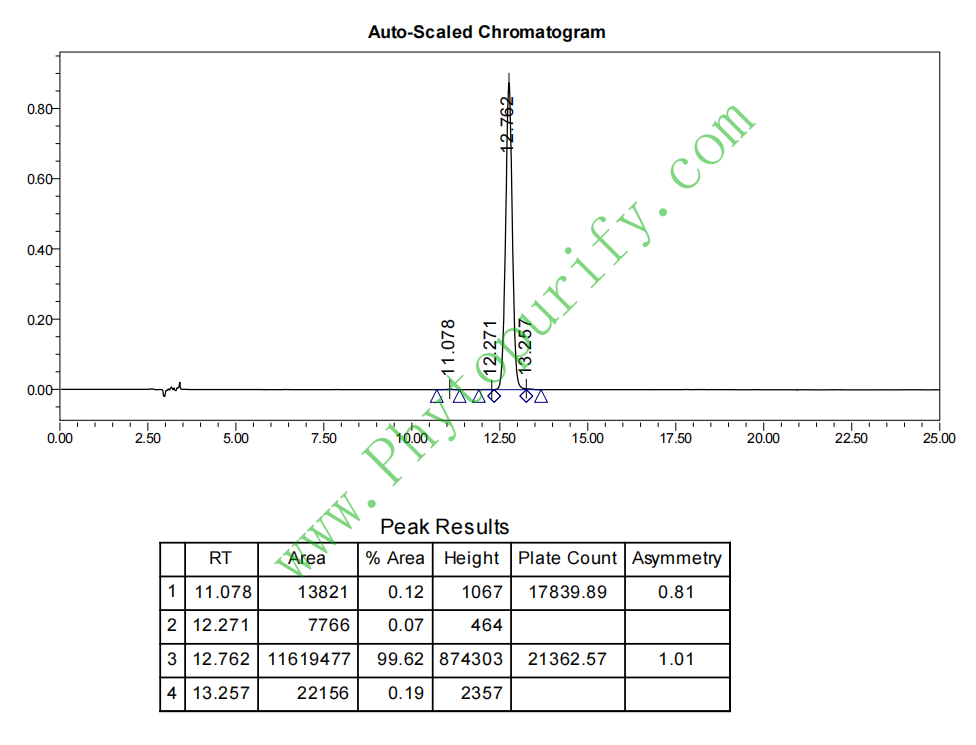
Purity: 95%~99%
Analysis Method: HPLC-DAD or/and HPLC-ELSD
Identification Method: Mass, NMR
Packing: Brown vial or HDPE plastic bottle
Can be supplied from milligrams to grams.
For Reference Standard and R&D, Not for Human Use Directly.
Inquire for bulk scale.
Description:
Beta-mangostin has cytotoxic, and anti-inflammatory effects, it exhibits strong antibacterial activity against B. cereus, and Mycobacterium tuberculosis with the MIC value of 0.25, and 6.25 microg/ml, respectively. It also shows antimalarial activity against Plasmodium falciparum with IC(50) values of 7.2 microg/ml.
References:
J Ethnopharmacol. 2014 Apr 28;153(2):435-45.
β Mangostin suppress LPS-induced inflammatory response in RAW 264.7 macrophages in vitro and carrageenan-induced peritonitis in vivo.
The fruit hull of Garcinia mangostana Linn. has been used in traditional medicine for treatment of various inflammatory diseases. Hence, this study aims to investigate the in vitro and in vivo anti-inflammatory effect of β mangostin (βM), a major compound present in Garcinia mangostana.
METHODS AND RESULTS:
The in silico analysis of inflammatory mediators such as cyclooxygenase (COX) and nuclear factor-kappa B (NF-kB) were performed via molecular docking. Further evaluation of anti-inflammatory effect was conducted in lipopolysaccharide (LPS) induced RAW 264.7 macrophages. Suppression of activated NF-kB was analyzed by high content screening. βM triggered inhibition of COX-1 and COX-2 in vitro were studied using biochemical kit. The in vivo model used in this study was carrageenan-induced peritonitis model, where reduction in carrageenan-induced peritonitis is measured by leukocyte migration and vascular permeability. In addition, the evaluation of βM׳s effect on carrageenan induced TNF-α and IL-1β release on peritoneal fluid was also carried out. Treatment with βM could inhibit the LPS-induced NO production but not the viability of RAW 264.7. Similarly, βM inhibited PGE2 production and the cytokines: TNF-α and IL-6. The COX catalyzed prostaglandin biosynthesis assay had showed selective COX-2 inhibition with a 53.0±6.01% inhibition at 20 μg/ml. Apart from this, βM was capable in repressing translocation of NF-kB into the nucleus. These results were concurrent with molecular docking which revealed COX-2 selectivity and NF-kB inhibition. The in vivo analysis showed that after four hours of peritonitis, βM was unable to reduce vascular permeability, yet could decrease the total leukocyte migration; particularly, neutrophils. Meanwhile, dexamethasone 0.5 mg/kg, successfully reduced vascular permeability. The levels of TNF-α and IL-1β in peritoneal fluid was reduced significantly by βM treatment.
CONCLUSIONS:
The current study supports the traditional use of Garcinia mangostana fruit hull for treatment of inflammatory conditions. In addition, it is clear that the anti-inflammatory efficacy of this plant is not limited to the presence of α and γ, but β also with significant activity.
Fitoterapia. 2014 Oct;98:179-83.
Antibacterial tetraoxygenated xanthones from the immature fruits of Garcinia cowa.
METHODS AND RESULTS:
A phytochemical investigation of the acetone extract from the immature fruits of Garcinia cowa led to the isolation of two novel tetraoxygenated xanthones, garcicowanones A (1) and B (2), together with eight known tetraoxygeanted xanthones. Their structures were determined by spectroscopic analysis.All isolated compounds were evaluated for their antibacterial activity against Bacillus cereus TISTR 688, Bacillus subtilis TISTR 008, Micrococcus luteus TISTR 884, Staphylococcus aureus TISTR 1466, Escherichia coli TISTR 780, Pseudomonas aeruginosa TISTR 781, Salmonella typhimurium TISTR 292 and Staphylococcus epidermidis ATCC 12228.
CONCLUSIONS:
α-Mangostin showed potent activity (MIC 0.25-1 μg/mL) against three Gram-positive strains and garcicowanone A and Beta-mangostin exhibited strong antibacterial activity against B. cereus with the same MIC values of 0.25 μg/mL.
HPLC of Beta-mangostin
Storage conditions:Short-term storage at 2~8℃, long-term storage at -20 ~ -80℃
89.1300
4.8415
4.7882
.0115
5.8369
7.1111
Low
91.9575
3.1175
No
No
Yes
No
Yes
Yes
0.6
No
No
Yes
No
Natural products have always been an important treasure trove for innovative drug discovery, among which anthraquinone compounds have attracted much attention due to their wide range of biological activities. Beta mangostin (β - MG), CAS number 20931-37-7, is derived from the Caryophyllaceae plant Caryophyllum(Garcinia mangostana L. A typical derivative of anthraquinone isolated from fruit peel. Traditionally, mangosteen peel has been used in Southeast Asian folk medicine to treat various diseases such as abdominal pain, diarrhea, and infections. Modern pharmacological studies have revealed that its extracts and monomeric components have multiple effects, including anti-inflammatory, antioxidant, antibacterial, antiparasitic, and anti-tumor properties. As one of the key active ingredients, β - quercetin has gradually expanded its research from early antibacterial and antimalarial activities to emerging fields such as anti-tumor, anti obesity, and neuroprotection, demonstrating great potential as a leading compound for multi-target therapy. This article aims to provide a systematic review of the chemical properties, plant sources, pharmacological activities, mechanisms of action, pharmacological evaluation, and clinical application prospects of β - quercetin, in order to provide comprehensive academic references for the in-depth research and development of this compound.
β - Twister is an anthraquinone compound substituted with isoprene group. Its basic parent nucleus is oxanthenone (9H-xenone-9-one), with hydroxyl substituents at positions 1, 3, 6, and 7, and isoprene groups (3-methylbut-2-ene) attached at positions 2 and 8, respectively. This unique structure gives it significant hydrophobicity and specific spatial conformation, which is the structural basis for its interaction with various biological targets.
Its molecular formula is C25H28O6 and its molecular weight is 424.4930. The calculated lipid water partition coefficient (LogP) is 4.8415, indicating that the compound has a high degree of lipophilicity. The topological polar surface area (TPSA) is 89.13 Å ², which is relatively low. These physical and chemical parameters collectively determine its poor water solubility, only 0.0115 mg/mL, which to some extent limits its bioavailability. In terms of drug absorption, distribution, metabolism, and excretion (ADME) characteristics, predictive models show low blood-brain barrier (BBB) permeability, suggesting that it may not easily enter the central nervous system. In addition, preliminary drug risk assessment showed that its result in Ames test (mutagenicity) was 0.6 (usually considered>1.0 as potential positive), indicating a low risk of mutagenicity; At the same time, it has no significant inhibitory effect on hERG potassium channels, indicating that its potential risk of arrhythmia is relatively low. These preliminary pharmacological parameters provide basic data support for the subsequent development of β - quercetin.
The main source of β - invertin comes from the Caryophyllum plant in the Caryophyllaceae family and the Caryophyllum genus(Garcinia mangostana L. The skin, shell, and trunk of the fruit. The skin of mangosteen is rich in various anthraquinone compounds, among which α - hesperetin has the highest content, and β - hesperetin is one of its important homologs. There are differences in the content of β - coumarin in different regions, harvesting seasons, and plant parts.
The extraction method mainly follows the conventional process of natural product chemistry. Firstly, the dried mangosteen peel is crushed and subjected to extraction or Soxhlet extraction using organic solvents such as methanol, ethanol, ethyl acetate, or dichloromethane. After decompression and concentration, the crude extract is separated and purified by a series of chromatographic techniques, including silica gel column chromatography, gel column chromatography (such as Sephadex LH-20) and high performance liquid chromatography (HPLC). Solvent systems often use gradient elution with different ratios of petroleum ether/ethyl acetate, chloroform/methanol, etc. In recent years, in order to improve extraction efficiency and environmental friendliness, some modern technologies such as ultrasound assisted extraction, microwave-assisted extraction, and supercritical fluid extraction (SFE-CO2) have also been explored and applied to the extraction of anthraquinone from mangosteen. These methods help shorten extraction time, reduce solvent usage, and improve the yield of target compounds. The purified β - rennin is usually subjected to structural identification and purity confirmation using nuclear magnetic resonance (NMR), mass spectrometry (MS), and chromatographic techniques compared to standard samples.
Numerous in vitro and in vivo studies have confirmed that β - quercetin has broad and significant pharmacological activities.
Antibacterial and antiparasitic activity:
anticancer activity:
The anticancer activity of β - catenin is a research hotspot, and it exhibits strong cytotoxicity against various cancer cell lines.
Anti obesity and metabolic regulatory activity:
This is an emerging and important research direction for β - cyclodextrin. Research has shown that β - rennin can inhibit the differentiation of preadipocytes and reduce fat accumulation. In a diet induced obesity animal model, intervention with β - quercetin can effectively reduce body weight, decrease adipose tissue weight, improve insulin resistance, and regulate blood lipid levels, demonstrating good potential for anti obesity and improving metabolic syndrome.
Other activities:
In addition, studies have reported that β - quercetin has anti-inflammatory, antioxidant, and neuroprotective activities (such as potential improvement effects on Alzheimer's disease), further expanding its potential therapeutic applications.
The multiple pharmacological activities of β - quercetin stem from its interactions with multiple key signaling pathways and molecular targets within cells. According to the provided target information, its mechanism of action in anti obesity and related metabolic diseases is particularly worthy of further exploration.
Regulation of Energy Metabolism and Fat Production:
Signal transduction and regulation of cell fate:
Other potential targets:
In summary, the molecular basis for the complex pharmacological activities such as anti obesity and anti-cancer of β - rennin is formed through the synergistic effects of multiple targets and pathways.
Despite the significant pharmacological activity of β - quercetin, its pharmacological properties still require systematic evaluation.
Absorption, distribution, metabolism, excretion (ADME):
Pharmacokinetic study:
At present, research on the pharmacokinetics of the β - quercetin system is relatively limited. Previous studies on animals such as rats have shown that their prototype drugs have lower exposure levels in plasma and faster elimination, which is related to their poor solubility and possible first pass effects. The identification and pharmacokinetic research of its main active metabolites will be the focus of the future.
Preliminary Safety Assessment:
The negative Ames test results and lack of hERG inhibition information provided are positive early safety signals. However, comprehensive preclinical safety evaluations, including acute toxicity, subchronic/chronic toxicity, reproductive toxicity, and potential side effects (such as adrenal function effects) targeting specific targets (such as long-term inhibition of 11 β - HSD1), still require further research.
β - Lonicera japonica has shown diversified development prospects from dietary supplements to prescription drugs.
Potential therapeutic areas:
Development Challenges and Strategies:
As a natural anthraquinone derived from the traditional medicinal plant Mangkhut, β - spinosad has shown great development value in the treatment of metabolic diseases such as antibacterial, anti malaria, especially anti-cancer and anti obesity, due to its unique chemical structure and multi-target action characteristics. The current research has preliminarily elucidated its key pharmacological activities and some molecular mechanisms, especially its regulatory effects on metabolic core targets such as AMPK, 11 β - HSD1, PTP1B, laying a solid scientific foundation for its use as a therapeutic agent for metabolic diseases. However, its inherent pharmaceutical defects, such as low water solubility and potentially low bioavailability, are the main bottlenecks restricting its translation into clinical applications. Future research should focus on overcoming these obstacles through innovative formulation technology and drug chemical modification strategies, while conducting in-depth systematic pharmacokinetic and safety evaluations. With the deepening of interdisciplinary research, β - troponin is expected to develop from a potential natural active molecule into a new drug candidate for the treatment of obesity, diabetes, cancer and other major diseases, contributing its unique value to the cause of human health.
