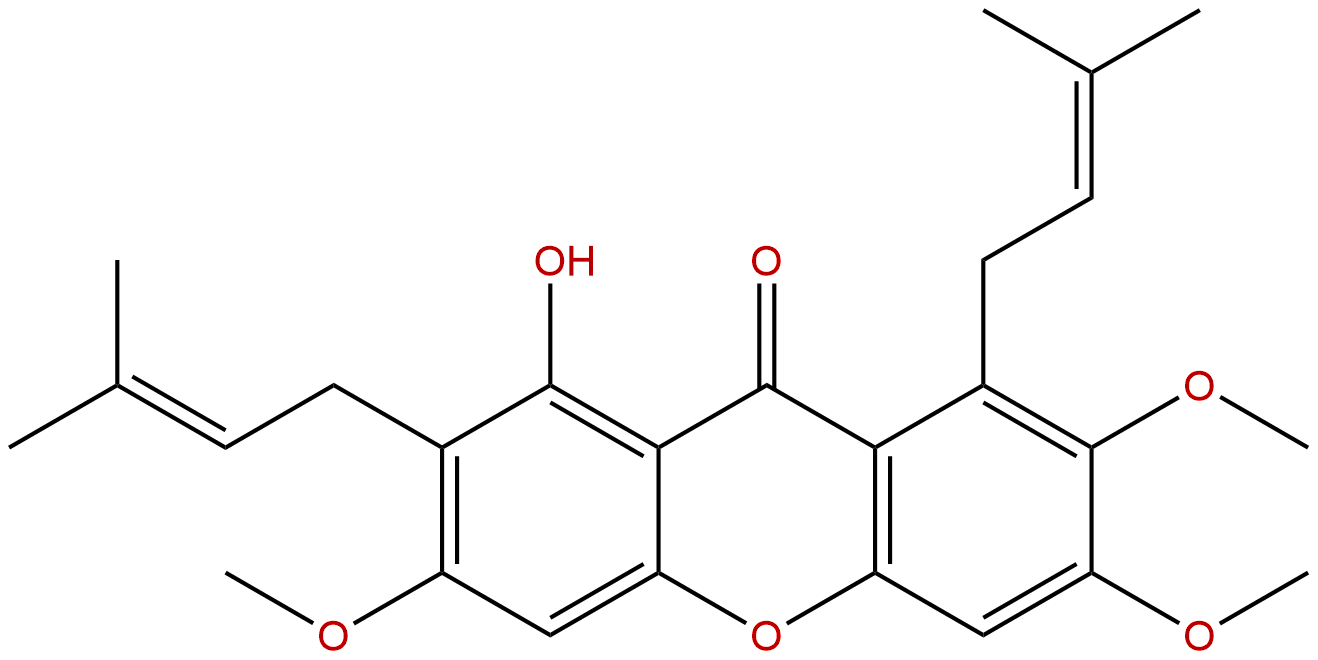


Product name: Fuscaxanthone C
Synonym name: NSC 27594; AIDS-011975
Catalogue No.: BP1669
Cas No.: 15404-76-9
Formula: C26H30O6
Mol Weight: 438.52
Botanical Source: Garcinia mangostana (mangosteen)
Physical Description:
Type of Compound: Xanthones
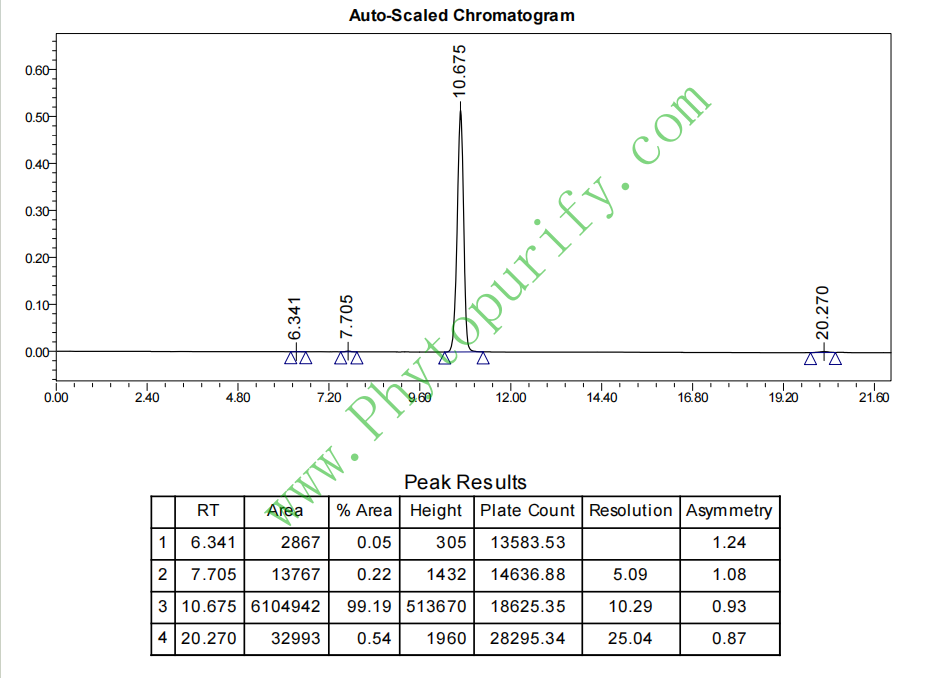
Purity: 95%~99%
Analysis Method: HPLC-DAD or/and HPLC-ELSD
Identification Method: Mass, NMR
Packing: Brown vial or HDPE plastic bottle
The product could be supplied from milligrams to grams. Inquire for bulk scale.
We provide solution to improve the water-solubility of compounds, thereby facilitating the variety of activity tests and clinic uses.
For Reference Standard and R&D, Not for Human Use Directly.
HPLC of Fuscaxanthone C
Storage conditions:Short-term storage at 2~8℃, long-term storage at -20 ~ -80℃
78.1300
5.1928
5.1821
.0114
5.0804
12.1596
Low
91.0378
3.0213
Yes
No
Yes
No
Yes
No
0.6
No
No
Yes
No
Oxanthrone compounds are a class of characteristic secondary metabolites widely present in nature, especially in plants of the Theaceae family. Their core structure is 9H-oxaanthracene-9-one. These compounds have long been of great interest to researchers in natural product chemistry and pharmacology due to their structural diversity and wide range of biological activities, such as anti-inflammatory, antioxidant, anti-tumor, antibacterial, etc. Fushaxanthone C (CAS number: 15404-76-9) is one of the oxanthrone derivatives isolated from plants of the Polygonatum genus. In recent years, with the rise of the incidence rate of malignant tumors such as melanoma and the emergence of therapeutic drug resistance, the search for new, efficient and low toxic anti-tumor drugs has become a research hotspot. Fusoxanthone C has emerged as a potential candidate molecule for anti melanoma treatment due to its multi-target and multi pathway pharmacological activity demonstrated in melanoma research. This article aims to provide a systematic review of the chemical structure, plant origin, pharmacological activity, mechanism of action, pharmacological evaluation, and clinical application prospects of Fusarium oxytetracycline C, in order to provide comprehensive scientific references for the in-depth research and development of this compound.
The molecular formula of Fusoxanthone C is C ₂₄ H ∝₀ O ₆, with a molecular weight of 438.5200. Its core structure is anthraquinone, which is composed of two benzene rings (A ring and C ring) fused together through an oxygen-containing heterocyclic ring (B ring, i.e. γ - pyranone ring). Fusoxanthone C typically has multiple substituents attached to its parent nucleus, such as methoxy, hydroxyl, and isopentenyl. The type, position, and quantity of these substituents are important structural foundations for its biological activity. The specific substitution mode needs to be accurately identified through spectroscopic methods such as nuclear magnetic resonance and mass spectrometry.
From the perspective of physicochemical parameters related to drug properties, the lipid water partition coefficient (LogP) of Fusarium C is 5.1928, indicating that the compound has high lipophilicity. The topological polar surface area (TPSA) is 78.1300 Å ², which is relatively low. The predicted value of water solubility is 0.0114 mg/mL, which belongs to insoluble compounds. These physicochemical properties collectively determine the fundamental characteristics of its pharmacokinetic behavior: high membrane permeability, but poor water solubility, which may affect its oral bioavailability. Its molecular weight is moderate and meets the basic requirements of the five rules for generic drugs, providing a foundation for subsequent structural optimization.
Fusaxanthine C is mainly isolated from the bark of plants in the genus Platycodon in the family Theaceae. Huangteng plants are widely distributed in tropical and subtropical regions and are often used in traditional medicine to treat diseases such as inflammation, infection, and pain. Its bark is the main part rich in anthraquinone compounds.
The extraction of Fusarium C is usually carried out using organic solvent extraction method. The classic extraction process is as follows: first, the dried bark of the Polygonatum plant is crushed, and then subjected to room temperature extraction or heating reflux extraction using polar organic solvents such as methanol, ethanol, or acetone. The crude extract was obtained by vacuum concentration of the extraction solution. Subsequently, a variety of chromatographic separation technologies were used to separate and purify the crude extract, including but not limited to silica gel column chromatography, reverse phase silica gel column chromatography, dextran gel column chromatography and high performance liquid chromatography. During the separation process, it is often monitored by thin-layer chromatography or high-performance liquid chromatography, and combined with spectroscopic data (such as mass spectrometry, nuclear magnetic resonance hydrogen spectrum, and carbon spectrum) to identify the structure of the obtained monomeric compounds, ultimately obtaining high-purity Fusaxanthine C. Modern extraction techniques such as ultrasound assisted extraction and microwave-assisted extraction have also been applied to improve extraction efficiency and yield of target compounds.
The pharmacological activity research of Fusarium oxytetracycline C is currently mainly focused on the field of anti-tumor, especially its anti proliferative, pro apoptotic, and anti metastatic activities against melanoma.
1. Anti melanoma activity:
Multiple in vitro studies have confirmed that Fusoxanthone C exhibits significant proliferative inhibitory activity against various human melanoma cell lines, such as A375, SK-MEL-28, B16-F10, etc. Its half maximal inhibitory concentration (IC ₅₀) is typically in the micromolar range. The effects are concentration dependent and time-dependent. In addition to inhibiting cell proliferation, Fusoxanthone C can effectively induce apoptosis in melanoma cells, characterized by typical apoptotic features such as morphological changes, phosphatidylserine eversion, caspase family protease activation, and DNA fragmentation. In addition, the compound can also inhibit the migration and invasion ability of melanoma cells, indicating its potential for anti metastasis.
2. Other potential activities:
Based on the commonality of oxanthrone compounds, Fusarium C may also have antioxidant and anti-inflammatory activities. The phenolic hydroxyl groups in its structure may act as hydrogen donors to scavenge free radicals, and may exert anti-inflammatory effects by regulating inflammatory pathways such as nuclear factor kappa B. However, these activities require further experimental research to clarify.
The anti melanoma effect of Fusaxanthine C involves the regulation of multiple key signaling pathways and molecular targets, reflecting the characteristics of multi-target action.
1. Energy metabolism and apoptosis regulation:
* AMPK signaling pathway: Fusarium C has been reported to activate AMP activated protein kinase (AMPK, encoded by PRKAA1). AMPK is an energy receptor in cells, and its activation can inhibit mammalian rapamycin target protein complex 1 signaling, thereby inhibiting protein synthesis and cell growth, while possibly promoting autophagy and apoptosis.
* BCL2 family: This compound can downregulate the expression of anti apoptotic protein B-cell lymphoma 2, disrupt mitochondrial membrane potential, promote cytochrome C release, and activate endogenous apoptotic pathways.
* Protein kinase C: Fusaxanthine C has a regulatory effect on certain subtypes of protein kinase C, such as PRKCA and PRKCE. The PKC family plays a complex role in cell proliferation, differentiation, and apoptosis, and its inhibition or abnormal activation may affect the survival of melanoma cells.
2. Transcriptional regulation and stress response:
* STAT3 signaling pathway: Signal transducer and activator of transcription factor 3 is an important oncogenic transcription factor. Fusoxanthone C can inhibit the phosphorylation activation of STAT3, thereby downregulating the expression of downstream target genes related to proliferation and survival.
* NFE2L2 (NRF2) pathway: NRF2 is a key transcription factor that regulates cellular oxidative stress response. Fusoxanthone C may affect the ability of melanoma cells to resist oxidative stress and chemotherapy drugs by regulating the NRF2 pathway.
* HIF1A pathway: Hypoxia inducible factor 1 alpha is crucial in tumor adaptation to hypoxic microenvironment, angiogenesis, and metastasis. Inhibiting the stability or activity of HIF1A is one of the anti-tumor strategies, and Fusarium C may have an intervention effect on this pathway.
3. Cytoskeleton and microenvironment remodeling:
* MAPT (Tau protein): Tau protein is involved in microtubule stability regulation. Its abnormal expression is related to cell mitosis and migration, and may become one of the action points of Fusarium oxytetracycline C.
* MMP2: Matrix metalloproteinase-2 is a key enzyme that degrades the extracellular matrix, promoting tumor invasion and metastasis. One of the mechanisms of its anti metastatic activity is that Fusarium oxytetracycline C can inhibit the expression or activity of MMP2.
4. Targets related to melanin synthesis:
* TYR (Tyrosinase): Tyrosinase is the rate limiting enzyme for melanin synthesis. Some oxanthrone analogues have been shown to be tyrosinase inhibitors. It is worth exploring whether Fusaxanthine C affects the biological behavior of melanoma cells by inhibiting TYR.
In summary, Fusoxanthone C exerts anti melanoma effects through synergistic effects on multiple targets such as AMPK, STAT3, BCL2, MMP2, etc., from multiple aspects such as inhibiting proliferation, inducing apoptosis, blocking cell cycle, and inhibiting invasion and metastasis.
Based on computational predictions and preliminary in vitro experimental data, a preliminary evaluation of the pharmacological properties of Fusarium oxytetracycline C is conducted
1. Absorption, distribution, metabolism, and excretion prediction:
* Absorption: A high LogP value and moderate TPSA suggest good intestinal permeability, which is beneficial for oral absorption. However, the extremely low water solubility is the main limiting factor for its oral bioavailability, which may result in slow dissolution rate and incomplete absorption.
* Distribution: The prediction shows that its blood-brain barrier permeability is low, which means it may not easily enter the central nervous system, which may be unfavorable for the treatment of brain metastatic melanoma, but may also reduce the risk of central neurotoxicity. Its high lipophilicity may lead to accumulation in adipose tissue.
* Metabolism: As an anthraquinone compound, the phenolic hydroxyl and methoxy groups in its structure may be the sites of phase I metabolism (such as oxidation and demethylation) and phase II metabolism (such as glucuronidation and sulfation), and the liver may be its main metabolic site.
* Excretion: Metabolites may be mainly excreted through bile and urine.
2. Preliminary safety evaluation:
* HERG inhibition: The predicted results indicate that there is no significant risk of hERG potassium channel inhibition, suggesting that the potential cardiac toxicity causing QT interval prolongation is low, which is a favorable safety feature.
* Genetic toxicity: The Ames test (prediction) result is 0.6, indicating a low risk of mutagenicity, but it needs to be confirmed through formal in vitro and in vivo genetic toxicity tests.
3. Pharmacokinetic challenges and optimization directions:
At present, there is a severe lack of in vivo pharmacokinetic research data on Fusarium oxytetracycline C. The main pharmaceutical challenge lies in its Poor water solubility Future structural optimization strategies may include preparing soluble salt forms, developing prodrugs, or improving solubility and delivery efficiency through nanoformulation technologies such as liposomes, nanocrystals, and polymer micelles. At the same time, it is necessary to conduct systematic pharmacokinetic studies in vivo to clarify its absolute bioavailability, half-life, tissue distribution, and major metabolites.
As a natural small molecule with multi-target anti melanoma activity, Fusarium C has both promising and challenging clinical applications.
1. Development prospects:
* New candidate drugs for anti melanoma: For patients with advanced melanoma, especially those who develop resistance to targeted therapies such as BRAF/MEK inhibitors or immune checkpoint inhibitors, the multi-target mechanism of action of Fusaxanthine C may provide new treatment options or be combined with existing therapies to enhance efficacy and overcome resistance.
* Combination therapy strategy: The characteristics of its action on pathways such as AMPK and STAT3 suggest that it may have synergistic effects with chemotherapy, targeted therapy, or immunotherapy, which is worth exploring in preclinical models.
* Lead compounds for structural optimization: Using it as the parent nucleus for structural modification aims to improve water solubility, enhance target selectivity, and improve pharmacokinetic properties, which is a reasonable direction for pharmaceutical chemistry research.
2. Challenges faced:
* Insufficient depth of pharmacological mechanisms: Existing research has mostly focused on phenotype observation and partial pathway validation, but there is still a lack of in-depth analysis on the precise molecular patterns of its interactions with various targets, whether there are main target genes, and the cross dialogue mechanisms between different pathways.
* Drug bottleneck: As mentioned earlier, poor water solubility is the primary physical and chemical bottleneck that restricts its development. The data on in vivo pharmacodynamics, pharmacokinetics, and toxicology are almost blank.
* Natural source restrictions: Extracting and isolating directly from plants has limited yield and is difficult to meet subsequent development needs. Therefore, developing its total synthetic route or biosynthetic method is crucial.
3. Future research directions and prospects:
* In depth mechanism research: Identify its direct target using chemical biology methods such as affinity chromatography probes and proteomics; Verify the function of key targets using gene editing technology.
* Systematic drug evaluation: Establish stable in vivo melanoma models (such as transplant tumor models, genetically engineered mouse models), comprehensively evaluate their in vivo anti-tumor activity, pharmacokinetic characteristics, and acute/subacute toxicity.
* Formulation development: Prioritize the use of novel drug delivery systems to address their solubility issues and evaluate the impact of formulations on in vivo behavior.
* Synthetic Biology: Explore its biosynthetic pathway and attempt to achieve heterologous synthesis in microbial chassis cells, providing a solution for sustainable acquisition.
Fushaxanthone C is a natural product of the anthraquinone class with significant anti melanoma activity isolated from plants of the Polygonatum genus. It exhibits a multi-target anti-tumor mode of action by regulating multiple key targets and signaling pathways closely related to tumor cell proliferation, apoptosis, and metastasis, such as AMPK, STAT3, BCL2, and MMP2, and has great potential for development. However, its poor water solubility, lack of pharmacokinetic and toxicological data in vivo, and insufficient depth of its mechanism of action are the main obstacles to pushing it from a lead compound to a clinical candidate drug. Future research needs to focus on in-depth elucidation of its molecular mechanism of action, systematic evaluation and optimization of drug properties, and active exploration of formulation development based on novel delivery systems. Through interdisciplinary collaboration, Fusoxanthone C is expected to become a valuable new starting point in the field of anti melanoma drug development, providing a new weapon for conquering this malignant disease.
