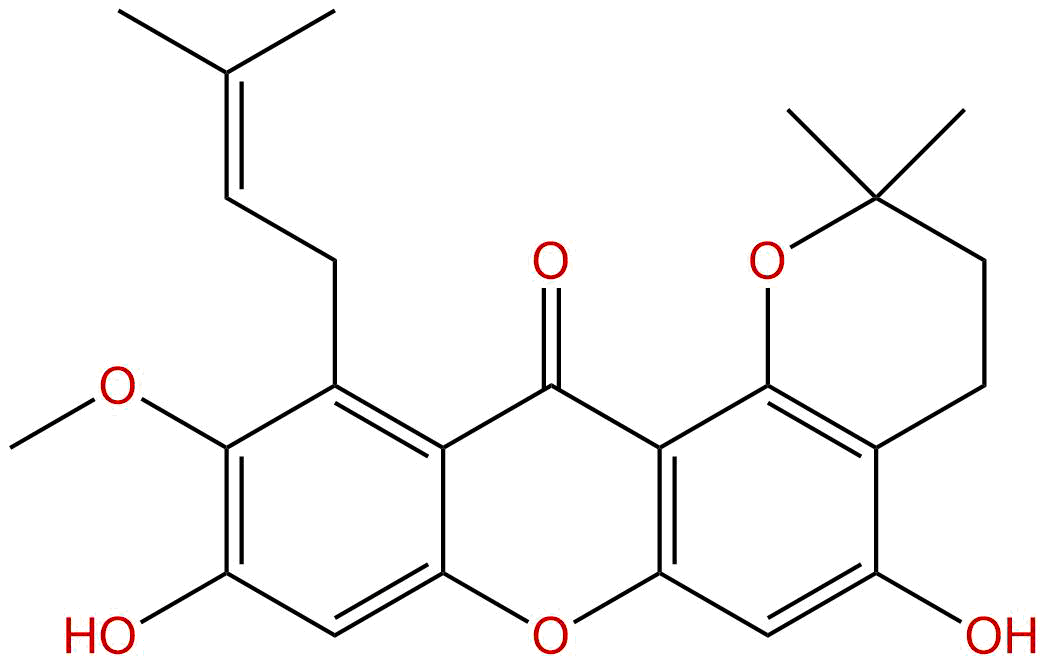


Product name: 1-Isomangostin
Synonym name:
Catalogue No.: BP2231
Cas No.: 19275-44-6
Formula: C24H26O6
Mol Weight: 410.466
Botanical Source:
Type of Compound: Xanthones
Purity: 95%~99%
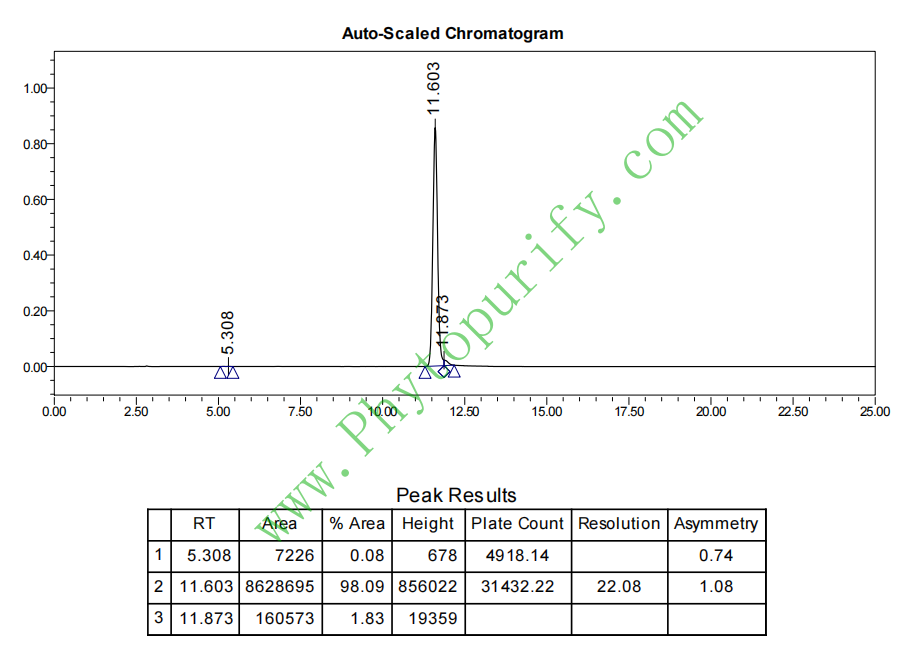
Analysis Method: HPLC-DAD or/and HPLC-ELSD
Identification Method: Mass, NMR
Packing: Brown vial or HDPE plastic bottle
Storage: Store in a well closed container, protected from air and light. Put into refrigerate or freeze for long term storage.
Whenever possible, you should prepare and use solutions on the same day. However, if you need to make up stock solutions in advance, we recommend that you store the solution as aliquots in tightly sealed vials at -20℃. Generally, these will be useable for up to two weeks.
The product could be supplied from milligrams to grams
Inquire for bulk scale.
For Reference Standard and R&D, Not for Human Use Directly.
HPLC of 1-Isomangostin
Storage conditions:Short-term storage at 2~8℃, long-term storage at -20 ~ -80℃
89.1300
4.6598
4.6022
.0053
4.3320
6.0193
Low
91.4243
3.2664
No
No
Yes
No
Yes
Yes
0.6
No
No
Yes
No
Obesity and its associated metabolic syndrome have become a major global public health challenge, with one of its core pathophysiological processes being the excessive absorption of dietary fat. Pancreatic lipase, as a key enzyme in the gut that hydrolyzes dietary triglycerides, is an important target for controlling fat absorption. Finding efficient and safe natural sources of pancreatic lipase inhibitors is one of the hot directions for developing new anti obesity drugs. 1-Isomangostin, a natural anthraquinone compound derived from the peel of tropical plant mangosteen, has attracted much attention due to its significant pancreatic lipase inhibitory activity and anti obesity potential. In recent years, with the deepening of research, its pharmacological activity spectrum continues to expand, especially in the field of anti breast cancer, showing the characteristics of multi target and multi pathway, revealing its broad application prospects from metabolic diseases to tumor treatment. This article aims to provide a systematic review of the chemical properties, plant sources, pharmacological activities, mechanisms of action, pharmacological evaluation, and clinical application prospects of 1-isoquercetin, in order to provide comprehensive academic references for the in-depth development and transformation research of this natural product.
1-Isoquercetin, chemical name 1,3,6,7-tetrahydroxy-2,8-di (3-methylbut-2-enyl) -9H-oxaanthrone-9-one, CAS number 19275-44-6. Its molecular formula is C24H26O6 and its molecular weight is 410.4660. Structurally, it belongs to isopentenyl substituted anthraquinone derivatives, with a core of a tricyclic anthraquinone skeleton substituted by hydroxyl groups at positions 1, 3, 6, and 7, endowing the molecule with certain hydrophilicity and hydrogen bonding ability; And two isopentenyl side chains are connected at positions 2 and 8, which significantly increases the hydrophobicity of the molecule. This unique structure is the material basis for its various biological activities.
Based on its structure, 1-isoquercetin exhibits typical physicochemical properties of natural polyphenolic compounds. The lipophilic water partition coefficient (LogP) of the compound is 4.6598, indicating that it has high lipophilicity. The topological polar surface area (TPSA) is 89.13 Å ², which is relatively moderate. The water solubility is extremely low, about 0.0053 mg/mL, which poses a challenge for its formulation development. Preliminary pharmacological predictions indicate that its ability to cross the blood-brain barrier is low, suggesting that the risk of central nervous system related side effects may be relatively low. In early toxicity screening, it showed no significant inhibitory effect on hERG potassium channels, indicating a low potential risk of arrhythmia; The Ames test result is 0.6, indicating a low risk of mutagenicity, but further in vitro and in vivo experiments are needed to confirm.
1-Isoquercetin is mainly derived from the fruit peel of the Caryophyllum plant in the Caryophyllaceae family. Mangkhut peel is commonly used in traditional medicine to treat abdominal pain, diarrhea, infections, and skin diseases, and its abundant anthraquinone components are considered the main material basis for its pharmacological effects. In addition to 1-isoquercetin, the skin of mangosteen also contains various structurally similar homologs such as α - quercetin and γ - quercetin, which together form its complex group of active ingredients.
The extraction of 1-isoquercetin from plant materials is usually carried out using organic solvent extraction method. Common extraction solvents include methanol, ethanol, ethyl acetate, etc. In order to improve extraction efficiency and selectivity, modern extraction techniques such as ultrasound assisted extraction, microwave-assisted extraction, and supercritical fluid extraction have been widely used. For example, using a certain concentration of ethanol aqueous solution for ultrasonic extraction can effectively improve the yield of anthraquinone compounds. The crude extract needs to undergo a systematic separation and purification process, often using techniques such as silica gel column chromatography and preparative high-performance liquid chromatography, to obtain high-purity 1-isoquercetin monomer. The optimization of extraction process is crucial for ensuring stable supply of compounds and subsequent pharmacological research.
The pharmacological activity research of 1-isoquercetin mainly focuses on two major fields: anti obesity and anti-tumor, and exhibits other potential biological activities.
1. Anti obesity activity:
This is one of the earliest discovered activities of 1-isoquercetin. The core mechanism lies in the potent inhibition of pancreatic lipase. Research has shown that 1-isoquercetin has a half maximal inhibitory concentration (IC50) of 34.5 μ M for porcine pancreatic lipase, demonstrating clear enzyme inhibition ability. In cell and animal models, it can dose dependently reduce the digestion and absorption of fat. Experimental results on a high-fat diet induced obese mouse model have shown that administration of 1-isoquercetin can significantly reduce body weight gain, epididymal adipose tissue weight, and improve blood lipid abnormalities (such as reducing serum triglycerides and total cholesterol levels). Its effect is similar to the classic pancreatic lipase inhibitor orlistat, but as a natural product, its long-term safety is more anticipated.
2. Anti breast cancer activity:
Recent studies have revealed the great potential of 1- heterotroponin in anti breast cancer. In vitro experiments show that it has significant proliferation inhibition and apoptosis induction effects on many human breast cancer cell lines (such as MCF-7, MDA-MB-231). Its anti-tumor activity is not limited to estrogen receptor positive cells, but also effective to triple negative breast cancer cells, suggesting that its mechanism of action does not depend on hormone receptor pathway. In addition, the study also found that 1-heterotroponin can inhibit the migration and invasion of breast cancer cells, indicating that it may have anti metastasis potential.
3. Other potential activities:
Based on the commonality of anthraquinone compounds, 1-isoquercetin may also have antioxidant, anti-inflammatory, and antibacterial activities. Its multiple phenolic hydroxyl structures enable it to effectively scavenge free radicals and alleviate oxidative stress. These auxiliary activities may synergize with their main effects on anti obesity and anti-tumor, such as improving the metabolic microenvironment or tumor microenvironment by reducing chronic inflammation.
The multiple pharmacological activities of 1-isoquercetin stem from its regulation of multiple key molecular targets and signaling pathways.
In terms of anti obesity:
Its direct and clear target of action is pancreatic lipase 1-Isoquercetin binds to the active center of pancreatic lipase through competitive or non competitive means, hindering its contact with dietary triglyceride substrates, thereby inhibiting fat hydrolysis, reducing the production of free fatty acids and monoglycerides, and ultimately reducing intestinal absorption of fat.
In terms of anti breast cancer:
Its mechanism of action is more complex, involving multi-target and multi-path networks:
* Energy metabolism and apoptosis regulation Research has shown that 1-isoquercetin can activate AMPK(PRKAA1)AMPK is an energy receptor in cells, and its activation can inhibit synthetic metabolic pathways such as mammalian rapamycin target protein (mTOR), while upregulating pro apoptotic signals. It can also downregulate anti apoptotic proteins Bcl-2(BCL2) The expression of caspase can disrupt mitochondrial membrane potential, promote cytochrome C release, activate caspase cascade reaction, and induce tumor cell apoptosis.
* Inhibition of signal transduction pathways 1. It has been confirmed that isoquercetin can inhibit STAT3(STAT3) Phosphorylation and activation. STAT3 is an important oncogenic transcription factor, and sustained activation of STAT3 promotes cell proliferation, survival, angiogenesis, and immune escape. Inhibiting STAT3 is one of the core mechanisms of its anti-tumor effect.
* Hormone receptors and drug resistance: It is for Estrogen receptor beta (ESR2) It may have a regulatory effect, which is related to its effect on hormone sensitive breast cancer. What is more noteworthy is that 1-heterotroponin can inhibit multidrug resistance protein in breast cancer cells P-glycoprotein (ABCB1) and Breast cancer resistance protein (ABCG2) Its function or expression may reverse the resistance of tumor cells to chemotherapy drugs and has the potential to serve as a chemotherapy sensitizer.
* Invasion and metastasis related targets This compound can also inhibit Matrix metalloproteinase-2 (MMP2) Expression and activity. MMP2 is a key enzyme that degrades the extracellular matrix, and inhibition of its activity can effectively reduce the invasion and metastasis ability of tumor cells. In addition, it has an impact on Protein kinase C alpha (PRKCA) and Lymphocyte specific protein tyrosine kinase (LCK) The influence of signaling molecules may also be involved in regulating cell proliferation, differentiation, and movement.
* Microtubule system Research suggests that it may be related to Microtubule associated protein Tau (MAPT) There are interactions that may affect the stability of the cytoskeleton and interfere with cell division.
In summary, 1-isoquercetin exhibits unique advantages in multi-target anti-tumor therapy by intervening in the energy metabolism, apoptosis pathway, survival signaling, invasion ability, and drug resistance of tumor cells through a "one stone, multiple birds" approach.
Although 1-isoquercetin has shown excellent biological activity in vitro, its pharmacological development still faces some challenges, and related pharmacokinetic studies are still in their early stages.
Drug Challenge:
The primary issue is its extremely low Water solubility(0.0053 mg/mL), This can lead to poor dissolution and low bioavailability after oral administration. tall LogP value(4.66) Although it is beneficial for transmembrane absorption, it may also bring problems such as large distribution volume and tissue accumulation. Its larger molecular weight and polyphenol structure may lead to faster metabolism and unstable oral absorption.
Pharmacodynamics (based on speculation and preliminary studies of similar substances):
As a natural anthraquinone, its pharmacokinetic behavior may be similar to other known compounds of the spinosad class. Expected to be absorbed in the small intestine after oral administration, but due to significant first pass effects (mainly metabolized through glucuronidation and sulfation in the liver), absolute bioavailability may not be high. It may be widely distributed in tissues such as fat and liver. Its metabolites are mainly excreted through bile and urine. At present, there is very limited data on the systematic pharmacokinetic studies of 1-isoquercetin monomer in animals or humans, which is a key gap that must be filled before its clinical application.
Formulation strategy:
In order to improve its pharmacological properties, advanced drug delivery systems need to be developed. Possible strategies include:
1. Salting or prodrug technology Introducing hydrophilic groups through chemical modification to improve solubility.
2. nano-formulation Prepared into nanocrystals, liposomes, polymer micelles, or solid lipid nanoparticles, significantly improving solubility and biofilm permeability, and potentially achieving targeted delivery.
3. Cyclodextrin inclusion complex Using the cavity of cyclodextrin for encapsulation to enhance water solubility and stability.
4. Self microemulsion drug delivery system Spontaneous formation of microemulsion in the gastrointestinal tract promotes its dissolution and lymphatic absorption.
1-Isoquercetin has diversified development prospects from dietary supplements to prescription drugs.
1. Anti obesity field:
As a natural source of pancreatic lipase inhibitor, 1-isoquercetin is expected to be developed into a novel compound Anti obesity functional foods or OTC drugs Compared to the synthetic drug orlistat, its natural properties may bring better public acceptance and long-term safety for use. It can be explored to combine it with other natural ingredients that have synergistic effects, such as dietary fiber and tea polyphenols, to develop composite weight management products. Future clinical studies need to focus on evaluating the effectiveness, safety, and impact on gut microbiota of long-term use.
2. In the field of anti-tumor:
This is the most valuable direction for the development of 1-isoxazolein. Its multi-target mechanism of action is particularly suitable for addressing tumor heterogeneity and drug resistance.
* Adjuvant therapy and chemotherapy sensitizers Given its ability to inhibit ABC transporters, it may be considered to combine it with conventional chemotherapy drugs such as doxorubicin and paclitaxel to reverse tumor multidrug resistance, improve chemotherapy efficacy, and reduce chemotherapy drug dosage and side effects.
* Targeted therapy combination strategy: Its AMPK activation and STAT3 inhibition characteristics can be combined with existing targeted drugs (such as mTOR inhibitor and STAT3 inhibitor) to form a multi-channel synergistic blocking, which may have better effect on refractory breast cancer (such as triple negative breast cancer).
* New anti-cancer lead compounds By using it as the parent nucleus for structural optimization and modifying its pharmacokinetic defects, it is expected to develop new small molecule anti-cancer candidate drugs with independent intellectual property rights.
3. Challenges and future research directions:
* Systematic pharmacodynamic and toxicological evaluation It is necessary to validate its efficacy in more and more clinical animal models, such as human tumor xenograft models and obesity complication models, and complete systematic acute, subacute, and long-term toxicity assessments.
* In depth pharmacokinetic research Clarify the entire process of absorption, distribution, metabolism, and excretion in the body, and determine its main active metabolites.
* Breakthrough in Pharmaceutical Science Develop stable formulations that can significantly improve their bioavailability.
* Refined mechanism of action Using chemical biology methods (such as chemical proteomics) to identify its direct target and draw more accurate signal network diagrams.
* Exploration of clinical translation After completing sufficient preclinical research, gradually advance early clinical trials.
As a natural xanthone derived from mangosteen, 1-isostrophin has developed from an initial pancreatic lipase inhibitor and anti obesity candidate to a potential multi-target active molecule in the field of anti breast cancer. It has demonstrated unique application value in the treatment of metabolic diseases and tumors by inhibiting pancreatic lipase, activating AMPK, inhibiting STAT3/Bcl-2 signaling axis, downregulating MMP2, and regulating drug-resistant proteins through various mechanisms. Despite facing challenges such as poor water solubility and unclear pharmacokinetic properties, these obstacles are expected to be overcome through the optimization of modern medicinal chemistry and pharmacology methods. In the future, with more in-depth analysis of its mechanism of action and innovation of preparation technology, 1-allotroxerin is expected to move from laboratory to clinical, providing new natural drug options or auxiliary treatment strategies for the treatment of obesity and its related metabolic diseases, especially refractory breast cancer, and demonstrating the continuous vitality of natural products in the research and development of innovative drugs.
