


Synonym name: Isomangostin
Catalogue No.: BP0065
Cas No.: 19275-46-8
Formula: C10H10O4
Mol Weight: 194.186
Botanical Source: Garcinia mangostana (mangosteen)
Purity: 95%~99%
Analysis Method: HPLC-DAD or/and HPLC-ELSD
Identification Method: Mass, NMR
Packing: Brown vial or HDPE plastic bottle
Can be supplied from milligrams to grams.
For Reference Standard and R&D, Not for Human Use Directly.
Inquire for bulk scale.
HPLC of 3-Isomangostin
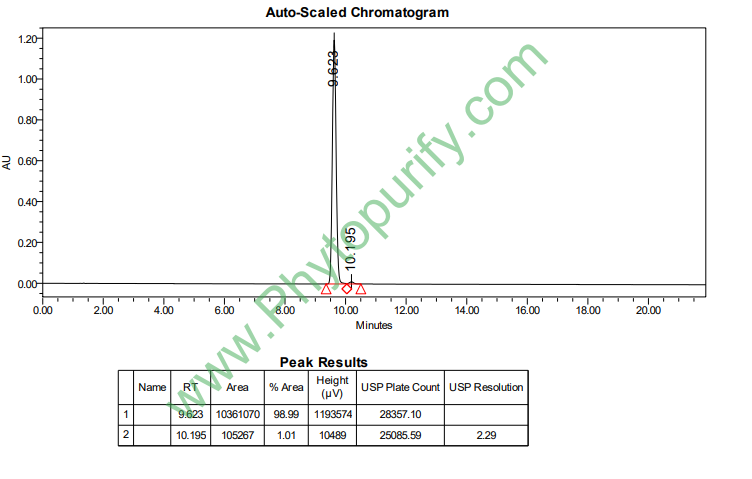
Storage conditions:Short-term storage at 2~8℃, long-term storage at -20 ~ -80℃
89.1300
4.6996
4.6310
.0064
5.4021
4.5768
Low
91.1844
3.2259
No
No
Yes
No
Yes
Yes
0.6
No
No
Yes
No
Oxanthrone compounds are a class of secondary metabolites that are widely present in nature and have the basic skeleton of benzophenones. Due to their rich and diverse biological activities, they have attracted much attention in the fields of natural product chemistry and pharmacology research. Among them, 3-Isomangostin (CAS: 19275-46-8) is derived from the Caryophyllaceae plant Caryophyllum(Garcinia mangostana L. An important derivative of anthraquinone isolated from fruit shells has shown remarkable multi-target pharmacological activity in recent years. Early studies revealed its potential as a powerful human aldose reductase inhibitor and a selective acetylcholinesterase inhibitor, suggesting its application prospects in the treatment of diabetes complications and neurodegenerative diseases. With the deepening of research, the antimalarial, antioxidant, anti-inflammatory, and especially anticancer activity of isoquercetin as a highly efficient inhibitor of the novel MutT homolog 1 (MTH1) have made it a star molecule for the development of multi indication therapeutic drugs. The purpose of this article is to systematically review the chemical properties, plant sources, pharmacological activities, mechanisms of action, pharmacological evaluation, and clinical application prospects of isoquercetin, in order to provide comprehensive academic references for the in-depth research and development of this compound.
Isopentenyl substituted anthraquinone is a typical compound of the anthraquinone class. Its molecular formula is C24H26O6 and its molecular weight is 410.4660. Its core structure is the parent nucleus of anthraquinone (benzochromenone), and substituents such as isopentenyl, hydroxyl, and methoxy are attached at different positions of the parent nucleus. This unique substitution pattern is the structural basis of its biological activity. Compared with the isomeric compound α - coumarin, isocoumarin has differences in the position of substituents, which leads to differences in their physicochemical properties and biological activities.
From the perspective of physicochemical parameters related to drug properties, the lipid water partition coefficient (LogP) of isoquercetin is 4.6996, indicating its high lipophilicity. Its topological polar surface area (TPSA) is 89.1300 Å ². The high LogP value and moderately low TPSA value together determine its poor water solubility, with a calculated value of approximately 0.0064 mg/mL. This characteristic may affect its oral bioavailability and formulation development. In the prediction of absorption, distribution, metabolism, and excretion (ADME), the ability of isoquercetin to cross the blood-brain barrier is evaluated as "low", which limits its potential to act on the central nervous system. However, the predicted risk of hERG inhibition is' no ', indicating a lower risk of cardiac toxicity. In the preliminary screening of genetic toxicity, the Ames test result was 0.6, indicating a low risk of mutagenicity in this testing system, providing preliminary safety basis for its further development.
The main source of heteropolytic acid is from the Caryophyllum plant in the Caryophyllaceae family and the Caryophyllum genus(Garcinia mangostana L. The shell (skin) of the fruit. Mangkhut fruit shells are commonly used in traditional medicine to treat abdominal pain, diarrhea, infections, wound healing, and chronic inflammation. Modern research has shown that they are rich in various anthraquinone compounds, among which isoquercetin is one of the important active ingredients.
The extraction of isoquercetin from mangosteen shells is usually carried out using organic solvent extraction combined with chromatographic separation techniques. The conventional process is as follows: first, the dried mangosteen shells are crushed, and polar organic solvents such as methanol, ethanol, or acetone are used for leaching or heating reflux extraction. After the crude extract is concentrated under reduced pressure, it is preliminarily enriched using liquid-liquid extraction (such as extraction with ethyl acetate or chloromethane). Subsequently, various chromatographic techniques such as silica gel column chromatography, preparative thin-layer chromatography, or high-performance liquid chromatography (HPLC) were used for separation and purification. In recent years, in order to improve extraction efficiency and environmental friendliness, some new technologies such as ultrasound assisted extraction, microwave-assisted extraction, and supercritical CO2 extraction have also been explored and applied in the extraction of anthraquinone compounds. The separated isoquercetin can be structurally identified and purity confirmed by nuclear magnetic resonance (NMR), mass spectrometry (MS), and comparison with standard samples.
Isotroponin shows extensive and significant pharmacological activities, covering metabolic diseases, nervous system diseases, infectious diseases, tumors and other fields.
Antidiabetic activity Isoquercetin is a potent inhibitor of human aldose reductase (AR) with an IC50 value as low as 3.48 μ M. Aldose reductase is the key rate limiting enzyme of polyol pathway, and its over activation is closely related to the occurrence and development of diabetes complications (such as neuropathy, retinopathy, nephropathy). By inhibiting AR, contortin can reduce the abnormal accumulation of sorbitol, thus playing a potential role in preventing and treating complications of diabetes.
Neuroprotective and Anti Alzheimer's Disease Potential Isoquercetin exhibits selective inhibitory activity against acetylcholinesterase (AChE). AChE is a key enzyme that degrades the neurotransmitter acetylcholine, and its excessive activity leads to a decrease in acetylcholine levels, which is an important pathological feature of cognitive disorders such as Alzheimer's disease. Therefore, as an AChE inhibitor, isoquercetin has the potential to improve cholinergic neurotransmission and alleviate cognitive impairment.
Antioxidant and anti-inflammatory activities Isoquercetin has significant free radical scavenging ability and can alleviate oxidative stress damage. Oxidative stress is the common pathological basis of many chronic diseases (such as inflammation, atherosclerosis, neurodegenerative diseases). In addition, its anti-inflammatory effect may be related to regulating related inflammatory pathways, providing a basis for its application in inflammatory diseases.
Antiparasitic activity Research shows that isoquercetin has an effect on malaria parasites(Plasmodium SPP has inhibitory activity with IC50 values ranging from 4.71 to 11.40 μ M, indicating its potential for development as a novel antimalarial drug.
Antitumor activity This is one of the most highly anticipated activities of isoquercetin in recent years. Its anti-cancer mechanisms are diverse, including inducing cell apoptosis, inhibiting cell proliferation, and blocking the cell cycle. Of particular note is that it has been identified as an efficient MTH1 protein inhibitor.
The multiple pharmacological activities of Yiqianzi extract stem from its interactions with multiple key biological targets, reflecting the characteristics of multi-target drugs.
Core anti-cancer target: MTH1 protein Isoquercetin is a highly efficient inhibitor of MTH1 (MutT homolog 1) with an IC50 value of up to 52 nM. MTH1 is a nucleotide pool cleaning enzyme that hydrolyzes oxidative damaged deoxyribonucleoside triphosphate (such as 8-oxo-dGTP) to prevent these damaged nucleotides from being incorporated into the genome during DNA replication, thereby maintaining genomic stability. However, many cancer cells highly rely on the activity of MTH1 to cope with their internal high levels of oxidative and replication stress. Inhibition of MTH1 can lead to the accumulation of oxidative damaged nucleotides in cancer cell DNA, causing DNA damage and cell death, with relatively little impact on normal cells. Therefore, as an MTH1 inhibitor, isoquercetin has the potential to selectively inhibit cancer.
Potential target groups associated with atopic eczema According to the provided target information, isoquercetin may intervene in the pathological process of atopic eczema by acting on multiple targets related to immune inflammation and skin barrier function. These targets include:
Other key enzyme targets As mentioned earlier,Aldehyde reductase (AR)and Acetylcholinesterase (AChE)It is a clear target of its direct action, which respectively mediates its anti diabetes complications and neuroprotective activities.
Despite its excellent in vitro activity, the development of its pharmacological properties still faces challenges and requires systematic pharmacokinetic and formulation studies.
At present, there is still a relative lack of research data on the pharmacokinetics of the isoquercetin system, which is a gap that must be filled for its clinical development.
The multi-target pharmacological properties of isoquercetin have depicted broad prospects for its application in multiple disease fields, but also come with challenges.
Development of anti-cancer drugs As an efficient and selective MTH1 inhibitor, isoquercetin is an excellent lead compound for developing novel targeted anticancer drugs. Future research directions include: ① optimizing its structure to improve water solubility and pharmacokinetic properties while maintaining MTH1 inhibitory activity; ② Explore its combination therapy with chemotherapy, radiotherapy, or other targeted drugs to enhance efficacy and overcome drug resistance; ③ Validate its efficacy in more types of cancer models, especially those sensitive to oxidative stress.
Skin disease treatment agents Regarding atopic eczema, isoquercetin may exert therapeutic effects through multiple pathways such as simultaneously inhibiting PDE4, regulating IDO1/ALOX5 inflammatory pathways, and affecting RARG mediated differentiation. It is an attractive development direction to develop it as a local topical preparation (such as cream and gel), which can avoid the problems of poor oral absorption and system exposure and directly act on skin lesions. Local administration can also minimize the risk of systemic toxicity to the greatest extent possible.
Metabolic and neurodegenerative diseases: Under the guidance of AR and AChE inhibitory activity, we can explore its application in the complications of diabetes (such as external treatment of diabetes foot ulcer, oral preparations for neuropathy) and the adjuvant treatment of mild cognitive impairment/Alzheimer's disease. Similarly, improving its brain delivery efficiency is the core challenge in developing central nervous system indications.
Challenges and Future Directions Faced:
As a natural anthraquinone compound derived from mangosteen, heteropolytic acid has shown great medicinal potential in various fields such as anti-tumor, anti-inflammatory, anti metabolic disease, and neuroprotection due to its unique chemical structure and multi-target mechanism of action. The discovery of it as a highly efficient MTH1 inhibitor provides new ideas for targeted cancer therapy. Despite facing challenges such as poor water solubility and unclear pharmacokinetic properties in drug development, these obstacles are expected to be overcome through the application of modern drug chemical modifications and novel drug delivery technologies. In the future, in-depth research on the mechanism of action, systematic optimization of drug properties, and comprehensive promotion of preclinical development should focus on the precise elucidation of isoquercetin. With the continuous deepening of research, isoquercetin is expected to be successfully transformed from a potential natural active molecule into a new type of drug that can be used for clinical treatment, contributing its unique value to human health.
