Introduction/Overview
Natural products have long been an important source of innovative drug discovery, providing lead compounds with novel structures and unique activities for numerous refractory diseases. The widely distributed plants of the Theaceae family in tropical and subtropical regions have attracted much attention for their abundant secondary metabolites and diverse biological activities. Huangniumu(Cratoxylum cochinchinense)As one of the representative plants of this family, it is commonly used in Southeast Asian traditional medicine to treat fever, inflammation and infectious diseases. Cratoxolone (CAS number: 149155-01-1) isolated from the bark of this plant is a natural compound with significant anti malaria activity. Its unique chemical structure suggests potential for a wide range of pharmacological activities beyond single anti malaria applications. In recent years, with the development of systems pharmacology and network pharmacology, research on natural products has shifted from single target and single activity to exploring the synergistic effects of multiple targets and pathways. Especially, pneumonia, as a common disease caused by pathogen infection or physical and chemical stimulation, accompanied by severe inflammatory response, has a complex pathological process involving multiple links such as immune recognition, inflammatory cascade, oxidative stress, and tissue repair, and urgently needs a new type of treatment strategy that can intervene from multiple dimensions. Preliminary bioinformatics analysis suggests that kaempferol may have the potential to regulate the immune inflammatory network by acting on multiple targets closely related to pneumonia pathology, including Toll like receptors (TLR4, TLR2), inflammatory signaling hubs (TNF, RELA), cell death key protein (CASP1), metabolic enzymes (IDH1, NOS2), and epigenetic regulatory factor (SIRT1). This article aims to provide a systematic review of the chemical properties, plant sources, and pharmacological activities of Huangniumu ketone, with a focus on exploring its potential mechanism of action and molecular targets for anti pneumonia. At the same time, the medicinal properties of Huangniumu ketone will be evaluated, in order to provide scientific basis for the deep development and clinical application of this natural product.
Chemical structure and physicochemical properties
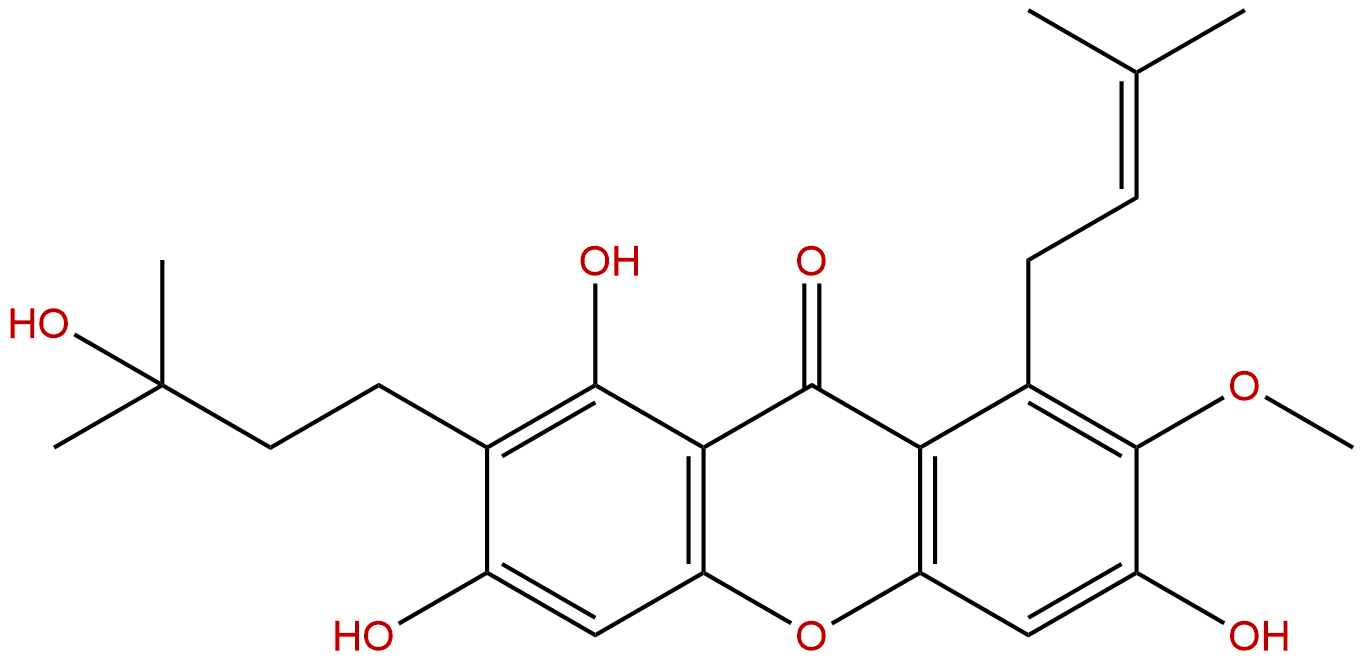
Huangniumu ketone is a natural compound with a complex condensed ring structure, with a molecular formula of C25H32O6 and a molecular weight of 428.4810 Da. Structurally, it belongs to highly oxidized xanthone derivatives or closely related structural types, usually with a core tricyclic skeleton and multiple substituents such as methyl, hydroxyl, or methoxy groups attached to it. This structural feature gives it typical properties of natural polyphenolic compounds.
Its physicochemical properties have a decisive impact on its biological activity, absorption, and distribution. The calculated lipid water partition coefficient (LogP) is 3.6714, indicating that the compound has moderate lipophilicity, which is beneficial for its penetration of cell membranes, but may also affect its solubility in aqueous media. Its topological polar surface area (TPSA) is 120.3600 Å ², reflecting the large surface area occupied by polar atoms (mainly oxygen atoms) in the molecule. This is the basis for its ability to form hydrogen bonding interactions with various biological targets, but it may also pose certain limitations on transmembrane permeability. The low water solubility value (0.0419 mg/mL) suggests that carvone is a poorly soluble compound, which is a key issue that needs to be addressed in formulation development. Strategies such as salt formation, micronization, or the use of solubilizers may be needed to improve its bioavailability. In the preliminary drug screening, Huangniumu ketone did not show significant inhibitory effects on hERG potassium channels (hERG inhibition: No), which reduces its potential risk of inducing QT interval prolongation and apical torsion type ventricular tachycardia, and is a favorable safety signal. The Ames test result is 0.6 (usually expressed as mutation rate, less than 2.0 is usually considered negative), which suggests that it may not have direct genetic toxicity, but further in vitro and in vivo genetic toxicity tests are needed to confirm. In addition, its blood-brain barrier permeability is predicted to be "low", indicating that it may not easily enter the central nervous system. This may help reduce central nervous system side effects for treatments primarily targeting the peripheral system (such as pulmonary inflammation), but if the target is located in the central nervous system, it becomes a disadvantage.
Plant sources and extraction methods
Huangniumu ketone mainly comes from the Clusiaceae family, Huangniumu genus(Cratoxylum)Plant yellow cowwood(Cratoxylum cochinchinense The bark of (Lour.) Blume. This plant is widely distributed in Southeast Asia, including southern China (such as Yunnan, Guangxi, Guangdong), Vietnam, Thailand, Malaysia, etc. It often grows in secondary forests or shrubs at low altitudes. In traditional medical practice, its bark, leaves, and roots are often used for decoction and consumption to treat malaria, dysentery, skin infections, and various inflammatory diseases.
The separation of kaempferol from plant materials usually follows the classic process of natural product chemistry. Firstly, the dried bark of yellow cattle trees is crushed and extracted using organic solvents. Common extraction solvents include methanol, ethanol, or acetone water mixed solvents, which can effectively extract polar components such as phenolic acids, flavonoids, and xanthones. After vacuum concentration, the crude extract is preliminarily partitioned using liquid-liquid extraction method (such as extraction with petroleum ether, ethyl acetate, and n-butanol in sequence). Due to its equipolarity, carvone is usually enriched in the ethyl acetate extraction site.
Further purification relies on various chromatographic techniques. The silica gel column chromatography method is commonly used for preliminary separation, with different ratios of petroleum ether ethyl acetate or chloroform methanol gradient elution. Then, fine purification was carried out by combining reversed-phase silica gel (such as C18) column chromatography, Sephadex LH-20 column chromatography and high performance liquid chromatography (HPLC) to finally obtain high-purity taurine monomer. Structural identification is accomplished through modern spectroscopic techniques, including mass spectrometry (MS) to determine molecular weight, nuclear magnetic resonance hydrogen spectroscopy (¹ H NMR) and carbon spectroscopy (¹ C NMR) to analyze the carbon hydrogen skeleton and substituent linkage, as well as auxiliary methods such as ultraviolet (UV) and infrared (IR) spectroscopy, ultimately determining its planar and stereochemical structure. In order to sustainably utilize and protect wild resources, conducting tissue culture of Huangniu wood or exploring chemical synthesis and semi synthesis pathways is also an important direction for future research.
Pharmacological activity research
The earliest reported activity of Huangniumu ketone was its anti malaria activity, which is consistent with its traditional use. Research has shown that it is effective against Plasmodium falciparum(Plasmodium falciparum)Specific strains of artemisinin exhibit inhibitory activity, and their mechanism of action may differ from classical artemisinin or chloroquine, suggesting that they may have novel anti malarial modes of action and provide potential candidate molecules for combating drug-resistant malaria.
In addition to its anti malarial activity, an increasing number of studies have revealed the potential of Huangniumu ketone in anti-inflammatory, antioxidant, antibacterial, and even anti-tumor aspects, which are closely related to its multi-target properties. In anti-inflammatory research, Huangniumu ketone can dose dependently inhibit the production of nitric oxide (NO), prostaglandin E2 (PGE2), and key inflammatory cytokines such as tumor necrosis factor - α (TNF - α), interleukin-6 (IL-6), and IL-1 β in lipopolysaccharide (LPS) - induced macrophage models (such as RAW264.7 cells). This extensive inhibitory effect on inflammatory mediators suggests that it may act on upstream key nodes of the inflammatory signaling pathway.
In the oxidative stress model, yellow cattle ketone exhibits the ability to scavenge free radicals such as DPPH and ABTS, and can enhance the activity of intracellular antioxidant enzymes such as superoxide dismutase (SOD) and glutathione peroxidase (GSH Px), while reducing levels of reactive oxygen species (ROS) and malondialdehyde (MDA), thereby protecting cells from oxidative damage. Although its antibacterial activity is not as strong as specific antibiotics, it exhibits certain inhibitory effects on certain Gram positive bacteria and fungi, which may be related to its destruction of microbial cell membranes or interference with their metabolism.
Of particular importance is the shift in pharmacological activity research of Huangniumu ketone from single disease models to complex multifactorial disease models, particularly pneumonia related models. In mouse models of sepsis related acute lung injury (ALI) induced by cecal ligation and puncture (CLP) or pneumonia models induced by LPS tracheal instillation, pretreatment with kaempferol can significantly reduce lung tissue edema, decrease the total number of inflammatory cells and neutrophil ratio in bronchoalveolar lavage fluid, downregulate pro-inflammatory cytokine levels in lung tissue, and improve lung tissue pathological damage. These in vivo experimental evidence provide direct support for its use in the treatment of inflammatory lung diseases such as pneumonia.
Mechanism of action and molecular targets
The therapeutic potential of Huangniumu ketone for inflammatory diseases such as pneumonia stems from its ability to regulate complex inflammatory networks in multiple ways. Based on existing research and target prediction, its mechanism of action may revolve around the following key targets and pathways:
-
Regulating pattern recognition receptors (TLR4/TLR2) and initial inflammatory signaling TLR4 is a key receptor for recognizing bacterial LPS, while TLR2 mainly recognizes Gram positive bacterial components. Their activation is the initiating step in the outbreak of infectious pneumonia inflammation. Huangniumu ketone may interfere directly or indirectly with the formation of TLR4/MD-2 complexes or the recruitment of downstream adaptor proteins (such as MyD88), thereby inhibiting premature and excessive activation of NF - κ B and MAPK pathways. Regulation of TLR2 may extend its anti-inflammatory spectrum to a wider range of pathogen infections.
-
Inhibition of inflammatory signaling hub NF - κ B (RELA) and TNF - αNF - κ B (whose key subunit is RELA/p65) is the core transcription factor for inflammatory gene expression. Huangniumu ketone may inhibit the activity of I κ B kinase (IKK) or promote the stability of I κ B, prevent NF - κ B nuclear translocation, and thereby downregulate the expression of genes such as TNF - α, IL-6, IL-1 β, and NOS2 (inducible nitric oxide synthase). TNF - α itself is also a powerful pro-inflammatory cytokine and a potent activator of NF - κ B. The inhibition of its production by kaempferol can form a positive feedback regulation, amplifying the anti-inflammatory effect.
-
Intervention in the Cell Apoptosis Pathway (CASP1)CASP1 (cysteine protease-1) is a key executor of inflammasome activation, responsible for cleaving pro-IL-1 β and pro-IL-18 into mature active forms and triggering Gasdermin D-mediated cell pyroptosis. In severe pneumonia and ARDS, excessive cell pyroptosis leads to tissue destruction and inflammation spread. Huangniumu ketone may alleviate lung tissue damage by inhibiting the assembly of inflammasomes such as NLRP3 or directly inhibiting the activity of CASP1, reducing the mature release of IL-1 β and IL-18, and inhibiting cell apoptosis.
-
Regulating metabolic and oxidative stress-related targets (IDH1, NOS2, SIRT1):
- IDH1 (isocitrate dehydrogenase 1)IDH1 participates in cellular antioxidant defense (generating NADPH) and the tricarboxylic acid cycle. Its mutation or dysfunction is associated with oxidative stress and inflammation. Huangniumu ketone may affect cellular metabolic reprogramming and redox balance by regulating IDH1 activity, providing an anti-inflammatory epigenetic metabolic environment for immune cells such as macrophages.
- NOS2 (inducible nitric oxide synthase)Overexpressed NOS2 produces a large amount of NO, which reacts with superoxide anions to produce highly cytotoxic peroxynitrite, exacerbating tissue damage. The inhibition of NOS2 expression by Huangniumu ketone is an important link in its anti-inflammatory and antioxidant effects.
- SIRT1 (deacetylase 1)SIRT1 is an important energy metabolism and stress receptor that negatively regulates the activity of transcription factors such as NF - κ B and STAT3 through deacetylation, and promotes the expression of antioxidant genes. Huangniumu ketone may act as an activator of SIRT1, by enhancing SIRT1 function, inhibiting inflammation, resisting oxidative stress, and cell apoptosis in multiple ways.
-
Affects other signaling pathways (PTPN1, SMAD3):
- PTPN1 (protein tyrosine phosphatase 1B)It is a negative regulator of the insulin and leptin signaling pathways and is also associated with inflammation. Regulating PTPN1 may indirectly affect pulmonary complications associated with metabolic inflammation.
- SMAD3 It is a key mediator of the TGF - β signaling pathway and participates in the fibrosis repair process in the late stage of pneumonia. Moderate regulation of SMAD3 may help prevent excessive tissue fibrosis while suppressing acute inflammation.
In summary, Huangniumu ketone does not act on a single target, but acts like a "versatile hand" that simultaneously acts on multiple levels of inflammatory response recognition, signal transduction, effect release, and metabolic regulation, forming a synergistic network pharmacology mechanism. This may be the fundamental reason for its effective intervention in the pathological process of complex pneumonia.
Evaluation of drug properties and pharmacokinetics
Although Huangniumu ketone has shown good pharmacological activity in vitro and animal models, its successful development as a drug still depends on systematic pharmacological evaluation and pharmacokinetic studies.
Drugability assessment:
As mentioned earlier, the molecular weight of Huangniumu ketone (428.48) meets the basic requirements of the Rule of Five for generic drugs. Its LogP value (3.67) is in the high range of the ideal range (2-5), indicating that its membrane permeability is still acceptable, but poor water solubility is its main physical and chemical bottleneck. The formulation strategy will be the key to solving this problem, such as preparing nanocrystals, liposomes, cyclodextrin inclusion complexes, or solid dispersions to improve their solubility and dissolution rate. Its higher TPSA (120.36) may limit its passive transmembrane diffusion, but it may be absorbed through active transport or phagocytosis. Preliminary safety warnings (hERG negative, Ames test negative) are positive signals, but comprehensive preclinical safety evaluations are still needed, including acute toxicity, subchronic toxicity, reproductive toxicity, and more comprehensive genetic toxicity combination tests.
Pharmacodynamics (Prediction and Prospect):
At present, there are insufficient reports on the pharmacokinetic studies of the yellow cattle ketone system, but preliminary predictions can be made based on its physicochemical properties. Due to its low water solubility and medium to high LogP, it may dissolve slowly in the gastrointestinal tract after oral administration, and the degree and speed of absorption may become the main factors limiting its bioavailability. After absorption, it may bind extensively to plasma proteins and be distributed to tissues with abundant blood flow, such as the liver, kidneys, and lungs. Its blood-brain barrier permeability is low and its central distribution is limited. In terms of metabolism, as a polyphenolic compound, it is likely to be a substrate for cytochrome P450 enzymes (especially CYP3A4, CYP2C family) and II binding enzymes (such as UGT, SULT), undergoing extensive phase I and II metabolism in the liver, generating hydroxylation, methylation, or glucuronic acid complexes. The activity and toxicity of its metabolites need further research. The excretion pathway may mainly be through bile and feces, with some metabolites being excreted through the kidneys and urine.
Future research requires the establishment of sensitive and specific biological analysis methods (such as LC-MS/MS) to systematically study key pharmacokinetic parameters such as absolute bioavailability, peak time, half-life, distribution volume, and clearance rate in animal models (rats, dogs, etc.), and to investigate whether there are nonlinear kinetics or gender differences. These data will provide crucial basis for subsequent formulation design, dosing regimen formulation, and potential drug drug interaction assessment.
Clinical application prospects and prospects
Huangniumu ketone, as a natural lead compound with multi-target effects, has shown unique development prospects in the fields of pulmonary inflammatory diseases, especially community-acquired pneumonia, hospital acquired pneumonia, acute lung injury/acute respiratory distress syndrome (ALI/ARDS), and acute exacerbation of chronic obstructive pulmonary disease (COPD). Its advantage lies in the ability to simultaneously intervene in multiple pathological processes such as pathogen recognition, inflammatory storms, oxidative damage, and tissue repair, which may have more comprehensive therapeutic effects and lower resistance risks than single target drugs (such as anti cytokine antibodies).
Its clinical application development may follow the following path:
1. As a new type of anti-inflammatory drug Develop intravenous injection formulations as an adjuvant anti-inflammatory treatment for excessive inflammatory reactions in severe pneumonia or ARDS, in combination with antibiotics, in order to reduce mortality and shorten mechanical ventilation time.
2. Developing oral formulations for the management of mild to moderate pneumonia or chronic inflammation After solving its oral bioavailability problem through advanced formulation technology, it can be used for the treatment of outpatient patients or long-term anti-inflammatory management of COPD.
3. Expand indications Its multi-target nature means that it may also be effective in other diseases associated with excessive activation of the TLR/NF - κ B pathway, such as sepsis, rheumatoid arthritis, inflammatory bowel disease, etc.
4. Structural optimization and derivative development Using yellow cattle ketone as the parent nucleus, reasonable structural modifications are carried out to improve its water solubility, target selectivity, metabolic stability, or reduce potential toxicity, in order to obtain candidate compounds with better drug properties.
However, its development also faces challenges: firstly, the sources of natural products and the stability of the supply chain need to be addressed, and the development of synthetic routes is crucial. Secondly, multi-target characteristics are a double-edged sword. While they bring therapeutic advantages, they may also increase the risk of off target effects and unforeseeable side effects, requiring close monitoring during preclinical and clinical stages. Finally, how to clarify its main target and precise molecular binding mode, and achieve a leap from "network regulation" to "precise interpretation", is the key to enhancing its scientific value and registration success rate.
Conclusion
Huangniumu ketone is a natural product with important research value discovered from the traditional medicinal plant Huangniumu. It not only has traditional origins in anti malaria, but also demonstrates great potential in modern pharmacological research to intervene in complex inflammatory diseases such as pneumonia through multi-target network regulation. Its mechanism of action involves a wide range of aspects, from TLR4/2 immune recognition to NF - κ B, CASP1 inflammatory execution, to metabolic oxidative stress regulation such as SIRT1, IDH1, etc., reflecting the unique advantages of natural product systems in intervening in complex diseases. Although further research and optimization are needed in terms of drug properties, especially in terms of water solubility and systemic pharmacokinetics, its preliminary good safety warning and clear in vitro and in vivo efficacy have laid a solid foundation for its subsequent development. In the future, through interdisciplinary collaboration, combined with modern medicinal chemistry, pharmacy, systems biology, and clinical medicine, in-depth development and translational research on Huangniumu ketone is expected to not only provide new treatment options for pulmonary inflammatory diseases, but also provide classic cases for elucidating the laws of action of natural multi-target drugs.