| Catalog No | Package | Original Price | Price | Inventory | Quantity | Operating |
|---|---|---|---|---|---|---|
| BP5086-5mg | 5mg | $750.00 | Sign in |
|


Storage conditions:Short-term storage at 2~8℃, long-term storage at -20 ~ -80℃
247.4300
-.5670
-.5796
3.5993
.5171
.2070
Low
69.3451
4.7001
Yes
No
No
No
Yes
No
1.5
Yes
No
Yes
Yes
Natural products, as an important source of drug discovery, play an irreplaceable role in the long-term struggle between humans and diseases. Xanthone is a natural polyphenolic compound with a tricyclic aromatic skeleton (dibenzo - γ - pyranone), widely found in plants such as Gentianaceae, Theaceae, and Hyperiaceae. Due to their structural diversity and significant biological activity, anthraquinone compounds have always been a hot topic in natural product chemistry and pharmacology research. In recent years, with the in-depth exploration of active ingredients in traditional medicinal plants, a series of structurally novel and uniquely active anthraquinone glycosides have been discovered. Among them, 1-O-gentiobiosyl-3,7-dimethoxy-8-hydroxyanthraquinone (GDX) has attracted widespread attention from researchers due to its unique chemical structure and potential antibacterial activity.
GDX is a typical oxanthrone glycoside, characterized by a gentiobiose group (β - D-glucopyranosyl - (1 → 6) - β - D-glucopyranosyl) attached to the C-1 position of the oxanthrone nucleus, and a methoxy group at the C-3 and C-7 positions, with a hydroxyl group at the C-8 position. This complex substitution pattern, especially glycosylation modification, not only endows the molecule with unique physicochemical properties, but also profoundly affects its biological activity, target selectivity, and pharmacokinetic behavior. From the perspective of structure-activity relationship (SAR), the glycosyl portion is generally believed to enhance the water solubility and improve bioavailability of molecules, and may mediate their targeting through interactions with specific transporters or receptors. The presence of methoxy and hydroxyl groups may regulate their binding affinity with biomolecules such as enzymes and receptors by affecting the electron cloud distribution and hydrogen bonding ability of the molecule.
From the perspective of medicinal plant chemical taxonomy, GDX and its analogues are mainly found in Gentianaceae plants, such as Swertia sinensis in western Sichuan(Swertia mussotii)Embracing stem Swertia(Swertia franchetiana)Wait. These plants are often used in traditional Tibetan medicine and traditional Chinese medicine systems to treat liver and gallbladder diseases, inflammation and infectious diseases. The material basis of their efficacy is closely related to the rich xanthones. Modern pharmacological research has confirmed that anthraquinone compounds have a wide range of biological activities, including anti-inflammatory, antioxidant, anti-tumor, hepatoprotective, antidepressant, and antibacterial properties. Especially its antibacterial activity, in today's increasingly severe antibiotic resistance, it is particularly urgent to explore natural antibacterial lead compounds with novel mechanisms of action.
This review aims to systematically review the research progress of GDX, comprehensively elaborating on its chemical structure and physicochemical properties, plant sources and extraction methods, pharmacological activity (especially antibacterial activity), mechanism of action and molecular targets, drug evaluation and pharmacokinetic characteristics, and looking forward to its clinical application prospects, in order to provide theoretical basis and scientific reference for the in-depth development and utilization of this natural product.
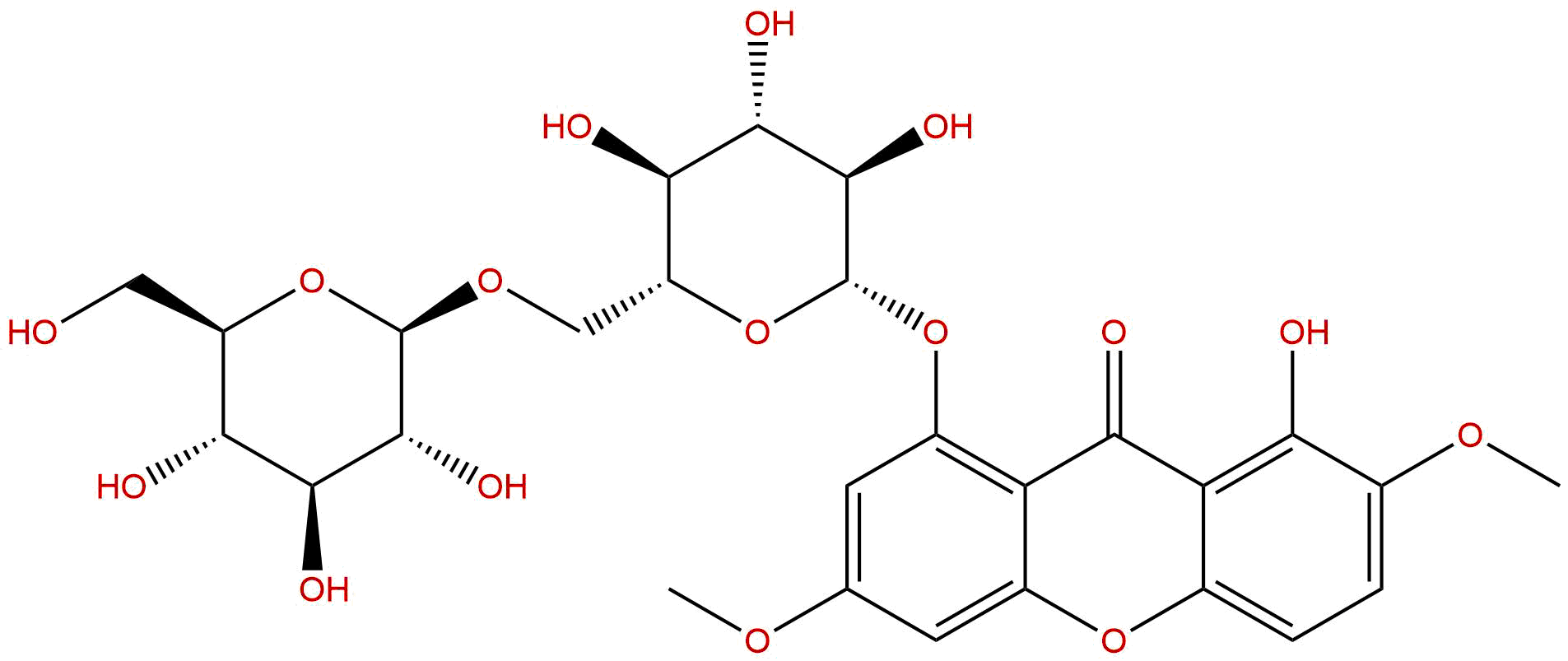
The chemical structure of GDX exhibits typical oxanthrone skeleton characteristics. The parent nucleus of 9H-xanthan-9-one is composed of two benzene rings fused together through a γ - pyranone ring, and its core structure is dibenzo - γ - pyranone. In GDX molecules, the substitution pattern on the mother nucleus is highly specific: the C-1 position is occupied by a disaccharide group - gentian disaccharide; C-3 and C-7 positions are respectively replaced by methoxy (- OCH ∝); The C-8 position is a free phenolic hydroxyl group (- OH). This substitution mode makes GDX unique among numerous anthraquinone derivatives.
Gentiobiose is a disaccharide composed of two molecules of D-glucose linked by β - (1 → 6) glycosidic bonds. Unlike common sucrose or maltose, the β - (1 → 6) linkage of gentian disaccharides endows them with unique spatial conformation and chemical properties. The sugar group is connected to the C-1 position of the anthraquinone nucleus through a β - glycosidic bond, forming a larger hydrophilic "head", while the anthraquinone nucleus forms a hydrophobic "tail". This "amphiphilic" structure is the basis for GDX molecules to interact with different biological environments.
The molecular formula of GDX is C ₂₈ H ∝ ₂ O ₁₆, with a molecular weight of 612.5370 g/mol. Its precise chemical name (IUPAC) is 1- [(6-O - β - D-glucopyranosyl - β - D-glucopyranosyl) oxy] -8-hydroxy-3,7-dimethoxy-9H-xian-9-one. The CAS registration number is 487040-33-5.
In terms of physical and chemical properties, GDX exhibits typical polar natural product characteristics. The calculated LogP value is -0.5670, indicating that the molecule has high hydrophilicity, which is closely related to the presence of multiple hydroxyl and sugar structural units in the molecule. High hydrophilicity usually means that the compound has good solubility and dispersibility in aqueous environments, but it may also limit its ability to passively diffuse through biological membranes such as cell membranes and the blood-brain barrier. Its topological polar surface area (TPSA) is as high as 247.4300 Å ², far exceeding the recommended upper limit of 140 Å ² for oral medications. The high TPSA value further confirms its strong polarity and ability to form hydrogen bonds, which is often associated with poor intestinal permeability and lower oral bioavailability. The water solubility parameter is 3.5993 (possibly corresponding to logS or similar units), indicating that its solubility in water is above average, which provides convenience for its preparation in in vitro pharmacological experiments.
In addition, the predictive model shows that the blood-brain barrier (BBB) penetration ability of GDX is relatively low, indicating its limited potential in the treatment of central nervous system diseases, but it may also mean a lower risk of central nervous system toxic side effects after peripheral administration. The prediction result of hERG inhibition is' no ', indicating a low risk of inducing QT interval prolongation and arrhythmia in the heart, which is a positive drug signal. The Ames test predicted a value of 1.5, indicating a potential genetic toxicity risk, but further experimental verification is needed. Overall, the physicochemical properties of GDX determine that it may be more suitable for injection or local administration rather than traditional oral administration.
GDX, as a naturally occurring anthraquinone glycoside, is mainly derived from the Gentianaceae genus of Swertia in the Gentianaceae family(Swertia)Plants. There are approximately 170 species of this genus of plants worldwide, mainly distributed in temperate and mountainous regions of Asia, Africa, and North America. In China, Swertia is rich in plant resources, and many species are used as traditional Tibetan medicine "Dida" or "Tibetan Herbal Medicine" to treat icteric hepatitis, cholecystitis, fever and various infectious diseases.
The reported plant species containing GDX include but are not limited to:
- Western Sichuan Swertia(Swertia mussotii Franch.)This is an important Tibetan medicinal plant in the Qinghai Tibet Plateau region and one of the main basal plants of "Tibetan Yin Chen". Research has shown that the entire plant contains various anthraquinone compounds, among which GDX is one of the representative compounds.
- Embracing stem Swertia(Swertia franchetiana H. Smith)Also known as "Embracing Stem Swertia", it is a commonly used Tibetan medicinal plant. Its chemical composition is similar to that of Western Sichuan Swertia and it is also rich in GDX.
- Other Swertia plants Like Indian Swertia(Swertia chirayita)Elliptical leaf flower anchor(Halenia elliptica Although belonging to the family Gentianaceae, it may also contain this compound or its structural analogues.
The content of GDX in plants is usually low and belongs to trace active ingredients. The extraction and separation purification process is a key link in natural product chemistry research, usually following the classic process of "extraction separation purification".
Extraction method:
1. Solvent extraction method Due to the high polarity of GDX, solvents with higher polarity are usually used for extraction. The most commonly used solvents are methanol or ethanol (70% -95%), and sometimes methanol water or ethanol water mixed systems are also used. The extraction methods include cold soaking, percolation, or heating reflux. Heating reflux extraction has a high efficiency, but it is important to control the temperature to avoid degradation of thermosensitive components. Usually, dried plant materials (whole plants or aboveground parts) are crushed and repeatedly extracted with several times the amount of solvent, and the extracted liquids are combined and concentrated under reduced pressure to obtain the total extract.
2. Assisted Extraction Technology To improve extraction efficiency and selectivity, modern extraction techniques have also been applied to the extraction of GDX. For example, ultrasound assisted extraction (UAE) utilizes the cavitation effect of ultrasound to destroy plant cell walls, accelerate solvent permeation and solute diffusion; Microwave assisted extraction (MAE) utilizes the body heating effect of microwaves to significantly shorten extraction time and improve yield.
Separation and purification methods:
The separation and purification of GDX from the total extract requires the comprehensive use of multiple chromatographic techniques.
1. Preliminary separation The total extract is usually first subjected to liquid-liquid extraction, such as sequential extraction with petroleum ether, ethyl acetate, n-butanol, and water, to separate the components of different polarities. Due to the high polarity of GDX, it is usually enriched in the n-butanol extraction layer or water layer.
2. Column chromatography separation This is the core step of separation and purification.
- Positive phase silica gel column chromatography The use of solvent systems such as chloroform methanol water or ethyl acetate methanol water for gradient elution is a classic method for separating anthraquinone glycosides.
- Reverse phase column chromatography Use ODS (octadecylsilane bonded silica gel) as the stationary phase and elute with methanol water or acetonitrile water system. Reverse phase chromatography is more effective in separating glycosides with higher polarity, and can effectively remove pigments and other impurities.
- Sephadex gel column chromatography For example, Sephadex LH-20 is used to separate large molecular impurities such as tannins and pigments based on their molecular size, and to finely purify the target components.
3. High performance liquid chromatography (HPLC)For mixtures with similar structures that are difficult to separate, preparative HPLC is the ultimate means of obtaining high-purity GDX monomers. Usually, a C18 reverse phase preparation column is used, with methanol water or acetonitrile water as the mobile phase, combined with a UV detector (detection wavelength usually around 254 nm or 280 nm) for separation.
During the entire separation process, it is necessary to monitor each fraction using thin-layer chromatography (TLC) and HPLC, and to identify the structure of the final pure compound as GDX through spectroscopic methods such as nuclear magnetic resonance spectroscopy (NMR) and mass spectrometry (MS).
At present, there are relatively limited reports on the direct pharmacological activity of GDX, but the oxanthrone glycosides to which it belongs have been proven to have a wide range of biological activities. Based on its structural characteristics and the research background of its compound family, the pharmacological activity research of GDX mainly focuses on the following aspects, among which antibacterial activity is the most prominent research direction.
1. Antibacterial Activity
This is the most closely watched area in GDX research. According to the provided target information, GDX has potential inhibitory effects on key proteins of various bacteria and fungi, suggesting that it may be a broad-spectrum antibacterial agent.
2. Other potential pharmacological activities
Based on the commonality of anthraquinone compounds, GDX may also have the following activities:
- anti-inflammatory activity Many anthraquinone compounds have been reported to inhibit the production of inflammatory mediators such as NO, PGE2, TNF - α, and IL-6, and their mechanisms may be related to the inhibition of NF - κ B and MAPK signaling pathways.
- antioxidant activity The phenolic hydroxyl groups in the molecule endow it with the ability to scavenge free radicals, which may exert antioxidant and cell protective effects.
- Hepatoprotective activity Plants of the Swertia genus are traditionally used for liver protection, and their active ingredients (including anthraquinone) have been shown to alleviate chemical liver damage through antioxidant, anti-inflammatory, and lipid metabolism regulation pathways.
- Antitumor activity Partial anthraquinone has been reported to be cytotoxic to various cancer cell lines, with mechanisms involving induction of apoptosis, cycle arrest, and inhibition of angiogenesis.
It should be emphasized that the antibacterial and other pharmacological activities of GDX mentioned above are currently mainly based on computational predictions (such as molecular docking, pharmacophore models) and literature inference of similar compounds. Direct and systematic in vitro and in vivo experimental validation data are still very scarce, which is the main gap in current research.
The research on the mechanism of action of GDX is still in its infancy, and the current understanding mainly comes from computational chemistry prediction and inference based on its structural analogues. According to the provided target information, GDX may interfere with the survival and proliferation of pathogenic microorganisms by acting on multiple key proteins.
1. Antibacterial mechanism
2. Mechanism of antifungal action
In summary, the mechanism of action of GDX exhibits the characteristics of "multi-target and multi pathway". The advantage of this mode of action is that, on the one hand, multiple targets are simultaneously inhibited, which can produce a synergistic effect and enhance the antibacterial effect; On the other hand, the probability of pathogenic microorganisms simultaneously producing drug-resistant mutations targeting multiple targets is extremely low, so GDX may have a lower rate of drug resistance induction. However, most of these mechanisms are based on computer simulation predictions and urgently need to be confirmed through molecular biology experiments such as enzyme activity inhibition experiments, surface plasmon resonance (SPR), isothermal titration calorimetry (ITC), and gene knockout/overexpression.
The evaluation of drug properties is a crucial step in determining whether natural products can transition from "compounds" to "drugs". The physicochemical properties and predicted pharmacokinetic characteristics of GDX paint a complex picture of its pharmacological properties.
1. Analysis of pharmacological parameters
2. Prediction of pharmacokinetic characteristics
Based on its physicochemical properties, the pharmacokinetic characteristics of GDX can be reasonably predicted:
- absorb Poor oral absorption and low bioavailability. It may be more suitable to administer through intravenous injection, intramuscular injection, or local administration (such as skin, mucous membrane) routes.
- distribution Due to its strong hydrophilicity, it is mainly distributed in the blood and extracellular fluid, making it difficult to enter the interior of cells. The binding rate with plasma proteins may be low. The distribution of tissues may be limited, especially in adipose tissue and brain tissue.
- Metabolism Glycoside compounds may be hydrolyzed by glycosidases in the gut microbiota or liver, releasing glycosides (i.e. glycosylated anthraquinone). Glycosides may have different pharmacological activities and pharmacokinetic behaviors. In addition, phase II metabolic enzymes in the liver, such as UDP glucuronosyltransferase and sulfotransferase, may bind to phenolic hydroxyl groups in molecules, promoting their excretion.
- excretion Due to their high polarity, prototype drugs and metabolites may be primarily excreted through the kidneys in the form of urine, or through bile excretion into the intestine.
3. Strategies for improving drug properties
Given the inherent deficiency of low oral bioavailability of GDX, if it is to be developed into a drug, corresponding strategies need to be taken:
- Prodrug design Esterification or etherification modification of hydroxyl groups on phenolic or sugar groups in molecules to enhance their lipid solubility and improve oral absorption. In the body, these prodrug groups are enzymatically hydrolyzed and released, restoring their activity.
- Drug delivery system Using nanotechnology, such as liposomes, polymer nanoparticles, phospholipid complexes, etc., to encapsulate GDX, improve its solubility and membrane permeability, and achieve targeted delivery and sustained release.
- structural optimization Simplify or replace the sugar moiety while retaining the core pharmacophore group, or adjust the substitution mode of methoxy/hydroxyl groups, in order to find derivatives with smaller molecular weight and better lipid solubility.
Although research on GDX is still in its early stages, its unique chemical structure and multi-target antibacterial potential depict broad prospects for its clinical application, especially in addressing the increasingly severe crisis of antibiotic resistance.
1. Anti drug resistant bacterial infection drugs
This is the most core and anticipated clinical application direction of GDX.
- Anti MRSA drugs Given its potential effect on MECA targets, GDX is expected to be developed as a novel anti MRSA drug or used as an "antibiotic adjuvant" in combination with beta lactam antibiotics to restore their sensitivity to MRSA.
- Antimicrobial drugs against multidrug-resistant bacteria Its multi-target mechanism of action makes it less likely to induce drug resistance, which gives it a unique advantage in combating multidrug-resistant Gram positive bacteria (such as MRSA, vancomycin resistant Enterococcus VRE) and Gram negative bacteria.
- Antidrug resistant fungal drugs The dual effects of ERG11 and CDR1 make it a potential new option for treating invasive fungal infections, especially those caused by azole resistant Candida.
2. Local anti infective agents
Given its low oral bioavailability but good water solubility, GDX is highly suitable for development as a topical formulation, such as:
- External ointment or cream for the skin Used to treat skin and soft tissue infections caused by Staphylococcus aureus, Streptococcus, etc., such as pyoderma, folliculitis, wound infections, etc.
- Mucosal preparation: For example, oral ulcer mask, vaginal suppository or gel are used to treat fungal or bacterial infections of oral or reproductive tract mucosa.
- Ophthalmic preparations Treat eye infections such as bacterial conjunctivitis and keratitis.
3. Optimize the structure as a lead compound
The complex structure of GDX provides abundant modification sites for medicinal chemists. Through the study of the structure-activity relationship of the system, it is possible to:
- simplified structure Search for simplified analogues with smaller molecular weight, easier synthesis, and better pharmacokinetic properties.
- Optimize activity By introducing different substituents, the selectivity and affinity for specific targets are improved, and toxic side effects are reduced.
- Improve pharmacokinetic properties As mentioned earlier, improving its absorption and distribution through prodrugs or nanotechnology.
4. Challenges faced and future research directions
The clinical translation of GDX still faces many challenges:
- Activity verification Currently, all information about its antibacterial activity and targets comes from computational predictions.The primary task is to conduct in vitro antibacterial activity experiments on the system Determine its minimum inhibitory concentration (MIC) and minimum bactericidal concentration (MBC) against multiple standard strains and clinically isolated drug-resistant strains.
- Mechanism verification It is necessary to confirm its direct binding and mode of action with predicted targets (such as GYRA, FTSZ, ERG11) through molecular biology and biochemical experiments.
- In vivo efficacy and toxicity It is necessary to establish appropriate animal infection models (such as skin infection models, systemic infection models) to evaluate their in vivo efficacy. At the same time, it is necessary to conduct systematic acute toxicity, subchronic toxicity, and genetic toxicity studies to comprehensively evaluate its safety.
- Pharmacokinetic study It is necessary to conduct pharmacokinetic experiments in animals to clarify their absorption, distribution, metabolism, and excretion characteristics, especially their bioavailability, half-life, and tissue distribution after oral and intravenous administration.
- Source issue Natural extraction has low yield and high cost. Efficient chemical or biological synthesis methods need to be developed to meet the demands of subsequent research and potential commercialization.
1-O-gentian disaccharide-3,7-dimethoxy-8-hydroxyanthraquinone (GDX), as a structurally unique anthraquinone glycoside derived from traditional Tibetan medicinal plants, demonstrates great potential as a novel antibacterial lead compound. Its complex chemical structure, especially the presence of gentian disaccharides, endows it with unique physicochemical properties and potential multi-target mechanisms of action. Through computer-aided drug design prediction, GDX may exert broad-spectrum antibacterial and antifungal activity by inhibiting key targets such as bacterial DNA gyrase, FTSZ, FABI, DHFR, PBPs, as well as fungal ERG11 and CDR1, and may have unique advantages over drug-resistant strains.
However, research on GDX is still in a very early stage, and there is a huge gap between "prediction" and "empirical". Its medicinal properties also face challenges such as low oral bioavailability and potential genetic toxicity. Future research should focus on: verifying its pharmacological activity and mechanism of action through systematic in vitro and in vivo experiments; Comprehensively evaluate its pharmacokinetic characteristics and safety; And based on this, improve its drug properties through structural optimization or design of new drug delivery systems. We have reason to believe that with the continuous deepening of research, GDX and its derivatives have the potential to provide new solutions for addressing the global antibiotic resistance crisis and ultimately benefit a large number of patients. The in-depth study of natural products derived from traditional medicinal plants is not only an important way for modern drug discovery, but also a scientific interpretation and inheritance of traditional medical wisdom.
Batch can search by a CAS number,one per line
