


Product name: Sennidin B
Synonym name:
Catalogue No.: BP1291
Cas No.: 517-44-2
Formula: C30H18O10
Mol Weight: 538.464
Botanical Source: Sennae Folium
Physical Description:
Type of Compound: Anthraquinones
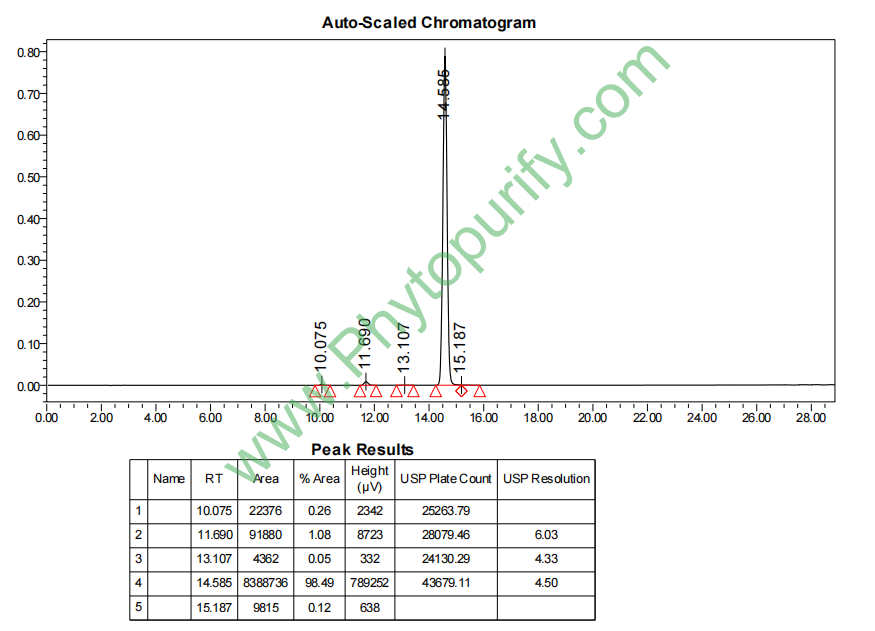
Purity: 95%~99%
Analysis Method: HPLC-DAD or/and HPLC-ELSD
Identification Method: Mass, NMR
Packing: Brown vial or HDPE plastic bottle
Storage: Store in a well closed container, protected from air and light. Put into refrigerate or freeze for long term storage.
Whenever possible, you should prepare and use solutions on the same day. However, if you need to make up stock solutions in advance, we recommend that you store the solution as aliquots in tightly sealed vials at -20℃. Generally, these will be useable for up to two weeks.
The product could be supplied from milligrams to grams
Inquire for bulk scale.
Description:
Sennidin B stimulates glucose incorporation in rat adipocytes.
References:
Appl Environ Microbiol. 1994 Mar;60(3):1041-3.
Isolation of a human intestinal anaerobe, Bifidobacterium sp. strain SEN, capable of hydrolyzing sennosides to sennidins.
A strictly anaerobic bacterium capable of metabolizing sennosides was isolated from human feces and identified as Bifidobacterium sp., named strain SEN.
METHODS AND RESULTS:
The bacterium hydrolyzed sennosides A and Sennidin B to sennidin A and Sennidin B via sennidin A and Sennidin B 8-monoglucosides, respectively. Among nine species of Bifidobacterium having beta-glucosidase activity, only Bifidobacterium dentium and B. adolescentis metabolized sennoside B to Sennidin B, suggesting that the sennoside-metabolizing bacteria produce a novel type of beta-glucosidase capable of hydrolyzing sennosides to sennidins.
Phytomedicine. 2008 May;15(5):373-7.
Transport of sennosides and sennidines from Cassia angustifolia and Cassia senna across Caco-2 monolayers--an in vitro model for intestinal absorption.
Laxative effects of Senna preparations are mainly mediated by rheinanthrone, a metabolite formed in the intestinal flora from dianthrones. Nevertheless, it was not clear whether dianthrones are bioavailable at all and contribute to the overall effects of this important medicinal plant.
METHODS AND RESULTS:
Using the Caco-2 human colonic cell line as an in vitro model of the human intestinal mucosal barrier, the bioavailability of dianthrones was studied in apical to basolateral (absorptive) and basolateral to apical (secretive) direction. Permeability coefficients (P(c)) and percent transport were calculated based on quantitations by HPLC. From the data obtained it was concluded that sennoside A and sennoside B, as well as their aglycones sennidin A and Sennidin B are transported through the Caco-2 monolayers in a concentration-dependent manner and their transport was linear with time. The absorption in apical to basolateral direction was poor and P(c) values were comparable to mannitol. The transport was higher in the secretory direction, indicating a significant efflux (e.g. by efflux pumps) of the (poorly) absorbed compounds in the intestinal lumen again.
CONCLUSIONS:
Our findings support the general understanding that the laxative effects of Senna are explainable mainly by metabolites and not by the natively present dianthrones.
HPLC of Sennidin B
Storage conditions:Short-term storage at 2~8℃, long-term storage at -20 ~ -80℃
189.6600
3.6775
.5705
.0361
4.0087
1.8937
Low
92.4240
3.6474
Yes
No
No
No
Yes
Yes
0.0
Yes
No
Yes
No
Sennidin B (CAS number: 517-44-2) is derived from the traditional medicinal plant Sennidin(Cassia angustifolia Vahl is one of the main members of a class of important anthraquinone derivatives, namely senosides. As a natural laxative with a long history, the study of its active ingredients has always been a hot topic in the field of natural product pharmacology. Fanxie glycoside compounds, especially their glycoside forms, are considered the key material basis for exerting pharmacological effects. As a stereoisomer of sennidin A, sennidin B was often regarded as a low activity co occurring component in early research. However, with the deepening of modern pharmacological research techniques, its unique chemical properties, differentiated biological activities, and potential as a probe molecule in revealing related disease mechanisms are increasingly attracting the attention of researchers. This article aims to systematically review the chemical properties, plant sources, pharmacological activities, potential mechanisms of action, pharmacological characteristics, and clinical application prospects of senoside B, in order to provide comprehensive academic references for the in-depth research and development of this compound.
The molecular formula of Fanxie Glycoside B is C30H26O10, with a molecular weight of 538.4640. From a chemical structure perspective, it belongs to the class of anthraquinone compounds, specifically the dimer of trans anthraquinone. Its core structure is composed of two Emodin or anthraquinone like units connected by a C10-C10 'bond, forming a median position(meso)Configuration. Fanxie Glycoside B and Fanxie Glycoside A are stereoisomers of each other, and the difference between the two lies in the different stereoisomers of the central single bond connecting the two anthrone units. This small stereochemical difference leads to significant differences in their spatial conformation, polarity, and subsequent interactions with biomolecules, thereby affecting their biological activity.
In terms of physicochemical properties, the lipid water partition coefficient (LogP) of senoside B is 3.6775, indicating its lipophilicity. Its topological polar surface area (TPSA) is 189.6600 Å ², reflecting the presence of multiple oxygen atoms in the molecule that can form hydrogen bonds, such as carbonyl and hydroxyl groups. The water solubility data (0.0361 mg/mL) confirms that it is a poorly soluble compound, which is one of the key factors affecting its oral absorption and bioavailability. These basic physicochemical parameters provide important basis for the evaluation of drug properties and formulation development.
Fanxie Glycogen B is mainly derived from Fabaceae, a genus of Cassia in the legume family(Cassia)Plants, among which narrow leaved diarrhea(Cassia angustifolia Vahl's diarrhea and pointed leaf diarrhea(Cassia acutifolia Delile is the most famous and is the main original plant of the traditional medicinal herb "senna leaf". In these plants, sennosides (such as sennosides A, B, C, D, etc.) are not abundant in their free form, but are stored in the leaves in their glucose form. Fanxie glycoside is a prodrug, which is hydrolyzed by β - glucosidase of gut microbiota (mainly anaerobic bacteria) after oral administration, releasing bioactive aglycones such as Fanxie glycoside A and B.
The extraction of senoside B is usually carried out using solvent extraction combined with chromatographic separation technology. The conventional process is as follows: first, the dried senna leaves are crushed, and then heated and refluxed with methanol, ethanol, or an aqueous alcohol solution or extracted with ultrasound assistance, and concentrated to obtain the total extract. Subsequently, preliminary enrichment was carried out using methods such as macroporous adsorption resin and silica gel column chromatography. Due to the extremely similar structures of senoside A and B, separation and purification are technical difficulties that often require the use of high-performance liquid chromatography (HPLC), especially preparative HPLC, which uses a reverse phase C18 chromatographic column and gradient elution with methanol water or acetonitrile water (often containing a small amount of formic acid or acetic acid to adjust pH) as the mobile phase. The separation of the two is achieved based on the small difference in retention time. In recent years, liquid-liquid distribution chromatography techniques such as high-speed countercurrent chromatography (HSCCC) have also been applied for the purification of such compounds due to their excellent ability to separate isomers.
Although there are fewer direct and systematic pharmacological studies on senoside B compared to senoside A, based on its identity as a hydrolysis product of senoside and related analog research, it can be inferred and partially confirmed that it has multiple biological activities.
The pharmacological effects of Fanxie Glycoside B and its homologs, especially the molecular mechanism of its laxative effect, involve complex regulation of multiple ion channels and water channels in the intestine. Existing research has revealed the following key molecular targets:
In terms of glucose metabolism regulation, the mechanism of action of senoside A involves activating Akt downstream of the insulin signaling pathway, thereby promoting GLUT4 translocation to the cell membrane and increasing glucose uptake by cells. The key to revealing the differentiation of its pharmacological properties lies in whether ubiquitin B triggers different signaling cascades through the same pathway or due to its structural differences.
In addition, the traditional view holds that the laxative effect of anthraquinone glycosides is partly due to their direct stimulation of the enteric nervous system (such as stimulating the enteric myenteric plexus), as well as the release of inflammatory mediators such as prostaglandins. However, the correlation between these effects and the aforementioned molecular targets needs to be comprehensively studied.
Based on the provided pharmacological parameters and existing knowledge, a preliminary evaluation of the pharmacological properties of senoside B is conducted
Overall, there is a challenge of low bioavailability of senoside B as a direct oral drug candidate molecule. Its more practical application form may be: 1) as one of the active ingredients that exert their effects in vivo as extracts or preparations of senna leaves; 2) As a lead compound for structural modification (such as preparing prodrugs, improving solubility) to optimize pharmacokinetic properties; 3) As a tool molecule for studying the physiological and pathological mechanisms of intestinal ion/water transport.
The clinical application prospects of Fanxie Glycoside B are closely related to a deep understanding of its pharmacological properties and technological innovation.
Future research should focus on: ① isolating and obtaining high-purity monomers of senoside B, and conducting systematic in vitro and in vivo pharmacological activity screening; ② By utilizing techniques such as molecular docking and surface plasmon resonance, the interaction modes between it and targets such as CFTR and NHE3 can be directly studied; ③ Conduct detailed pharmacokinetic studies to elucidate its absorption, distribution, metabolism, and excretion processes; ④ Based on the structure-activity relationship, carry out reasonable chemical modifications to improve its solubility, targeting, and stability.
Fanxie Glycogen B, as an important member of the Fanxie Glycogen family, a key active ingredient in traditional laxative senna leaves, has scientific value far beyond its co occurring or less active isomers. From a chemical perspective, it is an excellent example for studying the effects of stereochemistry on biological functions; From a pharmacological perspective, it carries the code for regulating intestinal water and electrolyte balance, affecting glucose metabolism, and other multiple biological activities. Although independent and systematic research on it is currently insufficient, existing clues indicate that senoside B has significant potential in revealing the molecular mechanisms of related diseases, expanding the clinical application scope of anthraquinone compounds, and serving as a lead compound for drug design. With the advancement of separation and identification techniques and the deepening of molecular pharmacology, precise and in-depth research on senoside B can not only enrich the content of natural product pharmacology, but also provide important scientific basis for the development of new strategies for treating constipation, metabolic diseases, and other conditions. The research process also enlightens us that in-depth exploration of "secondary" components in traditional medicinal plants is often an important way to discover new activities and mechanisms.
