


Product name: Sennoside C
Synonym name:
Catalogue No.: BP1294
Cas No.: 37271-16-2
Formula: C42H40O19
Mol Weight: 848.763
Botanical Source: Sennae Folium
Physical Description:
Type of Compound: Anthraquinones
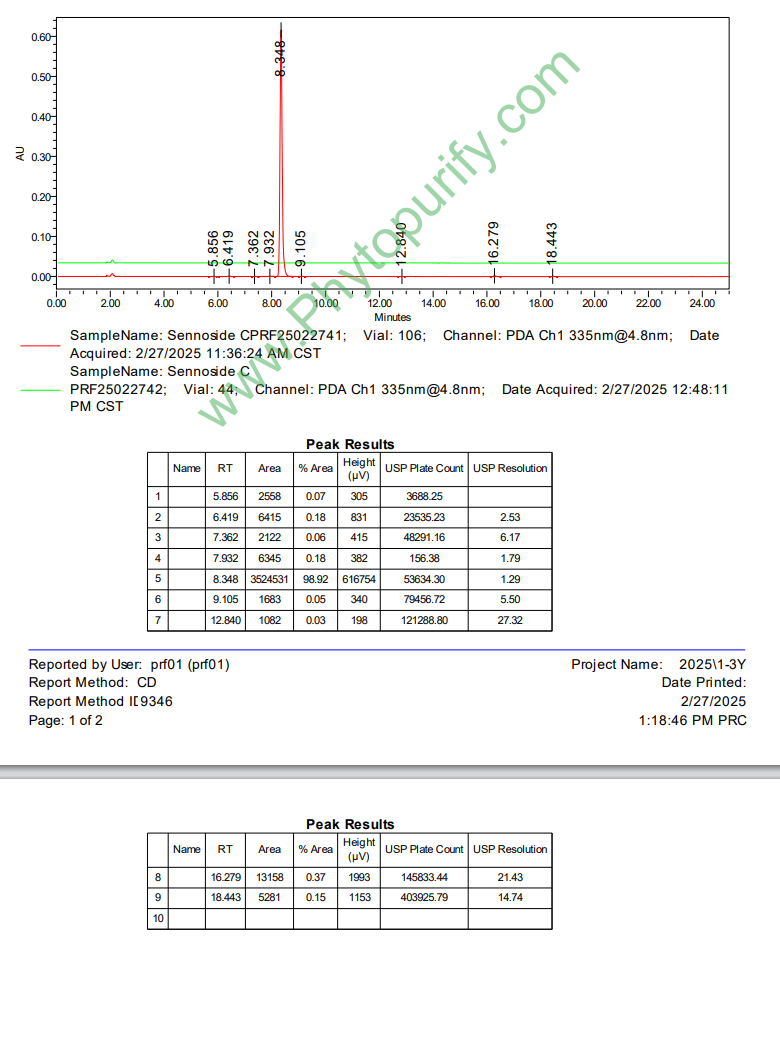
Purity: 95%~99%
Analysis Method: HPLC-DAD or/and HPLC-ELSD
Identification Method: Mass, NMR
Packing: Brown vial or HDPE plastic bottle
Storage: Store in a well closed container, protected from air and light. Put into refrigerate or freeze for long term storage.
Whenever possible, you should prepare and use solutions on the same day. However, if you need to make up stock solutions in advance, we recommend that you store the solution as aliquots in tightly sealed vials at -20℃. Generally, these will be useable for up to two weeks.
The product could be supplied from milligrams to grams
Inquire for bulk scale.
Description:
Sennoside C , aloe-emodin anthrone and rhein anthrone which formed mainly by intraluminal bacterial action, synergistically exert their purgative effects on mice.
References:
Comput Biol Chem. 2011 Oct 12;35(5):293-7.
Drug-target network and polypharmacology studies of a Traditional Chinese Medicine for type II diabetes mellitus.
Many Traditional Chinese Medicines (TCMs) are effective to relieve complicated diseases such as type II diabetes mellitus (T2DM).
METHODS AND RESULTS:
In this work, molecular docking and network analysis were employed to elucidate the action mechanism of a medical composition which had clinical efficacy for T2DM. We found that multiple active compounds contained in this medical composition would target multiple proteins related to T2DM and the biological network would be shifted. We predicted the key players in the medical composition and some of them have been reported in literature. Meanwhile, several compounds such as Rheidin A, Rheidin C, Sennoside C, procyanidin C1 and Dihydrobaicalin were notable although no one have reported their pharmacological activity against T2DM.
CONCLUSIONS:
The association between active compounds, target proteins and other diseases was also discussed.
J Pharm Pharmacol. 1992 Dec;44(12):973-6.
Metabolic activation of sennoside C in mice: synergistic action of anthrones.
METHODS AND RESULTS:
Sennosides A and C directly injected into the caecum of mice showed equal purgative activity. Intracaecal administration reduced time to onset of diarrhoea induced by Sennoside C from about 3 h after oral administration to about 24 min. At 2.3 h after oral administration of Sennoside C, nearly equimolar amounts of aloe-emodin anthrone and rhein anthrone were detected in the large intestine of mice. The purgative effect of oral Sennoside C could be reduced by pretreating mice with chloramphenicol. This was observed as a decreased formation of total anthrones in the large intestine. Both anthrones and an equimolar mixture of both anthrones directly injected into the caecum exerted a purgative effect, although the activity was lower for aloe-emodin anthrone. The intracaecal ED50 values were 54.5 (24.1-89.6), 11.4 (5.0-15.7) and 11.2 (6.1-14.6) mumol kg-1 for aloe-emodin anthrone, rhein anthrone and an equimolar mixture of both anthrones, respectively.
CONCLUSIONS:
We concluded that aloe-emodin anthrone and rhein anthrone, formed mainly by intraluminal bacterial action, are the true active metabolites of Sennoside C in mice and that both anthrones synergistically exert their purgative effects on mice.
HPLC of Sennoside C
Storage conditions:Short-term storage at 2~8℃, long-term storage at -20 ~ -80℃
Sennoside C (CAS number: 37271-16-2) is an important active ingredient isolated from the traditional Chinese medicine Sennae Folium, belonging to the anthraquinone dimer glycoside class. As one of the main laxative active ingredients of senna leaves, senoside C is widely used in traditional Chinese medicine to treat constipation and related intestinal dysfunction diseases. In recent years, with the in-depth study of the pharmacological mechanisms of natural products, sennoside C has not only shown significant activity in laxative effects, but has also been found to have the potential to inhibit amyloid fibrosis, demonstrating its research value in the field of anti amyloid related diseases.
This review aims to systematically summarize the chemical structure and physicochemical properties, plant sources and extraction methods, pharmacological activity and mechanism of action, pharmacological evaluation and pharmacokinetic characteristics of senoside C. Combined with its clinical application potential, it comprehensively reviews the research progress and future development directions of this natural product, providing reference and inspiration for researchers in related fields.
Fanxie glycoside C is a dimeric anthraquinone glycoside compound with a molecular formula of C42H38O20 and a molecular weight of 848.7630. Its structure is formed by connecting two anthraquinone units through glycosidic bonds, exhibiting typical characteristics of glycoside compounds. The molecule contains multiple hydroxyl and ether bonds, giving it good hydrophilicity.
In terms of physicochemical properties, the LogP value of senoside C is 0.6398, indicating its low hydrophobicity and good water solubility (with a water solubility index of approximately 0.7574), which is beneficial for its oral absorption and bioavailability. Its topological polar surface area (TPSA) is 330.89 Å ², and higher TPSA values usually indicate stronger molecular polarity, which may affect its ability to penetrate cell membranes. The low permeability of the blood-brain barrier suggests limited distribution of senoside C in the central nervous system. The negative result of hERG channel inhibition experiment indicates a low risk of cardiac toxicity. The Ames mutagenicity test result was 0.0, indicating no significant genetic toxicity.
The characteristics of its chemical structure determine the metabolic stability and binding properties with targets of senoside C in vivo, which is the basis for its pharmacological effects.
Fanxie glycoside C is mainly found in Sennae Folium, which is the dried leaf of the leguminous plant Senna Alexandrina Mill. or Senna angustifolia. This plant is widely distributed in tropical and subtropical regions and is an important source of traditional laxatives.
The common methods for extracting senoside C include:
Water extraction method Using hot water extraction to extract water-soluble glycosides from senna leaves is suitable for industrial scale preparation, but the components in the extract are complex and require further separation and purification.
Alcohol extraction method Using methanol or ethanol as solvents, the extraction efficiency is high and the stability of glycoside structures can be well maintained.
Column chromatography separation The extract was separated and purified using techniques such as silica gel column chromatography and reverse phase high performance liquid chromatography (RP-HPLC) to obtain high-purity senoside C.
Ultrasound assisted extraction and microwave-assisted extraction In recent years, ultrasound and microwave-assisted extraction techniques have been applied to the extraction of senoside C, improving extraction efficiency, shortening time, and reducing solvent usage.
The optimization of extraction process is crucial for ensuring the yield and purity of senoside C, and also affects its subsequent pharmacological research and clinical applications.
Fanxie glycoside C, as one of the main active ingredients in senna leaves, has significant laxative activity. Its laxative effect mainly manifests as promoting intestinal peristalsis, increasing intestinal fluid secretion, and regulating intestinal water absorption, thereby alleviating constipation symptoms.
In vitro and in vivo experiments have shown that senoside C can promote the accumulation of water in the intestinal lumen, soften feces, and enhance defecation motility by regulating ion channels and aquaporins in intestinal epithelial cells. In addition, senoside C can stimulate the intestinal nervous system, enhance intestinal muscle contraction, and promote the advancement of intestinal contents.
Starch like protein deposition is the pathological basis of various neurodegenerative diseases (such as Alzheimer's disease) and systemic amyloidosis. Fanxie glycoside C was found to bind to human lysozyme and inhibit its amyloid fibrosis process, with an IC50 of 186.20 μ M.
This effect suggests that senoside C may have potential therapeutic value against amyloid related diseases by blocking abnormal aggregation of amyloid proteins, delaying or preventing pathological progression.
In addition to its laxative and anti amyloid fibrosis effects, some studies have also reported that sennoside C has auxiliary pharmacological activities such as antioxidant and anti-inflammatory effects, but related research is still in the preliminary stage and needs further systematic verification.
The mechanism of action of Fanxie Glycoside C is complex, mainly involving the following aspects:
CFTR (cystic fibrosis transmembrane conductance regulator)
CFTR is a chloride ion channel in intestinal epithelial cells that regulates the secretion of ions and water in the intestinal lumen. Fanxie glycoside C activates or regulates CFTR channel function, promotes chloride ion and water secretion, increases intestinal fluid volume, and facilitates defecation.
SLC9A3 (Sodium Hydrogen Exchange Compound Type 3)
SLC9A3 participates in the exchange of sodium and hydrogen ions, regulating the acid-base balance and ion homeostasis of the intestinal environment. Fanxie glycoside C may regulate intestinal water and salt metabolism and promote intestinal fluid secretion by affecting SLC9A3 activity.
Aquaporins (AQP3, AQP4, AQP8)
Aquaporins regulate water transport in intestinal epithelial cells and affect water content in intestinal lumen. Fanxie glycoside C may exert its laxative effect by regulating the expression or activity of these aquaporins, promoting water transport to the intestinal lumen.
Fanxie glycoside C inhibits the formation of amyloid fibers by binding to human lysozyme, blocking its abnormal folding and aggregation processes. This binding may involve hydrogen bonding and hydrophobic interactions between molecules, stabilizing the conformation of lysozyme and reducing fibrosis toxicity.
In addition, senoside C may alleviate cellular stress and inflammatory response induced by amyloid protein through antioxidant and anti-inflammatory pathways, and assist in protecting tissue function.
The molecular weight of sennoside C is relatively high (848.7630), exceeding the ideal range of traditional oral small molecule drugs (generally less than 500), which may limit its cell membrane penetration and oral bioavailability. Its high TPSA (330.89 Å ²) also suggests strong molecular polarity, further affecting membrane permeability.
However, the LogP value of senoside C is 0.6398, indicating its lipophilicity and favorable interaction with lipid membranes. Moderate water solubility (0.7574) is beneficial for the dissolution and absorption of drugs.
The low permeability of the blood-brain barrier reduces the risk of central nervous system side effects. The hERG channel has no inhibitory effect and reduces the risk of cardiac toxicity. The Ames test is negative, indicating no significant mutagenicity and good safety.
Currently, there is limited systematic pharmacokinetic research on senoside C. Previous studies have suggested that after oral administration, senoside C is mainly hydrolyzed by microbial enzymes in the intestine into active metabolites, exerting its laxative effect. Further research is needed on its absorption, distribution, metabolism, and excretion (ADME) process in the body.
Due to its large molecular weight and strong polarity, the oral bioavailability of senoside C may be low and difficult to pass through the blood-brain barrier. The gut microbiota may play an important role in its metabolism, suggesting that its pharmacological effects are closely related to the gut microbiota.
Fanxie glycoside C, as the main active ingredient of senna leaves, has been widely used in traditional medicine to treat constipation due to its excellent laxative effect. With a deeper understanding of its molecular mechanism, the application prospects of senoside C in modern medicine are gradually expanding.
Fanxie glycoside C promotes intestinal peristalsis and intestinal fluid secretion by regulating intestinal ion channels and aquaporins, and is suitable for the treatment of intestinal dysfunction diseases such as chronic constipation and irritable bowel syndrome. Its natural source and low toxicity make it a safe and effective choice for laxatives.
The inhibitory effect of ubiquitin C on amyloid fibrosis provides a new idea for its potential application in neurodegenerative diseases such as Alzheimer's disease. In the future, through structural optimization and drug carrier technology, its targeting and bioavailability can be improved, and it is expected to be developed as a candidate drug for anti amyloid protein deposition.
Pharmacokinetic and Metabolic Mechanism Research
In depth exploration of the in vivo absorption, distribution, metabolism, and excretion patterns of senoside C, and clarification of its active metabolites and targets of action.
Structural optimization and drug design
Based on the structural characteristics of senoside C, molecular modification is carried out to improve its oral bioavailability and targeting, and to develop novel, efficient, and safe drugs.
Clinical trials and safety evaluation
Conduct systematic clinical research to evaluate its efficacy, safety, and long-term risks of use, and promote its clinical application.
Research on the mechanism of multi-target action
Combining modern molecular biology and systems pharmacology techniques, reveal the comprehensive pharmacological effects of multiple targets and pathways of sennoside C.
As the main active ingredient of senna leaves, senoside C has significant laxative effects and the potential to inhibit amyloid fibrosis, demonstrating a wide range of pharmacological activities and good safety. Its unique chemical structure and multi-target mechanism of action provide an important foundation for the development of new laxatives and drugs against amyloid related diseases.
Although preliminary progress has been made in the study of senoside C, its pharmacokinetic characteristics, mechanism of action details, and clinical applications still need to be further explored. In the future, through interdisciplinary collaboration and modern drug development technology, it is expected to promote the clinical translation of senoside C and its derivatives, providing new strategies and choices for the treatment of constipation and amyloid related diseases.
