


Product name: Sennoside A
Synonym name:
Catalogue No.: BP1292
Cas No.: 81-27-6
Formula: C42H38O20
Mol Weight: 862.746
Botanical Source: Sennae Folium
Physical Description:
Type of Compound: Anthraquinones
Purity: 95%~99%
Analysis Method: HPLC-DAD or/and HPLC-ELSD
Identification Method: Mass, NMR
Packing: Brown vial or HDPE plastic bottle
Storage: Store in a well closed container, protected from air and light. Put into refrigerate or freeze for long term storage.
Whenever possible, you should prepare and use solutions on the same day. However, if you need to make up stock solutions in advance, we recommend that you store the solution as aliquots in tightly sealed vials at -20℃. Generally, these will be useable for up to two weeks.
The product could be supplied from milligrams to grams
Inquire for bulk scale.
Description:
Sennoside A, a kind of irritant laxative isolated from rhei rhizome, causes purgative actions in the intestine, it and Sennoside B have protective effects on gastric lesion. Sennoside A also is a new dual HIV-1 inhibitor effective on HIV-1 replication.
References:
Phytomedicine. 2016 Nov 15;23(12):1383-1391.
Sennoside A, derived from the traditional chinese medicine plant Rheum L., is a new dual HIV-1 inhibitor effective on HIV-1 replication.
Despite the availability of effective antiretroviral therapies, drugs for HIV-1 treatment with new mode of action are still needed. An innovative approach is aimed to identify dual HIV-1 inhibitors, small molecules that can inhibit two viral functions at the same time. Rhubarb, originated from Rheum palmatum L. and Rheum officinale Baill., is one of the earliest and most commonly used medicinal plants in Traditional Chinese Medicine (TCM) practice. We wanted to explore TCM for the identification of new chemical scaffolds with dual action abilities against HIV-1.
METHODS AND RESULTS:
R. palmatum L. and R. officinale Baill. extracts along with their main single isolated constituents anthraquinone derivatives were tested on both HIV-1 Reverse Transcriptase (RT)-associated DNA Polymerase (RDDP) and Ribonuclease H (RNase H) activities in biochemical assays. Active compounds were then assayed for their effects on HIV-1 mutated RTs, integrase (IN) and viral replication. Both R. palmatum L. and R. officinale Baill. extracts inhibited the HIV-1 RT-associated RNase H activity. Among the isolated constituents, Sennoside A and B were effective on both RDDP and RNase H RT-associated functions in biochemical assays. Sennoside A was less potent when tested on K103N, Y181C, Y188L, N474A and Q475A mutated RTs, suggesting the involvement of two RT binding sites for its antiviral activity. Sennoside A affected also HIV-1 IN activity in vitro and HIV-1 replication in cell-based assays. Viral DNA production and time of addition studies showed that Sennoside A targets the HIV-1 reverse transcription process.
CONCLUSIONS:
Sennoside A is a new scaffold for the development of HIV-1 dual RT inhibitors.
Biol Pharm Bull. 2011;34(9):1438-42.
The influence of glycyrrhiza and antibiotics on the purgative action of sennoside a from Daiokanzoto in mice.
Daiokanzoto (DKT), a Kampo medicine that includes the combination of two crude drugs (rhubarb and glycyrrhiza), is clinically effective for constipation. The aim of this study is to clarify the influence of glycyrrhiza, three glycyrrhiza constituents (glycyrrhizin, liquiritin, and liquiritin apioside), and eight antibiotics on the purgative action of DKT, rhubarb, or Sennoside A, a constituent of rhubarb, in mice.
METHODS AND RESULTS:
The purgative actions of rhubarb and Sennoside A were significantly intensified when glycyrrhiza was co-administered orally to mice. Liquiritin and liquiritin apioside but not glycyrrhizin showed significant amplification of the purgative action in a dose-dependent manner. The purgative actions of DKT and Sennoside A were significantly reduced by the pre-administration of ampicillin, cefcapene pivoxil, faropenem, fosfomycin, or kanamycin, but were not affected by the pre-administration of clarithromycin or levofloxacin. On the other hand, the purgative action of Sennoside Awas significantly reduced by the pre-administration of minocycline, whereas that of DKT was not affected. The effect of minocycline on the purgative action of Sennoside A was lost when glycyrrhiza was co-administered.
CONCLUSIONS:
These results suggest that liquiritin and liquiritin apioside contribute as active substances for the purgative action of DKT, and some antibiotics reduce the purgative action of DKT and Sennoside A. Furthermore, glycyrrhiza has the ability to recover the purgative action of Sennoside A suppressed by minocycline via an unknown mechanism.
The FASEB Journal, 2015, 29(1): 716.10.
Protective mechanism on gastric lesion of Sennoside A and Sennoside B
Sennoside A and sennoside B is evacuant to increase the sensitivity of the colon.
METHODS AND RESULTS:
In vivo test, we performed HCl·ethanol-induced gastritis test, indomethacin-induced gastric ulcer test, gastric secretion in pylorus-ligated test, H+/K+ATPase activity test, gastric emptying and intestinal motility test. In vitro test, we examined acid-neutralizing capacity, quantity of PGE2 and inhibition of H. pylori colonization and we confirmed apoptosis using DAPI nuclear staining, FACS analysis. Sennoside A and B inhibit lesion index in gastritis and gastric ulcer in rats. These results showed that these components reduced gastric juice, an aggressive factor and total acidity and increased pH moderately. In addition, it was made sure that proton pump inhibiton influenced on gastric acid secretion control and that colonization inhibiting activity on H. pylori.
CONCLUSIONS:
As protection enhancing factors to gastric damage, Sennoside A and B increased PGE2 in a concentration-dependent manner.
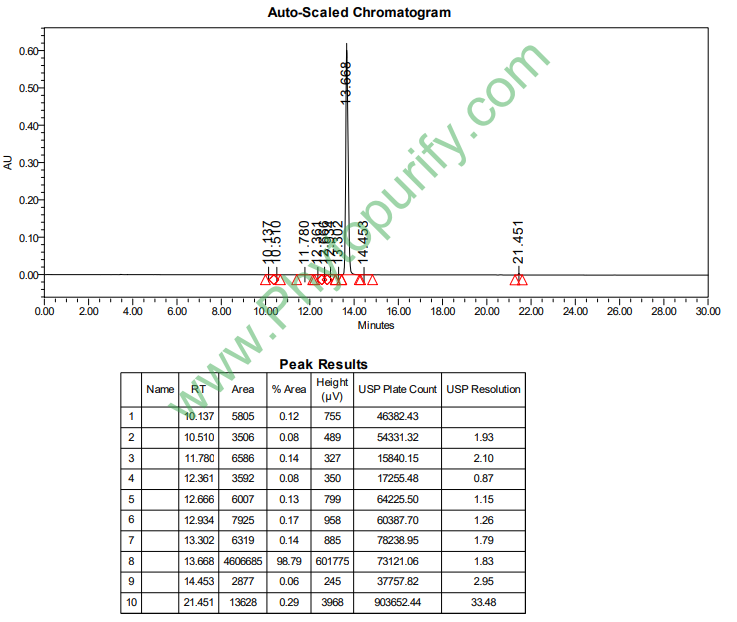
HPLC of Sennoside A
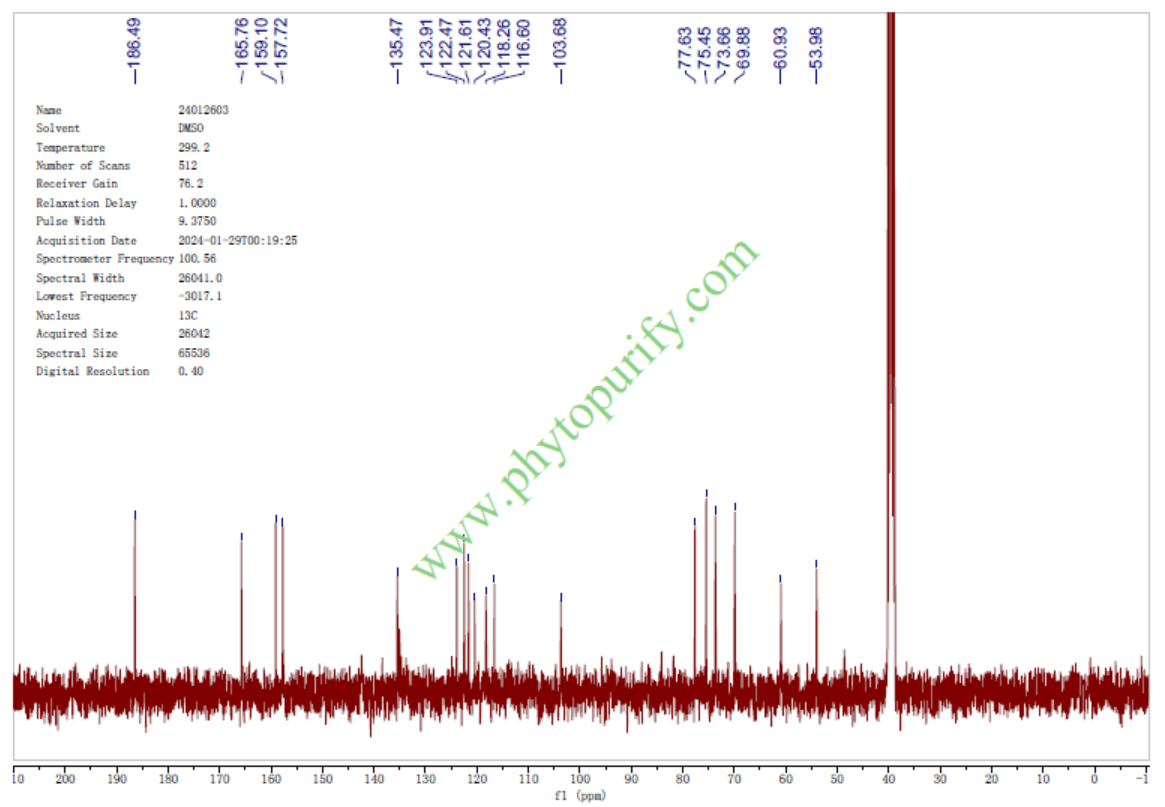
NMR of Sennoside A
Storage conditions:Short-term storage at 2~8℃, long-term storage at -20 ~ -80℃
Sennoside A (CAS number: 81-27-6) is an important class of natural anthraquinone glycosides, mainly found in the leaves of Cassia angustifolia. As an important component of traditional Chinese medicine and herbal laxatives, senoside A is widely used in the treatment of constipation due to its significant laxative effect. In addition, recent studies have shown that senoside A exhibits unique pharmacological activity in the field of antiviral activity, especially in the inhibition of HIV-1 infection, making it one of the hotspots in natural product pharmacology research. This article will provide a systematic review of the chemical structure and physicochemical properties, plant sources and extraction methods, pharmacological activity and mechanism of action, pharmacological evaluation and pharmacokinetic characteristics of senoside A, combined with its clinical application prospects, in order to provide theoretical basis and research guidance for the development and utilization of this natural product.
Fanxie glycoside A is an anthraquinone glycoside with a molecular formula of C42H38O20 and a molecular weight of 862.7460. Its structure consists of two anthraquinone units connected by glycosidic bonds to form a dimer, with a typical anthraquinone skeleton and multiple hydroxyl and sugar modifications. The LogP value of senoside A is 0.8253, indicating its strong hydrophilicity. Its TPSA (topological polar surface area) is as high as 347.96, reflecting its high polarity. Its water solubility is 0.7073, indicating its solubility in water. Its blood-brain barrier permeability is low, indicating difficulty in entering the central nervous system and reducing the risk of central side effects. The negative result of hERG channel inhibition experiment indicates a low risk of cardiac toxicity; The Ames mutagenicity test showed 0, indicating a low risk of genotoxicity. Overall, the physicochemical properties of senoside A conform to the typical characteristics of natural products and have a good safety foundation.
Fanxie glycoside A is mainly found in the legume plant Cassia angustifolia and its related species. Senna leaf is a traditional Chinese medicinal herb widely distributed in India, Africa, and some parts of Asia. Its leaves contain abundant anthraquinone glycosides, among which senoside A and senoside B are the main active ingredients.
The extraction method usually uses water extraction or alcohol extraction combined with liquid-liquid separation technology. The common process is as follows: first, the dried senna leaves are crushed and extracted with hot water or 70% ethanol. After filtration and concentration, the extract is separated and extracted using organic solvents such as ethyl acetate and chloroform. Then, high-purity senna glycoside A is purified by column chromatography (such as silica gel column, C18 reverse phase column). In recent years, the application of new technologies such as ultrasound assisted extraction and microwave-assisted extraction has improved the extraction efficiency and purity. In addition, high-performance liquid chromatography (HPLC) and mass spectrometry techniques are widely used for the qualitative and quantitative analysis of senoside A, ensuring the quality control of the extract.
Fanxie glycoside A, as the main active ingredient of senna leaves, has significant laxative effects. Its laxative effect is mainly achieved by stimulating intestinal peristalsis and promoting intestinal fluid secretion. In vitro and in vivo experiments have shown that senoside A can increase the frequency and amplitude of smooth muscle contractions in the large intestine, accelerating the advancement of intestinal contents. At the same time, sennoside A regulates the ion channels and aquaporins of intestinal epithelial cells, promotes water entry into the intestinal lumen, softens feces, and alleviates constipation symptoms.
In recent years, studies have found that sennoside A has the potential to inhibit HIV-1 replication. In vitro experiments have shown that sennoside A has significant inhibitory effects on HIV-1 reverse transcriptase (RT) - related DNA polymerase (RDDP) and ribonuclease H (RNase H), with IC50 values of 1.9 μ M and 5.3 μ M, respectively. In addition, the inhibitory IC50 of sennoside A on the overall replication process of HIV-1 is 3.8 μ M, indicating its potential as an HIV-1 reverse transcriptase inhibitor. This activity provides a new research direction for the development of antiviral drugs using senoside A.
Some studies have also reported potential antioxidant, anti-inflammatory, and anti-tumor activities of senoside A, but the relevant mechanisms have not been fully elucidated and further systematic research is needed.
The laxative effect of Fanxie glycoside A is mainly achieved through multi-target synergistic regulation. Its targets include:
CFTR (cystic fibrosis transmembrane conductance regulator)Fanxie glycoside A can activate CFTR channels in intestinal epithelial cells, promote chloride ion secretion, drive water into the intestinal lumen, and increase intestinal fluid secretion.
SLC9A3 (Sodium Hydrogen Exchange Compound Type 3)By regulating sodium ion absorption, it affects the water salt balance in the intestinal lumen and promotes water excretion.
AQP3, AQP4, AQP8 (aquaporins)Fanxie glycoside A regulates the expression and function of these aquaporins, improves intestinal water transport efficiency, and softens feces.
The synergistic effect of the above targets enables senoside A to effectively promote the excretion of intestinal contents and alleviate constipation.
Fanxie glycoside A directly inhibits the DNA polymerase activity and RNase H activity of HIV-1 reverse transcriptase, blocking the key step of virus RNA reverse transcription into DNA and inhibiting virus replication. The specific mechanism includes:
By combining with the active site of reverse transcriptase, the polymerization process of nucleotides is blocked.
Inhibiting RNase H activity, preventing degradation of viral RNA templates, and affecting viral genome replication.
This dual inhibitory mechanism gives senoside A a unique advantage in the field of anti-HIV-1 therapy.
The molecular weight of sennoside A is relatively high (862.7460) and the TPSA is high (347.96), indicating its strong polarity and good water solubility (0.7073), but it may limit its oral bioavailability and membrane permeability. Its LogP value is 0.8253, indicating moderate lipid solubility, which is beneficial for drug distribution.
The low permeability of the blood-brain barrier suggests that it is difficult for it to enter the central nervous system, reducing the risk of central nervous system side effects. The hERG channel inhibition was negative and the Ames test was 0, indicating a low risk of cardiac toxicity and genotoxicity, and good safety.
Currently, there is limited systematic pharmacokinetic research on senoside A. Previous literature has shown that after oral administration, senoside A is hydrolyzed by gut microbiota into active anthraquinone metabolites, which exert a laxative effect. Its larger molecular weight and polarity may lead to limited intestinal absorption, mainly acting locally in the intestine. Further research is needed on liver metabolism and distribution in the body.
Fanxie glycoside A, as the main active ingredient of traditional laxatives, has been widely used in clinical practice for the treatment of constipation, with definite efficacy and good safety. With further research on its anti-HIV-1 activity, senoside A is expected to be developed as a natural source antiviral drug, especially with potential value in the field of reverse transcriptase inhibitors.
Future research should focus on:
Optimize the drug formulation and administration route of senoside A to improve its bioavailability and targeting.
Systematically evaluate its in vivo efficacy and safety against HIV-1, and conduct preclinical and clinical trials.
Explore its potential pharmacological activities such as anti-inflammatory and anti-tumor effects, and expand its application scope.
Combining modern drug design techniques, develop structurally modified derivatives to enhance activity and pharmacokinetic performance.
Fanxie glycoside A, as a typical natural anthraquinone glycoside compound, exhibits broad medicinal value due to its significant laxative effect and emerging anti-HIV-1 activity. Its good safety and multi-target mechanism of action provide a solid foundation for its clinical application. In the future, through interdisciplinary research and technological innovation, it is expected to promote the transformation of senoside A from traditional laxatives to antiviral and multifunctional drugs, and promote the development and application of natural product pharmacology.
