


Product name: Sennoside D
Synonym name:
Catalogue No.: BP1295
Cas No.: 37271-17-3
Formula: C42H40O19
Mol Weight: 848.763
Botanical Source: Sennae Folium
Physical Description:
Type of Compound: Anthraquinones
Purity: 95%~99%
Analysis Method: HPLC-DAD or/and HPLC-ELSD
Identification Method: Mass, NMR
Packing: Brown vial or HDPE plastic bottle
Storage: Store in a well closed container, protected from air and light. Put into refrigerate or freeze for long term storage.
Whenever possible, you should prepare and use solutions on the same day. However, if you need to make up stock solutions in advance, we recommend that you store the solution as aliquots in tightly sealed vials at -20℃. Generally, these will be useable for up to two weeks.
The product could be supplied from milligrams to grams
Inquire for bulk scale.
Chengdu Biopurify Phytochemicals Ltd. is a leading company in the research, development, manufacture and marketing of High Quality Phytochemicals and Extracts(especially Active Ingredients from Traditional Chinese Medicine,TCM), Natural Active Pharmaceutical Ingredients worldwide.
The main services:
A. Supply active ingredients and reference standards of TCM, from mgs to kgs scale
B. Custom extraction and purification, target Herb Active Ingredients
C. Custom synthesis and semi-synthesis for Natural Active Ingredients
D. CR(contract research), CM(contract manufacture) and PD(process development) services from lab scale, pilot scale to commercial scale(GMP is also available)
E. TCM compounds library for drug screen,more than 3000 compounds available, many of them are rare and unique.
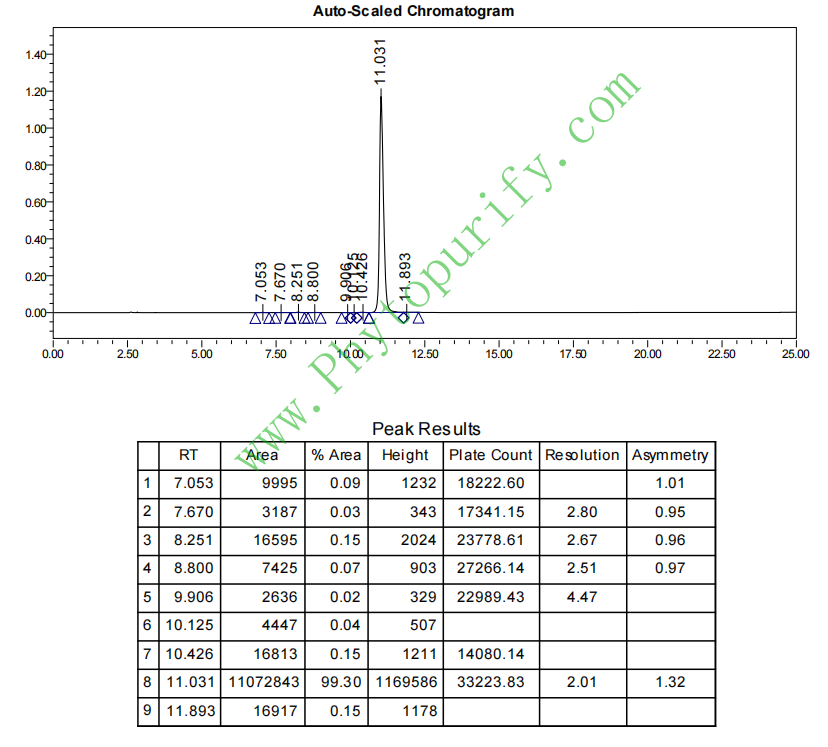
HPLC of Sennoside D
Storage conditions:Short-term storage at 2~8℃, long-term storage at -20 ~ -80℃
Sennoside D is a typical anthraquinone glycoside natural product, mainly found in Cassia angustifolia and its pods. As a widely used laxative herb in traditional Chinese medicine and herbal medicine, senna has been extensively studied for its significant laxative effect. Fanxie glycoside D, as one of its main active ingredients, plays a crucial role in regulating intestinal function, promoting intestinal peristalsis, and regulating intestinal water balance. In recent years, with the deepening of molecular pharmacology and pharmacokinetic research, the mechanism of action, molecular targets, and safety evaluation of senoside D have gradually become clear, providing a solid scientific foundation for its clinical application and new drug development.
This article aims to systematically review the chemical structure and physicochemical properties, plant sources and extraction methods, pharmacological activity and mechanism of action, pharmacological evaluation and pharmacokinetic characteristics, as well as the clinical application prospects and development trends of senoside D, in order to provide comprehensive and authoritative reference materials for relevant researchers.
The chemical structure of sennoside D belongs to the anthraquinone glycoside class, with a molecular formula of C42H38O20 and a molecular weight of 848.7630. Its structure consists of two anthraquinone units connected by glycosidic bonds to form a dimer, exhibiting typical multi hydroxyl and glycosidic bond characteristics of anthraquinone glycosides. The molecule contains multiple hydroxyl and glycoside groups, giving it high polarity and water solubility.
In terms of physical and chemical properties, the LogP value of senoside D is 0.6420, indicating its strong hydrophilicity and certain water solubility (solubility of approximately 0.7582 mg/mL). Its topological polar surface area (TPSA) is as high as 330.8900 Å ², reflecting the presence of a large number of polar groups in the molecule, which is conducive to the formation of hydrogen bonds and polar interactions with biomolecules. The low permeability of the blood-brain barrier suggests limited penetration ability in the central nervous system, reducing the risk of central toxicity. In addition, senoside D did not exhibit hERG channel inhibitory activity, and the Ames test result was 0.0, indicating a low risk of genetic toxicity and a good safety basis.
Fanxie glycoside D is mainly distributed in the legume plant Cassia angustifolia Vahl and its pods. Senna leaf is a perennial shrub native to India and surrounding areas, and is an important laxative herb in traditional Chinese medicine. Both its leaves and mature pods contain abundant anthraquinone glycosides, among which various isomers of senoside A, B, C, D coexist. However, senoside D has attracted much attention due to its unique pharmacological activity.
The extraction method usually uses water extraction or alcohol extraction combined with liquid-liquid separation technology. The specific process includes:
In recent years, new technologies such as ultrasound assisted extraction and microwave-assisted extraction have also been applied to the extraction of senoside D, significantly improving extraction efficiency and purity, and saving time and solvent usage.
The main pharmacological activity of sennoside D is focused on its laxative effect. As a stimulant laxative, it regulates intestinal function through multiple targets, promotes intestinal peristalsis and water secretion, and alleviates constipation symptoms.
Fanxie glycoside D is hydrolyzed by gut microbiota in the intestine and converted into active anthraquinone metabolites, such as rhein anthene. These metabolites stimulate the intestinal nervous system and epithelial cells, enhancing intestinal peristalsis and secretion function. Animal experiments have shown that senoside D can significantly shorten the intestinal transit time of mice and rats, increase the moisture content of intestinal contents, and improve the symptoms of constipation models.
Some studies have found that senoside D and its metabolites have certain anti-inflammatory activity, which can inhibit the expression of intestinal inflammatory factors and alleviate inflammatory reactions. In addition, its anthraquinone structure endows it with certain antioxidant capacity, which helps protect intestinal mucosa from oxidative stress damage.
In recent years, research on the regulation of gut microbiota balance and improvement of metabolic syndrome by senoside D has gradually increased, demonstrating its multi-target and multi effect pharmacological potential. However, the relevant mechanisms still need further clarification.
The laxative effect of senoside D is mainly achieved by regulating the water transport and electrolyte balance of intestinal epithelial cells. Its key molecular targets include:
CFTR (cystic fibrosis transmembrane conductance regulator)
CFTR is a chloride ion channel located on the membrane of intestinal epithelial cells, regulating the secretion of chloride ions and water in the intestinal lumen. Fanxie glycoside D and its metabolites can activate CFTR channels, promote chloride ion secretion, drive water into the intestinal lumen, increase the water content of intestinal contents, and promote defecation.
SLC9A3 (Sodium/Hydrogen Exchange Protein 3, NHE3)
SLC9A3 is involved in the reabsorption of sodium ions and water in the intestine. Fanxie glycoside D inhibits SLC9A3 activity, reduces the reabsorption of sodium ions and water, further increases intestinal lumen water, and exerts a laxative effect.
Aquaporins (AQP3, AQP4, AQP8)
Aquaporins play an important role in intestinal water transport. Fanxie glycoside D promotes intestinal water flow and balance, enhances intestinal water content, and improves constipation by regulating the expression and function of AQP3, AQP4, and AQP8.
In addition, the metabolites of senoside D can stimulate the enteric nervous system, promote smooth muscle contraction in the intestine, enhance intestinal peristalsis, and synergistically achieve the effect of diarrhea.
Fanxie glycoside D has a moderate molecular weight (848.7630) and high polarity (TPSA 330.89), with good water solubility (0.7582 mg/mL), but its high polarity and molecular weight limit its oral bioavailability. Its LogP value is 0.6420, indicating a moderate hydrophilic lipophilic balance, which is beneficial for intestinal absorption but not easy to penetrate the blood-brain barrier (BBB permeability is low), reducing the risk of central nervous system toxicity.
In terms of safety, sennoside D did not show hERG channel inhibition and the Ames genotoxicity test was negative, indicating a low risk of genotoxicity and good safety, making it suitable for long-term oral use.
After oral administration, senoside D is mainly hydrolyzed and converted into active anthraquinone metabolites in the gastrointestinal tract by β - glucosidase in the gut microbiota, which are the true pharmacological substances. The absorption of prototype sennoside D is limited and mainly acts locally in the intestinal lumen. Metabolites are partially absorbed into the bloodstream, then metabolized by the liver and excreted by the kidneys.
The local metabolism and functional characteristics of its intestinal tract determine that senoside D mainly exerts a local laxative effect, with lower systemic exposure and reduced occurrence of systemic side effects.
Fanxie glycoside D, as the main active ingredient of senna leaves, has been widely used in the treatment of constipation, especially for chronic functional constipation and postoperative intestinal function recovery. Its laxative effect is rapid and effective, suitable for short-term use.
In the future, with in-depth research on its mechanism of action and pharmacokinetics, senoside D is expected to enhance its oral bioavailability and targeting through structural optimization and formulation improvement, and expand its clinical application scope. In addition, the potential role of senoside D in regulating gut microbiota, anti-inflammatory and metabolic regulation provides new ideas for its application in intestinal diseases, metabolic diseases and other fields.
Meanwhile, the systematic evaluation of safety and long-term medication risks still needs to be strengthened, especially regarding the impact on gut microbiota and potential drug resistance issues, which require more clinical and basic research support.
Fanxie glycoside D, as a typical anthraquinone glycoside natural product, occupies an important position in the field of laxative therapy due to its unique chemical structure and good pharmacological activity. Its multi-target mechanism of action and good safety characteristics provide a solid foundation for clinical application. In the future, with the promotion of modern drug development technology, senoside D is expected to achieve wider clinical applications and new drug development, becoming an important model for natural product pharmacology research.
Continued in-depth basic and clinical research will further reveal its mechanism of action, optimize its pharmacokinetic properties, promote its application in the treatment of constipation and related intestinal diseases, and provide patients with safer and more efficient treatment options.
