


Product name: Wogonin
Synonym name: Vogonin
Catalogue No.: BP1453
Cas No.: 632-85-9
Formula: C16H12O5
Mol Weight: 284.267
Botanical Source: roots of Scutellaria baicalensis and from other plants
Physical Description: Yellow powder
Type of Compound: Flavonoids
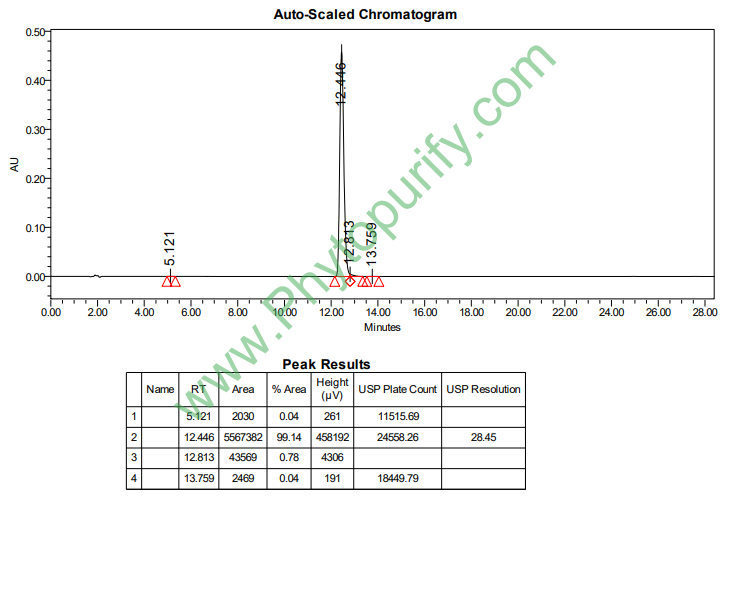
Purity: 95%~99%
Analysis Method: HPLC-DAD or/and HPLC-ELSD
Identification Method: Mass, NMR
Packing: Brown vial or HDPE plastic bottle
Storage: Store in a well closed container, protected from air and light. Put into refrigerate or freeze for long term storage.
Whenever possible, you should prepare and use solutions on the same day. However, if you need to make up stock solutions in advance, we recommend that you store the solution as aliquots in tightly sealed vials at -20℃. Generally, these will be useable for up to two weeks.
The product could be supplied from milligrams to grams, up to kilograms
Inquire for bulk scale.
Descriptions:
Wogonin is one major constituent of Scutellaria baicalensis, possesses potent anticancer activities , the activities are largely due to their abilities to scavenge oxidative radicals, to attenuate NF-kappaB activity, to inhibit several genes important for regulation of the cell cycle, to suppress COX-2 gene expression and to prevent viral infections. [1]
Wogonin and fisetin induce apoptosis in human promyeloleukemic cells, accompanied by a decrease of reactive oxygen species, and activation of caspase 3 and.endonuclease, induction of bax protein and suppression of Mcl-1 protein were detected in the process.[2]
Wogonin, baicalin, and baicalein are three major components of Scutellaria, they have anti-inflammatory activity against carrageenan-induced paw edema in rats, the baicalin exhibits the greatest inhibition activity.[3]
Wogonin can suppress the VEGF-stimulated migration and tube formation of human umbilical vein endothelial cells (HUVECs), also restrain VEGF-induced tyrosine phosphorylation of vascular endothelial growth factor receptor 2 (VEGFR2), strongly suggests that wogonin might be a promising antitumor drug.[4]
Wogonin induces apoptosis in RPMI 8226, a human myeloma cell line, by downregulating phospho-Akt and overexpressing Bax.[5]
References:
[1] Min L W. New therapeutic aspects of flavones: Cancer Treatment Reviews, 2009, 35(35):57-68.
[2] Lee W R, Shen S C, Lin H Y, et al. Biochem Pharmacol, 2002, 63(2):225-36.
[3] Chun-ChingLin, Den-EnShieh. Am J Chinese Med, 1996, 24(1):31-6.
[4] Na L, Ying G, Yun L, et al. Life Sci, 2008, 82(17-18):956-63.
[5] Zhang M, Liu L P, Chen Y, et al. Life Sci, 2013, 92(1):55-62.
[6] Lin D, Liang W. China Pharmacist, 2009, 12(08):1044-6.
HPLC of Wogonin
Storage conditions:Short-term storage at 2~8℃, long-term storage at -20 ~ -80℃
79.9000
2.4803
2.3534
.0369
4.7021
17.9324
Low
91.3577
2.2879
Yes
No
No
No
Yes
No
0.6
No
No
Yes
No
Natural products have always been an important treasure trove for innovative drug discovery, among which flavonoids have attracted much attention due to their wide range of biological activities. Wogonin, also known as 5,7-dihydroxy-8-methoxyflavone, is a characteristic monomethoxyflavone isolated from the roots of traditional Chinese medicine Scutellaria baicalensis Georgi. Since its structure was elucidated, baicalein has become a research hotspot in the fields of natural product pharmacology and medicinal chemistry due to its significant anti-inflammatory, antioxidant, antiviral, and particularly outstanding anti-tumor activities. Its CAS number is 632-85-9. Modern pharmacological research has constantly revealed that wogonin exerts its anti-tumor effect through multiple ways such as regulating cell cycle, inducing apoptosis, inhibiting invasion, metastasis and angiogenesis, and shows potential therapeutic value for breast cancer and other malignant tumors. This article aims to systematically review the chemical properties, pharmacological activities, molecular mechanisms of action, pharmacological evaluation, and clinical application prospects of baicalein, in order to provide comprehensive academic references for the in-depth research and development of this compound.
Hanhuangqin extract is a dihydroxy monomethoxy flavonoid, with its parent nucleus being a flavonoid (2-phenylchromatone-4-one). Its specific structure lies in the substitution of hydroxyl (- OH) at positions C-5 and C-7, while methoxy (- OCH3) is specifically located at position C-8. This unique substitution pattern is the key that distinguishes it from other flavonoids such as baicalein and apigenin, and deeply affects its physicochemical properties and biological activity.
From the analysis of physical and chemical properties, the molecular weight of baicalein is 284.27 g/mol. Its calculated lipid water partition coefficient (LogP) is about 2.48, indicating that it has moderate lipophilicity and is conducive to transmembrane transport. The topologically polar surface area (TPSA) is 79.9 Å ², which is relatively low due to the presence of only three hydrogen bond donors (two phenolic hydroxyl groups) and four hydrogen bond acceptors in its molecule. The experimental data shows that its water solubility is poor, about 0.0369 mg/mL, which to some extent limits its bioavailability. The preliminary safety assessment in vitro showed that the Ames test result was 0.6 (usually considered to be a potential mutagenic positive value>1.5), indicating a low risk of genetic toxicity; Meanwhile, there is no significant inhibitory effect on hERG potassium channels, indicating a lower potential risk of arrhythmia. However, its blood-brain barrier permeability is predicted to be 'low', indicating that it may have difficulty entering the central nervous system to exert its effects. These basic pharmacological parameters provide important basis for subsequent formulation improvement and structural optimization.
Hanhuangqin extract mainly comes from the dried roots of Scutellaria baicalensis Georgi, a plant in the family Lamiaceae. It is one of the key active ingredients of Scutellaria baicalensis and its main formulas, such as Huanglian Jiedu Tang and Gegen Qinlian Tang. In addition, there are also small amounts present in other plants of the Scutellaria genus, such as Scutellaria barbata D. Don.
The extraction of baicalein from Scutellaria baicalensis roots usually follows the general extraction strategy for flavonoids. Traditional methods include solvent extraction, which commonly uses different concentrations of ethanol or methanol for hot reflux or ultrasound assisted extraction, utilizing the good solubility of baicalein in organic solvents. Subsequently, a series of separation and purification techniques are required to obtain high-purity monomers from complex plant crude extracts, such as macroporous adsorption resin column chromatography (such as AB-8, D101 resin) for preliminary enrichment, followed by fine separation using silica gel column chromatography, polyamide column chromatography, and high-performance liquid chromatography (HPLC) or preparative thin layer chromatography (PTLC). Modern extraction techniques such as supercritical CO2 fluid extraction, microwave-assisted extraction, and high-speed countercurrent chromatography have also been applied to improve extraction efficiency and product purity. The optimization of extraction process usually focuses on key parameters such as solvent type, concentration, solid-liquid ratio, temperature, and time to balance extraction rate and cost.
Hanhuangqin extract exhibits a wide range of pharmacological activities, with anti-tumor effects being its most extensively studied area.
1. Antitumor activity:
A large number of in vitro and in vivo studies have confirmed that wogonin has significant proliferation inhibition and apoptosis promoting effects on many tumor cell lines, especially for breast cancer. In the breast cancer model, wogonin can effectively inhibit the growth of MCF-7, MDA-MB-231 and other cell subtypes in a concentration and time-dependent manner. Its anti-tumor effect is not limited to inducing cell apoptosis, but also includes inhibiting cell migration, invasion, epithelial mesenchymal transition (EMT), as well as inhibiting tumor angiogenesis.
2. Anti inflammatory and immune regulatory activity:
Hanhuangqin extract exerts a powerful anti-inflammatory effect by inhibiting key inflammatory signaling pathways such as nuclear factor kappa B (NF - κ B), signal transduction and transcriptional activation factor 3 (STAT3), downregulating the expression of cyclooxygenase-2 (COX-2), inducible nitric oxide synthase (iNOS), and various pro-inflammatory cytokines (such as TNF - α, IL-1 β, IL-6). Good results have been shown in various animal models of acute and chronic inflammation, such as arthritis, colitis, and sepsis.
3. Neuroprotective and Cardiovascular Protective Activities:
Research has shown that baicalein has the characteristics of antioxidant stress, inhibition of neuroinflammation, and anti apoptosis, and exhibits neuroprotective potential in animal models of Alzheimer's disease, Parkinson's disease, and cerebral ischemia-reperfusion injury. In addition, it can protect the cardiovascular system by protecting vascular endothelial function, inhibiting atherosclerotic plaque formation and myocardial cell apoptosis.
4. Antiviral and antibacterial activity:
Hanhuangqin extract has a certain inhibitory effect on influenza virus, respiratory syncytial virus, Epstein Barr virus, etc. Although its antibacterial activity is not as prominent as its anti-tumor and anti-inflammatory effects, it also shows a certain inhibitory effect on some drug-resistant strains.
The pharmacological effects of baicalein, especially its anti-tumor effect, are achieved by intervening in multiple cellular signaling pathways and molecular targets, reflecting the multi-target nature of natural products. In breast cancer and other cancer models, the key mechanisms include:
1. Inducing cell cycle arrest and apoptosis:
Hanhuangqin extract can induce mitochondrial apoptosis by upregulating pro apoptotic proteins (such as Bax, Bid) and downregulating the expression of anti apoptotic proteins (such as Bcl-2, Bcl xL, Mcl-1). It can also block the cell cycle in G1 or G2/M phase by inhibiting cyclin dependent kinases such as CDK8.
2. Inhibit key signaling pathways:
* STAT3 pathway: STAT3 is an important target of baicalein. Hanhuangqin extract can inhibit the phosphorylation (activation) of STAT3, block its nuclear translocation and the transcription of downstream target genes (such as Survivor, Cyclin D1), thereby inhibiting tumor cell proliferation, survival, and angiogenesis.
* Wnt/β - catenin pathway: Hanhuangqin extract has been confirmed to be an inhibitor of the Wnt signaling pathway. It can promote the degradation of β - catenin, inhibit its nuclear accumulation, thereby downregulating target genes such as c-Myc and Cyclin D1, inhibiting tumor growth and stem cell characteristics.
* AMPK pathway: Hanhuangqin extract can activate AMP activated protein kinase (AMPK), an energy receptor. The activation of AMPK inhibits the mammalian target protein of rapamycin (mTOR) pathway, induces autophagy, regulates metabolic reprogramming, and has an inhibitory effect on tumor growth.
* PI3K/Akt pathway: Hanhuangqin extract can inhibit the phosphorylation of phosphatidylinositol 3-kinase (PI3K) and its downstream effector molecule Akt, which is closely related to cell survival, proliferation, and metabolism.
3. Inhibit tumor invasion and metastasis:
Hanhuangqin extract inhibits the degradation ability of tumor cells to extracellular matrix by downregulating the expression and activity of matrix metalloproteinases such as MMP-2 and MMP-9. At the same time, it can upregulate tissue metalloproteinase inhibitors (TIMPs) and reverse the EMT process (such as increasing E-cadherin expression and reducing N-cadherin and vimentin expression), effectively inhibiting tumor invasion and metastasis.
4. Reversing multidrug resistance (MDR):
In breast cancer and other tumors, wogonin shows the potential to reverse multidrug resistance mediated by ATP binding cassette (ABC) transporters such as P-glycoprotein (ABCB1/MDR1) and breast cancer resistance protein (ABCG2/BCRP). It may increase the accumulation of chemotherapy drugs in cells and restore tumor cell sensitivity to chemotherapy by inhibiting the function or expression of these efflux pumps.
5. Regulating estrogen receptor signaling:
For estrogen receptor positive (ER+) breast cancer, wogonin showed selective estrogen receptor modulator (SERM) like characteristics. It can interact with estrogen receptor beta (ESR2) to regulate downstream gene transcription, thereby inhibiting estrogen dependent tumor cell growth.
Although baicalein has significant in vitro activity, its medicinal properties still face challenges, mainly due to its poor solubility and low bioavailability.
Pharmacokinetic study Based mainly on animal experiments, it has been shown that the oral absorption of baicalein is rapid but incomplete, and there is a significant first pass effect. It is widely distributed in the body, but has a low blood-brain barrier permeability. Hanhuangqin extract undergoes extensive metabolic transformations in the body, including glucuronidation and sulfation binding reactions (mainly at C-7 hydroxyl), as well as demethylation (C-8 methoxy) to produce baicalin. These metabolic processes are mainly mediated by uridine diphosphate glucuronosyltransferases (UGTs) and cytochrome P450 enzymes (CYPs) in the liver, resulting in low plasma concentrations and short half lives of their prototype drugs, which are mainly excreted through urine and feces.
To enhance its medicinal properties, researchers have employed various strategies:
1. Structural modification: By chemically synthesizing its derivatives or prodrugs, such as preparing phosphate esters, amino acid esters, or PEGylated derivatives, to improve water solubility and metabolic stability.
2. New drug delivery system: Using nanotechnology to prepare baicalein into liposomes, nanoparticles, micelles, solid dispersions, or cyclodextrin inclusion complexes. These nanocarriers can effectively improve the solubility of drugs, protect them from premature metabolism, prolong circulation time, enhance targeted accumulation at tumor sites (through enhanced permeation and retention effects or active targeted modifications), thereby significantly improving their in vivo anti-tumor efficacy and reducing overall toxicity.
3. Joint administration: The combination of baicalein with existing chemotherapy drugs such as doxorubicin, paclitaxel, and cisplatin has shown synergistic effects and reversal of drug resistance, providing a theoretical basis for clinical combination therapy.
Hanhuangqin extract, as a natural small molecule with multiple targets and functions, has broad development prospects in fields such as tumors, inflammatory diseases, and neurodegenerative diseases.
In the field of tumor treatment Its prospects are particularly prominent:
* As a chemotherapy sensitizer or resistance reversal agent: Combined with conventional chemotherapy drugs, it is expected to overcome tumor multidrug resistance and improve chemotherapy efficacy.
* As a supplement to targeted therapy: Its action on traditional targeted drugs such as STAT3 and Wnt, which are rarely involved in "non pharmacological" pathways, may provide a new option for combination targeted therapy.
* Prevention and adjuvant therapy: Its relatively low toxicity and anti-inflammatory, antioxidant properties make it potentially valuable in tumor prevention and adjuvant rehabilitation after radiotherapy and chemotherapy.
Challenges and Future Directions Faced:
1. Improved bioavailability: Developing efficient, stable, and industrially suitable nano delivery systems is the key to promoting their clinical application.
2. In depth mechanism research: Further use of chemical biology methods such as affinity fishing and molecular probes is needed to identify its direct target and elucidate its precise molecular mechanism.
3. Preclinical and clinical studies: Systematic and standardized GLP toxicological evaluation needs to be completed, and a reasonable clinical research scheme needs to be designed to explore the safety and effectiveness of it as a single drug or adjuvant drug in specific patient groups (such as triple negative breast cancer, drug-resistant breast cancer).
4. Structural optimization and synthetic biology: Based on structure-activity relationship research, design derivatives with higher activity, better selectivity, and superior pharmacokinetic properties; Using synthetic biology techniques to construct a microbial cell factory for high-yielding baicalein, addressing the limitations of plant sources.
Hanhuangqin extract is a star flavonoid compound derived from the traditional Chinese medicine Scutellaria baicalensis. With its unique chemical structure and rich pharmacological activity, it occupies an important position in modern pharmacological research. Its role in anti-tumor, especially in breast cancer, through intervention in multiple key pathways such as AMPK, STAT3 and Wnt, it can induce apoptosis, inhibit metastasis and reverse drug resistance, demonstrating the advantages of multi target therapy. Although its poor solubility and bioavailability are currently the main bottlenecks in clinical translation, this challenge is gradually being overcome through the intervention of new delivery strategies such as nanotechnology. In the future, with a deeper understanding of the mechanism of action of baicalein, the continuous development of new derivatives and drug delivery systems, and the advancement of rigorous clinical research, baicalein is expected to move from the laboratory to clinical practice, providing a new and effective natural choice for the treatment of major diseases such as cancer, fully reflecting the value of modernization and internationalization of traditional Chinese medicine.
