Introduction/Overview
Natural products have long been an important source of innovative drug discovery, with active ingredients from animal sources receiving much attention due to their unique chemical structure and significant biological activity. As an important source of traditional Chinese medicine such as toad venom and toad skin, toads contain a large number of structurally diverse and highly active steroid compounds in their skin secretions, collectively known as toad toxins. Pseudobufareogenin (CAS: 17008-69-4) is a member of this family of compounds. Although the background of its activity is not yet clear in early research, modern pharmacological studies have preliminarily revealed its enormous potential in the field of anti-tumor. As a steroid compound derived from toads, the chemical skeleton of pseudo isoxabufogenin is similar to that of cardiac steroids and toad venom ligands, indicating that it may exert pharmacological effects by intervening in key cellular life processes. In recent years, with the deepening understanding of the molecular mechanisms of tumor occurrence and development, as well as the rise of multi-target treatment strategies, pseudo isoxacinin has gradually emerged from numerous natural products due to its potential anti-tumor activity involving multiple key targets (such as MCL1, BCL2, STAT3, etc.), becoming an emerging hotspot in tumor pharmacology research. The purpose of this article is to systematically review the chemical characteristics, sources, pharmacological activities, mechanisms of action, and pharmacological properties of pseudo isoxacinin, in order to provide comprehensive academic references for the in-depth research and potential drug development of this compound.
Chemical structure and physicochemical properties
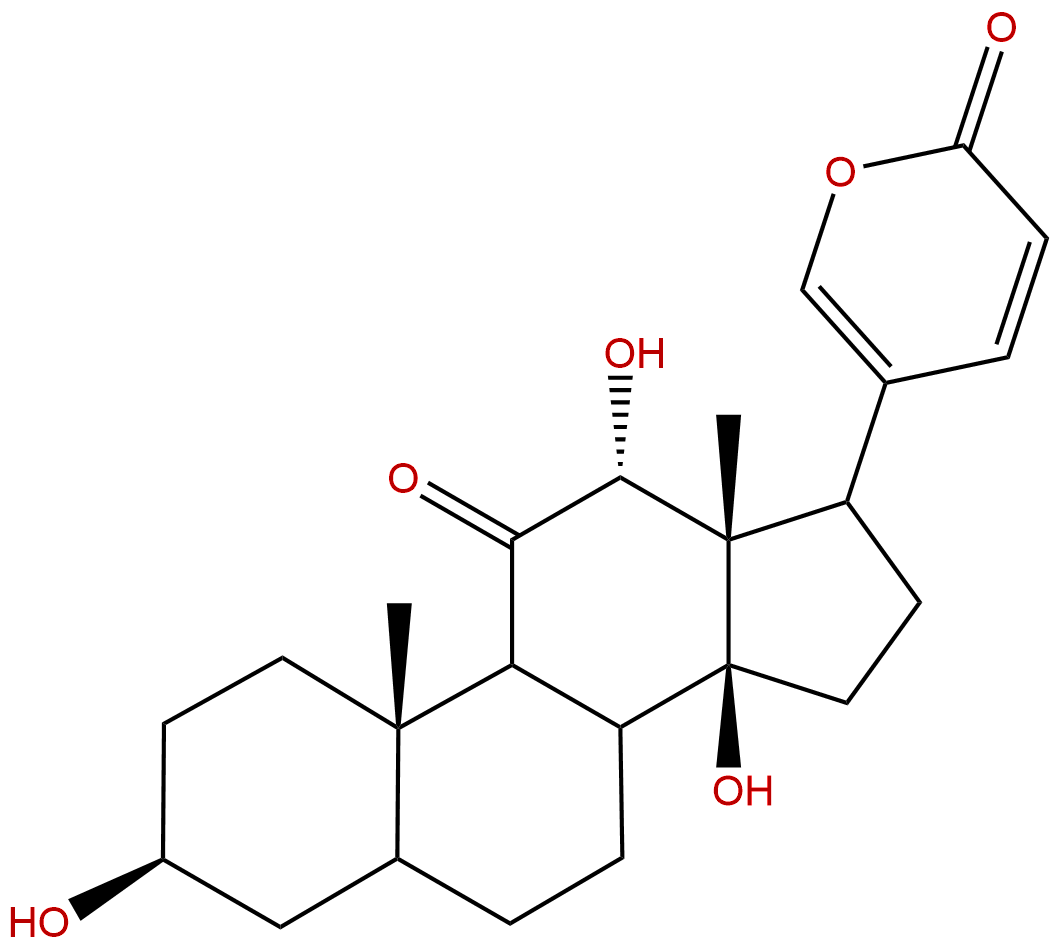
Pseudo Yi Sha Chan Poison Essence is a typical toad poison ligand steroid compound. Its basic skeleton is cyclopentane and phenanthrene, belonging to C24 steroid derivatives. Compared with common cardiac steroids such as digoxin, the bufotoxin ligand group usually has a β - hydroxyl group and a β - pyranone ring (α - pyranone ring) attached to the C-14 and C-3 positions of the steroid nucleus, respectively, which is its characteristic structural feature. The specific structural differences of pseudo Yi Sha Chan poison essence are reflected in the types and positions of its substituents, and these subtle structural modifications directly determine its unique physicochemical properties and biological activity.
According to its pharmacological parameters, the molecular weight of pseudo isoxacin is 416.5140 g/mol, which belongs to the category of small molecule compounds. The logarithmic value of its lipid water partition coefficient (LogP) is 1.8138, indicating that the compound has a certain degree of lipophilicity, but has not reached a highly hydrophobic level, which is beneficial for its penetration into biofilms while also retaining a certain water solubility basis. The theoretical polar surface area (TPSA) is 107.9700 Å ², which reflects the surface area occupied by polar atoms (such as oxygen atoms) in the molecule, indicating the existence of multiple hydrogen bonding sites in the molecule, such as hydroxyl and carbonyl groups, which are crucial for their interaction with target proteins. The calculated water solubility is 0.0387 mg/mL, which belongs to the slightly soluble level, and this may be a challenge that needs to be overcome in its subsequent formulation development. In the prediction of absorption, distribution, metabolism, and excretion (ADME), the ability of pseudo isoxacin to penetrate the blood-brain barrier was evaluated as "low", which means it may not easily enter the central nervous system. For the treatment of peripheral tumors, this may reduce the potential risk of neurotoxicity. In addition, preliminary toxicity predictions indicate that the risk of inhibiting hERG potassium channels is' no ', which reduces the potential cardiotoxicity risk of inducing QT interval prolongation and apical torsion type ventricular tachycardia. The Ames test predicted a value of 0.0, indicating that it may not have direct genetic toxicity mutagenesis potential. These preliminary pharmacological parameters depict a relatively positive starting point for the subsequent development of pseudo isoxacin.
Plant sources and extraction methods
Pseudo Yi Sha Chan Poison Essence is not derived from plants, but mainly isolated from toads. Common sources include the Chinese toad(Bufo gargarizans)And the black eyed toad(Duttaphrynus melanostictus)Wait. The ear glands, skin gland secretions (i.e. toad venom), and dried whole (toad skin) of these toads are traditional raw materials for extracting active steroid compounds.
Its extraction and separation is a complex multi-step process that combines traditional solvent extraction and modern chromatographic separation techniques. The typical process is as follows:
1. Raw material pretreatment Collect toad venom or dried toad skin, crush into coarse powder.
2. Solvent extraction Common organic solvents (such as methanol, ethanol, chloroform, or mixed solvents of different proportions) are used for cold soaking or heating reflux extraction to dissolve lipophilic components, including various bufotalin ligands such as pseudo isoxabufotalin, from the biological matrix.
3. Preliminary enrichment After vacuum concentration of the extract, it may be preliminarily grouped through liquid-liquid extraction (such as extraction with petroleum ether, ethyl acetate, n-butanol, etc.), and pseudo isoxacinin is mostly enriched in the moderately polar ethyl acetate fraction.
4. chromatographic separation This is a key step in obtaining high-purity pseudo Xenopus laevis venom. Silica gel column chromatography is commonly used for preliminary separation, using solvent systems of different polarities (such as chloroform methanol gradient elution) to separate complex mixtures into multiple streams. Subsequently, the fraction containing the target compound is further purified using techniques such as reverse phase high performance liquid chromatography (RP-HPLC), preparative thin layer chromatography (PTLC), or medium pressure liquid chromatography (MPLC) until the compound is chromatographically pure.
5. Identification and characterization The final pure product was structurally confirmed by techniques such as nuclear magnetic resonance (NMR, including 1H-NMR, 13C-NMR, 2D-NMR), mass spectrometry (MS), infrared spectroscopy (IR), and X-ray single crystal diffraction (if crystals can be obtained).
Due to the limited natural sources and complex extraction and separation processes, there are currently few reports on the chemical synthesis or semi synthesis of pseudo isoxacin, which to some extent limits its large-scale biological research and drug development. In the future, developing efficient and economical synthetic routes will be an important direction for promoting research on this compound.
Pharmacological activity research
The core pharmacological activity of Pseudo Yi Sha Chan Poison Essence focuses on the field of anti-tumor. Although little is known about its activity background in early studies, in recent years, the accumulation of in vitro and in vivo experimental evidence has revealed its significant inhibitory activity against various human tumor cell lines.
In vitro anti-tumor activity: Studies have shown that Pseudobufotalin can inhibit the proliferation of a variety of cancer cells in a dose-dependent and time-dependent manner, including but not limited to breast cancer (such as MCF-7), liver cancer (such as HepG2), lung cancer (such as A549), colon cancer (such as HCT-116) and leukemia (such as HL-60) cell lines. Its half maximal inhibitory concentration (IC50) is usually at the micromolar (μ M) or even sub micromolar level, exhibiting strong cytotoxicity or cell growth inhibitory activity. In addition to inhibiting proliferation, studies have also found that pseudo isoxacinin can induce apoptosis in tumor cells, manifested by morphological changes such as cell shrinkage and nuclear fragmentation, phosphatidylserine eversion, and activation of caspase family proteins.
In vivo anti-tumor activity In animal models of transplanted tumors (such as subcutaneous xenograft models in nude mice), the administration of pseudo isoxacinin (usually by intraperitoneal injection or gavage) can significantly inhibit the growth of tumor tissue, reduce tumor volume and weight, and in some models, the effect is better or similar to some clinical chemotherapy drugs. Meanwhile, preliminary toxicological observations indicate that at effective doses, the damage to the main organs of experimental animals (such as heart, liver, and kidneys) is relatively controllable, but the specific treatment window (the range between effective and toxic doses) still needs to be systematically evaluated.
Other potential activities Given its steroid mother nucleus structure, pseudo isoxacin may also possess other biological activities. For example, some bufotoxin based compounds have anti-inflammatory, analgesic, and immunomodulatory effects. Although there are currently few direct research reports on the effects of pseudo Xenomorpha frutescens in these areas, its structural similarity suggests potential pharmacological space worth exploring.
Mechanism of action and molecular targets
The anti-tumor effect of pseudo Yi Sha Chan poison essence is not achieved through a single pathway, but involves a complex multi-target network, which is closely related to its ability to intervene in multiple key signaling pathways and cellular processes. According to existing research clues, its mechanism of action mainly revolves around the following aspects:
-
Inducing cell apoptosis and regulating Bcl-2 family proteins Apoptosis escape is one of the characteristic features of tumor cells. Pseudo Yi Sha Chan Poison Essence can upregulate the expression of pro apoptotic proteins such as Bax and Bak, while downregulating anti apoptotic proteins BCL2 and MCL1 The expression. MCL1 is an important survival factor in the Bcl-2 family, overexpressed in many tumors and associated with drug resistance. The inhibition of MCL1 by pseudo Yi Sha Chan poison essence may directly weaken the survival ability of tumor cells and promote the occurrence of mitochondrial pathway apoptosis.
-
Inhibition of STAT3 signaling pathway Signal Transduction and Transcription Activation Factor 3(STAT3)STAT3 is a key oncogenic transcription factor that continuously activates and promotes cell proliferation, survival, angiogenesis, and immune escape. Research has shown that pseudo isoxacin can inhibit the phosphorylation (activation) of STAT3, prevent its nuclear translocation, and inhibit the transcription of downstream target genes (such as Cyclin D1, Bcl-2, VEGF), thereby exerting various anti-tumor effects.
-
Intervention in cell cycle and inhibition of topoisomerase Pseudo Xenopus laevis toxin can cause cell cycle arrest, commonly in the G2/M or S phase. This is not related to TOP1 and TOP2A The potential inhibitory effect is related. Topoisomerase is a key enzyme in DNA replication and transcription processes. Inhibiting its activity can lead to DNA damage and replication fork arrest, thereby activating cell cycle checkpoints or inducing apoptosis.
-
Inhibit tumor invasion and metastasis Tumor metastasis is the main cause of cancer treatment failure. Pseudo Yi Sha Chan Poison Essence can downregulate matrix metalloproteinases MMP2 Expression and activity. MMP2 plays a central role in tumor invasion and metastasis by degrading the extracellular matrix. Inhibiting MMP2 helps to block the migration and infiltration ability of tumor cells.
-
Regulating the MAPK/ERK signaling pathway Mitogen activated protein kinase 1(MAPK1 ERK2, also known as ERK2, is a key kinase that regulates cell growth and differentiation. Pseudo isoxacinin may interfere with the proliferation signal of tumor cells by affecting the activation state of this pathway.
-
Affects hormone related pathways: For hormone dependent tumors (such as breast cancer), Pseudobufotalin showed a significant effect on estrogen receptor ESR1 The regulatory potential may act as an estrogen receptor modulator. Meanwhile, it has an effect on aromatase CYP19A1 The potential impact may interfere with the biosynthesis of estrogen in tumor tissue, thereby inhibiting the growth of hormone dependent tumors.
-
Inhibition of hypoxia inducible factor In the hypoxic microenvironment of tumors,HIF1A Stability and activation are key factors in promoting angiogenesis and metabolic reprogramming. Pseudo Yi Sha Chan Poison Essence may disrupt tumor adaptation by inhibiting the activity or expression of HIF1A.
In summary, pseudo Yi Sha Chan poison essence forms a synergistic anti-tumor network by simultaneously acting on multiple targets in apoptosis regulation, signal transduction, cell cycle, invasion and metastasis, providing a theoretical possibility for overcoming the resistance of single target drugs.
Evaluation of drug properties and pharmacokinetics
Based on the predicted parameters mentioned earlier, pseudo isoxacin has shown some favorable characteristics in terms of medicinal properties, but there are also clear challenges.
Advantage:
* Security potential Predicting the absence of hERG inhibition and Ames mutagenicity provides preliminary positive signals for its cardiac safety and genetic toxicity risk.
* Moderate lipophilicity A LogP value of approximately 1.8 is beneficial for membrane penetration and oral absorption (if solubility issues can be resolved).
* Peripheral distribution tendency Low blood-brain barrier permeability may reduce the risk of central nervous system side effects.
Challenges and unknowns:
1. Solubility and oral bioavailability The extremely low water solubility (0.0387 mg/mL) is the primary obstacle to its drug development. Low solubility usually leads to poor oral absorption and low bioavailability. Future formulation development needs to focus on addressing this issue, and strategies may include: making prodrugs to increase hydrophilicity, using nano formulations (such as liposomes, nanocrystals, polymer micelles), solid dispersions, or cyclodextrin inclusion complexes, etc.
2. Lack of pharmacokinetic (PK) data At present, there is almost no experimental data on the absorption, distribution, metabolism, and excretion process of pseudo Xenopus laevis venom in the body. It is necessary to systematically study its plasma concentration time curve, tissue distribution characteristics, main metabolites and metabolic enzymes (such as CYP450 enzyme system), and excretion pathways in animal models. These pieces of information are crucial for determining dosing regimens, evaluating potential drug interactions, and toxicity.
3. The treatment window needs to be clearly defined Although in vivo experiments have shown anti-tumor effects, systematic toxicology studies (acute toxicity, long-term toxicity, reproductive toxicity, etc.) have not yet been conducted. Clarifying its maximum tolerated dose (MTD) and effective therapeutic dose is the basis for evaluating its clinical feasibility.
4. Potential digitalis like toxicity Due to its structural similarity to cardiac steroids, it is necessary to be highly vigilant about its potential inhibition of Na+/K+- ATPase, which can lead to cardiac toxicity similar to digitalis poisoning (such as arrhythmia). This needs to be closely monitored in subsequent preclinical safety evaluations.
Clinical application prospects and prospects
As a multi-target anti-tumor natural product, pseudo Yi Sha Chan poison essence has broad clinical application prospects, but the road is long and full of challenges.
Potential application directions:
1. Development of anti-tumor drugs The most direct prospect is the development of new anti-tumor candidate drugs. Especially suitable for malignant tumors that are resistant to existing chemotherapy drugs (such as topoisomerase inhibitors) or have abnormal activation of STAT3 and Bcl-2/Mgl-1 signaling pathways. It can be used as a single drug or in combination with existing chemotherapy, targeted drugs, immunotherapy to enhance efficacy or reverse drug resistance.
2. lead optimization Its steroid skeleton can serve as an excellent starting point for pharmaceutical chemical optimization. Through structural modification, the aim is to improve its water solubility, target selectivity, and reduce potential cardiac toxicity, thereby obtaining derivatives or analogues with better drug properties.
3. Research on Modernization of Traditional Chinese Medicine As one of the active ingredients in toad venom or toad skin, elucidating the mechanism of action of pseudo Yi Sha Chan toxin essence can help explain the anti-tumor effects of these traditional Chinese medicines at the molecular level, promote the standardization and internationalization of Chinese medicine.
Future research focus and prospects:
1. In depth mechanism research At present, the role of most targets is still "related" or "potential", and it is necessary to use technologies such as gene knockout/knockdown, reporter genes, co crystallization, surface plasmon resonance, etc. to directly verify the interaction mode, binding sites, and affinity between pseudo isoxacinin and key targets such as MCL1, STAT3, TOP1, etc.
2. Systematic pharmacokinetics and toxicology research This is the necessary path to promote its clinical translation. It is necessary to complete preclinical pharmacokinetic and safety evaluation studies that comply with regulations, and obtain comprehensive ADME and toxicity data.
3. Innovative formulation research and development In response to the bottleneck of poor solubility, actively developing new drug delivery systems, such as targeted nanomaterials, can not only improve bioavailability, but also potentially achieve targeted delivery to tumor sites, enhance efficacy, and reduce systemic toxicity.
4. Explore combination therapy strategies Based on its multi-target characteristics, designing a reasonable combination therapy plan and exploring synergistic effects with immune checkpoint inhibitors, other signaling pathway inhibitors, etc. is an important direction for future translational research.
5. Expand the field of diseases In addition to tumors, exploring the application value of pseudo isoxacinin in related fields based on the role of STAT3, MAPK and other targets in inflammation and autoimmune diseases is also worth paying attention to.
Conclusion
Pseudo Yi Sha Chan Poison Essence, a steroid compound derived from toads with unknown activity background, is gradually unveiling its mysterious veil with the deepening of modern pharmacological research. The existing evidence clearly indicates that it is a potential lead compound with multi-target anti-tumor activity, which can inhibit tumors by intervening in multiple key biological processes such as apoptosis, signal transduction, cell cycle, and invasion and metastasis. Its relatively favorable preliminary drug prediction parameters provide confidence for its further development. However, low water solubility, unknown pharmacokinetic characteristics, and potential risks of cardiac toxicity pose obstacles that must be overcome on its path to drug conversion. In the future, through interdisciplinary collaboration, combined with systematic research in medicinal chemistry, pharmacy, pharmacology, and toxicology, the mechanism of action will be thoroughly elucidated, its structure or dosage form will be optimized, and its fate and safety in vivo will be comprehensively evaluated. Pseudo isoxacinin is expected to transform from an interesting natural molecule into a new weapon against malignant tumors, and also contribute to interpreting the modern scientific connotation of traditional animal medicine. The research process once again confirms the irreplaceable value of natural products in innovative drug discovery.