


Product name: Lycopene
Synonym name: Tomato lycopene
Catalogue No.: BP0901
Cas No.: 502-65-8
Formula: C40H56
Mol Weight: 536.888
Botanical Source: Lycopersicon esculentum Mill.
Physical Description:
Type of Compound: Miscellaneous
Purity: 95%~99%
Analysis Method: HPLC-DAD or/and HPLC-ELSD
Identification Method: Mass, NMR
Packing: Brown vial or HDPE plastic bottle
Storage: Store in a well closed container, protected from air and light. Put into refrigerate or freeze for long term storage.
Whenever possible, you should prepare and use solutions on the same day. However, if you need to make up stock solutions in advance, we recommend that you store the solution as aliquots in tightly sealed vials at -20℃. Generally, these will be useable for up to two weeks.
The product could be supplied from milligrams to grams
Inquire for bulk scale.
Description:
Lycopene is the pigment principally responsible for the characteristic deep-red color of ripe tomato fruits and tomato products. Lycopene is an antioxidant scavenger, hypolipaemic agent, inhibitor of pro-inflammatory and pro-thrombotic factors, thus potentially of benefit in cardiovascular disease (CVD). Lycopene may play a role in the prevention of Renal cell carcinoma, it also may play a role against obesity-related complications.
References:
Clin Exp Pharmacol Physiol. 2015 Jun;42(6):632-9.
Lycopene inhibits cyclic strain-induced endothelin-1 expression through the suppression of reactive oxygen species generation and induction of heme oxygenase-1 in human umbilical vein endothelial cells.
Lycopene is the most potent active antioxidant among the major carotenoids, and its use has been associated with a reduced risk for cardiovascular disease (CVD). This study investigated the effects of Lycopene on cyclic strain-induced ET-1 gene expression in human umbilical vein endothelial cells (HUVECs) and identified the signal transduction pathways that are involved in this process.
METHODS AND RESULTS:
Cultured HUVECs were exposed to cyclic strain (20% in length, 1 Hz) in the presence or absence of Lycopene. Lycopene inhibited strain-induced ET-1 expression through the suppression of reactive oxygen species (ROS) generation through attenuation of p22(phox) mRNA expression and NAD(P)H oxidase activity. Furthermore, Lycopene inhibited strain-induced ET-1 secretion by reducing ROS-mediated extrace-llular signal-regulated kinase (ERK) phosphorylation. Conversely, Lycopene treatment enhanced heme oxygenase-1 (HO-1) gene expression through the activation of phosphoinositide 3-kinase (PI3K)/Akt pathway, followed by induction of the nuclear factor erythroid 2-related factor 2 (Nrf2) nuclear translocation; in addition, HO-1 silencing partially inhibited the repressive effects of Lycopene on strain-induced ET-1 expression.
CONCLUSIONS:
In summary, our study showed, for the first time, that Lycopene inhibits cyclic strain-induced ET-1 gene expression through the suppression of ROS generation and induction of HO-1 in HUVECs.Therefore, this study provides new valuable insight into the molecular pathways that may contribute to the proposed beneficial effects of Lycopene on the cardiovascular system.
Ultrason Sonochem. 2015 Nov;27:586-591.
Effect of high power low frequency ultrasound processing on the stability of lycopene.
The stability of Lycopene was evaluated after application of high power low frequency ultrasound.
METHODS AND RESULTS:
The study was carried out on a solution containing pure Lycopene to evaluate the direct effect of ultrasound on Lycopene and on tomato purée to evaluate the direct and indirect effects of ultrasound application within a food matrix. Power densities ranging from 55 to 5000 W/L and temperatures ranging from 23°C (ambient) to 60°C were evaluated. The experiments on pure Lycopene showed that the application of ultrasound did not have any direct effect over Lycopene. However, the retention of Lycopene in tomato puree has decreased indicating an indirect effect on Lycopene stability caused by high concentration of hydrogen peroxide and the activation of peroxidase enzymes leading to the reduction of ascorbic acid and its regenerative action towards Lycopene.
Curr Med Chem. 2011;18(8):1146-63.
Lycopene and cardiovascular diseases: an update.
Cardiovascular disease (CVD) is the leading cause of death in Western societies and accounts for up to a third of all deaths worldwide. In comparison to the Northern European or other Western countries, the Mediterranean area has lower rates of mortality from cardiovascular diseases and cancer, and this is attributed, at least in part, to the so-called Mediterranean diet, which is rich in plantderived bioactive phytochemicals. Identification of the active constituents of the Mediterranean diet is therefore crucial to the formulation of appropriate dietary guidelines.
METHODS AND RESULTS:
Lycopene is a natural carotenoid found in tomato, an essential component of the Mediterranean diet, which, although belonging to the carotenoid family, does not have pro-vitamin A activity but many other biochemical functions as an antioxidant scavenger, hypolipaemic agent, inhibitor of pro-inflammatory and pro-thrombotic factors, thus potentially of benefit in CVD. In particular, the review intends to conduct a systematic analysis of the literature (epidemiological studies and interventional trials) in order to critically evaluate the association between Lycopene (or tomato products) supplementation and cardiovascular diseases and/or cardiovascular disease risk factors progression, and to prepare provision of evidence-based guidelines for patients and clinicians. Several reports have appeared in support of the role of Lycopene in the prevention of CVD, mostly based on epidemiological studies showing a dose-response relationship between Lycopene and CVD. A less clear and more complex picture emerges from the interventional trials, where several works have reported conflicting results.
CONCLUSIONS:
Although many aspects of Lycopene in vivo metabolism, functions and clinical indications remain to be clarified, supplementation of low doses of Lycopene has been already suggested as a preventive measure for contrasting and ameliorating many aspects of CVD.
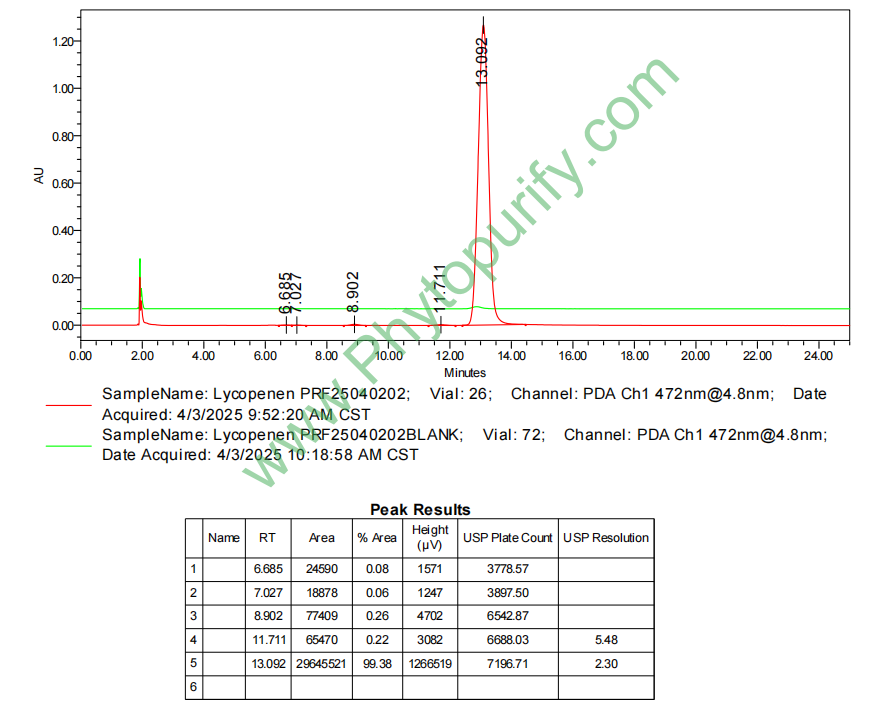
HPLC of Lycopene
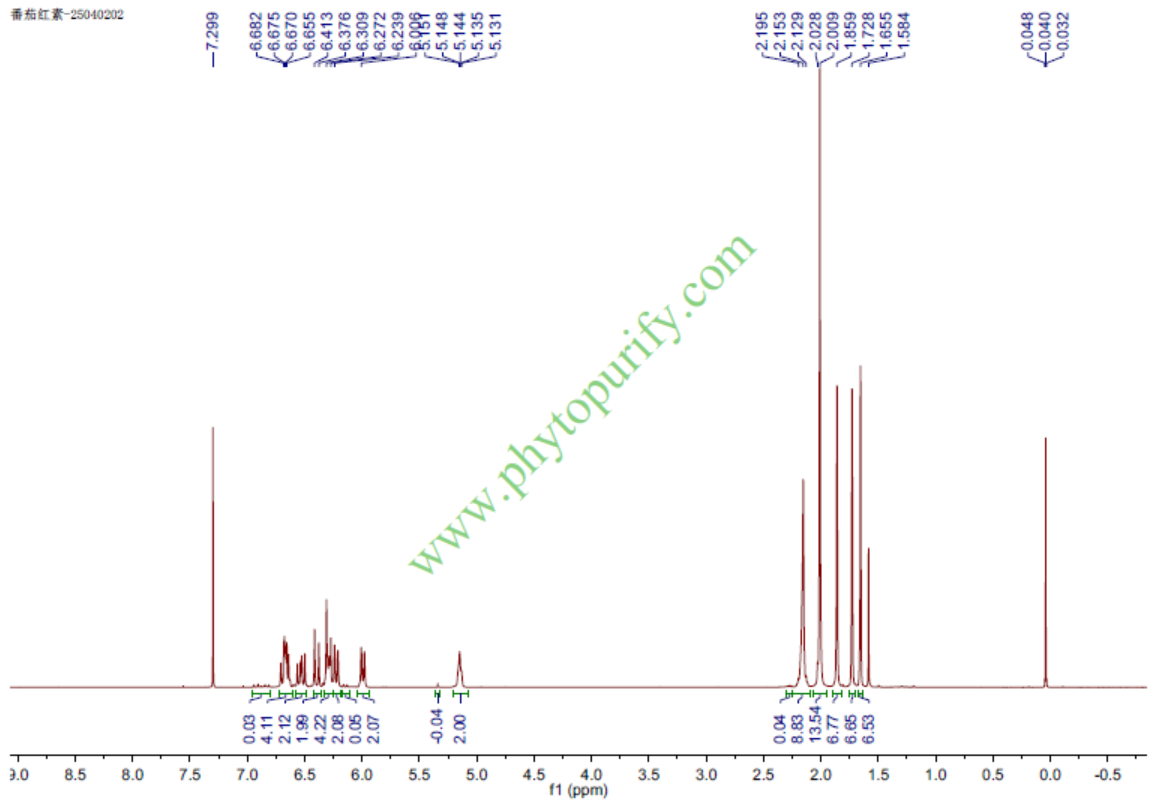
HNMR of Lycopene
Storage conditions:Short-term storage at 2~8℃, long-term storage at -20 ~ -80℃
Lycopene, CAS number 502-65-8, is a natural carotenoid widely found in tomatoes and their products, red fruits, and vegetables. As a pigment free lipid soluble compound, lycopene has attracted widespread attention in the field of natural product pharmacology in recent years due to its strong antioxidant capacity and potential health benefits. Numerous epidemiological and experimental studies have shown that lycopene exhibits significant biological activity in the prevention and adjuvant treatment of various chronic diseases, especially tumor diseases such as prostate cancer. This article will systematically review the chemical structure and physicochemical properties, plant sources and extraction methods, pharmacological activity and mechanism of action of lycopene, and explore its clinical application prospects and future research directions based on its pharmacological evaluation and pharmacokinetic characteristics.
Lycopene belongs to an open chain polyunsaturated olefin structure in the carotenoid family, with a molecular formula of C40H56 and a molecular weight of 536.8880. Its structural feature is a long-chain polyene skeleton composed of 13 conjugated double bonds, which endows it with excellent light absorption and antioxidant properties. Lycopene is non-polar, with a TPSA (topological polar surface area) of 0, indicating a lack of polar groups, resulting in extremely low water solubility (0.0000), while LogP is as high as 12.2143, demonstrating its strong lipophilicity and lipophilicity. This physicochemical property allows lycopene to be mainly distributed in lipid rich tissues in the body, especially cell membranes and lipid droplets.
In addition, lycopene has a high blood-brain barrier permeability, suggesting its potential role in neurological diseases. The hERG channel inhibition test result was negative, indicating a low risk of cardiac toxicity. The Ames mutagenicity test score is 0.3, indicating a low risk of genotoxicity and good safety.
Lycopene is mainly present in tomatoes (Solanum lycopersicum) and their processed products, such as tomato sauce, tomato juice, and tomato powder. In addition, red fruits and vegetables such as watermelon, grapefruit, and chili peppers also contain a certain amount of lycopene. During the ripening process of tomatoes, the content of lycopene significantly increases with the degradation of chlorophyll and the accumulation of carotenoids.
The traditional method for extracting lycopene mainly uses organic solvents such as ethanol, hexane, acetone, etc. for extraction, followed by purification through liquid-liquid distribution, column chromatography, and other means. In recent years, supercritical CO2 extraction technology has become the mainstream technology for extracting lycopene due to its advantages of green environmental protection, solvent-free residue, and efficient extraction. In addition, emerging technologies such as ultrasound assisted extraction and microwave-assisted extraction are widely used to improve extraction efficiency and purity.
During the extraction process, attention should be paid to the sensitivity of lycopene to light, heat, and oxygen. Measures such as avoiding light, low temperature, and inert gas protection are often used to prevent its degradation and isomerization.
The pharmacological activity of lycopene is mainly reflected in its powerful antioxidant, anti-inflammatory, anti-tumor, and cardiovascular protective effects. Its antioxidant capacity originates from its multiple conjugated double bond structure, which can effectively scavenge free radicals, inhibit lipid peroxidation, and protect cells from oxidative damage.
Prostate cancer is the most in-depth area of lycopene research. A large number of in vivo and in vitro experiments and epidemiological studies have shown that lycopene intake is significantly related to the reduction of the incidence rate of prostate cancer. Its anti-tumor mechanism involves inducing cancer cell apoptosis, inhibiting cell proliferation, blocking tumor angiogenesis, and regulating the tumor microenvironment.
Lycopene can downregulate the expression of various inflammatory mediators, such as tumor necrosis factor - α (TNF - α), interleukin-6 (IL-6), etc., alleviate chronic inflammation, and thus exert a protective effect.
Lycopene can reduce the risk of atherosclerosis by reducing the oxidation of low-density lipoprotein, improving vascular endothelial function and regulating lipid metabolism, showing a good potential for cardiovascular protection.
In addition, lycopene also showed certain pharmacological activities in skin protection, prevention and treatment of diabetes complications and neuroprotection.
The biological activity of lycopene is mainly achieved by regulating multiple signaling pathways and key molecular targets. The main targets of lycopene for prostate cancer include:
Through the synergistic regulation of the above targets, lycopene can effectively inhibit the growth and metastasis of prostate cancer cells, promote apoptosis, and improve the tumor microenvironment.
The high lipid solubility (LogP 12.2143) and zero polarity (TPSA 0) of lycopene result in extremely poor water solubility, affecting its oral bioavailability. Its absorption in the gastrointestinal tract depends on lipid mediators, and its co intake with dietary fats can significantly increase absorption rate. Lycopene is mainly distributed in organs such as adipose tissue, liver, and prostate in the body, and has good blood-brain barrier permeability.
In terms of metabolism, lycopene is mainly metabolized by the liver cytochrome P450 enzyme system, and some metabolites have biological activity. The main excretion pathways are bile and feces, with less excretion by the kidneys.
The safety evaluation shows that lycopene has no significant hERG channel inhibitory effect, low genotoxicity risk, and good long-term intake safety. However, due to its strong lipid solubility and limited bioavailability, formulation development needs to focus on addressing its solubility and stability issues.
Based on its significant antioxidant and anti-tumor activities, lycopene has shown broad application prospects in the prevention and adjuvant therapy of prostate cancer. Multiple clinical trials have shown that long-term supplementation of lycopene can reduce the risk of prostate cancer and improve patients' quality of life. In addition, lycopene, as a natural product, has low side effects and is suitable for long-term use.
Future research should focus on:
Lycopene, as a natural carotenoid, has become a hot topic in natural product pharmacology research due to its unique chemical structure and significant biological activity. Its potential for prevention and treatment in various diseases such as prostate cancer has been preliminarily validated. Despite challenges such as low bioavailability and poor stability, lycopene is expected to become a safe and effective natural medicine or adjuvant therapy through modern pharmaceutical formulation technology and molecular mechanism research. In the future, interdisciplinary in-depth research will drive lycopene from the laboratory to clinical practice, benefiting more patients.
