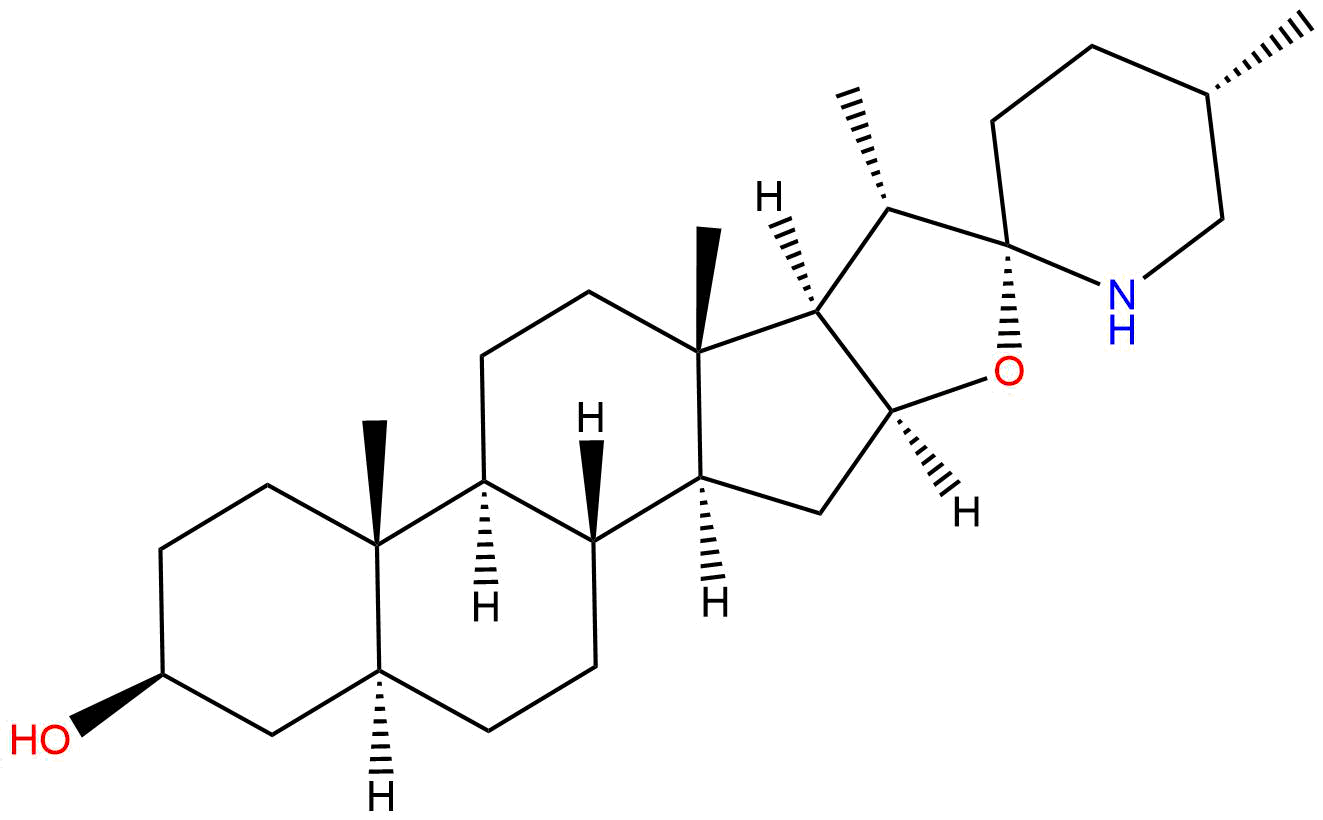


Product name: Tomatidine
Synonym name:
Catalogue No.: BP3391
Cas No.: 77-59-8
Formula: C27H45NO2
Mol Weight: 415.662
Botanical Source:
Physical Description: Powder
Type of Compound: Alkaloids
Purity: 95%~99%
Analysis Method: HPLC-DAD or/and HPLC-ELSD
Identification Method: Mass, NMR
Packing: Brown vial or HDPE plastic bottle
The product could be supplied from milligrams to grams, upto kilograms..
Inquire for bulk scale.
Tomatidine HCl, 6192-62-7, is also available.
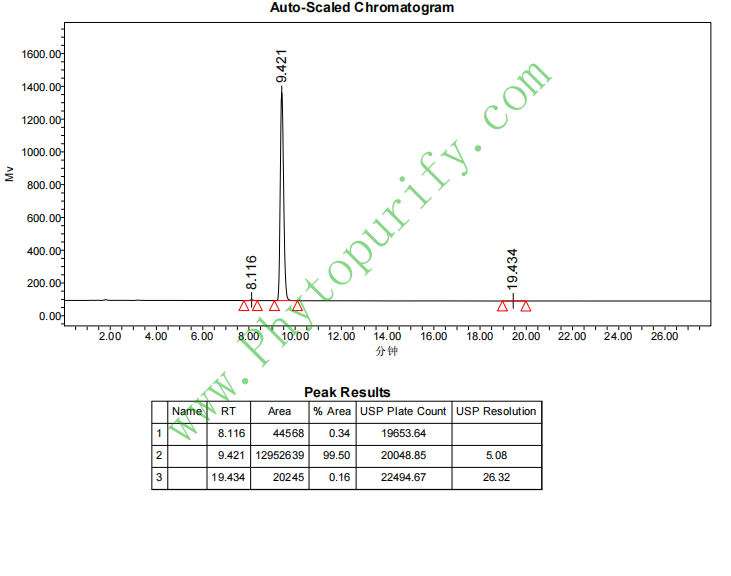
HPLC of Tomatidine
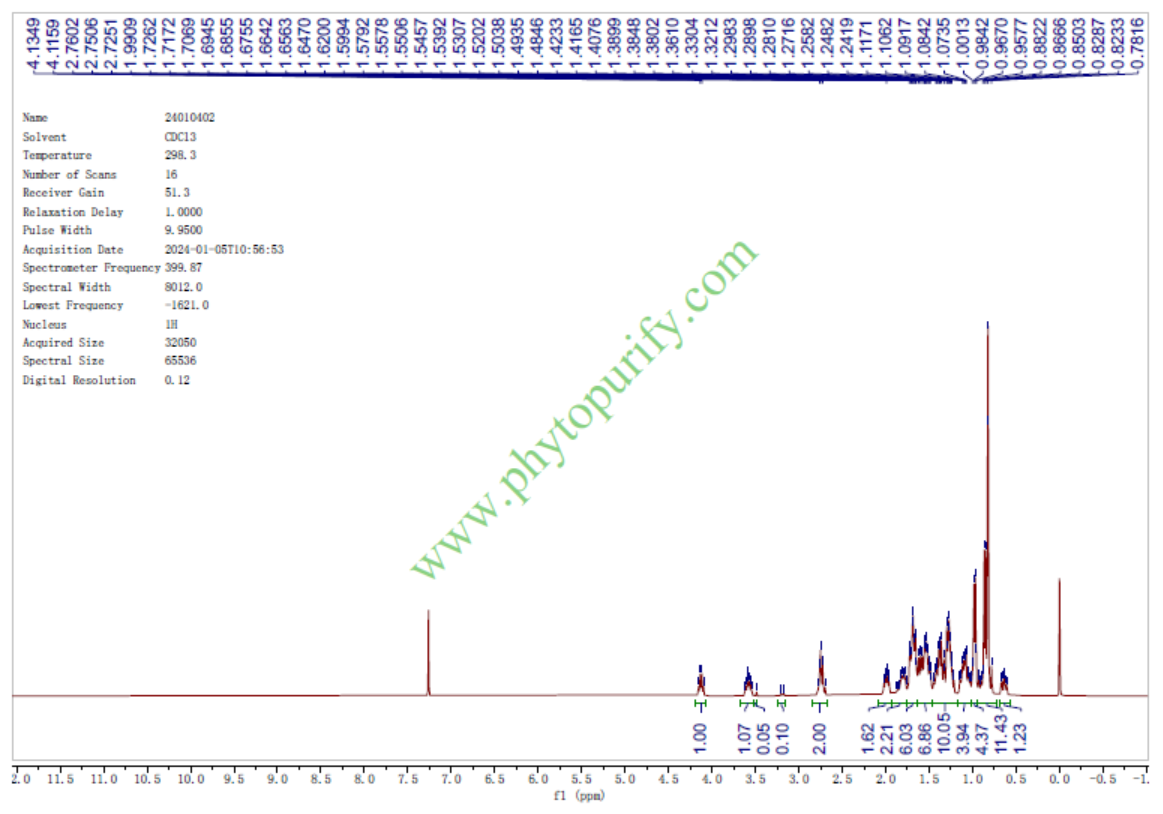
HNMR of Tomatidine
Storage conditions:Short-term storage at 2~8℃, long-term storage at -20 ~ -80℃
41.4900
4.8979
3.1569
.0032
3.3710
10.7389
High
79.5217
5.3696
No
No
No
Yes
No
No
0.0
No
No
No
No
Tomatina (CAS number: 77-59-8) is a naturally occurring steroid alkaloid mainly derived from the tomato plant in the Solanaceae family(Solanum lycopersicum)The green parts (such as stems, leaves, and immature fruits). As an important secondary metabolite in tomatoes, tomato alkaloids have long been of concern due to their potential biological activity. In recent years, with the deepening of molecular biology and pharmacology research, lycopene has changed from a simple phytochemical component to an anti-inflammatory, anti atherosclerosis, especially antitumor Lead compounds with enormous potential in the field. Research has revealed that lycopene can exert its biological effects by intervening in multiple key cellular signaling pathways, including NF - κ B, JNK, ERK, and Akt, and activating autophagy. Its target proteins include TP53, CASP3, MYC, BAX, and CDKN1A, which are closely related to cell cycle, apoptosis, and tumorigenesis. This provides a solid scientific basis for its application in tumor therapy. This article will provide a systematic professional interpretation of tomato alkaloids from the aspects of their chemical nature, sources, pharmacological mechanisms, drug evaluation, and future prospects.
The molecular formula of tomato alkaloids is C27H45NO2, with a molecular weight of 415.6620 g/mol. From its SMILES expression (C [C @ @ H] 1CC [C @ @] 2 (NC1) O [C @ H] 1C [C @ H] 3 [C @ @ H] 4CCC5C C@@H CC [C @] 5 (C) [C @ H] 4CC [C @] 3 (C) [C @ H] 1 [C @ @ H] 2C) clearly shows that it is a complex polycyclic steroid skeleton structure, containing one nitrogen atom (forming a nitrogen heterocyclic ring) and one oxygen atom (forming an oxygen heterocyclic ring), and has a hydroxyl group at the 3 β position. This unique Nitrogen-containing spirosteroids Structure is the chemical basis of its biological activity.
According to the analysis of the pharmacological parameters, the LogP of its lipid water partition coefficient is 4.8979, indicating that the compound has a high Lipophilic nature This is consistent with its steroid skeleton structure, but also means that its water solubility is poor (water solubility is only 0.0032 mg/mL). Higher lipophilicity is usually beneficial for compounds to penetrate cell membranes, but excessively high LogP (>5) may also lead to metabolic instability and increased toxicity. Its topological polar surface area (TPSA) is 41.49 Å ², which is relatively small and beneficial for the membrane permeability of the compound. This characteristic was confirmed in the permeability experiment of Caco-2 cells, with a permeability of up to 10.7389 × 10 ⁻⁶ cm/s, indicating that it has Good intestinal absorption potential In addition, its blood-brain barrier (BBB) permeability is predicted to be "high", suggesting that tomato alkaloids may act on targets or diseases related to the central nervous system. The plasma protein binding rate (PPB) is about 79.52%, which is a moderately high level, which may affect its free drug concentration and efficacy.
Tomatoes are mainly derived from the substances we consume in our daily lives tomato(Solanum lycopersicum). It is worth noting that the content of lycopene and its glycosidic form (α - lycopene) in mature red tomato fruits is extremely low, while a large amount is present in the green tissues of tomato plants (such as leaves and stems)Immature green fruit In the middle. This is also one of the reasons why consuming immature tomatoes may cause mild gastrointestinal discomfort, as high doses of steroid alkaloids have certain biological toxicity.
In terms of traditional applications, although tomatoes are widely consumed as food, the medicinal records of their plants are relatively limited. However, in some folk medicine, tomato leaves have been used to make topical medications to treat certain skin inflammations and pains. Modern pharmacological research reveals the possible scientific principles behind these traditional applications: tomato alkaloids have clear anti-inflammatory activity It inhibits the production of inflammatory factors by blocking pro-inflammatory signaling pathways such as NF - κ B and JNK, which may explain its potential value in topical anti-inflammatory applications. The discovery of lead compounds with clear pharmacological effects from traditional edible plants is a classic pathway for the development of natural product drugs, and tomato alkaloids are such an example.
The pharmacological activities of tomato alkaloids are diverse, among which the most notable is their antitumor Potential. The existing research data links it to multiple key tumor related targets, outlining a multi-target, multi pathway network of action.
Analysis of the core mechanism of action:
Regulating cell cycle and proliferation (targeting MYC, CDKN1A):
Inducing cell apoptosis (targeting TP53, BAX, CASP3):
Inhibit invasion and metastasis:
In addition to the aforementioned targets, studies have also found that tomato alkaloids can significantly inhibit the invasive ability of lung cancer A549 cells. The mechanism is to reduce the expression of matrix metalloproteinases (MMPs). MMPs are important tools for tumor cells to degrade extracellular matrix, achieve invasion and metastasis. Meanwhile, tomato alkaloids can also inhibit the signaling pathways of ERK and Akt, which are closely related to cell survival, proliferation, and migration, and block the activity of transcription factor NF - κ B. NF - κ B controls the expression of numerous pro-inflammatory, pro survival, and pro metastatic genes. Through this combination of punches, tomato alkaloids are displayed Anti tumor metastasis The potential.
Activate autophagy:
Autophagy is the process by which cells degrade damaged components through lysosomes, playing an important role in maintaining cellular homeostasis and responding to stress. Tomato alkaloids have been shown to activate autophagy in mammalian cells and model organism Caenorhabditis elegans. In the context of tumors, autophagy plays a double-edged sword role, as it may inhibit tumor development in the early stages and help tumor cells survive in harsh environments in the late stages. The specific role of tomato alkaloid induced autophagy in anti-tumor treatment needs to be evaluated based on the specific tumor type and microenvironment.
Other activities:
Tomato alkaloids also have Antibacterial and Anti atherosclerosis Activity. Its antiatherosclerotic effect is related to the significant inhibition of acyl coenzyme A: cholesterol acyltransferase (ACAT), which promotes the accumulation of intracellular cholesterol esters, and is a key step in the formation of foam cells.
Association with diseases:
In summary, tomato alkaloids act simultaneously on TP53、CASP3、MYC、BAX、CDKN1A These five core targets synergistically regulate tumor cells Proliferation, apoptosis, and cycle progression And combined with mechanisms such as inhibiting invasion and metastasis and activating autophagy, it constitutes its resistance tumor The pharmacological basis of this complex disease. Its multi-target characteristics may help overcome the problem of drug resistance that may arise from single target drugs.
Based on the provided pharmacological parameters, we can conduct a preliminary evaluation of the potential of tomato alkaloids as drug candidate molecules, and refer to the well-known Lipinski's Five Rules Analyze the "Five Principles of Similar Drugs":
Conclusion Tomato alkaloids generally conform to or slightly deviate from the Lipinski Five Rules, and overall have good performance drug-likeness Its high Caco-2 permeability and predicted high BBB permeability indicate good potential for oral absorption and central distribution.
Analysis of other key pharmacological parameters:
* Toxicity warning:HERG inhibition The prompt is' yes', which is a signal that requires high vigilance. Inhibition of hERG potassium channels may lead to prolonged QT interval in the heart, causing apical torsion type ventricular tachycardia, which is an important reason for many drug development failures. This is a key area that must be studied and optimized for the clinical application of tomato alkaloids Key risk points。
* Genotoxicity The Ames test and chromosome aberration test results were both negative, indicating that it has no mutagenicity and good safety.
* Hepatotoxicity warning Serum markers (ALT, AST, ALP, GGT) were predicted to be negative, indicating a low potential risk of liver toxicity.
* Other No skin sensitization, respiratory sensitization, or phototoxicity prediction, further supporting its safety.
Comprehensive Assessment Tomato alkaloids have a clear multi-target anti-tumor mechanism in pharmacology, and exhibit good membrane permeability and oral absorption potential in pharmaceutical properties. However, its poor performance Water solubility And potential Cardiotoxicity (hERG inhibition) This is the main challenge faced in developing it into a safe and effective drug. Future structural optimization (such as preparing water-soluble prodrugs, modifying structures to reduce hERG affinity) and formulation development (such as nano formulations, cyclodextrin inclusion) will be key research directions.
At present, research on tomato alkaloids is mainly focused on Preclinical stage A large number of in vitro cell experiments and some animal model studies have fully proved its anti-inflammatory, anti atherosclerosis, especially anti-tumor activities. Its unique multi-target mechanism, especially its activation of autophagy, has attracted increasing interest from researchers.
Research status:
1. Deepening mechanism research The current research is aimed at more accurately elucidating the direct mode of action between tomato alkaloids and the aforementioned targets (such as p53, MYC), whether it is directly bound or regulated through upstream signaling. Its role in the tumor microenvironment and the advantages and disadvantages of autophagy activation in specific tumor types are also research hotspots.
2. Exploration of combination therapy Given its multi-target nature, researchers are exploring the synergistic effects of tomato alkaloids in combination with existing chemotherapy drugs (such as cisplatin, docetaxel) or targeted drugs, in order to reduce the dosage of existing drugs, minimize side effects, and overcome drug resistance.
3. Structural modification and derivative development In order to improve its water solubility and reduce hERG toxicity, medicinal chemists are modifying the structure of the parent nucleus of tomato alkaloids, synthesizing a series of derivatives, and screening for candidate molecules with better activity and higher safety.
Application Prospects:
1. Lead compounds of anti-tumor drugs The most promising application direction of tomato alkaloids is to develop them into new types Multi targeted anti-tumor drugs Used for the treatment or adjuvant therapy of various solid tumors such as lung cancer, colon cancer, prostate cancer, etc. Its anti metastatic properties also make it valuable in preventing tumor recurrence and metastasis.
2. Health Products and Functional Foods: Considering that it comes from food plants, low dose of lycopene or its tomato plant extract rich in lycopene may be developed for preventing atherosclerosis, assisting anti-inflammatory or cancer prevention Health food or dietary supplements But this requires strict safety assessment and dosage definition.
3. Life Science Research Tools As a natural product Autophagy activator Tomatina can be used as a tool molecule in scientific research to explore the role of autophagy in aging, neurodegenerative diseases, and metabolic disorders.
Challenges and Future Directions:
Future research will focus on: ① completing systematic preclinical pharmacokinetic and toxicological evaluations, particularly addressing issues related to Hidden danger of cardiac toxicity② Conduct more in vivo pharmacological validation, especially in models closer to clinical practice such as human tumor xenografts (PDX); ③ Promote the introduction of structurally optimized and more effective tomato alkaloid derivatives clinical trial Stage.
In short, as a natural product found in daily food, tomato alkaloids have become a highly anticipated new star in the field of natural medicine research and development due to their novel chemical structure and multi-target anti-tumor mechanism. Although there are still challenges to overcome in drug development ahead, its enormous potential undoubtedly provides new ideas and candidate molecules for cancer treatment and even the prevention and treatment of other diseases.
