Introduction/Overview
Natural products, as an important treasure trove for drug discovery, play an irreplaceable role in the long history of human fight against diseases. Among them, plant derived steroidal alkaloids have always been a hot topic in medicinal chemistry and pharmacology research due to their unique chemical structure and wide range of biological activities. Beta Tomatine (CAS number: 17406-46-1) is a substance primarily found in tomatoes(Solanum lycopersicum)Glycoside alkaloids in Solanaceae plants have long been recognized for their natural defense against fungi and insects. In recent years, with the deepening of research, its excellent anti-tumor activity, especially its significant effect on androgen dependent and non dependent prostate cancer, has rapidly transformed it from a common plant secondary metabolite into a highly promising candidate molecule in the field of anti-tumor drug development. Prostate cancer is the second highest incidence of malignancy among men in the world. Its treatment is facing severe challenges in the stage of castration resistance. It is urgent to develop drugs with new mechanisms of action. This article aims to systematically review the chemical properties, plant sources, pharmacological activities of Beta tomato alkaloid glycoside, and focus on analyzing its molecular mechanism of multi-target and multi pathway synergistic effects in the treatment of prostate cancer. At the same time, it objectively evaluates its pharmacological properties and looks forward to its clinical translation prospects, in order to provide comprehensive scientific references for the deep development and utilization of this compound.
Chemical structure and physicochemical properties
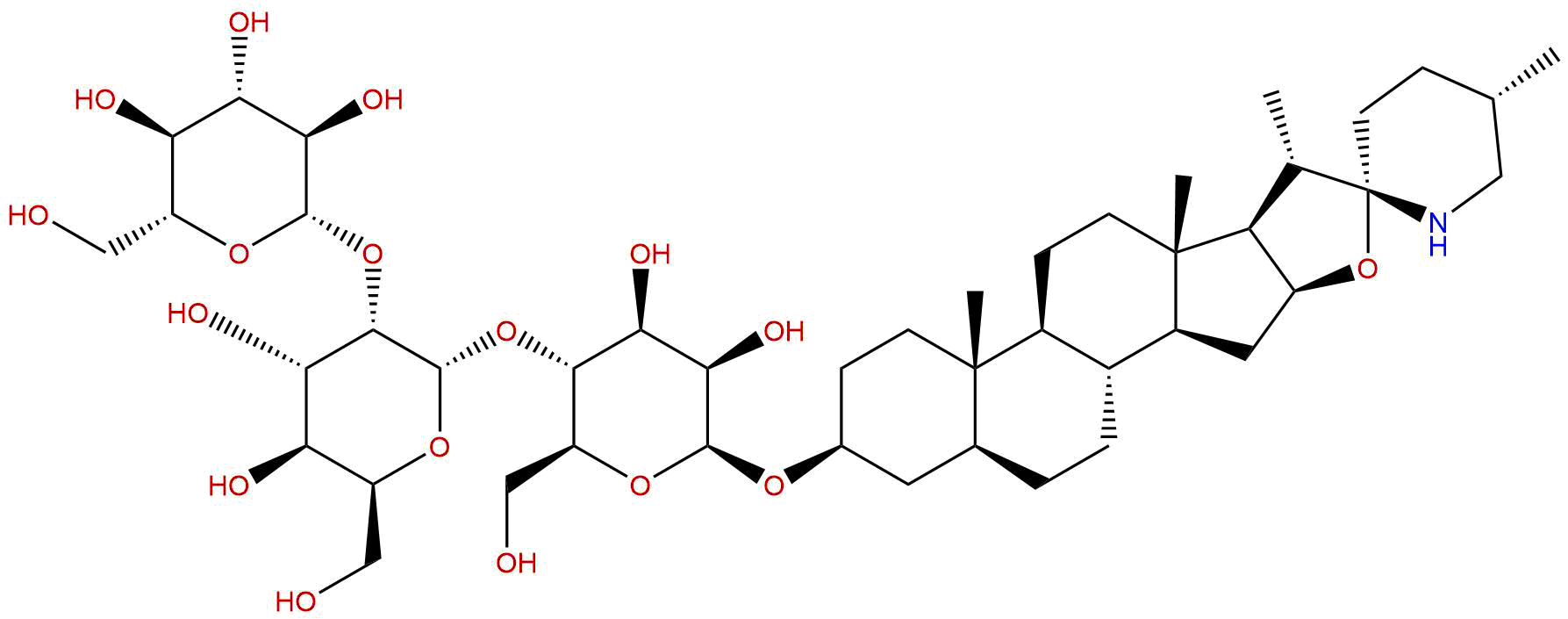
Beta tomato alkaloid is a typical steroid glycoside alkaloid, whose molecular structure is composed of hydrophobic steroid alkaloid aglycones (tomatidine) and hydrophilic oligosaccharide chains connected by glycosidic bonds. The glycoside part is a C27 steroid skeleton containing nitrogen heterocycles, which is the structural basis of its alkaloid properties. The sugar chain is composed of two molecules of β - D-glucose, one molecule of β - D-xylose, and one molecule of β - D-galactose. This highly polar tetrasaccharide unit greatly affects its physicochemical properties and biological activity.
Its molecular weight is 902.0850, belonging to a highly polar molecule. The calculated lipid water partition coefficient (LogP) is 1.6646, indicating that although the molecule contains hydrophobic steroid nuclei, its overall hydrophilicity is strong. The topologically polar surface area (TPSA) is as high as 278.94 Å ², mainly attributed to the abundant hydroxyl groups on the sugar chain and nitrogen atoms in the glycosides, indicating that its membrane permeability may face challenges. The experimental data shows that its water solubility is about 0.1881 mg/mL, belonging to the category of slight solubility, which poses a challenge for its formulation development. The preliminary pharmacological prediction model shows that the compound has a low ability to penetrate the blood-brain barrier, which to some extent limits its application in central nervous system tumors, but may also reduce the potential risk of neurotoxicity. Importantly, its hERG inhibition risk prediction was negative, and the Ames test predicted a value of 0.0, indicating a low potential risk of arrhythmia and genotoxicity, providing preliminary positive signals for its safety evaluation.
Plant sources and extraction methods
Beta tomato alkaloids are mainly enriched in the green tissues (such as stems and leaves) of tomato plants and immature green fruits. As the fruit matures and turns red in color, its content significantly decreases, and the content in mature red fruits is extremely low. This distribution pattern is consistent with its function as a defensive compound against insects and fungi in plants. In addition to tomatoes, its glycoside tomato alkaloid is also present in other Solanaceae plants.
The extraction of Beta lycopene glycosides from plant materials is usually carried out using organic solvent extraction method. The common process is as follows: Dry and crushed tomato leaves or immature fruit powder is first degreased with a low polarity solvent (such as petroleum ether) to remove impurities such as chlorophyll and oil. Subsequently, medium polarity alcohol solvents (such as methanol, ethanol) or alcohol water mixed solvents are used for leaching or heating reflux extraction, and glycoside alkaloids have higher solubility in such solvents. After vacuum concentration, the crude extract can be preliminarily purified by dissolving it in acidic water and alkalizing it to precipitate. Its alkaloid properties are utilized to form salts that dissolve in acidic water, and then dissociate under alkaline conditions. Further purification relies on modern chromatographic techniques such as silica gel column chromatography, reverse phase C18 column chromatography, and high-performance liquid chromatography (HPLC) preparation. In recent years, green extraction techniques such as ultrasound assisted extraction and microwave-assisted extraction have also been applied to improve extraction efficiency and shorten extraction time. Attention should be paid to controlling temperature and pH during the extraction process to prevent hydrolysis of glycosidic bonds.
Pharmacological activity research
Numerous in vitro and in vivo pharmacological studies have confirmed that Beta lycopene has a wide range of biological activities, most notably its powerful anti-tumor effects.
1. Antitumor activity: Beta tomato alkaloid glycoside exhibits significant cytotoxicity against various human cancer cell lines, with particularly prominent inhibitory effects on prostate cancer cells such as LNCaP, PC-3, DU145. Research has shown that it can inhibit the proliferation of prostate cancer cells and induce cell apoptosis in a dose-dependent and time-dependent manner. Its anti-cancer spectrum is not limited to prostate cancer, but also has inhibitory effects on breast cancer, colon cancer, lung cancer, liver cancer and other malignant tumor cells. Animal model experiments further confirmed that Beta lycopene can effectively inhibit the growth of transplanted tumors, and when combined with certain chemotherapy drugs (such as docetaxel), it exhibits synergistic effects and can alleviate some of the side effects caused by chemotherapy.
2. Antibacterial and antifungal activity: As a natural defense substance of plants, Beta lycopene has inhibitory effects on various fungi (such as Fusarium and Botrytis cinerea) and bacteria. The mechanism may be related to the destruction of the structural integrity of pathogenic microorganism cell membranes. Its steroid structure can bind with sterols (such as ergosterol) in fungal cell membranes, forming complexes and pores on the membrane, leading to content leakage and cell death.
3. Anti inflammatory and immune regulatory activity: Research has shown that Beta lycopene can inhibit the excessive production of nitric oxide (NO) and prostaglandin E2 (PGE2) in macrophages induced by lipopolysaccharides (LPS), downregulate the expression of inducible nitric oxide synthase (iNOS) and cyclooxygenase-2 (COX-2), suggesting its anti-inflammatory potential. In addition, it can also regulate the function of immune cells.
4. Cholesterol lowering activity: Its glycoside tomato alkaloid has been reported to inhibit cholesterol biosynthesis and exhibit activity in reducing serum cholesterol levels in experimental animals by affecting cholesterol absorption and metabolism.
Mechanism of action and molecular targets
The anti prostate cancer effect of Beta tomato alkaloid glycoside is not through a single target, but presents a network regulatory feature of multi-target and multi pathway synergy, which provides the possibility for it to overcome tumor drug resistance. Its mechanism of action mainly revolves around inducing cell apoptosis, inhibiting proliferation, invasion and metastasis, and overcoming drug efflux, involving the following key molecular targets and pathways:
1. Inducing endogenous apoptosis pathway: Beta lycopene can upregulate the expression of pro apoptotic protein Bax and downregulate key anti apoptotic proteins BCL2 The expression of leads to a decrease in mitochondrial membrane potential and the release of cytochrome C. Subsequently, the caspase cascade reaction is activated, ultimately resulting in CASP9 Caspase-9 and its downstream caspase-3 execute the apoptotic program.
2. Inhibition of survival and proliferation signaling pathways:
* STAT3 signaling pathway: Continuously activated signal transduction and transcriptional activator 3(STAT3)It is a key driving factor for the growth, survival, and immune escape of prostate cancer. Beta lycopene can effectively inhibit the phosphorylation (activation) of STAT3, block its nuclear translocation and the transcription of downstream target genes (such as Cyclin D1, BCL2), thereby inhibiting cell proliferation and promoting apoptosis.
* MAPK/ERK pathway: Mitogen activated protein kinase 1(MAPK1 ERK2, also known as ERK2, is a core signaling molecule that regulates cell growth and differentiation. Beta lycopene can inhibit the phosphorylation of ERK and block this pro survival signaling pathway.
* Androgen receptor (AR) signaling axis: AR signal is the core of the occurrence and development of prostate cancer. Beta lycopene can interfere with AR signaling, possibly by affecting the stability of AR or the recruitment of co regulatory factors, downregulating the expression of AR target genes such as prostate-specific antigen (PSA), which is particularly important for androgen dependent prostate cancer.
* Estrogen receptor beta (ESR2): ESR2 is believed to exert tumor suppressive effects in the prostate. Beta lycopene may indirectly affect the growth balance of tumor cells by regulating the activity or expression of ESR2.
3. Regulating oxidative stress and detoxification system: The transcription factor NFE2L2 (Nrf2) regulates cellular antioxidant response. Beta lycopene may affect the redox balance of tumor cells by moderately regulating the Nrf2 pathway, making them more susceptible to oxidative stress-induced apoptosis.
4. Inhibit drug efflux pump: Multidrug resistance protein P-glycoprotein (composed of ABCB1 Gene coding is one of the main mechanisms of tumor chemotherapy resistance. Research has shown that Beta lycopene may act as a regulator of ABCB1, inhibiting its efflux pump function, thereby reversing tumor cell resistance to chemotherapy drugs such as docetaxel and enhancing chemotherapy efficacy.
5. Impact on enzyme activity:
* Protein tyrosine phosphatase 1B (PTPN1): PTPN1 is a negative regulator of the insulin and leptin signaling pathways, and is also associated with cancer. The effect of Beta lycopene on its activity may indirectly participate in metabolic reprogramming and cell signaling regulation.
* Aromatase (CYP19A1): This enzyme catalyzes the conversion of androgens to estrogens. In the microenvironment of prostate cancer, the production of local estrogen may affect the disease progression. The potential regulatory effect of Beta tomato alkaloid glycoside on CYP19A1 deserves further investigation.
In summary, Beta lycopene forms a "multi-target arsenal" that synergistically attacks prostate cancer cells by simultaneously acting on multiple targets such as apoptosis regulatory factors (BCL2, CASP9), key signaling nodes (STAT3, MAPK1, AR), and resistance proteins (ABCB1).
Evaluation of drug properties and pharmacokinetics
Although Beta tomato alkaloid glycoside exhibits excellent anti-cancer activity in vitro, its clinical application must cross the critical threshold of drug formation. Based on its physical and chemical properties, there are both challenges and opportunities for its medicinal properties.
Challenge:
1. Oral bioavailability: High polarity (high TPSA) and high molecular weight may lead to poor gastrointestinal absorption and low oral bioavailability. Glycoside structures are easily hydrolyzed by gut microbiota or digestive enzymes to produce aglycone tomato alkaloids, which may have different activity from the prototype drug.
2. Solubility and formulation: The characteristic of slight solubility limits its concentration in aqueous media, which poses difficulties for the development of injection and other dosage forms, requiring the use of solubilization techniques such as cyclodextrin inclusion, nano formulations, liposomes, etc.
3. Distribution and Metabolism: Low blood-brain barrier permeability limits its effect on brain tumors, but as mentioned earlier, it may also reduce central side effects. As an exogenous alkaloid, it may undergo extensive phase I and phase II metabolism in vivo, particularly hydrolysis of sugar chains and glucuronidation or sulfation of hydroxyl groups, leading to rapid clearance.
Opportunities and improvement strategies:
1. Preliminary prediction of good security: The absence of hERG inhibition and Ames mutagenicity warning laid the foundation for its safety development.
2. Pre medication strategy: Chemical modification of the hydroxyl groups on its sugar chains or glycosides to prepare precursor drugs with higher lipid solubility may improve their membrane permeability and oral absorption, and then convert them into active forms in vivo.
3. New drug delivery system: Using nanotechnology such as polymer nanoparticles, solid lipid nanoparticles, and micelles to encapsulate it can significantly improve its solubility, prolong circulation time, enhance passive targeting of tumor sites through enhanced permeability and retention (EPR) effects, and potentially bypass P-glycoprotein mediated efflux.
4. Pharmacokinetic research requirements: At present, there is still a relative lack of in vivo pharmacokinetic research data on the Beta tomato alkaloid glycoside system, including absorption, distribution, metabolism, and excretion. In the future, it is necessary to use sensitive analytical methods such as LC-MS/MS to conduct comprehensive studies in animal models, clarify the drug time curves, tissue distribution, and excretion pathways of the prototype and main metabolites, and provide a basis for dosage form design and optimization of administration plans.
Clinical application prospects and prospects
The multi-target anti prostate cancer properties of Beta lycopene give it unique application prospects in clinical translation, especially in solving the challenges of castration resistant prostate cancer (CRPC) and multidrug resistance.
1. As a monotherapy or combination therapy: Given its ability to simultaneously inhibit AR signaling, STAT3 pathway, and induce apoptosis, it is expected to be developed as a monotherapy for the treatment of CRPC, especially for patients who have failed traditional endocrine therapy. A more realistic strategy is to use it in combination with existing standard therapies such as docetaxel, abiraterone, and enzalutamide. Its potential ABCB1 inhibitory activity may effectively reverse tumor resistance to docetaxel, produce synergistic effects, and potentially reduce the required dose of chemotherapy drugs, thereby alleviating toxic side effects.
2. As a chemical preventive agent: There is an epidemiological association between the intake of tomatoes and their products and a reduced risk of prostate cancer. As an active ingredient in tomatoes, Beta lycopene or its dietary supplement form may play a role in preventing the occurrence or delaying the progression of prostate cancer, but this requires large-scale prospective clinical studies to verify.
3. Precision medicine based on target network: Future research can further clarify the weights of the contributions of each target and the interaction relationships between them. By using biomarkers such as p-STAT3 overexpression, AR-V7 positivity, and ABCB1 overexpression, the patient population most likely to benefit from Beta tomato alkaloid glycoside treatment is screened to achieve precise treatment.
4. Structural optimization and innovative formulations: Pharmaceutical chemists can rationalize its structure to improve its pharmacokinetic properties while retaining the core pharmacophore. The research focus of pharmacy should be on developing efficient, stable, and targeted nano delivery systems to address the core bottleneck of drug development.
Challenges faced: In addition to the above-mentioned drug resistance barriers, its clinical translation also requires systematic preclinical safety evaluation (acute toxicity, long-term toxicity, reproductive toxicity, etc.), confirmatory pharmacological studies, and standardized clinical trials (phases I-III). In addition, how to achieve stable, economical, and sustainable large-scale production of active pharmaceutical ingredients (fully synthetic or semi synthetic) is also a problem that industrialization must consider.
Conclusion
Beta lycopene, a common plant defense molecule, has emerged as a shining star in the field of natural anti-tumor drug development due to its synergistic mechanism targeting multiple targets and pathways in prostate cancer. It not only effectively induces cancer cell apoptosis and inhibits key survival signals, but also has the potential to reverse chemotherapy resistance, demonstrating its comprehensive strength in dealing with complex and refractory prostate cancer. Although its high polarity and poor solubility pose significant challenges for drug development, modern drug chemical modification strategies and advanced nano delivery technologies provide powerful tools to overcome these bottlenecks. Future research should focus on elucidating its metabolic fate in vivo, optimizing its structure or dosage form to improve pharmacokinetic properties, and actively conducting standardized preclinical development and clinical trial exploration. With the continuous deepening of research, Beta tomato alkaloid glycosides are expected to move from the laboratory to clinical practice, providing a new and unique treatment option for prostate cancer patients, especially those facing drug resistance difficulties, and continuing the glorious chapter of natural products in the history of drug discovery.