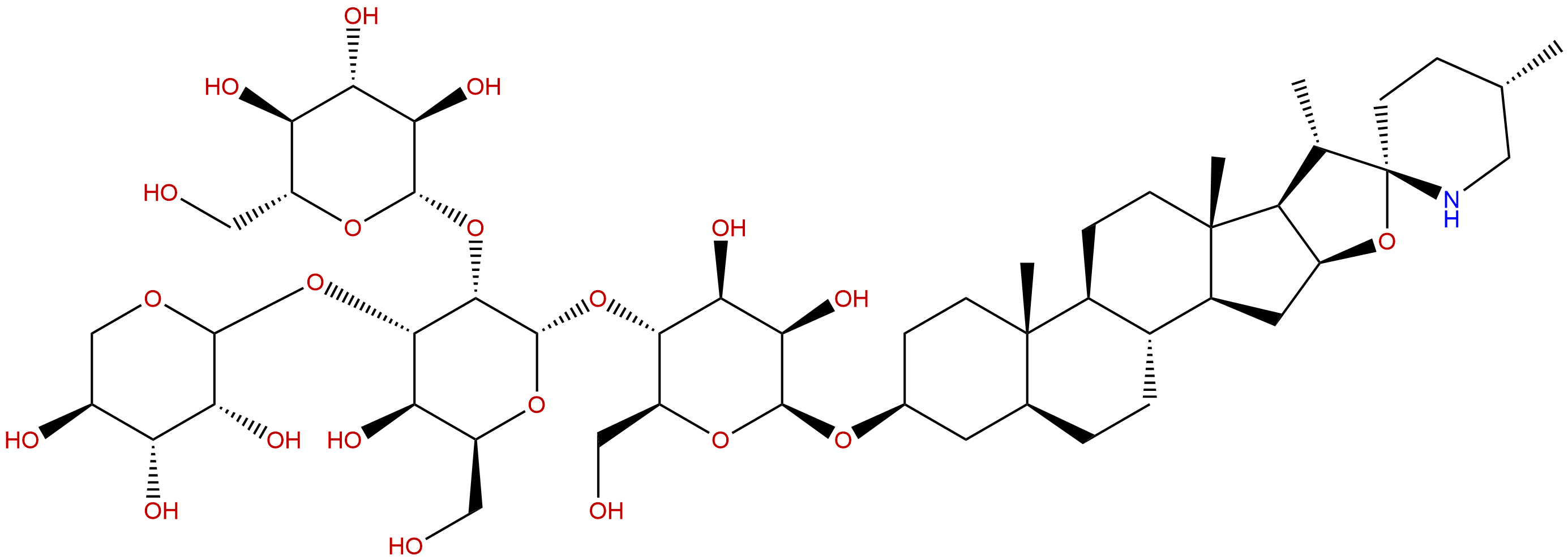


Product name: Tomatine
Synonym name:
Catalogue No.: BP1726
Cas No.: 17406-45-0
Formula: C50H83NO21
Mol Weight: 1034.2
Botanical Source: Lycopersicon esculentum
Physical Description:
Type of Compound: Alkaloids
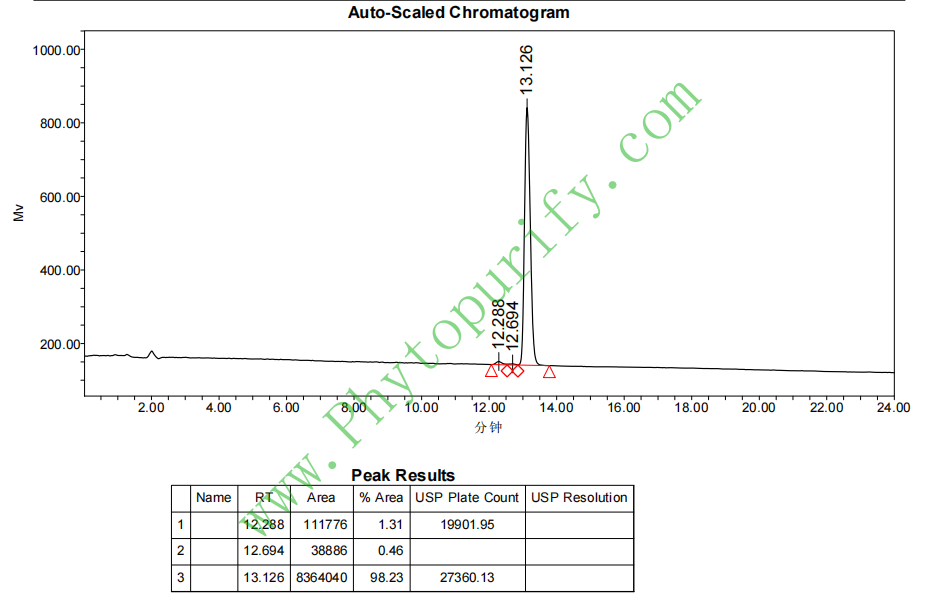
Purity: 95%~99%
Analysis Method: HPLC-DAD or/and HPLC-ELSD
Identification Method: Mass, NMR
Packing: Brown vial or HDPE plastic bottle
The product could be supplied from milligrams to grams, upto kilograms..
Inquire for bulk scale.
HPLC of Tomatine
Storage conditions:Short-term storage at 2~8℃, long-term storage at -20 ~ -80℃
337.8600
1.3637
.2124
.3237
.5219
.5026
Low
45.9063
7.1960
Yes
No
No
No
No
No
0.0
Yes
No
No
No
Tomatine (CAS number: 17406-45-0) is a substance mainly found in tomatoes(Lycopersicon esculentum Mill., Currently classified as Solanum lycopersicum)Glycoside alkaloids in the green parts of plants, such as stems, leaves, and immature fruits. As a secondary metabolite of plants, tomato alkaloids play a key role in the plant defense system, able to resist the invasion of pathogens, insects, and herbivores. In recent years, with the deepening of pharmacological research on natural products, tomato alkaloids have received widespread attention in the pharmacological community due to their extensive biological activities, especially their potential anti-tumor effects. Research has shown that tomato alkaloids not only induce neurotoxicity through unique RIP1 kinase and caspase independent pathways, upregulate apoptosis inducing factor (AIF), but also inhibit 20S proteasome activity, demonstrating the potential for multi-target action. Especially in solid tumor models such as colorectal cancer, tomato alkaloids have shown regulatory effects on multiple key targets such as AMPK, MCL1, STAT3, ABC transporters, suggesting that they may become a promising anti-tumor lead compound. This article aims to systematically review the chemical structure, plant origin, pharmacological activity, mechanism of action, and medicinal properties of tomato alkaloids, and to provide prospects for their clinical applications.
Lycopene is a steroid glycoside alkaloid, whose molecular structure is composed of hydrophobic steroid aglycones (tomatidine) connected to a hydrophilic oligosaccharide chain through glycosidic bonds. This oligosaccharide chain typically consists of two molecules of glucose, one molecule of galactose, and one molecule of xylose, forming a large polar head. Its molecular formula is C50H83NO21, with a molecular weight of up to 1034.2000 daltons. This unique "amphiphilic" structure (with one end being a hydrophobic steroid nucleus and the other end being a hydrophilic sugar chain) is the structural basis for its interaction with biofilms and the production of various biological activities.
In terms of physicochemical properties, the lipid water partition coefficient (LogP) of tomato alkaloid glycosides is 1.3637, indicating that they have a certain degree of lipophilicity, but their large sugar chain structure gives them a high polar surface area (TPSA: 337.8600 Å ²). Its water solubility value is 0.3237 (usually referring to logS or related measures, indicating limited solubility), belonging to compounds that are slightly soluble in water. These parameters collectively determine its absorption and distribution characteristics within the organism. In addition, preliminary pharmacological predictions indicate that lycopene has a low ability to penetrate the blood-brain barrier and has no significant inhibitory effect on hERG potassium channels (suggesting a low potential risk of cardiac toxicity), and the Ames test result is 0.0 (indicating no mutagenicity), providing some basis for its relative safety.
Lycopene mainly comes from plants of the tomato genus in the Solanaceae family, especially in immature green tomato fruits and in the stems and leaves of tomatoes, where its content is relatively high. As the fruit matures and turns red in color, the content of tomato alkaloids significantly decreases and is converted into other metabolites, which is also one of the reasons why mature tomatoes are safe to consume. Its biosynthetic pathway originates from cholesterol and is formed through a series of hydroxylation, amination, and glycosylation reactions.
Solvent extraction is commonly used in laboratory and industrial extraction of tomato alkaloid glycosides. The common process includes: extracting or refluxing dried and crushed tomato stems, leaves, or immature fruit materials using polar solvents such as methanol, ethanol, or aqueous ethanol. After concentration, the extraction solution is preliminarily purified by utilizing the characteristic of tomato alkaloid glycosides that can form salts with acids and dissolve in water, and then react with bases to form free precipitates. Further refinement can be achieved through column chromatography techniques, such as using silica gel, macroporous adsorption resin, or reverse phase C18 chromatography materials, combined with gradient elution separation. Modern separation techniques such as high-speed countercurrent chromatography (HSCCC) can also be used for efficient preparation of high-purity tomato alkaloid glycosides. The optimization of extraction process mainly focuses on improving yield, maintaining activity, and environmental friendliness.
The pharmacological activity research of tomato alkaloids has revealed that they have multiple biological effects, among which anti-tumor activity is the most prominent.
The anti-tumor mechanism of tomato alkaloid glycoside is complex, involving network regulation of multiple pathways and targets. In models such as colorectal cancer, its targets mainly include:
Energy metabolism and apoptosis regulation targets:
Signal transduction and transcriptional activation targets:
Drug efflux and metabolic targets:
Extracellular matrix degradation and immune recognition targets:
Integration of core mechanisms:
These targets are not isolated, and tomato alkaloids are likely to form a synergistic anti-tumor effect by simultaneously acting on multiple links such as energy metabolism, apoptosis balance, signal transduction, and drug disposal.
Although tomato alkaloid glycosides have significant in vitro activity, their medicinal properties face challenges mainly due to their high molecular weight and complex sugar based structure.
Absorption, distribution, metabolism, excretion (ADME):
Preliminary evaluation of safety:
Formulation strategy:
To enhance its pharmacological properties, advanced drug delivery technologies may be required. For example, preparing it into liposomes, nanoparticles, or polymer micelles can improve its water solubility, enhance tumor targeting (through EPR effect or active target modification), protect it from premature degradation, and potentially reduce systemic toxicity.
Lycopene, as a multi-target anti-tumor natural product, has broad clinical application prospects but is also full of challenges.
Potential application directions:
challenges faced:
Future Prospects:
Future research should focus on: ① using systems biology and computational chemistry methods to more accurately depict its target network; ② Conduct in-depth pharmacokinetic research to clarify its in vivo fate; ③ Actively exploring new nano drug delivery systems to overcome their physical and chemical defects; ④ Conduct more effective preclinical studies on combination therapy to find the best treatment plan. The research on tomato alkaloids not only has the potential to generate new anti-tumor drugs, but also provides an important paradigm for understanding the pharmacological effects of glycoside alkaloids.
Lycopene is a glycoside alkaloid derived from tomato plants, which has important pharmacological activity. It exhibits unique potential in anti-tumor (especially colorectal cancer) by regulating multiple targets such as AMPK, STAT3, proteasome, and inducing caspase independent apoptosis. Despite the challenges posed by its large molecular structure and complex pharmacokinetic parameters for drug development, these obstacles are expected to be gradually overcome with the in-depth analysis of the mechanism of action and the application of modern drug delivery technologies. The continuous research on tomato alkaloids not only helps to explore the therapeutic value of natural products, but also provides a new perspective and lead structure for the development of multi-target and drug resistant novel anti-tumor strategies.
