Introduction/Overview
Atherosclerosis and its complications, such as coronary heart disease and stroke, are the main causes of death and disability worldwide. The pathological process of this chronic inflammatory disease involves lipid metabolism disorder, endothelial dysfunction, inflammatory cell infiltration and foam cell formation. Although lipid-lowering therapies such as statins have achieved significant results, residual cardiovascular risks still exist, and some patients may have intolerance. Therefore, it is always an important direction for drug research and development to explore new anti atherosclerosis candidate drugs with multi target and multi pathway regulatory effects from natural products. Ilacin A, as a pentacyclic triterpene compound isolated from traditional medicinal plants, has attracted much attention in recent years because of its outstanding pharmacological activities in many aspects, such as anti-inflammatory, lipid regulating, anti apoptosis and endothelial protection, especially in the field of atherosclerosis prevention and treatment. This article aims to systematically review the chemical properties, plant sources, pharmacological activities, molecular mechanisms of action, and medicinal properties of wintergreen A, in order to provide comprehensive scientific references for the in-depth research and development of this compound.
Chemical structure and physicochemical properties
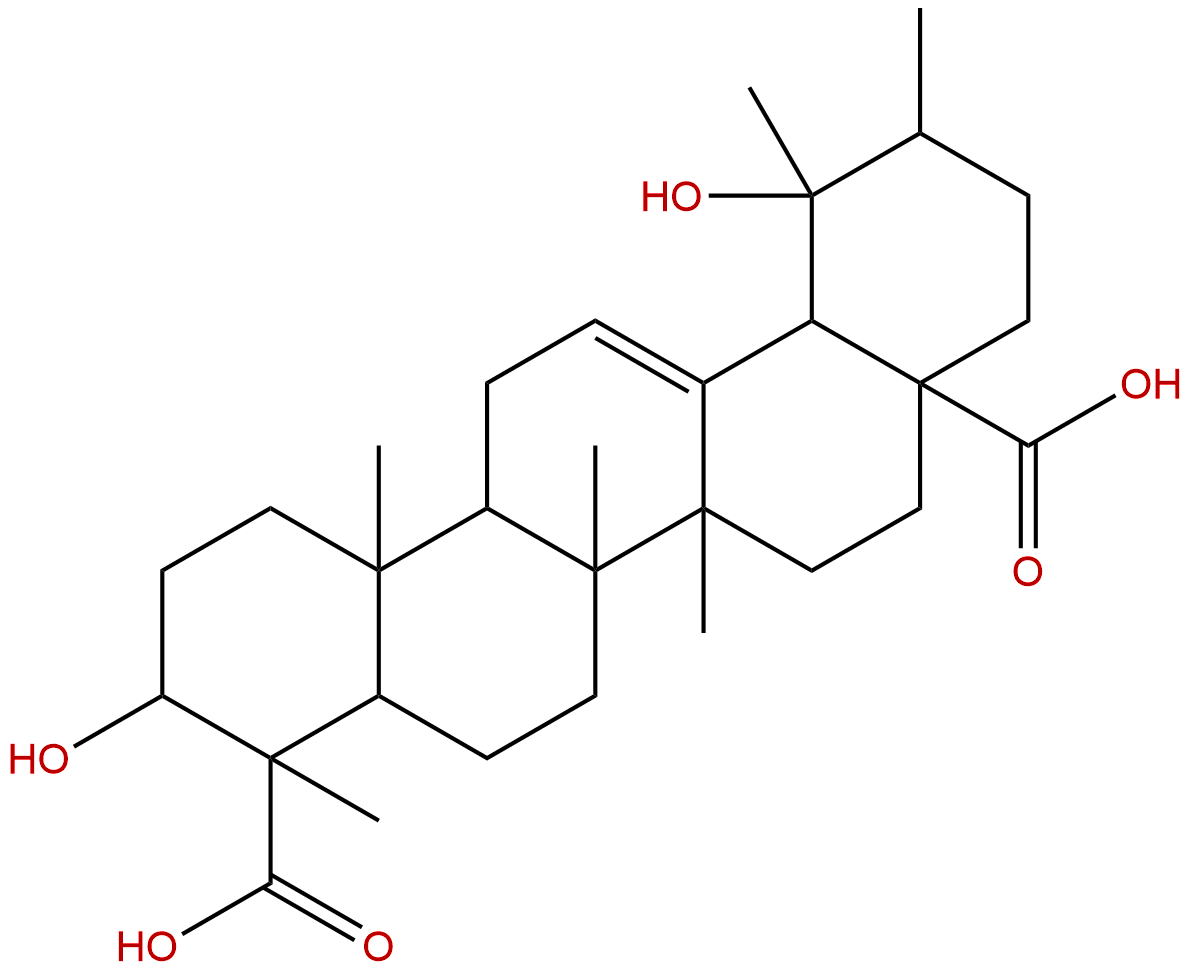
The chemical name of wintergreen A is (3 β, 19 α) -3,19-dihydroxyurso-12-en-28-oic acid, and its CAS number is 108524-94-3. Structurally, it is a typical pentacyclic triterpenoid compound of the Ussurine type. Its parent nucleus is composed of five fused rings (A/B/C/D/E) and has the characteristic structure of a triterpenoid of the Ussurine type: the E ring is a hexagonal ring, and the C-19 angular methyl is connected to the C-4 position. Ilex A has a hydroxyl substitution at positions C-3 and C-19, a carboxyl group at position C-17, and a double bond at position C-12. These functional groups are crucial for their biological activity and physicochemical properties.
Its molecular weight is 502.6920 g/mol, and the calculated lipid water partition coefficient (LogP) is 4.1780, indicating that the compound has good lipophilicity. The theoretical polar surface area (TPSA) is 115.0600 Å ², reflecting the surface area occupied by polar groups (hydroxyl, carboxyl) in the molecule. The water solubility data is relatively low, about 0.0191 mg/mL, which is consistent with its high LogP value, indicating that wintergreen A may need to be improved in its solubility and bioavailability through formulation methods (such as making nanoparticles, cyclodextrin inclusion complexes, or prodrugs) during the development process. Preliminary drug risk assessment shows that its ability to cross the blood-brain barrier is relatively low, which to some extent limits its direct effects on central nervous system related diseases, but may also reduce potential neurotoxic risks. In addition, existing data indicates that it has no significant hERG channel inhibitory activity and genetic toxicity (Ames test result is negative), providing preliminary positive signals for its safety.
Plant sources and extraction methods
Ilex A mainly comes from plants of the Ilex genus in the Ilex family, among which Hainan holly As the main source. Holly plants are widely distributed worldwide, and many species are used in traditional medicine to treat fever, inflammation, and cardiovascular diseases. The unique ecological environment of Hainan Island in China has nurtured abundant resources of holly plants, providing a material basis for the discovery of wintergreen A.
Its extraction and separation usually follow the conventional process of natural product chemistry. Firstly, the dried leaves or stem bark of Hainan holly are crushed and subjected to reflux extraction or ultrasound assisted extraction using organic solvents such as methanol, ethanol, or aqueous ethanol to maximize the extraction of triterpenoid components. The extract is concentrated under reduced pressure to obtain a crude extract. Subsequently, the crude extract was preliminarily separated using solvent partitioning method (such as extraction with petroleum ether, ethyl acetate, and n-butanol in sequence), and wintergreen A was mostly enriched in the ethyl acetate fraction. Further purification depends on a variety of chromatographic techniques, including silica gel column chromatography, reverse phase silica gel column chromatography (such as ODS), dextran gel column chromatography (such as Sephadex LH-20), and high-performance liquid chromatography. By comparing the physicochemical properties of compounds (such as thin-layer chromatography behavior, color reaction) and spectral data (nuclear magnetic resonance hydrogen spectrum, carbon spectrum, mass spectrometry), high-purity wintergreen A can be identified and obtained. With the development of green extraction technology, modern methods such as supercritical fluid extraction may also be applied to improve extraction efficiency and selectivity.
Pharmacological activity research
The pharmacological activity research of Ilex A mainly focuses on anti atherosclerosis and its related pathological processes, showing many beneficial effects.
1. Anti inflammatory effect: Inflammation is the core driving force of atherosclerosis. Research has shown that wintergreen A can significantly inhibit the expression and release of pro-inflammatory factors (such as tumor necrosis factor - α, interleukin-6, interleukin-1 β) in macrophages induced by lipopolysaccharide (LPS) or oxidized low-density lipoprotein (ox LDL). This anti-inflammatory effect is an important basis for its anti atherosclerosis activity.
2. Lipid regulation and promotion of cholesterol efflux: Ilacin A can effectively inhibit the uptake of ox LDL by macrophages, reduce the intracellular lipid accumulation, and thus inhibit the formation of foam cells. More importantly, it can significantly upregulate the expression of ATP binding cassette transporter A1, which is a key protein in the cholesterol reversal process, responsible for transporting intracellular cholesterol to apolipoprotein A-I and promoting cholesterol clearance from peripheral tissues (such as arterial walls) to the liver.
3. Endothelial protective effect: Vascular endothelial dysfunction is the initial link of atherosclerosis. Ilex A has been shown to alleviate endothelial cell damage and apoptosis caused by ox LDL, and improve endothelial dependent vasodilation function. Its mechanism is related to the inhibition of oxidative stress and inflammatory response.
4. Anti apoptotic and plaque stabilizing effects: The rupture of vulnerable plaques is the main cause of acute cardiovascular events. Ilex A regulates the expression of Bcl-2 family proteins (such as upregulating anti apoptotic proteins Bcl-2 and Mcl-1, downregulating pro apoptotic proteins), inhibits apoptosis of vascular endothelial cells and smooth muscle cells, and helps enhance plaque stability.
5. Anti proliferative and anticancer activity: In addition to cardiovascular protection, Ilex A also shows birth growth inhibitory and pro apoptotic activities on a variety of cancer cell lines (such as liver cancer, breast cancer, and lung cancer cells), suggesting that it has the potential to act as an anti-tumor lead compound, but its research depth in the field of cancer is not as deep as arterial atherosclerosis.
Mechanism of action and molecular targets
The multiple pharmacological effects of wintergreen A stem from its precise regulation of multiple key molecular targets and signaling pathways. Existing research has revealed its partial mechanism of action network:
1. Targeting the LOX-1 signaling pathway: Lectin like oxidized low-density lipoprotein receptor-1 is the main receptor for recognizing and uptake of ox LDL on endothelial cells and macrophages, and plays a key role in atherosclerosis. Ilex A has been proven to be an effective inhibitor of LOX-1. It can directly or indirectly inhibit the expression of LOX-1 and its mediated ox LDL endocytosis, thereby blocking the activation of pro-inflammatory signaling pathways such as NF - κ B downstream of LOX-1, reducing inflammation and endothelial damage.
2. Activate the AMPK signaling pathway: AMP activated protein kinase is a core regulator of cellular energy metabolism. Ilex A can activate AMPK. The activation of AMPK can inhibit acetyl CoA carboxylase, hydroxymethylglutaryl-CoA reductase, and regulate the synthesis of fatty acids and cholesterol; On the other hand, activation of AMPK can upregulate the expression of ABCA1 and promote cholesterol efflux. In addition, the activation of AMPK also has anti-inflammatory and insulin sensitivity improving effects.
3. Regulating the epigenetic modifying enzyme EHMT2: Histone lysine methyltransferase 2 is a key enzyme that catalyzes the dimethylation modification of lysine at position 9 of histone H3, and is involved in gene transcriptional silencing. Research has found that wintergreen A can inhibit the activity of EHMT2. The inhibition of EHMT2 may lead to the disinhibition and up regulation of a series of atherosclerotic protective genes (such as ABCA1), which provides a novel epigenetic explanation for the role of ilestin A.
4. Regulating apoptosis related proteins: Ilex A inhibits cell apoptosis by upregulating the expression of anti apoptotic proteins Bcl-2 and Mcl-1, and may also affect other pro apoptotic proteins, which is crucial for maintaining endothelial integrity and plaque stability.
5. Potential target RECQ1: RECQ1 helicase is an important maintainer of DNA repair and genome stability. Some studies suggest that Ilacin A may interact with it, which may be related to its potential anti-tumor activity, but the specific role of Ilacin A in the context of atherosclerosis remains to be clarified.
To sum up, Ilex A forms a synergistic network by simultaneously acting on multiple targets, such as LOX-1, AMPK, EHMT2, Bcl-2/Mgl-1, etc., to jointly exert anti atherosclerosis effects from multiple levels, such as inhibiting lipid uptake, promoting cholesterol clearance, anti-inflammatory, antioxidant, and protecting cell survival.
Evaluation of drug properties and pharmacokinetics
Based on its physicochemical parameters, wintergreen A exhibits potential and challenges as a lead compound for oral medication. Its high LogP value and low water solubility are the main limiting factors affecting its oral absorption and bioavailability. In the development of drug formulations, it is necessary to focus on addressing the issues of solubility and dissolution rate. Its larger molecular weight and moderate TPSA value also suggest that its membrane permeability may be moderate.
At present, there are relatively limited reports on the pharmacokinetic studies of the wintergreen A system, which is a key link that must be supplemented for its preclinical development. Future research needs to investigate in detail the absorption, distribution, metabolism, and excretion processes of small animals (such as rats) and even higher-level animal models after administration. Key focus should be on: absolute bioavailability of oral administration; Its distribution concentration in major target tissues such as aorta and liver; Examine the main metabolic enzymes (such as CYP450 isoenzymes) and metabolites through liver microsomal enzymes or recombinant enzymes; And its excretion pathways (bile, urine). The characteristic of low blood-brain barrier permeability has been obtained from computational data and needs further verification through experiments.
In terms of safety, preliminary hERG inhibition negative and Ames test negative results are a good start, but comprehensive preclinical safety evaluation is still needed, including acute toxicity, long-term repeated administration toxicity, and safety pharmacology studies targeting cardiovascular, respiratory, and central nervous systems.
Clinical application prospects and prospects
As a multi target natural product, Ilex A has broad prospects for development in the prevention and treatment of cardiovascular diseases, especially atherosclerosis and its complications. Its mechanism of action covers many hot directions of current anti atherosclerosis treatment (such as inflammation, cholesterol reverse transport, epigenetic regulation), which may provide new strategies for coping with residual cardiovascular risk.
Its clinical application development may follow the following path:
1. As a new type of chemical entity drug development: After completing systematic pharmacodynamics, pharmacokinetics and toxicology studies, it can be developed as an oral anti atherosclerosis drug. In view of its multi target characteristics, it may be suitable for early intervention of atherosclerosis and treatment of stable plaque.
2. As a dietary supplement or functional food ingredient: Due to its natural source and relatively good safety profile, wintergreen extract or wintergreen extract rich in this ingredient is expected to be developed as a health product for cardiovascular health maintenance.
3. Combination therapy: The mechanism of action of wintergreen A is complementary to statins (which mainly inhibit cholesterol synthesis). Future research can explore whether its combination with statins can achieve better synergistic efficacy while reducing statin dosage or alleviating its side effects.
4. Structural modification and optimization: By using it as the parent nucleus for structural modification, improving its water solubility and pharmacokinetic properties, it is expected to obtain derivatives with stronger activity and better drug properties.
However, in order to achieve its clinical application, it still faces a series of challenges: it needs more in-depth and systematic validation of the efficacy in vivo, especially the efficacy evaluation of long-term administration in atherosclerosis animal models (such as ApoE -/- mice); It is necessary to improve its preclinical pharmacokinetic and toxicological research data as soon as possible; We need to explore and optimize drug delivery systems that are suitable for their physicochemical properties. In addition, the primary secondary relationships and cross dialogue between the targets in its mechanism of action network still need to be further clarified.
Conclusion
Dongxinsu A is a pentacyclic triterpenoid compound with significant biological activity isolated from Hainan holly. A large number of studies have confirmed that it plays a strong anti atherosclerotic potential in anti inflammation, lipid regulation, promoting cholesterol reverse transport, protecting endothelium and anti apoptosis through multi target and multi pathway synergy. Its mechanism of action involves the regulation of key targets such as LOX-1, AMPK, EHMT2, reflecting the advantages of multi-component and multi-target effects of natural products. Although there are challenges such as solubility in the aspect of drug preparation, and systematic pharmacokinetic studies need to be carried out urgently, there is no doubt that Ilex A is a leading anti atherosclerosis compound with great development value. With the continuous deepening of future research, especially the solid promotion of preclinical development, wintergreen A is expected to provide a new natural drug choice for the prevention and treatment of cardiovascular diseases, and also provide important scientific basis for the design of multi-target drugs based on natural products.