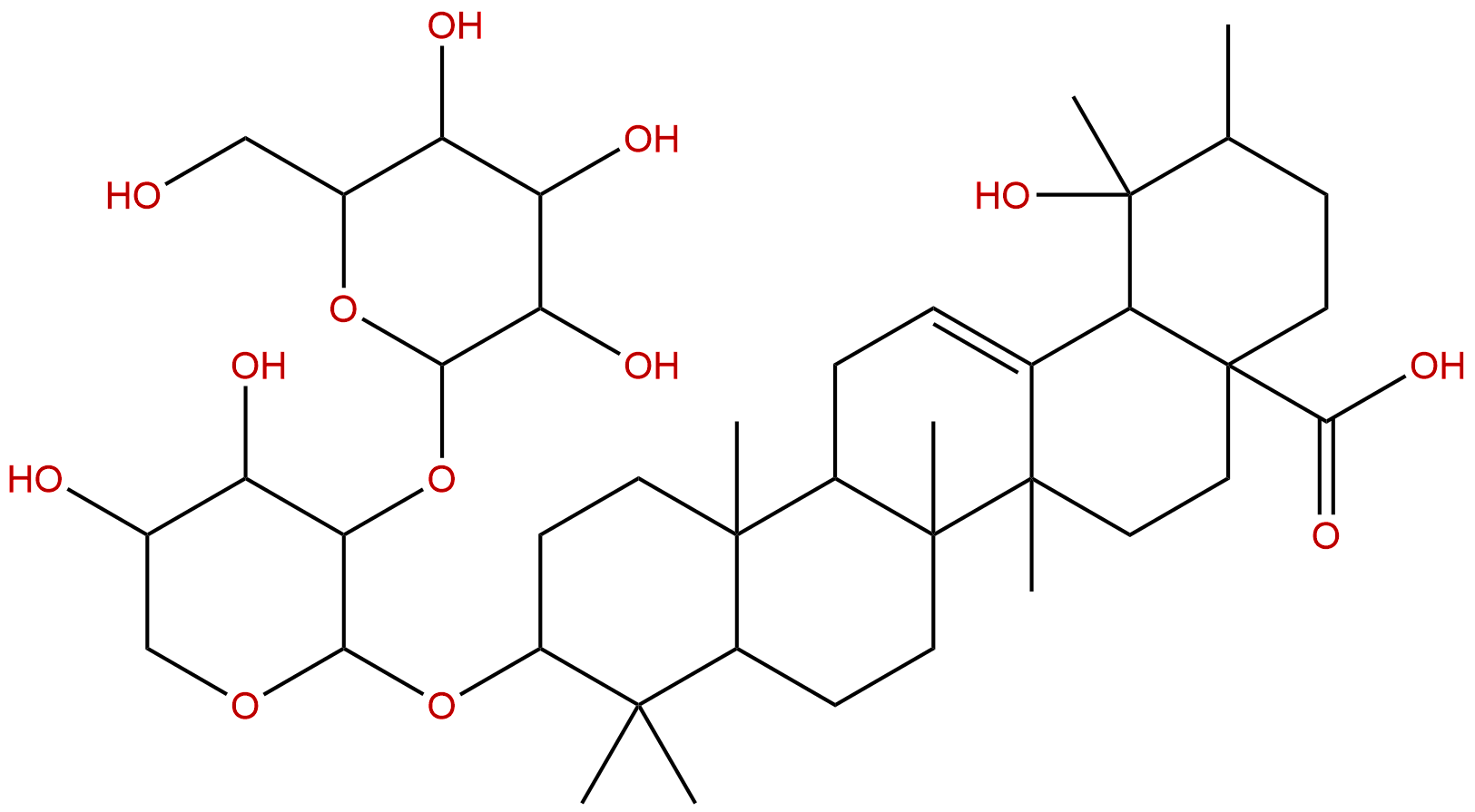


Product name: Ilexsaponin B1
Synonym name:
Catalogue No.: BP1761
Cas No.: 109008-27-7
Formula: C41H66O13
Mol Weight: 766.966
Botanical Source: llexhainanensis Merr(Hainan holly leaf); Ilex pubescens
Physical Description:
Type of Compound:
Purity: 95%~99%
Analysis Method: HPLC-DAD or/and HPLC-ELSD
Identification Method: Mass, NMR
Packing: Brown vial or HDPE plastic bottle
The product could be supplied from milligrams to grams. Inquire for bulk scale.
We provide solution to improve the water-solubility of compounds, thereby facilitating the variety of activity tests and clinic uses.
For Reference Standard and R&D, Not for Human Use Directly.
Storage conditions:Short-term storage at 2~8℃, long-term storage at -20 ~ -80℃
Ilexsaponin B1 is a natural triterpenoid saponin derived from plants of the Ilex genus. Due to its diverse biological activities and potential medicinal value, it has attracted widespread attention in the field of natural product pharmacology in recent years. The plants of the genus Ilex are widely used in traditional Chinese medicine for clearing heat and detoxifying, anti-inflammatory and analgesic purposes. As one of its important chemical components, Ilex saponin B1 exhibits significant anti-tumor, anti-inflammatory and immune regulatory activities, especially in the treatment research of malignant tumors such as lung cancer, showing unique potential.
Lung cancer, as one of the malignant tumors with the highest incidence rate and mortality worldwide, urgently needs to develop new treatment strategies and drugs. Mao Dongqing saponin B1 exhibits multiple mechanisms of inhibiting lung cancer cell proliferation, inducing apoptosis, and suppressing tumor metastasis by regulating multiple signaling pathways and key molecular targets, making it a hot topic in the research of natural anticancer drugs. This article will provide a systematic review of the chemical structure and physicochemical properties, plant sources and extraction processes, pharmacological activity and mechanism of action, pharmacological evaluation and pharmacokinetic characteristics of Mao Dongqing saponin B1. Combined with its potential application in the treatment of lung cancer, it will explore its future clinical development prospects.
Mao Dongqing saponin B1 is a typical triterpenoid saponin with a molecular formula of C42H66O14 and a molecular weight of 766.9660. Its structure contains a pentacyclic triterpenoid nucleus, connecting multiple sugar residues to form a typical saponin structure. The LogP value of this compound is 2.4519, indicating moderate lipid solubility and facilitating membrane penetration. The TPSA (topological polar surface area) is 215.8300, indicating that it has strong polar groups, which may affect the permeability of its biofilm and its binding ability to targets.
The water solubility is 0.0759, which belongs to low solubility compounds, indicating that dissolution and absorption in vivo may be limited. The low blood-brain barrier permeability of Mao Dongqing saponin B1 indicates its limited distribution in the central nervous system, which may reduce the risk of central nervous system toxicity. The hERG channel inhibition experiment showed a negative result, indicating a low risk of cardiac toxicity. The Ames mutagenicity test result was 0.0, indicating that the compound had no significant mutagenicity and had high safety.
Mao Dongqing saponin B1 mainly exists in plants of the Mao Dongqing genus, especially in Ilex pubescens and its related species. The genus Ilex is widely distributed in southern China and Southeast Asia, traditionally used for treating cardiovascular diseases, inflammation, and tumors.
The common methods for extracting saponin B1 from Ilex mongolica include solvent extraction, liquid-liquid partitioning, column chromatography, and high-performance liquid chromatography (HPLC) separation. Generally, ethanol or methanol is used for crude extraction, followed by separation of the aqueous and organic phases to remove lipophilic impurities, and then separation and purification are carried out using silica gel columns or C18 reverse phase columns. In recent years, ultrasound assisted extraction and microwave-assisted extraction techniques have been introduced to improve extraction efficiency and purity. In addition, attention should be paid to controlling temperature and pH during the preparation process to prevent degradation of saponin structures.
Mao Dongqing saponin B1 exhibits significant inhibitory effects in various lung cancer cell lines. In vitro experiments have shown that the compound can inhibit the proliferation of lung cancer cells, induce cell cycle arrest, and promote cell apoptosis. Its anti-tumor effect is closely related to the regulation of multiple signaling pathways, including inhibition of STAT3, MAPK1, and PI3K/Akt pathways, regulation of BCL2 family protein expression, and promotion of CASP9-mediated apoptosis pathway activation.
Mao Dongqing saponin B1 has good anti-inflammatory activity, which can inhibit the expression of inflammatory factors such as TNF - α, IL-6, and NF - κ B, and alleviate inflammatory reactions. Its immune regulatory effect mainly manifests as regulating the function of macrophages and lymphocytes, enhancing the body's immune surveillance ability, and providing auxiliary support for its anti-tumor effect.
In addition to anti lung cancer and anti-inflammatory effects, the saponin B1 of Ilex mongolica also exhibits certain antioxidant activity, which can clear free radicals and protect cells from oxidative damage. In addition, studies have shown that it has a protective effect on the cardiovascular system and may improve myocardial injury by regulating the PPAR γ signaling pathway.
The anti lung cancer effect of Mao Dongqing saponin B1 involves multiple molecular targets and signaling pathways, and the specific mechanism is as follows:
The synergistic effect of these targets gives Mao Dongqing Saponin B1 the advantage of multi-target and multi pathway in the treatment of lung cancer, which helps to overcome the resistance problem of single target drugs.
The pharmacological parameters of Mao Dongqing saponin B1 indicate that it has certain potential for development. The high molecular weight (766.9660) and polarity (TPSA 215.8300) may limit its oral bioavailability, but a moderate LogP value (2.4519) is beneficial for membrane permeation. Its water solubility is low (0.0759), indicating the need to improve dissolution and absorption through formulation optimization such as nanocarriers, liposomes, etc.
The low permeability of the blood-brain barrier reduces the risk of central nervous system side effects. A negative hERG channel inhibition indicates good cardiac safety, while a negative Ames test supports its genotoxic safety. There are relatively few studies on the pharmacokinetics of this compound in vivo, and preliminary data indicate that it is widely distributed in the body, mainly metabolized through the liver enzyme system, with a moderate half-life, making it suitable for further pharmacokinetic optimization and formulation development.
As a natural product with multi-target anti lung cancer activity, Mao Dongqing saponin B1 has good pharmacological activity and safety basis, showing great potential for clinical development. Future research should focus on:
In summary, as an emerging candidate molecule for natural product drug development, Mao Dongqing saponin B1 has broad application prospects and deserves continuous attention and investment from scientific research and the pharmaceutical industry.
Mao Dongqing saponin B1, as an important triterpenoid saponin in Mao Dongqing plants, has shown significant potential in the treatment of malignant tumors such as lung cancer due to its unique chemical structure and multi-target pharmacological activity. Its anti-tumor mechanism involves multiple signaling pathways and key molecular targets, with multiple effects such as inducing apoptosis, inhibiting proliferation, and anti-inflammatory immune regulation. The pharmacological evaluation shows that the compound has good safety, but its water solubility and bioavailability still need to be optimized. In the future, through in-depth pharmacokinetic studies, dosage form innovation, and preclinical validation, it is expected to promote the clinical application of Ilex japonicus saponin B1 and provide new treatment options for lung cancer patients. As an important resource for drug discovery, natural products have enriched the natural anti-cancer drug library and provided strong support for multi-target anti-tumor strategies.
