Introduction/Overview
Natural products, as an important source of drug discovery, play an irreplaceable role in the history of human disease treatment. Among them, saponin compounds have always been a hot topic in medicinal chemistry and pharmacology research due to their structural diversity and wide range of biological activities. Ilexsaponin B2, a traditional medicinal plant derived from Ilex mongolica(Ilex pubescens The active saponins isolated from Hook. et Arn. are increasingly receiving attention from researchers. Its CAS number is 108906-69-0, and preliminary studies have revealed that it has significant phosphodiesterase 5 (PDE5) inhibitory activity (IC50=48.8 μ M), suggesting its potential application value in cardiovascular and male dysfunction fields. However, in recent years, the research perspective has been greatly expanded, especially in the field of anti-tumor. Mao Dongqing saponin B2 has shown the potential for multi-target and multi pathway intervention in colorectal cancer models, involving multiple key targets such as AMPK, apoptosis related proteins (MCL1, BCL2), drug metabolizing enzymes (CES1, CES2), inflammation and signaling pathways (TLR4, STAT3), drug efflux pumps (ABCB1, ABCG2), and matrix metalloproteinases (MMP2). This article aims to systematically review the chemical properties, plant sources, pharmacological activities, mechanisms of action, medicinal properties, and clinical application prospects of Mao Dongqing saponin B2, in order to provide comprehensive scientific references for the in-depth research and development of this compound.
Chemical structure and physicochemical properties
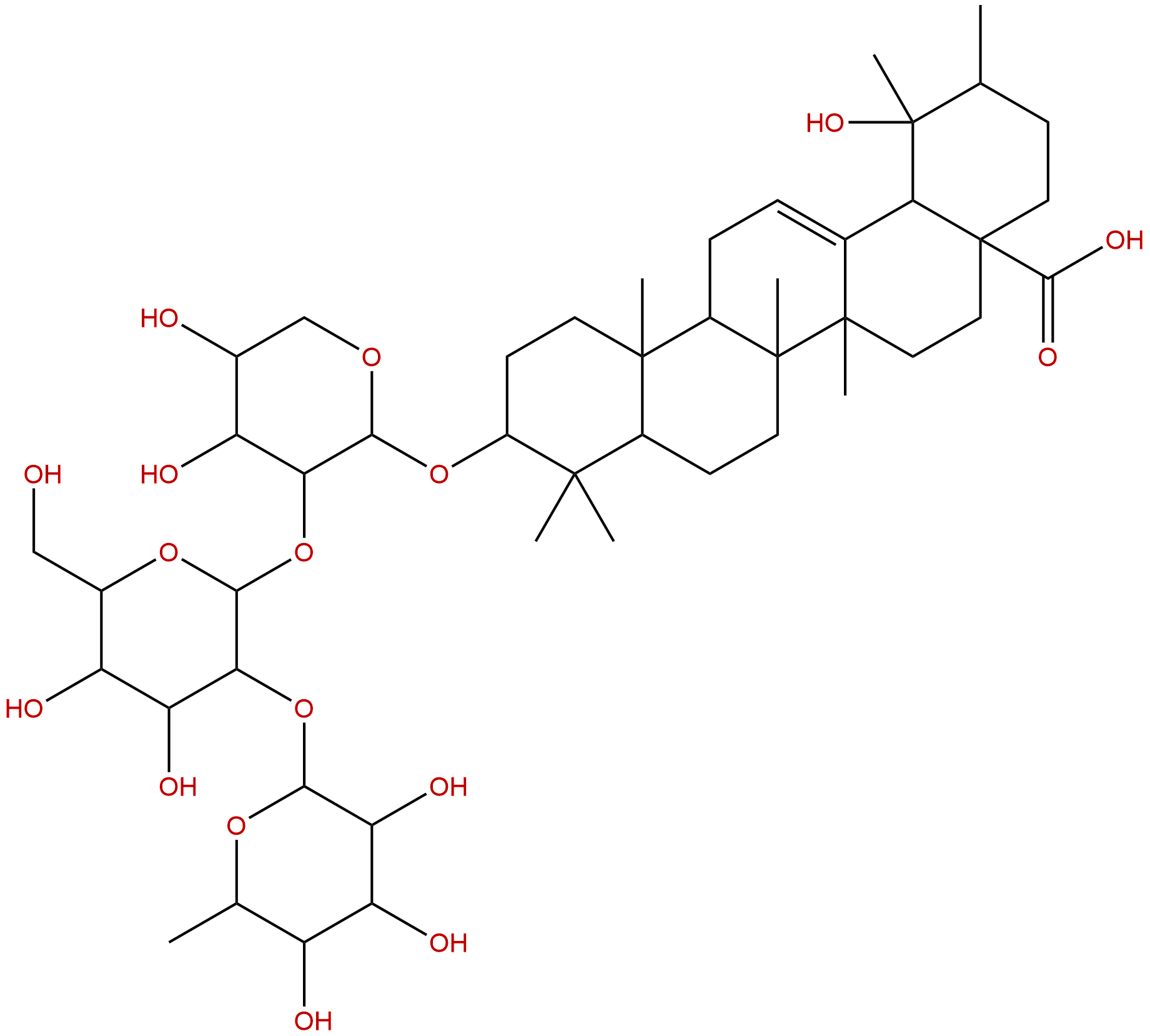
Mao Dongqing saponin B2 belongs to the triterpenoid saponin class, with a molecular formula of C47H76O17 and a molecular weight of 913.1080. Its basic skeleton is an oleanane type pentacyclic triterpene, with the sugar chain partially connected to specific hydroxyl positions of sapogenins. This glycosylation modification is crucial for its water solubility and biological activity. From the analysis of physical and chemical properties, the calculated lipid water partition coefficient (LogP) is 2.1290, indicating that the compound has a certain lipophilicity but is not highly lipophilic. Its topological polar surface area (TPSA) is as high as 274.7500 Å ², mainly attributed to the abundant hydroxyl and glycosyl oxygen atoms in the molecule, indicating strong molecular polarity. The water solubility value is 0.1257, belonging to the category of slight solubility, which is consistent with the structural characteristics of its saponins - although it contains hydrophilic sugar chains, the large hydrophobic triterpenoid skeleton limits its free dissolution in water. These basic physicochemical parameters provide a preliminary predictive basis for its subsequent formulation research and pharmacokinetic behavior.
Plant sources and extraction methods
Mao Dongqing Saponin B2 mainly comes from the genus Mao Dongqing in the family Ileaceae(Ilex pubescens Hook. et Arn. roots or leaves. Mao Dongqing, also known as "Mao Pi Shu", is a commonly used folk herb in southern China, traditionally used to treat cardiovascular diseases, inflammation, and sore throat. The extraction of its active ingredients usually follows the conventional process of natural product chemistry. Firstly, dry holly roots or leaves are crushed and subjected to heating reflux or ultrasound assisted extraction using methanol, ethanol, or ethanol water mixed solvents to extract polar components including saponin B2 to the maximum extent possible. After vacuum concentration, the crude extract was subjected to systematic solvent partitioning using solvents such as petroleum ether, ethyl acetate, and n-butanol. The saponin B2 of Ilex mongolica was mainly enriched in the n-butanol fraction. Further purification relies on modern chromatographic techniques such as silica gel column chromatography, reverse phase C18 column chromatography, and high-performance liquid chromatography (HPLC) preparation. Through structural identification using techniques such as nuclear magnetic resonance (NMR) and mass spectrometry (MS), high-purity B2 monomers of Ilex mongolica saponins were ultimately obtained. Optimizing the extraction and separation process to improve yield is a prerequisite for ensuring its subsequent biological research and application.
Pharmacological activity research
The pharmacological activity research of Mao Dongqing saponin B2 has expanded from the initial PDE inhibition to a wider range of fields, especially accumulating important evidence in anti-tumor aspects.
1. PDE inhibitory activity As an effective PDE5 inhibitor (IC50 48.8 μ M), wintergreen saponin B2 can mediate vascular smooth muscle relaxation by increasing intracellular cyclic guanosine monophosphate (cGMP) levels, providing a theoretical basis for its application in diseases such as pulmonary hypertension and erectile dysfunction. Its inhibitory activity against PDE1 (IC50 477.5 μ M) is relatively weak.
2. Anti colorectal cancer activity This is the core focus of current research. In vitro experiments have shown that saponin B2 from Ilex japonicus can significantly inhibit the proliferation of various colorectal cancer cell lines (such as HCT-116, SW480) and induce cell apoptosis. In animal models, it can inhibit the growth of transplanted tumors and show synergistic effects when combined with certain chemotherapy drugs.
3. Other potential activities Based on its traditional use as a plant source, holly saponin B2 may also have anti-inflammatory, antioxidant, and cardiovascular protective effects, but specific research in these areas is still needed.
Mechanism of action and molecular targets
The mechanism of action of Mao Dongqing saponin B2 against colorectal cancer is complex, showing the characteristics of multi-target and networked regulation, mainly involving the following pathways and targets:
1. Energy metabolism and apoptosis regulation Mao Dongqing saponin B2 has been confirmed to activate AMP activated protein kinase (AMPK, encoded by PRKAA1). AMPK is an energy sensor in cells, and its activation can inhibit the mammalian rapamycin target protein (mTOR) pathway, thereby suppressing tumor cell proliferation and initiating autophagy. At the same time, it can downregulate the expression of anti apoptotic proteins B cell lymphoma 2 (BCL2) and myeloid leukemia 1 (MCL1), disrupt mitochondrial membrane stability, promote cytochrome C release, and activate the caspase cascade reaction, leading to tumor cell apoptosis.
2. Drug sensitivity regulation The regulation of carboxylesterase 1 and 2 (CES1, CES2) by holly saponin B2 may affect the activation efficiency of prodrugs (such as irinotecan) in tumor cells. More importantly, it can inhibit the expression or function of ATP binding cassette transporters B1 and G2 (ABCB1/P-gp, ABCG2/BCRP). These two proteins are the main efflux pumps that cause multidrug resistance (MDR) in tumors, and their inhibition can reverse drug resistance and increase the accumulation of chemotherapy drugs in cells.
3. Inflammation and tumor microenvironment intervention By inhibiting the activation of Toll like receptor 4 (TLR4) and its downstream signaling and transcription activator 3 (STAT3), holly saponin B2 can block the transmission of pro-inflammatory and pro survival signals. The sustained activation of STAT3 is closely related to tumor proliferation, angiogenesis, and immune escape. In addition, its inhibition of matrix metalloproteinase 2 (MMP2) may help reduce the invasion and metastasis ability of tumor cells.
4. Initial target and signal integration Although its PDE5 inhibitory activity is clear, it is unclear whether PDE5 inhibition is its core initiating event in the context of anti-tumor therapy. At present, it is believed that the saponin B2 of Ilex mongolica may exert its anti colorectal cancer effect by directly or indirectly acting on multiple targets mentioned above, integrating metabolic, apoptotic, inflammatory, and microenvironmental signals.
Evaluation of drug properties and pharmacokinetics
Based on the provided parameters and existing knowledge, the preliminary evaluation of the pharmacological properties of Mao Dongqing saponin B2 is as follows:
* Absorption and distribution A molecular weight exceeding 900 and a high TPSA value may limit its ability to passively diffuse across intestinal epithelial cell membranes, resulting in lower oral bioavailability. Its blood-brain barrier permeability is predicted to be "low", which is consistent with the characteristics of most highly polar saponins, meaning that it may not easily enter the central nervous system, which is unfavorable for treating brain tumors, but may also reduce the risk of central nervous system side effects.
* Metabolism and excretion As a saponin compound, it is easily hydrolyzed by glycosidases in gastrointestinal microbiota and intestinal epithelial cells in vivo, undergoing deglycosylation and generating glycosides. Glycosides have higher LogP values and are more easily absorbed, but their activity may change. The specific metabolic pathways (such as the degree of involvement of CYP450 enzyme system) and excretion modes (bile/kidney) of prototype drugs and metabolites still need to be experimentally elucidated.
* Preliminary Safety Prediction The inhibitory prediction of hERG is' no ', which is a positive signal indicating a lower risk of potential cardiac toxicity (inducing long QT syndrome). The Ames test predicted a value of 0.0, indicating that it may not have direct genetic toxicity. However, these are all computational predictions that must be validated through standardized preclinical toxicology experiments (such as acute toxicity, long-term toxicity, reproductive toxicity, etc.).
* Formulation Challenge Due to its micro solubility, developing suitable formulations to improve its solubility and oral absorption is a key step for future drug development, and formulation technologies such as nanocrystals, liposomes, and solid dispersions can be considered.
Clinical application prospects and prospects
The clinical application prospects of Mao Dongqing saponin B2 mainly revolve around two directions:
1. As a candidate drug or adjuvant therapy for colorectal cancer Its multi-target mechanism of action, especially its ability to reverse multidrug resistance and induce apoptosis, makes it promising for development as a novel anti colorectal cancer drug. A more realistic approach may be to use it as a sensitizer for chemotherapy (such as 5-fluorouracil, oxaliplatin) or targeted therapy, to overcome clinical resistance challenges and improve the efficacy of existing therapies.
2. Expand to other indications Based on its PDE5 inhibitory activity, its application value in areas such as pulmonary arterial hypertension and erectile dysfunction can be explored. Its potential anti-inflammatory and immune regulating effects are also worth verifying in inflammation related disease models.
However, there are many challenges facing clinical application: firstly, it is necessary to systematically complete preclinical pharmacological, pharmacokinetic, and toxicological studies, clarify their therapeutic window and safety. Secondly, it is necessary to solve the problem of low oral bioavailability, which relies on innovation in the field of pharmacy. Furthermore, further structural biology research is needed to clarify the exact binding mode with key targets such as AMPK and ABCB1, providing guidance for structural optimization. Finally, exploring its rational combination therapy with other drugs will be an important strategy to achieve its clinical value.
Conclusion
Mao Dongqing saponin B2, as a natural saponin derived from traditional herbs, has evolved from a single PDE inhibitor to a star molecule with multi-target intervention potential in the field of colorectal cancer. It exhibits a comprehensive pharmacological effect of inhibiting tumor growth, reversing drug resistance, and regulating the microenvironment by regulating multiple key nodes such as AMPK, apoptotic proteins, drug transport pumps, and inflammatory signaling pathways. Despite facing challenges in drug formulation, such as solubility and oral absorption, commonly found in saponin compounds, their relatively good preliminary safety predictions have laid the foundation for their subsequent development. Future research should focus on revealing its original targets and signaling networks, optimizing its pharmacokinetic properties, and actively conducting standardized preclinical and clinical studies. The exploration process of Mao Dongqing saponin B2 once again confirms that discovering natural products from traditional medicinal plants that are compatible with modern disease treatment targets is a promising new drug development path.