


Product name: Isoferulic Acid
Synonym name: Hesperetic acid; Hesperetinic acid; Extra CAS No: 24276-84-4, 25522-33-2
Catalogue No.: BP0781
Cas No.: 537-73-5
Formula: C10H10O4
Mol Weight: 194.186
Botanical Source: Cimicifuga racemosa, Catalpa ovata, Ixora javanica and other plants
Physical Description: Powder
Type of Compound: Phenylpropanoids
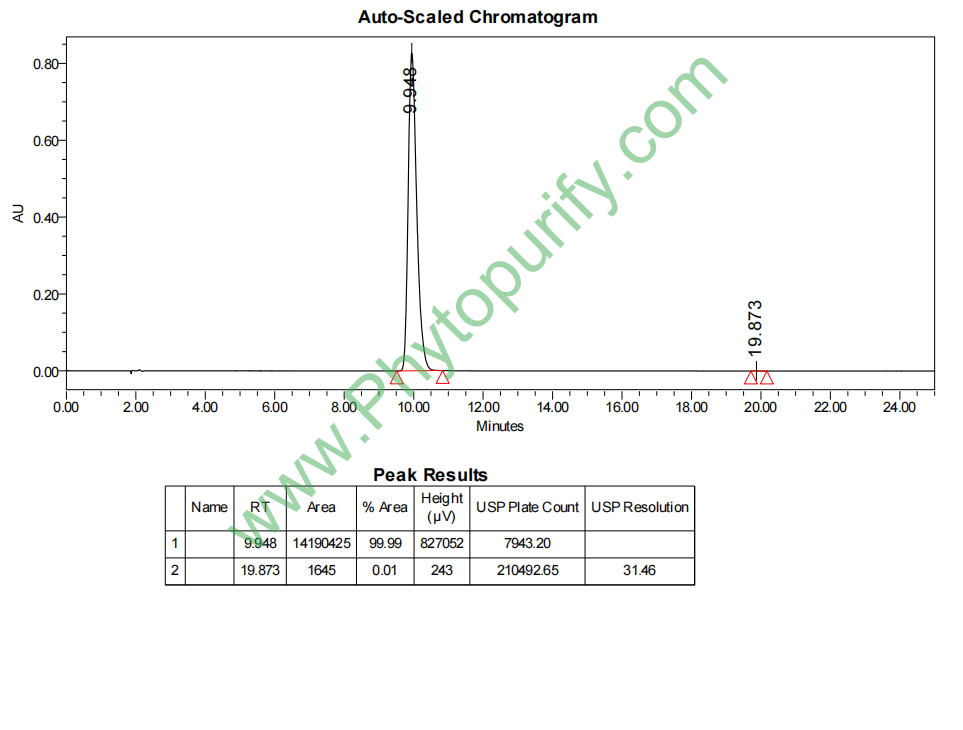
Purity: 95%~99%
Analysis Method: HPLC-DAD or/and HPLC-ELSD
Identification Method: Mass, NMR
Packing: Brown vial or HDPE plastic bottle
Storage: Store in a well closed container, protected from air and light. Put into refrigerate or freeze for long term storage.
Whenever possible, you should prepare and use solutions on the same day. However, if you need to make up stock solutions in advance, we recommend that you store the solution as aliquots in tightly sealed vials at -20℃. Generally, these will be useable for up to two weeks.
The product could be supplied from milligrams to grams, up to kilograms
Inquire for bulk scale.
Descriptions:
3-Hydroxy-4-methoxycinnamic acid has kinetics governing the inhibitory effect on tyrosinase-catalyzed reactions.[1]
References:
[1]Gong S Z, Chen Q S, Xu M Y, et al. Modern Food Science & Technology, 2015, 31(4):192-6.
[2] Huang G W, Wei B H, Huang X Y, et al. Detergent & Cosmetics, 2010, 33(7):30-2.
HPLC of Isoferulic Acid
Storage conditions:Short-term storage at 2~8℃, long-term storage at -20 ~ -80℃
66.7600
1.8862
-.7297
1.5785
5.0125
14.6471
Low
87.3724
1.9097
Yes
No
No
No
Yes
No
0.0
No
Yes
Yes
Yes
Isoferulic acid (CAS number: 537-73-5) is an important natural phenolic compound belonging to the family of trans cinnamic acid derivatives. Its structural features include methoxy and hydroxyl substituents at positions 4 and 3 on the benzene ring, respectively, endowing it with unique biological activity. As a naturally occurring secondary metabolite, isoferulic acid is widely distributed in various Chinese herbal medicines and edible plants. Due to its significant antioxidant activity and multi-target regulatory effects, it has received widespread attention in the field of natural product pharmacology in recent years. Isoferulic acid not only exhibits excellent free radical scavenging ability, but also regulates the expression of various antioxidant enzymes in cells, thereby exerting a protective effect on cells from oxidative damage. In addition, its potential as a metabolite and biomarker is gradually being explored, providing new ideas for disease prevention and treatment.
This article will provide a systematic review of the chemical structure and physicochemical properties, plant sources and extraction methods, pharmacological activity and mechanism of action, pharmacological evaluation and pharmacokinetic characteristics of isoferulic acid, and explore its clinical application prospects and future development directions, aiming to provide comprehensive and authoritative reference materials for researchers in related fields.
The chemical name of isoferulic acid is 3-hydroxy-4-methoxycinnamic acid, which is an isomer of ferulic acid with a molecular formula of C10H10O4 and a molecular weight of 194.1860. It contains a trans cinnamic acid skeleton in its structure, and the substituents at the 3rd hydroxyl and 4th methoxy positions on the benzene ring endow it with strong electron supply ability and free radical stability. The LogP value of isoferulic acid is about 1.8862, indicating that it has moderate lipid solubility, which is beneficial for cell membrane penetration but not excessively hydrophobic, promoting its bioavailability. The polar surface area (TPSA) is 66.76 Å ², indicating that it has a certain affinity in polar environments, which is conducive to binding to protein targets.
The water solubility data (1.5785) shows that isoferulic acid has good water solubility, which is of positive significance for oral administration and in vivo distribution. The low permeability of the blood-brain barrier suggests that its direct effect on the central nervous system may be limited, but it also reduces the potential toxicity risk to the central nervous system. The hERG channel inhibition experiment result was negative, indicating that isoferulic acid has a high electrophysiological safety for the heart. The Ames mutagenicity test result was 0.0, indicating no significant genotoxicity and good safety.
In summary, the physicochemical properties of isoferulic acid provide a good foundation for its use as a drug candidate molecule, with moderate lipid solubility and water solubility, and excellent safety indicators.
Isoferulic acid is widely present in various medicinal and edible plants, especially in some traditional Chinese medicinal materials where its content is relatively high. Common plant sources include but are not limited to:
The commonly used methods for extracting isoferulic acid are mainly based on solvent extraction and chromatographic separation techniques. Traditional extraction often uses polar organic solvents such as methanol, ethanol, or ethyl acetate, and improves extraction efficiency through reflux extraction or ultrasound assisted extraction. After concentration, the extract is purified and separated using silica gel column chromatography and reverse phase high performance liquid chromatography (RP-HPLC).
In recent years, green extraction techniques such as supercritical CO2 extraction, microwave-assisted extraction, and enzymatic assisted extraction have also been applied to the extraction of isoferulic acid, significantly improving extraction efficiency and purity, reducing the use of organic solvents, and in line with the environmental trend of modern natural product extraction.
The pharmacological activity research of isoferulic acid mainly focuses on its antioxidant, anti-inflammatory, anti-tumor, and neuroprotective aspects.
Isoferulic acid has significant free radical scavenging ability and can effectively scavenge superoxide anion radicals, hydroxyl radicals, and reactive oxygen species (ROS) such as hydrogen peroxide. In vitro experiments have shown that its DPPH free radical scavenging rate and ABTS free radical scavenging rate are superior to similar natural phenolic compounds. Its antioxidant effect is not only reflected in direct free radical scavenging, but also achieved by regulating the intracellular antioxidant enzyme system, including superoxide dismutase (SOD1, SOD2), catalase (CAT), glutathione peroxidase (GPX1), and heme oxygenase 1 (HMOX1).
Isoferulic acid can inhibit the expression of various pro-inflammatory factors, such as tumor necrosis factor - α (TNF - α), interleukin-6 (IL-6), and cyclooxygenase-2 (COX-2), and alleviate inflammatory responses. Its anti-inflammatory mechanism partially relies on inhibiting the activation of the NF - κ B signaling pathway and reducing the production of inflammatory mediators.
Multiple in vitro cell experiments have shown that isoferulic acid has inhibitory effects on proliferation and induces apoptosis in various tumor cell lines. Its mechanism involves regulating cell cycle proteins, activating mitochondrial apoptosis pathways, and inhibiting tumor related signaling pathways such as PI3K/Akt and MAPK pathways. Meanwhile, isoferulic acid can enhance the sensitivity of chemotherapy drugs and demonstrate potential adjuvant anti-cancer value.
Although isoferulic acid has low blood-brain barrier permeability, it exhibits certain neuroprotective effects by regulating oxidative stress and inflammatory responses in the peripheral nervous system. In Alzheimer's and Parkinson's disease models, isoferulic acid can alleviate oxidative damage, inhibit neuroinflammation, and delay the progression of neurodegenerative diseases.
The biological effects of isoferulic acid are mainly achieved by regulating the intracellular antioxidant defense system and related signaling pathways. Its key molecular targets include:
NFE2L2 (Nuclear factor erythroid 2-related factor 2, NRF2)Isoferulic acid can activate the NRF2 signaling pathway, promote nuclear translocation, and enhance the expression of downstream antioxidant enzyme genes such as SOD1, SOD2, CAT, GPX1, and HMOX1, thereby enhancing cellular antioxidant capacity and reducing oxidative stress damage.
SOD1 and SOD2 (superoxide dismutase)Isoferulic acid promotes the conversion of superoxide anion radicals into hydrogen peroxide and reduces the toxicity of free radicals by upregulating the expression of SOD1 and SOD2.
CAT (catalase) and GPX1 (glutathione peroxidase)Isoferulic acid enhances the activity of these enzymes, accelerates the decomposition of hydrogen peroxide, and maintains intracellular redox balance.
HMOX1 (Heme Oxygenase 1)As a key enzyme in cellular stress response, HMOX1 expression is induced by isoferulic acid, which participates in cellular defense mechanisms and reduces oxidative damage.
In addition, isoferulic acid also regulates inflammation and cell apoptosis by inhibiting signaling pathways such as NF - κ B, MAPK, and PI3K/Akt, forming a multi-target, multi pathway synergistic pharmacological network.
From the perspective of medicinal properties, isoferulic acid has multiple advantageous characteristics:
In terms of pharmacokinetics, isoferulic acid exhibits good absorption characteristics in vivo, but its distribution in the central nervous system is limited due to the low permeability of the blood-brain barrier. Its metabolic pathway mainly involves phase I and phase II metabolism of the liver enzyme system, generating various water-soluble metabolites and promoting excretion. Moderate half-life in the body, suitable for multiple administrations to maintain effective blood drug concentration.
At present, the systematic pharmacokinetic research on isoferulic acid is not sufficient, and further in-depth studies on in vivo kinetics, metabolic pathways, and drug interactions are needed in the future to improve its pharmacological evaluation.
As a natural product, isoferulic acid has shown great potential for application in the prevention and treatment of various diseases due to its excellent antioxidant and multi-target regulatory properties.
Future research should focus on the structural modification of isoferulic acid and the development of drug delivery systems to enhance its bioavailability and targeting; Simultaneously strengthen preclinical and clinical research to verify its safety and efficacy, and promote its translation into clinical applications.
As a natural product with multiple biological activities, isoferulic acid has shown extensive pharmacological potential in fields such as antioxidant, anti-inflammatory, anti-tumor, and neuroprotective effects due to its unique chemical structure and excellent physicochemical properties. It exerts a cell protective effect by activating NRF2 and regulating the expression of various antioxidant enzymes, with a clear mechanism and multi-target synergy. Good drug properties and high safety have laid a solid foundation for its drug development.
Although significant progress has been made in the research of isoferulic acid, its systematic pharmacokinetic characteristics, clinical efficacy, and safety verification still need to be further explored. In the future, the combination of modern medicinal chemistry, molecular biology, and drug delivery technology is expected to promote the development of isoferulic acid and its derivatives as important members of new natural medicines, providing innovative solutions for the prevention and treatment of related diseases.
