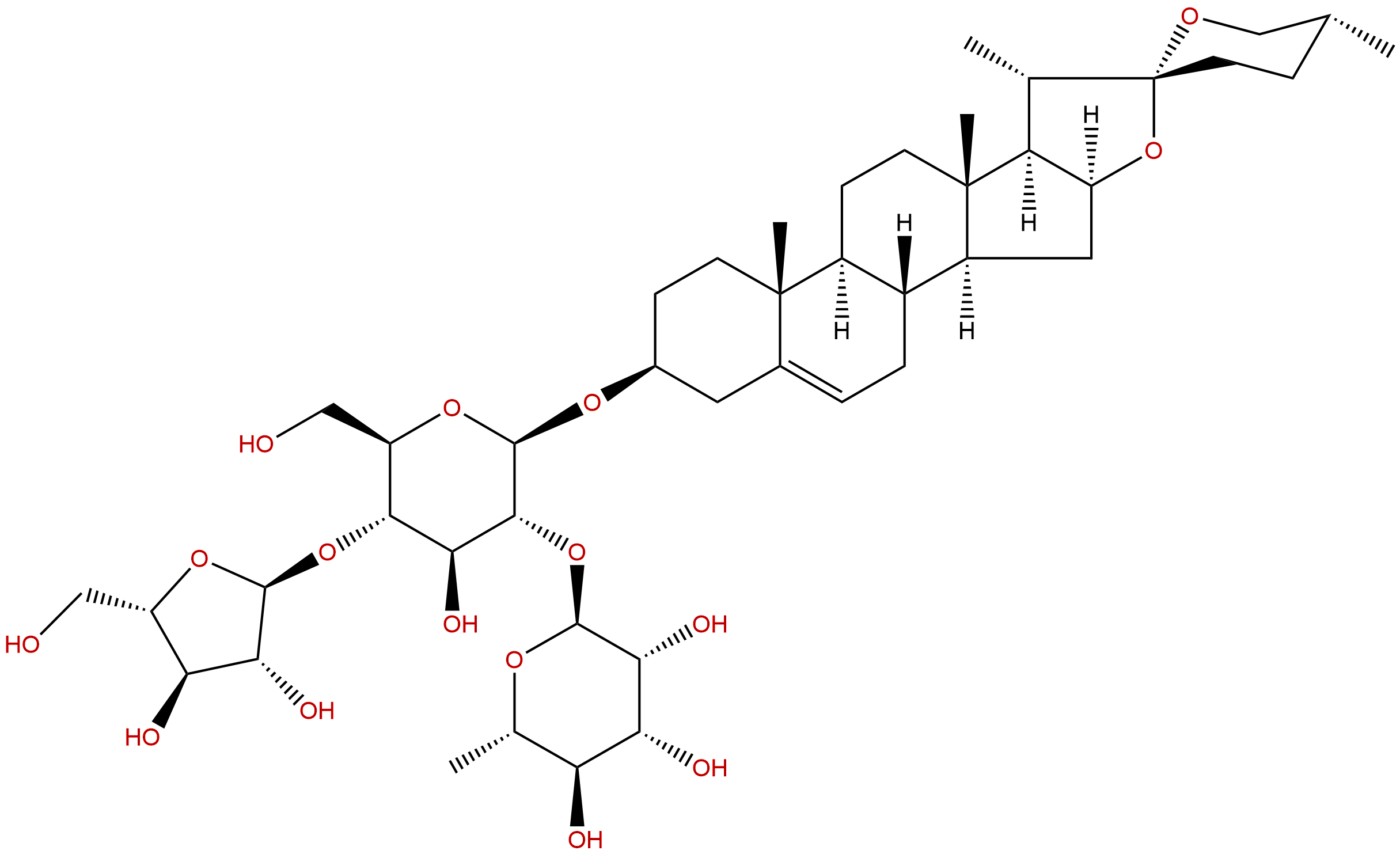


Product name: Polyphyllin I
Synonym name:
Catalogue No.: BP3323
Cas No.: 50773-41-6
Formula: C44H70O16
Mol Weight: 855.028
Botanical Source:
Physical Description: Powder
Type of Compound: Steroids
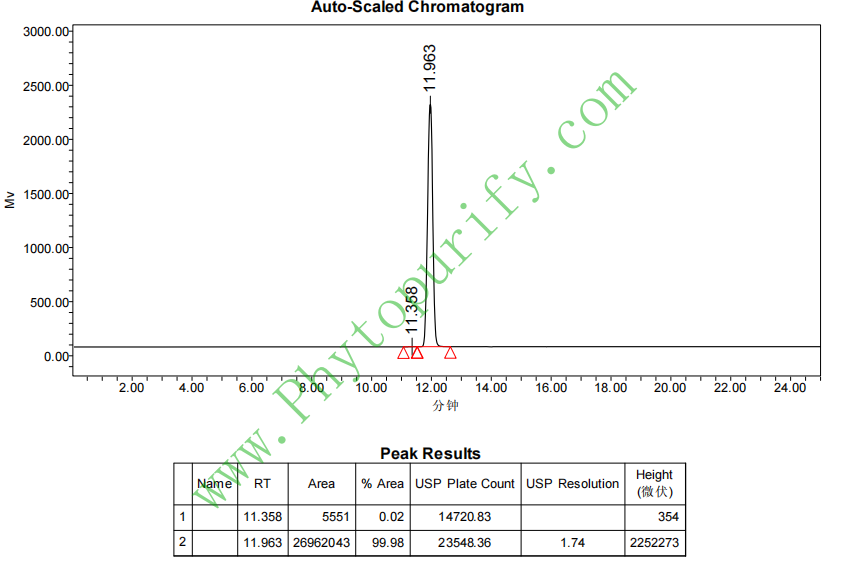
Purity: 95%~99%
Analysis Method: HPLC-DAD or/and HPLC-ELSD
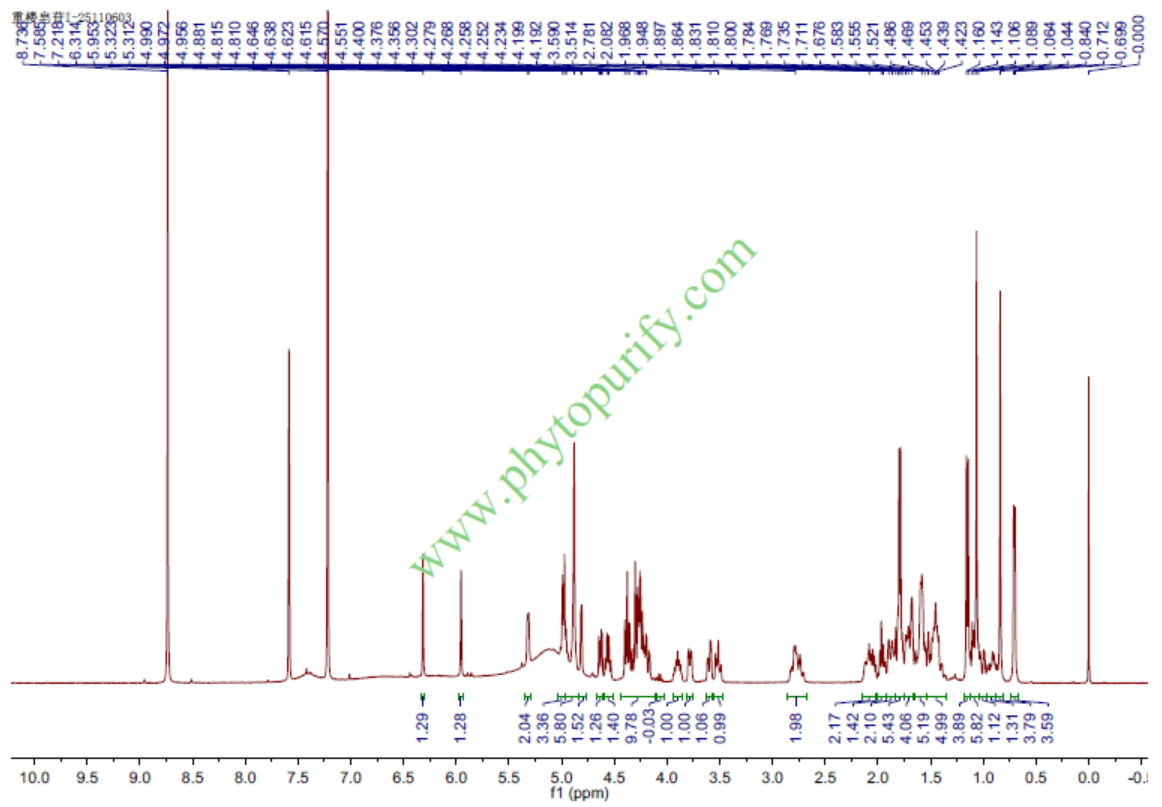
Identification Method: Mass, NMR
Packing: Brown vial or HDPE plastic bottle
The product could be supplied from milligrams to grams. Inquire for bulk scale.
We provide solution to improve the water-solubility of compounds, thereby facilitating the variety of activity tests and clinic uses.
For Reference Standard and R&D, Not for Human Use Directly.
Description:
Polyphyllin D has anti-angiogenic, and anticancer effects, it induces apoptosis via the mitochondrial apoptotic pathway as evidenced by decreased Bcl-2 expression levels, disruption of MMP and increased Bax, cytochrome C and cleaved-caspase-3 levels.Polyphyllin D has toxicity in human RBCs as well as its underlying mechanism for the hemolysis and eryptosis/erythroptosis.
References:
J Pharm Pharmacol. 2014 May;66(5):713-21.
Polyphyllin D induces apoptosis in K562/A02 cells through G2/M phase arrest.
The effect of Polyphyllin D on inducing cell death of the K562/A02 human leukaemia drug-resistant cells in vitro was examined.
METHODS AND RESULTS:
The effect of Polyphyllin D on K562/A02 cells were analysed by studying their cytotoxicity, apoptosis, cell cycle distribution, caspase-3 activity and disruption of mitochondrial membrane potential (MMP). Polyphyllin D, a small molecular monomer extracted from rhizoma of Paris polyphyllin, exhibited strong anticancer activity in a previous study. Our results demonstrate that Polyphyllin Dexerts a growth inhibitory effect by arresting cells at G2/M phase and by the induction of apoptosis in K562/A02 human leukaemia drug-resistant cells, G2/M phase arrest was found to be associated with up-regulation of p21 and down-regulation of cyclin B1 and cyclin-dependent protein kinase 1. Polyphyllin D-induced apoptosis via the mitochondrial apoptotic pathway as evidenced by decreased Bcl-2 expression levels, disruption of MMP and increased Bax, cytochrome C and cleaved-caspase-3 levels.
CONCLUSIONS:
These data suggest that Polyphyllin D has a potential as a potent therapeutic agent for chronic myeloid leukaemia.
Arch Toxicol. 2012 May;86(5):741-52.
Polyphyllin D induces apoptosis in human erythrocytes through Ca²⁺ rise and membrane permeabilization.
Polyphyllin D (PD) is a potent anticancer agent isolated from a traditional medicinal herb Paris polyphylla that has been used in China for many years to treat cancer. Polyphyllin D is not a substrate of p-glycoprotein, and it can bypass the multi-drug resistance in cancer cell line R-HepG2. However, the effect of Polyphyllin D on the induction of cell death in human erythrocytes remains unknown. Given that Polyphyllin D is a small molecule that can depolarize the mitochondrial membrane potential and release apoptosis-inducing factor (AIF) in isolated mitochondria, we hypothesized that the apoptogenic effect of Polyphyllin D in human erythrocytes devoid of mitochondria would be minimal. This study therefore tried to evaluate the in vitro effect of Polyphyllin Don hemolysis and apoptosis in human erythrocytes.
METHODS AND RESULTS:
Apoptosis in human red blood cells (RBCs), also known as eryptosis or erythroptosis, after Polyphyllin D treatment was determined by flow cytometry and confocal microscopy for the phosphatidyl-serine externalization and other apoptosis feature events. False to our prediction, Polyphyllin D caused hemolysis and eryptosis/erythroptosis in human RBCs. Mechanistically, elevation in the cytosolic Ca²⁺ ion level seems to be a key but not the only mediator in the Polyphyllin D-mediated eryptosis/erythroptosis because depletion of the external Ca²⁺ could not eliminate the Polyphyllin D effect. Also, Polyphyllin D was able to permeabilize the membrane of RBC ghosts in a way similar to digitonin.
CONCLUSIONS:
Taken together, we report here for the first time the toxicity of Polyphyllin D in human RBCs as well as its underlying mechanism for the hemolysis and eryptosis/erythroptosis.
J Ethnopharmacol. 2011 Sep 1;137(1):64-9.
Polyphyllin D, a steroidal saponin from Paris polyphylla, inhibits endothelial cell functions in vitro and angiogenesis in zebrafish embryos in vivo.
Angiogenesis, the process of blood vessel formation, is critical to tumour growth. The importance of angiogenesis in tumour development has lead to the development of anti-angiogenic strategies to inhibit tumour growth. In this study, Polyphyllin D (PD), an active component in Chinese herb, Paris polyphylla, was evaluated for its potential anti-angiogenic effects.
METHODS AND RESULTS:
The inhibitory effects of Polyphyllin D on three important processes involved in angiogenesis, i.e. proliferation, migration and differentiation were examined using human microvascular endothelial cell line HMEC-1 by MTT assay, scratch assay and tube formation assay, respectively. Using zebrafish embryos as an animal model of angiogenesis, the anti-angiogenic effect of Polyphyllin D was further verified in vivo. Polyphyllin D suppressed the growth of HMEC-1 cells at 0.1-0.4 μM without toxic effects. At 0.3 μM and 0.4 μM, Polyphyllin D significantly inhibited endothelial cell migration and capillary tube formation. About 70% of the zebrafish embryos showed defects in intersegmental vessel formation upon treatment with Polyphyllin D at concentrations of 0.156 μM and 0.313 μM.
CONCLUSIONS:
The anti-angiogenic effects of Polyphyllin D have been explored in the study which implied a potential therapeutic development of Polyphyllin D in cancer treatment.
HPLC of Polyphyllin I
HNMR of Polyphyllin I
Storage conditions:Short-term storage at 2~8℃, long-term storage at -20 ~ -80℃
235.6800
2.1723
2.1722
.0409
.6060
.3740
Low
68.9152
6.6051
No
No
No
No
No
No
0.3
Yes
No
Yes
No
Malignant tumors are a major disease that seriously threatens human health, and their occurrence and development involve complex molecular network regulation. Although modern medicine has made significant progress in fields such as surgery, radiation therapy, and chemotherapy, traditional chemotherapy drugs suffer from poor selectivity, significant toxic side effects, and susceptibility to drug resistance, prompting researchers to continuously search for highly effective and low toxicity anti-tumor candidate drugs from natural products. Polyphyllin I (PP I), a steroid saponin isolated from traditional medicinal plants, has attracted much attention in recent years due to its strong anti-tumor activity in various tumor models. Its CAS number is 50773-41-6. Research has shown that saponins from Polygonatum sibiricum can effectively inhibit tumor cell proliferation, invasion, and metastasis through multi-target and multi pathway mechanisms, and induce cell cycle arrest, autophagy, and apoptosis. This article aims to provide a systematic review of the chemical structure, plant origin, pharmacological activity, molecular mechanism of action, pharmacological evaluation, and clinical application prospects of saponins I from Polygonatum sibiricum, in order to provide comprehensive scientific references for the in-depth research and development of this natural product.
Zhonglou saponin I belongs to the class of steroidal saponins, with a molecular formula of C44H70O16 and a molecular weight of 855.0280. Its basic skeleton is spiral sterane type, with the sugar chain partially connected to the C-3 hydroxyl group. It is usually composed of multiple sugar groups (such as glucose, xylose, etc.), and this unique structure is an important basis for its biological activity.
In terms of physical and chemical properties, the lipid water partition coefficient (LogP) of Zhonglou saponin I is 2.1723, indicating that it has a certain lipophilicity, but not high lipophilicity. Its topological polar surface area (TPSA) is as high as 235.6800 Å ², which is mainly attributed to the presence of multiple hydroxyl and sugar ring structures in the molecule, resulting in its high polarity. The water solubility data shows that its solubility is relatively low, about 0.0409 mg/mL, indicating that it may need to be improved in bioavailability through structural modification or the use of solubilizers in formulation development. These basic physicochemical parameters provide key basis for subsequent pharmacokinetic studies and formulation design.
Zhonglou saponin I mainly comes from plants in the genus Zhonglou of the family Trillium, among which Paris polyphylla The most famous. This plant is widely distributed in Asian countries such as China, Nepal, and India. Its roots and stems have the effects of clearing heat and detoxifying, reducing swelling and pain, cooling the liver and calming the nerves in traditional Chinese medicine theory. They are commonly used to treat conditions such as abscesses, sore throat, venomous snake bites, and convulsions.
The extraction of saponins I from plant materials is usually carried out using organic solvent extraction method. The common process includes crushing the dried roots and rhizomes of the plant, and first degreasing them with petroleum ether or ether to remove fat soluble impurities. Subsequently, using high concentration ethanol (such as 70% -95%) or methanol for heating reflux extraction or ultrasound assisted extraction can effectively extract saponin components. After vacuum concentration, the crude extract obtained was systematically separated and purified using macroporous adsorption resin column chromatography (such as D101, AB-8 type), silica gel column chromatography, reverse phase silica gel column chromatography (such as ODS), and high performance liquid chromatography (HPLC) preparation methods, ultimately obtaining high-purity monomers of saponins I. Modern technologies such as high-speed countercurrent chromatography (HSCCC) have also been applied for the separation and purification of such saponins due to their high efficiency and no loss of solid adsorbents.
Numerous in vitro and in vivo studies have confirmed that saponins from Polygonatum sibiricum exhibit broad-spectrum and strong inhibitory activity against various human malignant tumor cells.
The anti-tumor effect of Zhonglou saponin I is not achieved through a single target, but through a complex multi-target regulatory network. Its core mechanism of action is closely related to intervention in multiple key signaling pathways:
In summary, Zhonglou saponin I forms a powerful anti-tumor network by synergistically acting on multiple targets and pathways mentioned above, ultimately converging towards the common endpoint of inducing cell cycle arrest, autophagy, and apoptosis.
Despite the significant in vitro activity of saponins I from Polygonatum sibiricum, their pharmacological properties still face challenges and require systematic evaluation.
Absorption, distribution, metabolism, excretion (ADME):
Preliminary evaluation of safety:
Formulation development challenges In order to improve its water solubility and bioavailability, researchers are exploring various novel drug delivery strategies, such as nano formulations (liposomes, polymer nanoparticles, micelles), phospholipid complexes, cyclodextrin inclusion complexes, and prodrug design.
As a highly promising natural anti-tumor candidate drug, Zhonglou Saponin I has broad clinical application prospects, but the road ahead is still long.
Zhonglou Saponin I is a highly efficient steroidal saponin isolated from the traditional Chinese medicine Zhonglou. It activates multiple signaling pathways such as JNK and inhibits Akt/mTOR, and acts on key molecular targets such as MCL1, BCL2, STAT3, MMP2, exerting strong anti-tumor effects, including inducing cell cycle arrest, autophagy, and apoptosis. Although it has shown encouraging activity in vitro and animal models, and preliminary safety evaluations indicate low risk of cardiac toxicity and genetic toxicity, its low water solubility and oral bioavailability, incomplete in vivo metabolic fate, and incomplete systemic toxicity data constitute the main bottlenecks in its translation into clinical drugs. Future research should focus on using modern pharmaceutical technologies to improve its delivery efficiency, explore more optimized combination therapy regimens, and comprehensively evaluate its safety and efficacy through in-depth preclinical and clinical studies, ultimately promoting the rejuvenation of this ancient natural molecule and providing a new treatment option for tumor patients.
