


Product Name: Polyphyllin II
Synonym name: Chonglou saponin II; Formosanin C; Paris saponin II; Asperin;Parissaponin Pb
Catalogue No.: BP1125
Cas No.: 50773-42-7
Formula: C51H82O20
Mol Weight: 1015.2
Botanical Source: Smilax aspera, Dioscorea sp. and Paris spp., e.g. Paris polyphylla
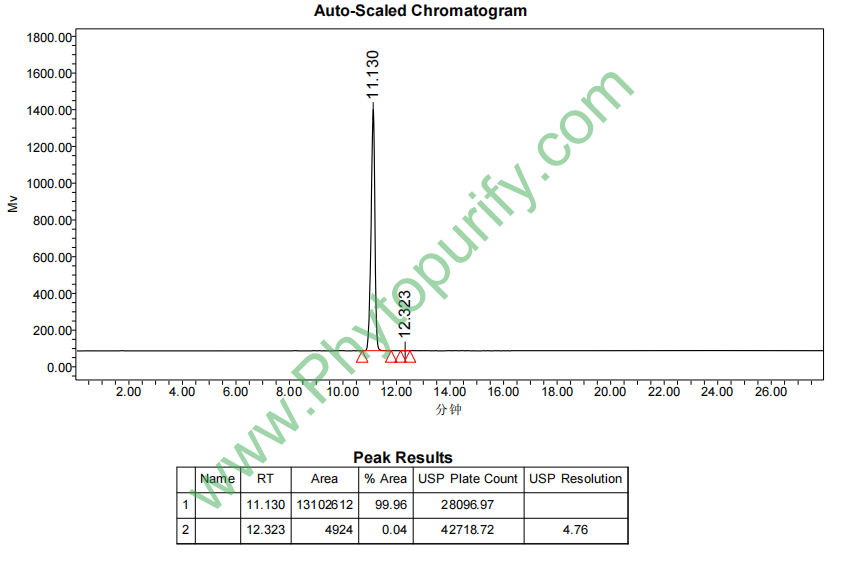
Purity: 95%~99%
Analysis Method: HPLC-DAD or/and HPLC-ELSD
Identification Method: Mass, NMR
Packing: Brown vial or HDPE plastic bottle
Can be supplied from milligrams to grams.
For Reference Standard and R&D, Not for Human Use Directly.
Inquire for bulk scale.
HPLC of Chonglou saponin II
Storage conditions:Short-term storage at 2~8℃, long-term storage at -20 ~ -80℃
294.6000
2.2746
2.2745
.0654
.5833
.5617
Low
67.4724
7.1337
No
No
No
No
No
No
0.0
Yes
No
Yes
No
Natural products have always been an important source of innovative drug discovery, among which saponin compounds have attracted much attention due to their wide range of biological activities. Chonglou saponin II (CAS number: 50773-42-7) is an important steroid saponin isolated from the traditional Chinese medicine Paris polyphylla. Chonglou has a long history in traditional Chinese medicine clinical practice and is commonly used to treat conditions such as carbuncle, sore throat, traumatic injury, and convulsions. Modern pharmacological research has revealed that saponins II from Polygonatum sibiricum are one of the key components that exert pharmacological effects, especially anti-tumor activity. In recent years, with the continuous rise of the incidence rate of cancer and the emergence of drug resistance of existing chemotherapy drugs, it is urgent to develop new efficient and low toxic anti-tumor drugs. Zhonglou saponin II has become a hot topic in the research of natural anti-tumor drugs due to its significant inhibitory activity on various tumor cells and its ability to induce tumor cell apoptosis, inhibit invasion and metastasis by intervening in multiple key signaling pathways and molecular targets. This article aims to provide a systematic review of the chemical structure, plant origin, pharmacological activity, mechanism of action, pharmacological evaluation, and clinical application prospects of Zhonglou saponin II, in order to provide comprehensive scientific references for the in-depth research and development of this compound.
Zhonglou saponin II is a steroid saponin with the molecular formula C ₅₁ H ₈₄ O ₂₁ and a molecular weight of 1015.1970. Its basic skeleton is the spirostanol type steroid nucleus, which is connected at the C-3 position by an oligosaccharide chain composed of multiple sugar groups (usually including glucose, xylose, etc.), which is an important structural basis for its biological activity. The structural complexity of the sugar chain also determines its relatively high molecular weight and polarity.
From the analysis of the parameters related to drug properties, the logarithmic (LogP) value of the lipid water partition coefficient of Zhonglou saponin II is 2.2746, indicating that it has a certain degree of lipophilicity, but not high lipid solubility. Its topological polar surface area (TPSA) is as high as 294.6000 Å ², which is mainly attributed to the abundant hydroxyl and glycosidic bonds in the molecule, leading to its high polarity. The calculated water solubility value is 0.0654 mg/mL, belonging to the category of slightly soluble to poorly soluble, which poses a challenge for its formulation development. In terms of absorption, distribution, metabolism, and excretion (ADME) characteristics, the prediction shows that its ability to cross the blood-brain barrier is relatively low, indicating that its direct effect on central nervous system related tumors may be limited, but it may also imply a lower risk of potential central nervous system side effects. Importantly, preliminary toxicity predictions showed no significant inhibitory risk of resveratrol II on hERG potassium channels (hERG inhibition: No), and the Ames test predicted a value of 0.0, suggesting that it may not have direct genetic toxicity. These characteristics provide preliminary favorable information for its safety evaluation.
Zhonglou saponin II mainly comes from the dried rhizomes of various plants in the Paris genus of the Liliaceae family, among which Yunnan Zhonglou (Paris polyphylla var. yunnanensis) and Paris polyphylla are more abundant. These plants are mainly distributed in the Himalayan regions of southwestern China, Nepal, Bhutan, etc., and prefer shady and humid environments.
The extraction of saponins II from Polygonatum sibiricum is usually carried out using solvent extraction combined with modern separation and purification techniques. The standard procedure is as follows:
1. Preprocessing Crush and sieve the dried rhizomes of the tall building.
2. Extract The most commonly used extraction solvents are ethanol (such as 70% -95% ethanol) or methanol. Hot reflux extraction, ultrasound assisted extraction, or percolation method can be used. Ethanol is more favored due to its low toxicity, high extraction efficiency, and environmental friendliness. Sometimes, the water extraction and alcohol precipitation method is also used to preliminarily enrich saponins.
3. Enrichment and Purification After the extraction solution is concentrated under reduced pressure and the solvent is recovered, a paste is obtained. After suspending the extract in water, it is sequentially extracted with low polarity solvents such as petroleum ether and ethyl acetate to remove fat soluble impurities. Saponins are mainly retained in the aqueous layer or n-butanol extraction layer. Further purification relies on column chromatography technology, often using fillers such as macroporous adsorption resins (such as D101, AB-8), silica gel, and reverse phase silica gel (such as ODS) for separation. In recent years, technologies such as high-speed counter current chromatography (HSCCC) and preparative high-performance liquid chromatography (Prep HPLC) have become key means for obtaining high-purity saponins II from Polygonatum sibiricum due to their high resolution and recovery rate. The optimization of extraction processes (such as solvent ratio, temperature, time) and the use of green extraction techniques (such as supercritical CO ₂ extraction) are research priorities for improving yield and purity.
Numerous in vitro and in vivo studies have confirmed that saponins II from Polygonatum sibiricum have a wide range of pharmacological activities, with the most prominent and extensively studied being their anti-tumor effects.
Antitumor activity: Paris polyphylla saponin II has broad-spectrum growth inhibition and cytotoxic effects on a variety of human tumor cell lines, including but not limited to breast cancer, liver cancer, lung cancer, colon cancer, stomach cancer, ovarian cancer and leukemia cells. Its characteristic function is not only to inhibit cell proliferation, but more importantly, to effectively induce apoptosis of tumor cells. For example, in breast cancer MCF-7 and MDA-MB-231 cells, Paris polyphylla saponin II can significantly reduce cell viability in a dose-dependent and time-dependent manner. In liver cancer HepG2 and SMMC-7721 cells, it also showed strong proliferation inhibitory effects. Animal model experiments further supported its in vivo anti-tumor efficacy. In the nude mouse model of transplanted tumor, intraperitoneal injection or intragastric administration of Paris polyphylla saponin II can significantly inhibit the growth of breast cancer, lung cancer and other tumors, and the reduction of tumor weight is positively correlated with the dose, while the impact on animal weight is relatively small, suggesting that it has a certain therapeutic window.
Other potential activities In addition to anti-tumor effects, research also suggests that saponins II from Polygonatum sibiricum may have anti-inflammatory, hemostatic, antibacterial, and immunomodulatory activities, which are consistent with the efficacy records of traditional Chinese medicine Polygonatum sibiricum. However, its specific strength and mechanism of action require more systematic and in-depth research.
The anti-tumor effect of Zhonglou saponin II is not achieved through a single pathway, but involves the synergistic regulation of multiple targets and pathways, which may help overcome the problem of single target drug resistance in tumor cells to some extent. Its mechanism of action mainly includes inducing cell apoptosis, inhibiting cell proliferation, blocking the cell cycle, inhibiting invasion and metastasis, and regulating the tumor microenvironment.
Inducing endogenous and exogenous apoptotic pathways Zhonglou saponin II can induce cell apoptosis through the mitochondrial pathway by regulating members of the Bcl-2 protein family. Research shows that it can Downregulation of anti apoptotic proteins Bcl-2 and Mcl-1 Simultaneously upregulating the expression of pro apoptotic protein Bax leads to a decrease in mitochondrial membrane potential, release of cytochrome C, and activation of the caspase-9 and caspase-3 cascade reaction, ultimately resulting in cell apoptosis. In addition, it may also promote apoptosis through the death receptor pathway (exogenous pathway).
Inhibit key signaling pathways:
Interference with cell cycle progression Zhonglou saponin II can block tumor cells at specific cell cycle checkpoints, such as G2/M phase or S phase, preventing them from completing division normally. This may be related to its impact on the expression of cyclins and cyclin dependent kinases (CDKs).
Inhibit tumor invasion and metastasis Tumor metastasis is the main cause of treatment failure. Zhonglou Saponin II Downregulation of matrix metalloproteinase-2 (MMP2) Expression and activity. MMP2 is a key enzyme that degrades extracellular matrix (ECM) and basement membrane, and its reduced activity can effectively inhibit the invasion and migration ability of tumor cells.
Acting on other specific targets:
In summary, Zhonglou saponin II forms a complex anti-tumor network by simultaneously acting on multiple key targets such as MCL1, BCL2, STAT3, MMP2, TOP1/2A, HIF1A, MAPK1, ESR1, CYP19A1, etc., synergistically exerting its anti-cancer effects.
Despite the enormous potential of saponins II in pharmacological activity, their pharmacological properties, especially pharmacokinetic properties, pose a major challenge in their conversion into drugs.
Absorption, Distribution, Metabolism, and Excretion (ADME):
* absorb As a highly polar and high molecular weight saponin, the oral bioavailability of Zhonglou saponin II is expected to be low. Its absorption in the gastrointestinal tract may be influenced by active efflux transporters (such as P-glycoprotein), and is susceptible to inactivation or conversion into other products by gut microbiota metabolism (such as glycation hydrolysis).
* distribution Its large TPSA and polarity result in limited transmembrane diffusion ability, and tissue distribution may be slow and not widespread. It is predicted that its blood-brain barrier permeability is low, which limits its therapeutic application for brain tumors.
* Metabolism Saponins mainly undergo hydrolysis (deglycosylation), oxidation, and binding reactions in the body. The liver may be its main metabolic site, and the cytochrome P450 enzyme system may be involved in its metabolic processes.
* excretion The prototype drug and its metabolites may be mainly excreted through bile and kidneys.
The existing limited preclinical pharmacokinetic studies are mostly based on rat or mouse models. These studies typically show that after intravenous administration, the elimination half-life of saponins II in the plasma is short, manifested by limited distribution volume, which is consistent with its high polarity. After oral administration, the blood drug concentration was low and the peak time was uncertain, confirming the inference of poor oral absorption.
Formulation strategy In order to improve its pharmacological properties, researchers are actively exploring various formulation strategies:
1. Prodrug design Chemical modification of hydroxyl groups on sugar or steroid nuclei to synthesize lipophilic prodrugs for improved membrane permeability and oral absorption.
2. Nano delivery system This is currently one of the most promising strategies. Encapsulation or loading of saponins II in liposomes, polymer nanoparticles, micelles, or solid lipid nanoparticles can significantly improve their water solubility, protect them from premature metabolism, target tumor tissues using enhanced permeability and retention (EPR) effects, and potentially overcome multidrug resistance.
3. Phospholipid complex Forming complexes with phospholipids can effectively increase their lipophilicity, promote gastrointestinal absorption and bioavailability.
safety Preliminary toxicity prediction (without hERG inhibition, Ames negative) provides a good starting point, but comprehensive preclinical safety evaluation (acute toxicity, long-term toxicity, reproductive toxicity, etc.) still needs to be systematically carried out. Saponin compounds generally have the potential for hemolysis, which is also one of the safety indicators that need to be focused on for Zhonglou Saponin II.
As a multi-target anti-tumor natural compound, Zhonglou saponin II has broad clinical application prospects, but the road is also full of challenges.
Potential application directions:
1. Antitumor monotherapy As a new type of chemotherapy or targeted drug, it is particularly suitable for tumor patients who have developed resistance or difficulty tolerating traditional chemotherapy drugs. Its multi-target characteristics may be effective for tumors with strong heterogeneity.
2. combination therapy Combined with existing chemotherapy drugs (such as paclitaxel, cisplatin, 5-fluorouracil, etc.) or targeted drugs, it may produce synergistic effects, reduce their respective dosages, thereby reducing toxic side effects and delaying the development of drug resistance. Its mechanism of action is different from many traditional drugs, providing a theoretical basis for combination therapy.
3. Adjuvant treatment and prevention Based on its anti-inflammatory and immune regulatory potential, it may be used for adjuvant therapy of tumors and chemoprevention in high-risk populations.
challenges faced:
1. Drug bottleneck As mentioned earlier, low solubility, low permeability, and low oral bioavailability are the core issues that constrain its development.
2. Complexity of mechanism of action Multi targeting is both an advantage and a challenge. More precise elucidation of its main targets and pathways in specific tumor types is needed to avoid potential off target effects and unpredictable toxicity.
3. Material Basis and Quality Control The saponin components in the medicinal herb of Chonglou are complex, and the content of Chonglou saponin II is influenced by factors such as place of origin, variety, and harvest season. During the development process, it is necessary to establish stable and sustainable sources of raw materials and strict quality control standards.
4. Lack of clinical translational research At present, the vast majority of research is still at the cellular and animal level, lacking systematic preclinical pharmacology, pharmacokinetics, and safety evaluation data, and there is still a distance to go from clinical trials.
Future Prospects:
Future research should focus on: ① using structural modification and advanced delivery technologies (such as intelligent responsive nano formulations) to systematically optimize their drug properties; ② Utilizing omics technologies (proteomics, metabolomics) and gene editing tools to uncover their precise mechanisms of action and biomarkers in different tumor backgrounds; ③ Conduct preclinical safety evaluations that comply with Good Laboratory Practice (GLP) standards; ④ Explore its potential application in new indications such as autoimmune diseases and fibrotic diseases. Through interdisciplinary collaboration, Zhonglou Saponin II has the potential to evolve from a promising lead compound into an innovative drug with clinical value.
Zhonglou Saponin II is a steroid saponin compound with significant anti-tumor activity discovered from traditional Chinese medicine Zhonglou. It exhibits multi pathway and multi link pharmacological effects in inducing tumor cell apoptosis, inhibiting proliferation, blocking the cell cycle, and resisting invasion and metastasis by synergistically acting on multiple key targets such as MCL1, BCL2, STAT3, MMP2, TOP1/2A, and HIF1A. However, the inherent physicochemical properties of the drug lead to drug defects, especially poor solubility and difficulty in oral absorption, which are currently the main obstacles limiting its clinical translation. With the rapid development of modern medicinal chemistry, pharmacy, and nanotechnology, it is expected to overcome these bottlenecks through rational structural optimization and innovative formulation strategies. In the future, based on a thorough elucidation of its molecular mechanism and the completion of systematic preclinical evaluation, saponins II from Polygonatum sibiricum are expected to become a highly valuable candidate molecule in the field of anti-tumor drug development, providing not only new options for tumor treatment but also important examples for the modernization of traditional Chinese medicine and the development of innovative drugs from natural products.
