![Hexadecanamide, N-[(3-methoxyphenyl)methyl]-](/upload/0201/01/BP1830.png)


Product name: Macamide Impurity 5
Synonym name: N-(3-Methoxybenzyl)palmitamide
Catalogue No.: BP1830
Cas No.: 847361-96-0
Formula: C24H41NO2
Mol Weight: 375.597
Botanical Source:
Physical Description: White Powder
Type of Compound:
Purity: 95%~99%
Analysis Method: HPLC-DAD or/and HPLC-ELSD
Identification Method: Mass, NMR
Packing: Brown vial or HDPE plastic bottle
The product could be supplied from milligrams to grams. Inquire for bulk scale.
We provide solution to improve the water-solubility of compounds, thereby facilitating the variety of activity tests and clinic uses.
For Reference Standard and R&D, Not for Human Use Directly.
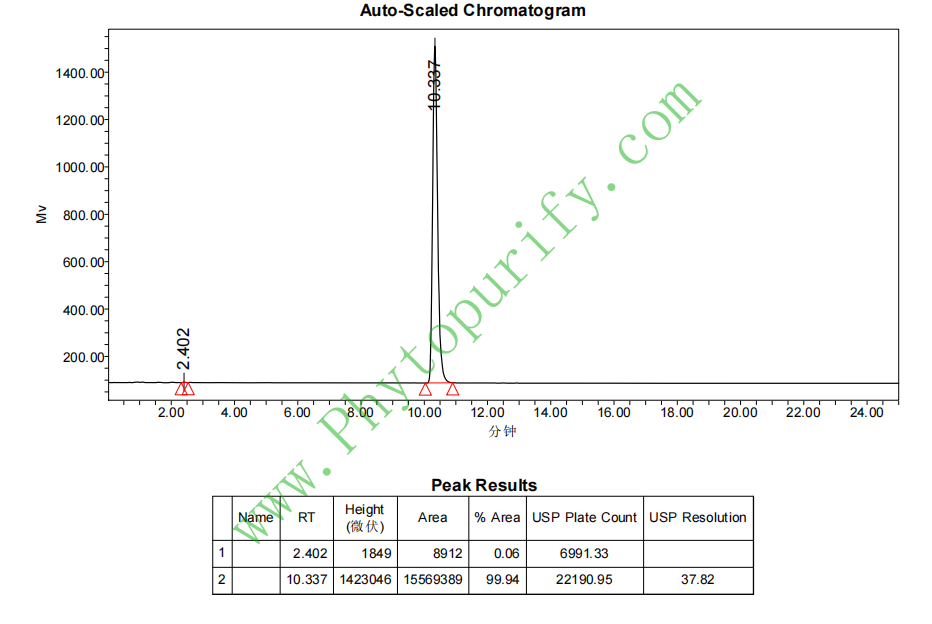
HPLC of Macamide Impurity 5
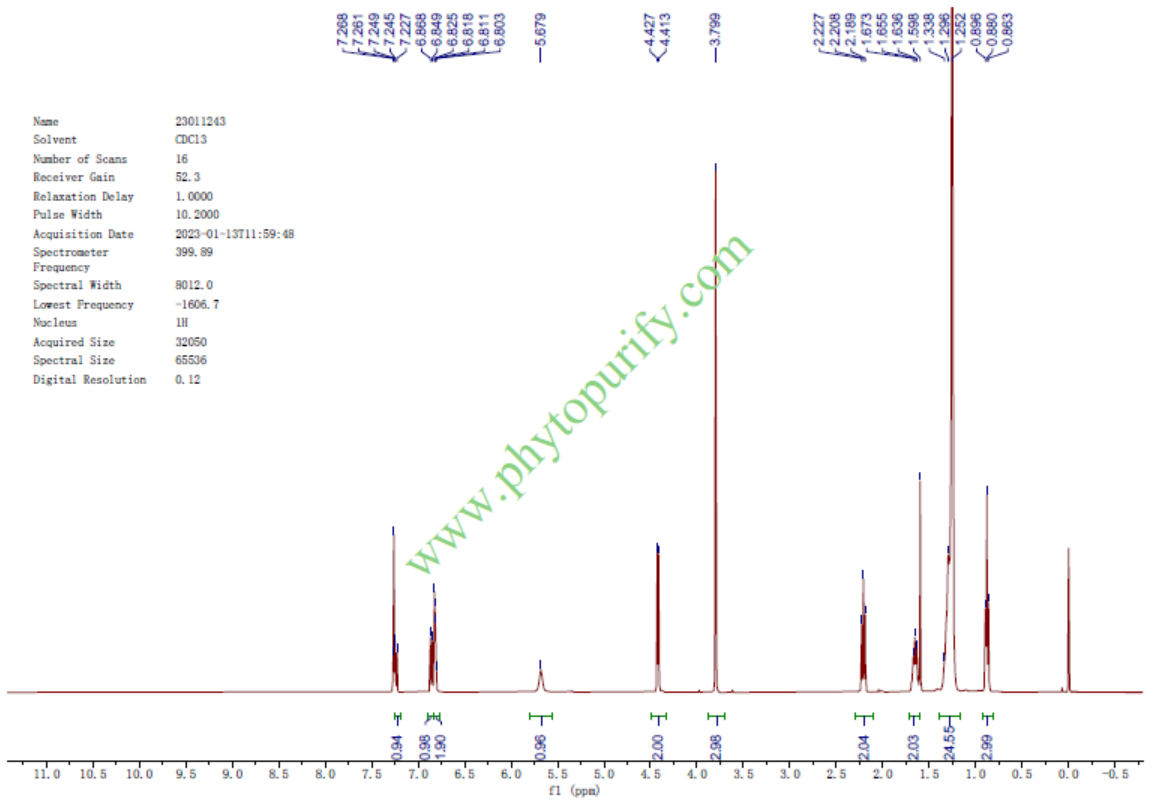
HNMR of Macamide Impurity 5
Storage conditions:Short-term storage at 2~8℃, long-term storage at -20 ~ -80℃
38.3300
7.4841
7.4841
.0011
3.0590
13.8917
High
95.1031
1.8575
No
No
Yes
No
No
No
0.0
No
No
No
No
Benign Prostatic Hyperplasia (BPH) is a common urinary system disease in middle-aged and elderly men. Its incidence rate increases significantly with age, which seriously affects the quality of life of patients. At present, the clinical treatment of BPH mainly relies on drugs such as α 1-adrenergic receptor blockers and 5 α - reductase inhibitors, but these therapies often accompany side effects such as sexual dysfunction, dizziness, and fatigue, and some patients have poor efficacy. Therefore, searching for efficient and low toxicity new therapeutic drugs from natural products has always been a research hotspot in this field. Maca (Lepidium meyenii Walp.), originally from the Andes Mountains of Peru, is a traditional medicinal and edible plant that has attracted much attention for its effectiveness in improving sexual function, anti fatigue, and other aspects. In recent years, researchers have isolated and identified a series of unique macamide compounds from maca lipid soluble extracts, which are considered important material basis for maca biological activity. Among them, Hexadecanamide impurity 5 (N - [(3-methoxyphenyl) methyl] -, CAS number: 847361-96-0), as a structurally clear macamide, has gradually attracted the interest of the pharmacological community for its potential anti prostate hyperplasia activity. The purpose of this article is to systematically review the chemical structure, plant origin, pharmacological activity, mechanism of action, and pharmacological properties of impurity 5 of macacamide, in order to provide comprehensive scientific basis for the in-depth research and development of this compound as a candidate drug for BPH treatment.
The chemical name of impurity 5 in macamide is N - [(3-methoxyphenyl) methyl] hexadecanamide, with a molecular formula of C24H41NO2 and a molecular weight of 375.5970. Structurally, this compound belongs to the N-benzyl fatty acid amide class, consisting of a saturated fatty acid chain of sixteen carbons (palmitamide moiety) connected to a 3-methoxybenzylamine via an amide bond. This structure combines the hydrophobic properties of long-chain fatty hydrocarbons with the rigid planar structure of aromatic rings, forming the basis for its unique physicochemical properties and biological activity.
The key physicochemical property parameters are as follows: the calculated lipid water partition coefficient (LogP) is 7.4841, indicating that the compound has strong lipophilicity, which is consistent with its long alkyl chain structural characteristics. The topological polar surface area (TPSA) is 38.33 Å ², which is relatively small and mainly contributed by amide bonds and methoxy groups. The water solubility is extremely low, only 0.0011 mg/mL, indicating that it may require the use of solubilization techniques (such as cyclodextrin inclusion, nanoemulsions, liposomes, etc.) in formulation development to improve bioavailability. Preliminary predictions of its pharmacological properties indicate that the compound has a high blood-brain barrier permeability potential, which is associated with its high lipophilicity; Meanwhile, the hERG inhibition risk prediction was negative, indicating a low potential risk of arrhythmogenic cardiac toxicity; The Ames test predicted a result of 0.0, indicating that it may not have direct genetic toxicity. These preliminary pharmacological parameters provide a favorable starting point for further in-depth research, but high lipophilicity and low water solubility are the key challenges that need to be overcome in the drug development process.
The impurity 5 of macamide mainly comes from the dried rhizomes of Lepidium meyenii Walp. Maca can be divided into various types based on root color, such as black, purple, yellow, etc., among which black maca is considered to have more abundant bioactive ingredients. Macamide compounds, including Macamide Impurity 5, are characteristic components of Macamide lipid soluble fractions. They are present in low concentrations in fresh Macamide, but may be converted from precursor substances (such as Macaene, Macamide precursor glycosides, or other amides) or exist as homologous/isomer impurities during drying, storage, and extraction processes.
Its extraction, separation, and purification usually follow the following process:
1. Raw material pretreatment After crushing the dried roots and stems of maca, organic solvents are usually used for degreasing. Commonly used petroleum ether or n-hexane is used to remove most of the oil and wax under Soxhlet extractor or room temperature immersion.
2. Extraction of active parts Extract the defatted maca powder using a medium polarity solvent. Ethanol or methanol are commonly used solvents, and the total extract can be obtained through reflux extraction or ultrasound assisted extraction.
3. Enrichment and Separation After appropriate concentration of the total extract, preliminary separation can be carried out using silica gel column chromatography, and gradient elution systems such as petroleum ether ethyl acetate or chloroform methanol can be used to preliminarily enrich the macamide components. Macamide impurity 5, as one of them, requires further refinement.
4. Purification and identification The enriched components can be separated using preparative high-performance liquid chromatography (HPLC), often using a reverse phase C18 column with methanol water or acetonitrile water as the mobile phase to collect the target peak. The structure of the final pure product was confirmed by nuclear magnetic resonance (NMR, including 1H NMR and 13C NMR), mass spectrometry (MS), and comparison with the control sample.
At present, there is insufficient research on the exact content of impurity 5 in macamide and its influence on variety, origin, and processing technology. This is also a direction that future standardization research needs to focus on.
Existing research, particularly based on network pharmacology predictions and preliminary in vitro experiments, suggests that macacamide impurity 5 has multiple potential pharmacological activities in combating prostate hyperplasia.
It should be pointed out that there is still a lack of direct and systematic pharmacological experimental data (especially in vivo animal experiments) on impurity 5 of macamide. Most of the activity inferences come from computational predictions and extensions of its parent nucleus structure (macamide) activity. Therefore, subsequent activity validation is crucial.
Based on computational biology methods such as network pharmacology and molecular docking, the anti BPH effect of macacamide impurity 5 may involve a complex multi-target and multi pathway network, rather than acting on a single target. Its core mechanism of action may revolve around the following key targets and pathways:
Hormone signaling pathway regulation:
Regulation of Cell Cycle and Apoptosis Pathway:
Growth factors and regulation of inflammatory pathways:
Oxidative stress and protein kinase pathway:
In summary, the impurity of macacamide 5 may act like a "versatile hand", intervening in multiple key aspects of BPH development such as hormone imbalance, cell proliferation/apoptosis imbalance, chronic inflammation, and oxidative stress. This multi-target action characteristic is consistent with the multifactorial pathogenesis of BPH, and may bring more comprehensive therapeutic effects and reduce drug resistance.
Although the calculation prediction shows that the risk of macamide impurity 5 in hERG inhibition and genotoxicity is low, its actual pharmacological properties still face challenges, and related pharmacokinetic studies are almost blank.
Prediction and Challenges of Absorption, Distribution, Metabolism, and Excretion (ADME):
Pharmaceutical Science Challenge Developing a suitable drug delivery system is the key to advancing its application. Possible strategies include: creating nanocrystals, self microemulsion delivery systems, phospholipid complexes, or encapsulating them in liposomes to enhance their solubility and oral absorption. Local administration (such as rectal administration) is also a potential pathway to bypass the first pass effect and directly act on the prostate.
Preliminary Safety Assessment Computational toxicology prediction (Ames negative, hERG negative) provides preliminary safety signals, but its safety must be comprehensively evaluated through standardized in vitro cytotoxicity experiments, acute toxicity experiments, and long-term repeated administration toxicity experiments. The toxicity of its metabolites also needs to be considered.
Macamide impurity 5, as a natural small molecule with multi-target anti BPH potential, has broad clinical application prospects, but the road ahead is long.
Development of new BPH treatment drugs Its multi-target mechanism of action may be superior to existing single target drugs, and it is expected to be developed as a first-line or second-line drug for the treatment of BPH, especially for patients who are insensitive to traditional drugs or cannot tolerate side effects. Strategies for monotherapy or combination therapy with low-dose existing drugs can be explored to enhance efficacy and reduce side effects.
As an active ingredient in functional foods or health supplements Given the tradition of maca as a food, maca extracts or concentrates with standardized levels of maca amide impurity 5 may be developed into health products for improving prostate health and preventing the progression of BPH. This requires rigorous dose-response relationship studies and long-term safety assessments for consumption.
Future research directions:
Macamide Impurity 5 is a unique N-benzyl fatty acid amide compound found in the traditional medicinal plant Maca. Based on existing computational predictions and preliminary research, this compound exhibits potential multi-target anti benign prostatic hyperplasia activity by intervening in multiple pathways such as androgen/estrogen signaling, cell cycle and apoptosis, and inflammatory response. Its pharmacological prediction shows advantages in terms of cardiac toxicity and genetic toxicity, but its extremely high lipophilicity and low water solubility are the core challenges it must face in the development process. At present, there is still insufficient direct experimental evidence on this compound, and its exact pharmacological effect, detailed mechanism of action, in vivo metabolic process, and safety all require in-depth and systematic research. In the future, through interdisciplinary cooperation in pharmacology, pharmacy, medicinal chemistry, and other fields, macacamide impurity 5 is expected to develop from a potential natural product molecule into a new drug or functional ingredient for treating BPH, providing valuable examples for modern research and development of natural products.
