


Product name: 5-Hydroxy-6,7-dimethoxylflavone
Synonym name: 5-Hydroxy-6,7-dimethoxyflavone; Mosloflavone
Catalogue No.: BP0086
Cas No.: 740-33-0
Formula: C17H14O5
Mol Weight: 298.294
Botanical Source: Crotalaria pallida Ait.
Physical Description:
Type of Compound: Flavonoids
Purity: 95%~99%
Analysis Method: HPLC-DAD or/and HPLC-ELSD
Identification Method: Mass, NMR
Packing: Brown vial or HDPE plastic bottle
Storage: Store in a well closed container, protected from air and light. Put into refrigerate or freeze for long term storage.
Whenever possible, you should prepare and use solutions on the same day. However, if you need to make up stock solutions in advance, we recommend that you store the solution as aliquots in tightly sealed vials at -20℃. Generally, these will be useable for up to two weeks.
The product could be supplied from milligrams to grams
Inquire for bulk scale.
Chengdu Biopurify Phytochemicals Ltd. is a leading company in the research, development, manufacture and marketing of High Quality Phytochemicals and Extracts(especially Active Ingredients from Traditional Chinese Medicine,TCM), Natural Active Pharmaceutical Ingredients worldwide.
The main services:
A. Supply active ingredients and reference standards of TCM, from mgs to kgs scale
B. Custom extraction and purification, target Herb Active Ingredients
C. Custom synthesis and semi-synthesis for Natural Active Ingredients
D. CR(contract research), CM(contract manufacture) and PD(process development) services from lab scale, pilot scale to commercial scale(GMP is also available)
E. TCM compounds library for drug screen,more than 3000 compounds available, many of them are rare and unique.
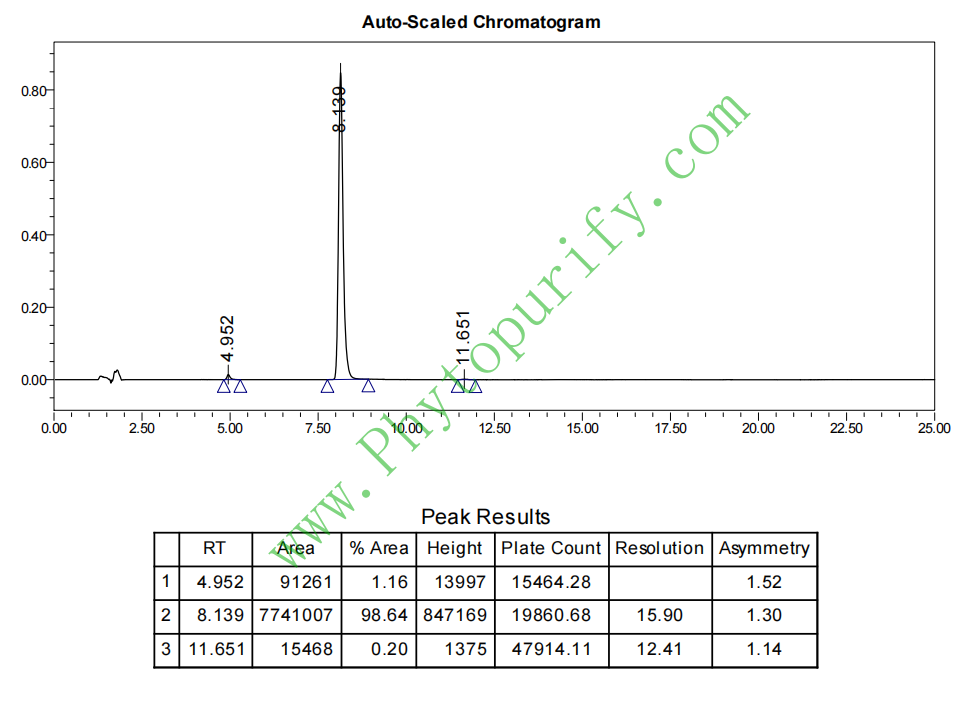
HPLC of Mosloflavone
Storage conditions:Short-term storage at 2~8℃, long-term storage at -20 ~ -80℃
83.8300
2.3000
2.3000
Low
No
No
No
No
No
No
Mosloflavone (CAS number: 740-33-0) is a naturally occurring flavonoid compound belonging to 2-hydroxyflavanones, with significant biological activity. As one of the important active ingredients in Scutellaria baicalensis, kaempferol has attracted widespread attention for its diverse pharmacological effects, especially in the fields of antiviral, anti-inflammatory, and antibacterial properties, showing excellent potential. In recent years, with the in-depth study of the mechanism of viral infection and the regulation of inflammatory response, the role of flavonoids in the prevention of enterovirus 71 (EV71) infection, inhibition of inflammatory factor expression, and regulation of immune response has gradually been revealed. In addition, its toxicity to Pseudomonas aeruginosa and inhibitory effect on biofilm formation provide a theoretical basis for its development as a novel fungicide. This article will provide a systematic review of the chemical structure, sources, pharmacological activity, mechanism of action, pharmacological evaluation, and clinical application prospects of flavonoids from Mosuo, aiming to provide reference for natural product pharmacology research and new drug development.
Cinnamomum camphora flavonoids are a typical flavonoid ether with a molecular formula of C17H14O6 and a molecular weight of 302.29. Its chemical structural feature is the presence of hydroxyl and methoxy substituents on the flavanone skeleton, specifically the 2-hydroxyflavanone structure, which endows it with strong free radical scavenging ability and biological activity. In terms of physical and chemical properties, the LogP value of Ligustrum lucidum flavonoids is 2.3, indicating that they have moderate lipid solubility, which is beneficial for cell membrane penetration and bioavailability. Its topological polar surface area (TPSA) is 83.83 Å ² and the number of hydrogen bond acceptors is 5, indicating its good affinity for binding with biomolecules. The permeability of the blood-brain barrier is low, and the risks of hepatotoxicity and cardiotoxicity are also low. There is no hERG channel inhibition or Ames mutagenicity, indicating good safety and potential for drug development.
The flavonoids from the Chinese medicinal herb Scutellaria baicalensis are mainly isolated and obtained. Scutellaria baicalensis is a plant in the family Lamiaceae, and its roots contain abundant flavonoids. As one of the active monomers in Scutellaria baicalensis, the content is relatively stable. Traditional extraction methods usually use alcohol solvents (such as methanol, ethanol) for extraction, combined with liquid-liquid distribution, column chromatography and other separation and purification techniques to obtain high-purity flavonoids from ramie. In recent years, the application of ultrasound assisted extraction, microwave-assisted extraction, and high-performance liquid chromatography (HPLC) technology has improved extraction efficiency and purity, meeting the needs of pharmacological research and formulation development.
The research on the antiviral effect of Ligustrum lucidum flavonoids is particularly prominent, especially in the inhibition of enterovirus 71 (EV71). EV71 is an important pathogen causing hand, foot, and mouth disease and severe neurological complications, and existing treatment methods are limited. Research has shown that the flavonoids from Zizania latifolia can significantly inhibit virus replication and reduce the formation of cytopathic effects (CPE) in the early stages of viral infection. Its mechanism of action involves inhibiting the expression of virus VP2 protein, blocking the synthesis of virus capsid protein, and thereby hindering virus assembly and transmission. This discovery provides a new molecular basis for the development of anti EV71 drugs.
Fenluo flavonoids have shown good anti-inflammatory effects by regulating the expression of inflammatory mediators. In vitro experiments have shown that it has a dose-dependent inhibitory effect on the levels of TNF - β, IL-1 β, and inducible nitric oxide synthase (iNOS) in the supernatant of mouse macrophage line J774A. Their IC50 values were 16.4 μ M (TNF - β) and 6.4 μ M (IL-1 β), respectively, indicating high inhibitory efficacy. By inhibiting these key inflammatory factors, the flavonoids from Moshi are expected to play a role in the treatment of inflammatory diseases and immune regulation related diseases.
As a promising natural fungicide, the flavonoids from Fusarium oxysporum exhibit significant toxicity inhibition against Pseudomonas aeruginosa. Pseudomonas aeruginosa is a common multidrug-resistant pathogen in clinical practice, and its biofilm formation is an important factor leading to difficult to cure infections. The flavonoids from Zizania latifolia not only inhibit the formation of its biofilm, but also reduce the expression of bacterial virulence factors, demonstrating potential application value.
The multi-target mechanism of action of the flavonoids in shepherd's purse is the basis for its broad pharmacological activity. In terms of antiviral activity, it mainly targets the VP2 protein of EV71 virus, blocks the synthesis of viral capsid protein, and inhibits virus replication. The anti-inflammatory effect is achieved by downregulating the expression of pro-inflammatory cytokines TNF - β and IL-1 β, inhibiting iNOS activity, reducing the release of inflammatory mediators, and alleviating inflammatory reactions.
In addition, various molecular targets related to heart failure, including AMPK (PRKAA1), EHMT2, APP, PTPN1, MAOA, ESR2, ABCB1, ALOX15, ABCG2, and FEN1, have potential interactions with the flavonoids of Zizania latifolia. These targets involve multiple signaling pathways such as energy metabolism, epigenetic regulation, neuroprotection, inflammatory response, and drug transport, suggesting that quercetin may play multiple regulatory roles in the treatment of cardiovascular diseases, especially heart failure.
The pharmacological parameters of the extract from Zizania latifolia indicate that it has good potential for drug development. Its molecular weight is moderate, its lipophilicity is suitable for cell membrane penetration, and the number of TPSA and hydrogen bond receptors is within the ideal range for most oral drugs. Low blood-brain barrier permeability reduces the risk of central nervous system toxicity. Low risk of hepatotoxicity and cardiotoxicity, with no hERG channel inhibition or mutagenicity, and high safety.
Although there is currently limited research on the pharmacokinetics of flavonoids in shepherd's purse, existing data indicate that they are well absorbed orally, and their metabolism in the body is mainly carried out through the liver enzyme system. The activity and excretion pathways of metabolites still need further clarification. Future research should focus on the systematic evaluation of its in vivo dynamic characteristics, metabolic stability, and bioavailability to promote its clinical translation.
Due to its multi-target and multifunctional pharmacological properties, the flavonoids from Zizania latifolia have shown broad application prospects in the fields of antiviral, anti-inflammatory, and antibacterial. Especially in the prevention and treatment of EV71 virus infection, as a natural antiviral candidate drug, kaempferol has significant clinical development value. Its anti-inflammatory effect provides new ideas for the treatment of chronic inflammatory diseases and immune regulation disorders. At the same time, as a new type of antibacterial agent, the inhibitory effect of Fusarium oxyphyllum flavonoids on multidrug-resistant strains provides the possibility for antibiotic substitution or adjuvant therapy.
In the future, the clinical application of saikosaponin will rely on systematic pharmacokinetics, safety evaluation, and clinical trial validation. By combining modern drug design techniques and optimizing its structure to enhance activity and pharmacokinetic performance, it will further promote its becoming a clinically available natural medicine. In addition, based on its multi-target mechanism of action, the potential therapeutic value of quercetin in complex diseases such as heart failure is also worth further exploration.
As a natural flavonoid derived from Scutellaria baicalensis, the flavonoids of Zizania elata have attracted much attention due to their significant antiviral, anti-inflammatory, and antibacterial activities. Its unique chemical structure endows it with good biological activity and drug properties, and its mechanism of action involves multiple molecular targets, reflecting the advantages of multi-target pharmacology of natural products. Although current research mainly focuses on in vitro and animal models, the clinical translation of saikosaponin still faces certain challenges, but its potential as a new natural drug lead compound cannot be ignored. In the future, through interdisciplinary collaboration and in-depth analysis of its mechanism of action and pharmacokinetic characteristics, it is expected to promote the clinical application of saikosaponin in antiviral, anti-inflammatory, and antibacterial fields, benefiting patients.
