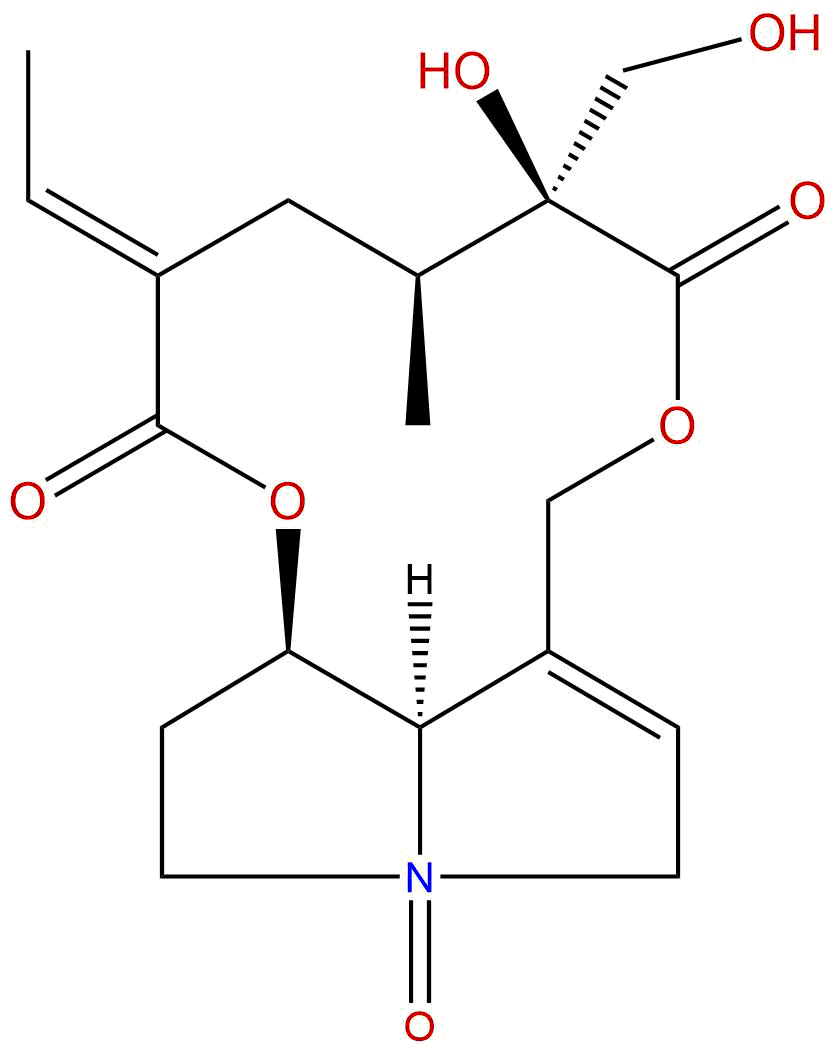


Product name: Usaramine N-oxide
Synonym name:
Catalogue No.: BP4092
Cas No.: 117020-54-9
Formula: C18H25NO7
Mol Weight: 367.398
Botanical Source: Crotalaria pallida Ait.
Physical Description:
Type of Compound: Alkaloids
Purity: 95%~99%
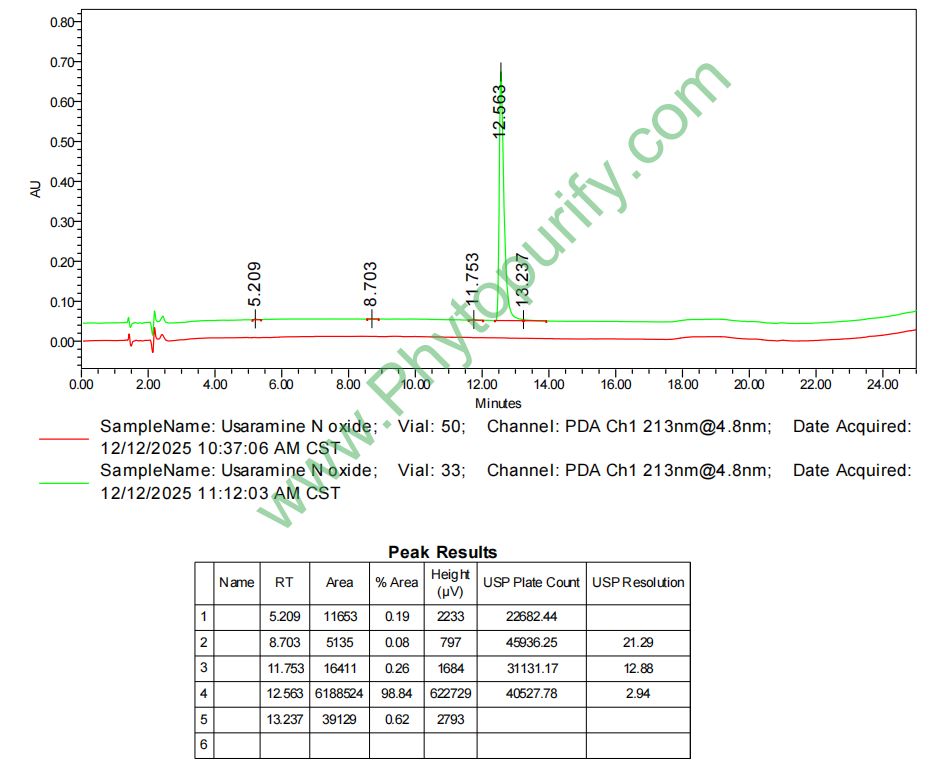
Analysis Method: HPLC-DAD or/and HPLC-ELSD
Identification Method: Mass, NMR
Packing: Brown vial or HDPE plastic bottle
Storage: Store in a well closed container, protected from air and light. Put into refrigerate or freeze for long term storage.
Whenever possible, you should prepare and use solutions on the same day. However, if you need to make up stock solutions in advance, we recommend that you store the solution as aliquots in tightly sealed vials at -20℃. Generally, these will be useable for up to two weeks.
The product could be supplied from milligrams to grams
Inquire for bulk scale.
For Reference Standard and R&D, Not for Human Use Directly.
HPLC of Usaramine N-oxide
Storage conditions:Short-term storage at 2~8℃, long-term storage at -20 ~ -80℃
Usamine N-oxide (CAS number: 117020-54-9) is a natural pyrrolizine alkaloid isolated from the plant Crotalaria pallida in the genus Syringa. As a derivative of gibberellins, the nitrogen oxides of Liliaceae have unique chemical structures and diverse biological activities, particularly exhibiting significant anti-inflammatory and potential anti-tumor activities. In recent years, with the continuous development of natural product pharmacology, the nitrogen oxides of Liliaceae have gradually become a research hotspot in the field of drug development due to their multi-target mechanism of action and good safety characteristics.
This review aims to systematically summarize the chemical structure, physicochemical properties, plant sources, and extraction methods of nitrogen oxides from Liliaceae, with a focus on its pharmacological activity and mechanism of action, exploring its pharmacological properties and pharmacokinetic characteristics, and finally looking forward to its clinical application potential and future research directions, providing reference and inspiration for researchers in related fields.
The nitrogen oxides of Liliaceae are complex organic heterocyclic compounds belonging to the pyrrolidine alkaloid family. Its molecular formula is C18H27N1O6 and its molecular weight is 367.3980. Structurally, the nitrogen oxide of Liliaceae is a ceratopsian skeleton with two additional hydroxyl substituents located at positions 12 and 18, respectively; Simultaneously carrying two oxo groups at positions 11 and 16, and containing one N-oxide substituent. This structural feature endows the compound with high polarity and complex three-dimensional conformation.
In terms of physical and chemical properties, the LogP value of nitrogen oxides in Liliaceae is -0.9771, indicating strong hydrophilicity and a water solubility of 140.0428 mg/mL, demonstrating good water solubility. Its topological polar surface area (TPSA) is 116-1200 Å ², indicating that the molecule has a high number of polar functional groups, which is conducive to binding with biomolecules. The low permeability of the blood-brain barrier indicates its limited ability to penetrate the central nervous system. The hERG channel inhibition experiment showed a negative result, indicating a low risk of cardiac toxicity. The Ames mutagenicity test score is 1.2, indicating a low risk of genetic toxicity.
In summary, the unique chemical structure and excellent physicochemical properties of nitrogen oxides from Liliaceae have laid a solid foundation for its biological activity and drug development.
The nitrogen oxides of Liliaceae mainly come from the plant Crotalaria pallida, which is widely distributed in tropical and subtropical regions and traditionally used in traditional Chinese medicine and folk herbal medicine to treat various diseases. Crotalaria pallida is rich in various pyrrolizine alkaloids, among which nitrogen oxides of Liliaceae are an important component.
The extraction method usually uses dried plant whole grass or rhizomes as raw materials, and first extracts with suitable polar solvents (such as methanol, ethanol, or ethyl acetate). After concentration of the extract, the alkaloid components were separated using acid-base extraction method. Subsequently, further purification was carried out using column chromatography (such as silica gel column, C18 reverse phase column) and high performance liquid chromatography (HPLC) techniques to obtain high-purity nitrogen oxides of Liliaceae.
In recent years, the application of ultrasound assisted extraction and microwave-assisted extraction technologies has improved extraction efficiency and purity, reduced solvent usage, and promoted the large-scale preparation and research of this compound.
The nitrogen oxides of Liliaceae were first studied for their significant anti-inflammatory effects. Both in vitro and in vivo experiments have shown that the compound can significantly inhibit the release of inflammatory mediators, such as tumor necrosis factor alpha (TNF - α), interleukin-6 (IL-6), and nitric oxide (NO). The mechanism by which it inhibits inflammatory response may be related to regulating the nuclear factor kappa B (NF - κ B) signaling pathway, thereby reducing tissue inflammatory damage.
In recent years, there has been an increasing amount of research on the application of nitrogen oxides from Liliaceae in the field of anti-tumor treatment. Several cell experiments showed that the compound had significant inhibitory effects on a variety of tumor cell lines (such as breast cancer, lung cancer, liver cancer cells). Its anti-tumor effect is manifested by inducing tumor cell apoptosis, inhibiting cell proliferation and migration ability.
In addition to anti-inflammatory and anti-tumor effects, the nitrogen oxides of Liliaceae also exhibit certain antioxidant and immune regulatory activities. It further exerts a protective effect by regulating oxidative stress-related enzymes and immune cell function.
The pharmacological effects of nitrogen oxides in Liliaceae involve multiple signaling pathways and molecular targets, reflecting its multi-target and multi mechanism characteristics.
The nitrogen oxides of Liliaceae can inhibit the NF - κ B signaling pathway, reduce the expression of pro-inflammatory factors, and decrease the inflammatory response. In addition, it regulates the activity of oxidative stress-related enzymes and reduces cell damage.
In summary, the nitrogen oxides of Liliaceae can achieve their anti-inflammatory and anti-tumor pharmacological effects through multi-target and multi pathway synergistic effects.
The molecular weight of nitrogen oxides in Liliaceae is 367.3980, which meets the molecular weight requirements of Lipinski's rule. Its LogP value is -0.9771, indicating strong hydrophilicity, which may affect its oral absorption and cell membrane permeability. The TPSA is 116-1200, indicating that the molecule has a high number of polar groups, which may limit its membrane permeability but facilitate target binding.
Good water solubility (140.0428 mg/mL) is beneficial for formulation development and improved bioavailability. The low permeability of the blood-brain barrier indicates a lower risk of side effects in the central nervous system.
The hERG channel inhibition experiment was negative, indicating a low risk of cardiac toxicity. The Ames test score is 1.2, indicating a low risk of genetic toxicity and good safety.
At present, there is limited research on the pharmacokinetics of nitrogen oxides in Liliaceae. Based on its physicochemical properties, it is speculated that its oral absorption may be limited and its bioavailability needs to be improved through drug carriers or structural modifications. Its hydrophilicity and high polarity may lead to rapid renal excretion with a short half-life.
Future research should focus on its in vivo distribution, metabolic pathways, and excretion mechanisms, optimizing administration methods and dosage form design.
Due to its significant anti-inflammatory and anti-tumor activities, the nitrogen oxides of Liliaceae have shown broad clinical application potential. Its multi-target mechanism of action is suitable for the treatment of complex diseases, especially in the regulation of tumor microenvironment and the treatment of inflammation related tumors, with unique advantages.
Future research directions include:
In addition, with the development of natural product pharmacology and synthetic biology, the production process and drug development of nitrogen oxides from Liliaceae will be further optimized, promoting it as an important candidate for new anti-inflammatory and anti-tumor drugs.
As a natural pyrrolizine alkaloid derived from Crotalaria pallida, the nitrogen oxides of Liliaceae have become a hot topic in natural product pharmacology research due to their unique chemical structure and multi-target pharmacological activity. Its significant anti-inflammatory and anti-tumor mechanisms provide new ideas and candidate molecules for the treatment of related diseases.
Although its pharmacokinetics and clinical application research are still in the preliminary stage, its good pharmacokinetic parameters and safety evaluation have laid a solid foundation for subsequent research. In the future, through interdisciplinary collaboration, the nitrogen oxides of Liliaceae are expected to play an important role in anti-tumor and anti-inflammatory fields, becoming a model for the development of natural product drugs.
In summary, the nitrogen oxides of Liliaceae not only enrich the chemical and pharmacological knowledge system of natural products, but also provide valuable resources for innovative drug development, which is worthy of further in-depth research and development.
