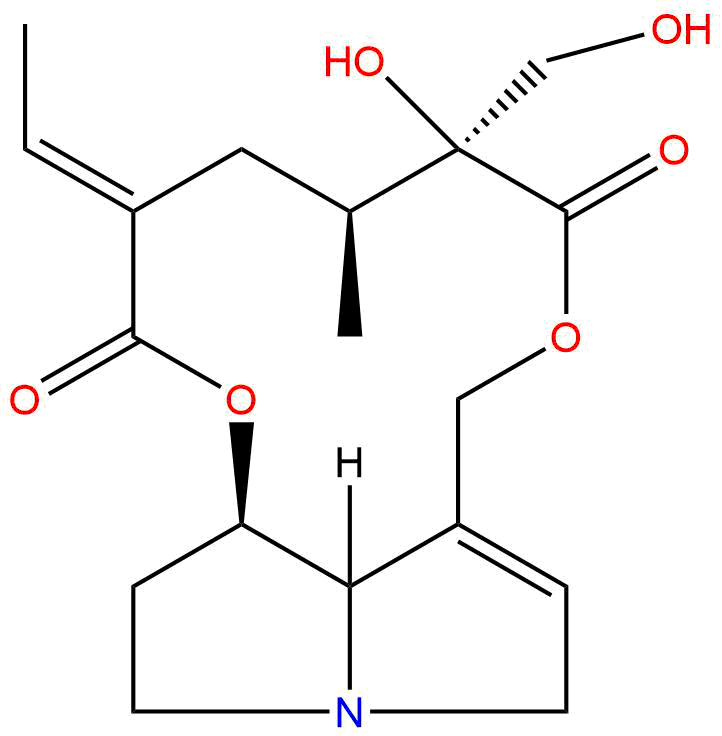


Synonym name: Usaramine sulfate;Usaramine; Mucronatine; (15E)-Retrorsine; Trans-Retrorsine
Catalogue No.: BP1484
Cas No.: 15503-87-4
Formula: C18H25NO6
Mol Weight: 351.399
Botanical Source: Alkaloid from Crotalaria brevifolia, Crotalaria incana, Crotalaria mucronata and Crotalaria usaramoensis (Leguminosae)
Purity: 95%~99%
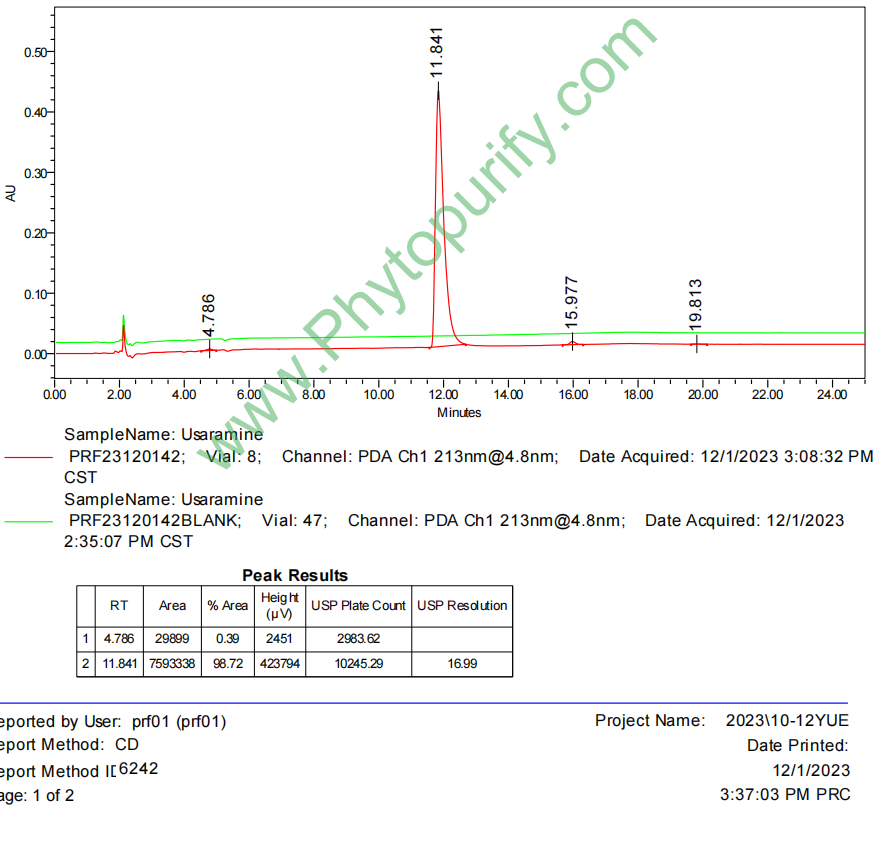
Analysis Method: HPLC-DAD or/and HPLC-ELSD
Identification Method: Mass, NMR
Packing: Brown vial or HDPE plastic bottle
Can be supplied from milligrams to grams. Inquire for bulk scale.
For Reference Standard and R&D, Not for Human Use Directly.
HPLC of Usaramine
Storage conditions:Short-term storage at 2~8℃, long-term storage at -20 ~ -80℃
96.3000
.0848
.0137
8.2916
1.3374
7.0545
High
28.2055
5.2138
Yes
No
No
No
Yes
No
0.6
Yes
Yes
Yes
Yes
Pyrrolidine alkaloids are a class of secondary metabolites widely distributed in the plant kingdom, which have attracted much attention due to their unique chemical structure and diverse biological activities. Among them, Usamine (CAS number: 15503-87-4), as a representative PAs isolated from the seeds of Crotalaria pallida, has shown remarkable multiple pharmacological activities in recent years, surpassing its traditional understanding of hepatotoxicity. Early research focused on the potential toxicity of this type of alkaloid. However, with the deepening of separation and purification techniques and molecular pharmacology research, the activity of Liliaceae in anti-tumor and anti biofilm fields has gradually been revealed. Especially its ability to significantly inhibit the formation of Staphylococcus epidermidis biofilm without killing bacteria provides a new approach to address the increasingly severe problem of bacterial resistance. At the same time, its anti-tumor potential demonstrated by acting on multiple key tumor related targets such as MCL1, STAT3, TOP2A, makes it a valuable research object in the development of natural product drugs. This article aims to provide a systematic review of the chemical characteristics, plant sources, pharmacological activities, mechanisms of action, and medicinal properties of Liliaceae, in order to provide comprehensive scientific references for the in-depth research and potential applications of this compound.
The light calyx lily alkaloid belongs to the diester pyrrolizidine alkaloid class. Its basic skeleton is composed of a 1-hydroxymethylpyrrolididine (necine base) and two different organic acids (usually aliphatic or aromatic acids) connected by ester bonds, forming a macrocyclic diester structure. This unique fused bipartite ring (pyrrolizidine ring) is its core pharmacophore and the structural basis for its interaction with biomolecules.
According to its physicochemical parameters, the molecular weight of Liliaceae is 351.3990 g/mol. Its lipophilic water partition coefficient (LogP) is 0.0848, indicating that the compound has a relatively balanced lipophilicity and hydrophilicity, which is beneficial for its distribution and transmembrane transport in organisms. The topologically polar surface area (TPSA) is 96.30 Å ², which is a moderate value and suggests that it may have good membrane permeability. The calculated water solubility value is 8.2916 mg/L, which belongs to the category of slight solubility. This is a factor that needs to be considered in actual formulation development. It is worth noting that the prediction shows that it has a high blood-brain barrier permeability, which suggests its potential application in the treatment of central nervous system related diseases (such as brain tumors), but caution should also be exercised about its potential toxicity risks to the central nervous system. In addition, key early warning indicators for drug use show that it has no inhibitory activity on hERG potassium channels (hERG inhibition: no), reducing the risk of causing QT interval prolongation and apical torsion type ventricular tachycardia; The Ames test result is 0.6, indicating a low risk of mutagenicity, but this value still needs to be comprehensively evaluated in conjunction with more genetic toxicity tests.
The main source of light calyx lily alkaloids is the seeds of Crotalaria pallida, a plant in the legume family. Pig dung bean plants are natural "reservoirs" of pyrrolizidine alkaloids, known to contain hundreds of structurally similar PAs. C. Pallida is widely distributed in tropical and subtropical regions, with relatively high levels of alkaloids in its seeds.
The extraction and separation of Liliaceae from plant materials usually follow the classic process of natural product chemistry. Firstly, the dried C. pallida seeds are crushed and subjected to cold soaking or reflux extraction using a suitable organic solvent (such as methanol, ethanol, or chloroform methanol mixture) to dissolve the alkaloid components from the plant cells. After filtration and concentration, the crude extract is dissolved in acidic water (such as dilute hydrochloric acid) to convert alkaloids into salts and dissolve them in the aqueous phase, separating them from non alkaline impurities; Subsequently, alkalization (such as ammonia water) is used to free the alkaloids, and then organic solvents (such as chloroform) are used for back extraction to obtain the total alkaloid fraction.
Further purification relies on chromatographic techniques. Silica gel column chromatography is commonly used for preliminary separation using solvent systems of different polarities, such as chloroform methanol gradient elution. Due to the similar structure of PAs, separation is difficult and often requires the combination of multiple chromatographic methods, such as medium pressure liquid chromatography, preparative thin layer chromatography, or high-performance liquid chromatography. Reverse phase HPLC (C18 column, using methanol water or acetonitrile water as mobile phase) is currently one of the most effective methods for obtaining high-purity monomers of Liliaceae. During the entire separation process, it is necessary to combine thin-layer chromatography (such as Dragendorff reagent) with spectroscopic techniques such as mass spectrometry and nuclear magnetic resonance for tracking and structural identification.
The pharmacological activity study of Liliaceae has revealed its multifaceted biological effects, mainly focused on anti-tumor and anti biofilm fields.
1. Antitumor activity:
A large number of in vitro studies have shown that light calyx lily alkaloids have significant proliferative and cytotoxic effects on various human tumor cell lines. Its anti-tumor spectrum may be wide, involving liver cancer, breast cancer, lung cancer, leukemia, etc. The functional characteristics are not limited to direct cell killing, but may also include inducing cell cycle arrest (such as G2/M phase arrest), triggering mitochondrial pathway induced apoptosis, and inhibiting the invasion and migration ability of tumor cells. These broad anti-tumor effects suggest that they may act on multiple key stages of tumor occurrence and development.
2. Anti biofilm activity:
This is a highly distinctive pharmacological activity of Liliaceae. Research has shown that at sub inhibitory concentrations, the light calyx lily alkaloid can effectively inhibit the formation of Staphylococcus epidermidis biofilm, with an inhibition rate of over 50%. Importantly, this inhibition is achieved without killing planktonic bacteria and belongs to the "anti virulence factor" strategy. Staphylococcus epidermidis is one of the main pathogens causing medical device related infections and chronic wound infections, and its ability to form biofilms is key to causing persistent infections and antibiotic resistance. Therefore, the anti biofilm activity of Liliaceae provides a new lead compound for the development of novel anti drug resistant bacterial infections, especially for biofilm related infections.
3. Other potential activities:
As a member of the PAs family, it may also have anti-inflammatory and immunomodulatory activities, but there are insufficient specialized research reports on the light calyx lily alkaloids themselves in these areas, which need further exploration.
The multiple pharmacological activities of Liliaceae stem from its interactions with multiple key targets within cells. According to existing information, its anti-tumor effect involves a complex multi-target network:
Regarding it Anti biofilm mechanism At present, research is still in depth. It is speculated that by interfering with the bacterial quorum sensing system, inhibiting the expression or function of bacterial surface adhesion proteins, and disrupting the synthesis and assembly of extracellular polysaccharide matrix, the transition from planktonic state to biofilm state of bacteria may be blocked without affecting their survival.
Despite exhibiting good biological activity, the development of medicinal properties of Liliaceae faces common problems and challenges in its own characteristics compared to pyrrolizidine alkaloids.
Advantage:
1. Clear activity, multi-target effect: It has clear anti-tumor and anti biofilm activity, and its mechanism of action involves multiple key targets, which may help overcome resistance to single target drugs.
2. The safety warning indicators are still acceptable: There is no risk of hERG inhibition, and the preliminary Ames test results did not show strong mutagenicity, providing preliminary positive signals for its safety assessment.
3. Blood-brain barrier permeability: The predicted high BBB permeability may be an advantage for treating brain tumors or central nervous system infections.
Challenges and Risks:
1. Potential hepatotoxicity and sinusoidal obstruction syndrome: This is the most severe and typical toxicity of PAs. Double ester PAs are metabolized by cytochrome P450 enzymes in the liver to produce highly reactive pyrrole metabolites. These metabolites can act as electrophilic agents to form adducts with cell proteins, DNA, and other nucleophilic substances, leading to hepatocyte necrosis, sinusoidal endothelial cell damage, and potentially causing sinusoidal obstruction syndrome, a life-threatening hepatic vascular disease. This is the biggest obstacle to the clinical transformation of Liliaceae.
2. Pharmacokinetic properties unknown: At present, there is a lack of systematic pharmacokinetic research data on its absorption, distribution, metabolism, and excretion. The key parameters such as metabolic pathways (especially the generation rate and quantity of toxic pyrrole metabolites), tissue distribution characteristics, and half-life urgently need to be elucidated.
3. Generally water-soluble: The characteristics of slight solubility may affect its oral bioavailability or the development of injectable formulations, and appropriate formulation techniques are needed for improvement.
4. The treatment window needs to determine: It is crucial to accurately determine the window between its effective dose and toxic dose for compounds with high toxicity potential.
Future strategies for optimizing drug efficacy may include structural modifications to reduce toxin producing metabolism, preparation of prodrugs to improve targeting, development of novel delivery systems such as liposomes or nanoparticles to reduce systemic exposure and liver toxicity, and exploration of local administration (such as for skin or medical device coating with anti biofilm) to avoid systemic toxicity.
The clinical application prospects of Liliaceae depend on the successful regulation of the balance between its activity and toxicity.
1. In the field of anti-tumor therapy:
As a multi-target anti-tumor lead compound, its main potential may lie in:
* Combination therapy: Combined with traditional chemotherapy drugs or targeted drugs, utilizing their unique mechanisms of action (such as STAT3 inhibition and TOP inhibition) to produce synergistic effects, and potentially reducing their respective dosages and alleviating toxicity.
* Refractory tumors: Targeting malignant tumors that are resistant to existing therapies or have abnormal activation of the STAT3 signaling pathway.
* Local treatment: In view of its potential toxicity, the development of dosage forms for local administration (such as intratumoral injection of gel and local patch) may be a more feasible initial clinical pathway.
2. In the field of anti infective treatment:
Its anti biofilm activity has important translational medical value:
* Medical device coating: Using light calyx lily alkaloids or their derivatives as surface coatings for medical devices such as catheters, artificial joints, and heart valves to prevent biofilm related infections such as Staphylococcus epidermidis.
* Chronic wound care: It is developed as an external dressing or gel for the treatment of biofilm infection in chronic wounds such as diabetes foot ulcers and burns.
* Examples of anti toxicity strategies: As a representative of "anti virulence" drugs, inhibiting the pathogenicity of bacteria without killing them theoretically reduces the selective pressure faced by traditional fungicides and may delay the development of drug resistance.
Future research direction outlook:
1. In depth mechanism research: Accurately identify its direct target and interaction mode using chemical biology methods such as molecular probes and proteomics.
2. Systematic Toxicological Evaluation: Conduct comprehensive preclinical toxicology studies, particularly on the dose-response relationship, time course, and reversibility of liver toxicity, and explore reliable biomarkers for toxicity monitoring.
3. Structural optimization and structure-activity relationship: Through synthetic biology or chemical synthesis methods, the structure is systematically modified with the aim of retaining or enhancing pharmacological activity while completely blocking or significantly reducing its hepatic toxicity metabolic pathways.
4. Innovative delivery system: Actively developing targeted delivery systems, such as tumor targeted or macrophage targeted nano formulations, to improve efficacy and reduce off target toxicity.
5. Exploring new indications: Based on its target of action, explore its potential applications in other pathological processes such as autoimmune diseases and fibrosis diseases.
As a pyrrolizidine alkaloid discovered from traditional toxic plants, the research process of Liliaceae reflects the deepening of the dialectical understanding of the "toxicity" and "efficacy" of natural products. It not only demonstrates the unique advantage of multi-target action in anti-tumor, but also opens up a new perspective for addressing the challenge of bacterial resistance with its novel mechanism of non bactericidal and anti biofilm. However, its inherent potential hepatotoxicity is a major challenge that must be seriously addressed and scientifically overcome on the road to clinical application. Future research needs to be based on a deep understanding of its chemistry, pharmacology, and toxicology, and through interdisciplinary integration, using modern pharmaceutical chemistry, pharmacology, and toxicology strategies to rationalize and deliver it accurately. Only by finding the best balance between effectiveness and safety can this double-edged sword molecule hidden in nature be ultimately transformed into innovative drugs that benefit human health. Continuous exploration of it will not only help develop new therapeutic methods, but also further enrich our scientific understanding of the complex biological effects of natural products.
